Recovery

The only way out is through.

The hardest part of depression is recovery. Being depressed is actually incredibly easy—and I know you’re not supposed to say that, but it is. By the time recovery is necessary, being depressed has become second nature: wash, rinse, spin, repeat. It’s all down to how long one has lived with a simple deception: this is fine. The subsequent isolation of self is a consequence of this deception. Others on the outside might be less inclined to believe the lie, so they become subject to distraction and schism, just as the self endures. In the end, one has slowly become their own abuser, a link in a chain of trauma forged by the same fraud: this is fine.

Like a bully, trauma must eventually be faced. Trying to work with trauma anonymously perpetuates what’s already known to be untrue, though this knowledge doesn’t halt initial attempts at dialog—that’s how you’ll think of it at least. But it’s all part a budding relationship subservient to trauma. In the absence of confrontation, trauma consumes those around it. Trauma defines the lives and dictates the relationships of all who enforce and invite its presence by allowing it to grow through inaction. Denial begets subjugation as trauma is forced upon others. Life transforms into the lie: this is fine.

“The distinction between protecting the addiction from the truth or the life from the lie is meaningless because it all starts to look the same. The entirety of your existence becomes isolating everything that’s not the addiction from everything that is—including you. Once you can lie to yourself, once you can believe it, the rest is easy: you go away. The addiction is all that’s left.”

I wrote the above about four and a half years ago, in April of 2016. Now I’m struck by how effortless it is to substitute the word addiction with the word depression and have the text still capture the same disparate circumstance. The concept of addiction and depression describing the same thing seems ludicrous, but these concepts—traditionally viewed as distinct—so often exist together the exercise of determining a cause and effect relationship between the two starts to seem just as ludicrous. The resulting behaviour is the same act.

Recovery starts when the lie can no longer be sold. This is fine is revealed to be what it has been all along—incongruous. Life changes. It isn’t fine anymore. It never was. But there is no feeling of liberation from the lie because there’s no feeling left other than numbness. It’s one of the most difficult feelings to bare because of its implications as an emotional fail‐safe. Numbness has taken the place of awareness because awareness has become overwhelmed by the presence of absence.

The worst part of recovery is when your dreams return—because you’ll realize at one point you stopped having them and didn’t notice. And it’s not just the sleeping dreams either. Wonder, hope, anticipation—the waking dreams of inspiration and imagination—they all were disappeared by depression. The part of you that never stopped dreaming returns from oppression in a state of strange elation, a mix of joy, of rage, and of potent sorrow.

You left me there alone.

The next worst part of recovery is when your memories return—because, much like your dreams, at one point you stopped having them and didn’t notice They’re all still there, but depression has placed so much distance between you and them that they feel like the memories of an approaching stranger. There is a certain horror to the experience: the approaching stranger is you.

You left us there alone.

This is the most dangerous part of recovery. The intensity of emotional experience brought on by the building pressure of intense dreams and forgotten memories is becoming unpredictable. Stability is at risk. The need to return to a more familiar numbness is strong and fuelled by shear terror. A growing shockwave is consuming your narrowing path. The only way out is through.

But I don’t know if I’ll survive.

Welcome to the paradox of recovery: you’re not going to survive, not as you are at least—and I know you’re not supposed to say that either.


This was going to be a story about using an airplane to reach the speed of sound, but another story appeared when I started working on it, a fear‐induced cockpit confessional, as it were. It’s the second time this other narrative took hold of something else I’ve been writing. There’s a draft post about my trip into the mountains while I was in Iceland—it detoured in the same way. I was recalling the memories of one the most beautiful places I’ve ever been, yet eventually all my words could muster was darkness. I couldn’t proceed. It felt like I was polluting a serene place with outside noise.

I started this post instead, a purposefully more technical exercise, but the words from the mountains appeared to follow me, materialized in front of me, seemingly out of thin air. This time I let them take shape and watched them take flight. The words hadn’t worked on the ground. They needed to be in the sky, up in the clouds. That’s where they were from. That’s where they lived. It’s no wonder they found me in the mountains.


Through air, the speed of sound is about 1,235 km/h or 767 mph—it fluctuates depending on air temperature. The piston engines used in propeller planes of the late 1930s couldn’t produce the necessary thrust to get anywhere near the speed of sound during level flight. Pilots would perform power dives to compensate: they’d climb as high as they could, rev the engines as high as they could, point the nose of the plane down at an extreme angle, and hope they’d be able to pull out of the dive as the ground inevitably came rushing up. Violent turbulence resulted as the plane approached the speed of sound. The flight control surfaces of the aircraft wouldn’t function as expected. Inputs would suddenly have the opposite effect before swapping back just as suddenly. Corrections were not intuitive and would often make things worse. Sometimes the controls wouldn’t function at all. There were many crashes, injuries, and deaths. It would take nearly another decade of research, development, and experience before the implications of supersonic flight were properly translated into aircraft design.

In the meantime, the idea of a sound barrier had formed in the minds of engineers and pilots alike, and understandably so: what they were undertaking, in retrospect, was an impossible task.

The best they could do with what they had at the time was get dangerously close to the speed of sound. Without getting into too much detail, sound and flight are related: they both result from changes in air pressure. The way air pressure changed around an object moving through it near or at the speed of sound was drastically different than at slower speeds. Without a reliable way to safely maintain the faster speeds needed to understand how drastically different, it was all rather like learning how a parachute worked while falling to Earth without one. More powerful piston engines wouldn’t necessarily help because once the rotating tips of the propeller blades approached the speed of sound, the propeller wouldn’t produce as much thrust as when it was rotating at slower speeds. The historical use of the term sound barrier brought to mind something physically in front of the plane preventing it from reaching the speed of sound, and looking back now there actually was: the propeller itself.

It wasn’t until the development of the jet engine that planes could easily approach—and critically, exceed—the speed of sound. Power dives were no longer necessary. Meaningful data collection could occur during sustained and level flight. Aircraft design rapidly evolved in turn. The shapes of the wing and body were altered. New control systems were developed. Flights of prototype designs revealed the increasingly unstable nature of the aircraft as it approached the speed of sound would dissipate once the speed of sound was exceeded. The key was not to linger near or at the speed of sound itself, but to advanced past it. Subsequent designs further rendered the transition from subsonic to supersonic flight a nonevent, barely noticeable to pilot and eventually passenger.


I didn’t know this when I was up in the mountains back in Iceland, but I wasn’t far from a place called Krýsuvíkurskóli—or Krýsuvík School in English. Proposed in 1967, and in connection with the Church of Iceland, the building was originally to be used as a boarding school for teenage children who did not “fit in” with their peers. Isolation was the contemporary approach to treatment; however, upon completion of the project, as the website notes, it became clear that people’s ideas about upbringing and schooling had changed. Investigation, adaptation, and integration were now the preferred approach, so a building out in the middle of nowhere capable of housing about 60 people was no longer necessary. It sat vacant for years.

Falling into ill‐repair through disuse, the building was later sold to a group who refurbished the structure. Now it’s used to support young adults recovering from the trauma of drug and alcohol addiction. The building’s location surrounded by the natural world is combined with progressive therapy and compassion. The facility has one of the highest success rates in Iceland.

And I also didn’t know this, but I ended up getting a picture of the building as part of a mountain view when I was leaving the area.

At the time I assumed it was one of the support buildings for the many power plants found throughout Iceland’s landscapes. And thinking about it now, I suppose it still is.


What happened? Where am I?

You’re okay. You’re on the other side of the shockwave.

And you are something new. Something improved. Something better. But also—still you. The turbulence is fading and things are settling. It’s quieter now—peaceful by comparison. Everything is familiar, but everything is a little different at the same time, as if there’s space where there wasn’t before. The sky is filled with good air, and there’s nothing in front of you. You can trust your craft again. The noise and disruption that’s past can no longer keep up, can no longer catch you. Keep pushing the throttle forward.

Almost there…

Phase 2 Photography

Really unreal reality.

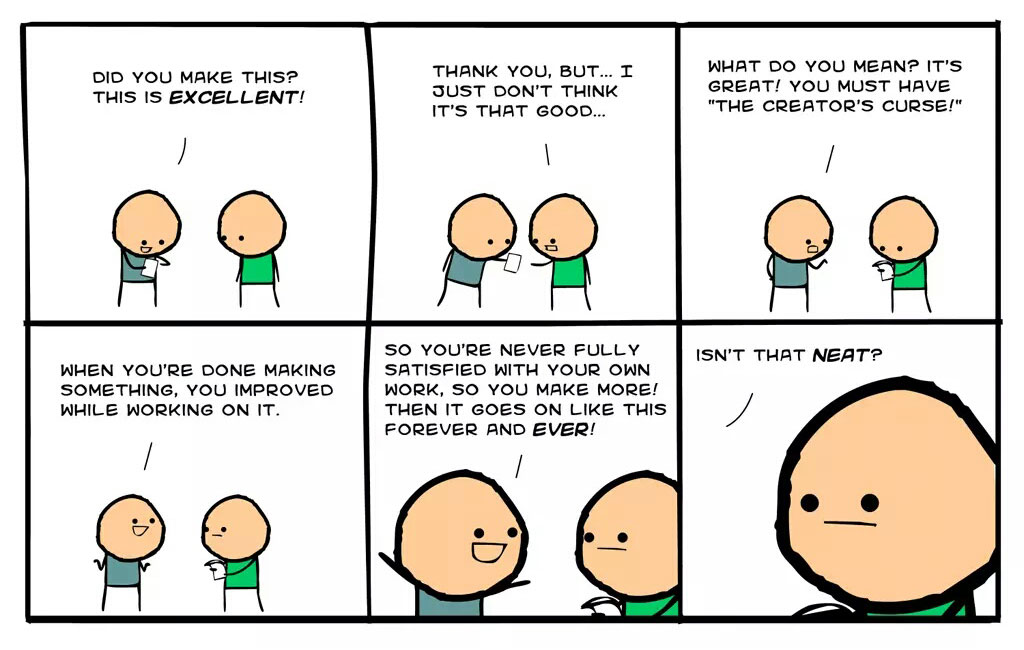
I came across the following web comic a while back.

What has taken just as many years for me to fully appreciate is neatly summed up in six small panels. It’s representative of a previous relationship with creativity I didn’t understand, a peculiar mix of success that fuelled the desire for future success as it simultaneously sowed doubt over the legitimacy of previously success. Put more simply: was it really talent, or just luck?

Determining the answer tempted obsession. But the question itself was flawed. It assumed success was the need my creativity satisfied. But I don’t pursue creativity because I need to feel success. I pursue creativity because I need to be creative. Success got tangled up in the act, mistaken for a motive when it’s actually a result—not an unfair conclusion when, in general, my most successful feeling creative projects tend been the ones I felt the most need to pursue. But that’s only when viewed in retrospect. Correlation does not demonstrate causation. I don’t start a project because I think it’s going to be great when it’s complete. History has shown this precarious path to success is highly dependant on if the project is completed at all. But when is a project completed? Is it when I can’t advance the work any further because everything I wanted to do with it has been accomplished? Or is it when I can’t advance the work any further because I’ve trapped myself in a creative corner and am sick of the sight of it? In either case, the work will end up published for all to see, or lurk—possibly forever—in the shadows of past drafts. And if I’m honest, the outcome in either case resolves my need to be creative.

Or as the great Mitch Hedberg once posited: Did you find your wallet? Yeah—but I kept looking for it.

I’ve been sitting on a number of images I took with my dad back in June. He’d come to visit just before Father’s Day and we took advantage of some recently relaxed public health restrictions to enjoy walking around outside on a sunny day while we did some photography. It had been a few years since our last photo adventure together, and after weeks of not being able to see each other, I was happy we got the opportunity. The afternoon walk and subsequent pizza dinner stand out as some of the most usually expected memories of a summer that hardly existed in any usual way otherwise.

Later, as I was looking through the images I’d taken, the undeniable unusuality of the situation surrounding them was apparent. Some of this was due to a technical error I’d made. I’d inadvertently locked the camera into ISO 400 mode. I didn’t notice this until almost the end of the afternoon. I ought to have noticed it earlier—particularly as the camera itself was trying to alert me to my mistake by constantly proposing bizarre exposure settings—but it had been a long time since I’d used any camera other than the one in my phone. The weather on the day of was warm with an initial mix of brilliantly bright and blue skies producing wonderful shadows, but cloud cover later intensified and blocked out direct sunlight. The shadows disappeared and were replaced with defused, uniform light. Colour receded. It was workable, but it wasn’t ideal as my earlier error was akin to having loaded a camera with indoor film and then using it outside to take pictures on a bright day.

All the pictures looked a bit off as a result. I’m usually happy enough with what comes directly out of a digital camera that I’ll use the images as they are, perhaps only with minimal brightness adjustments, a purist nod to my learning photography on film first. But in this case, accidentally simulating a film photographic experience failed me. I really wasn’t happy with most of the pictures. Nothing looked correct. Colours were weird. In‐camera attempts at coaxing details from the monotonously lit day would blow‐out the sky and kill contrasts. It was all very frustrating and unnatural. Not at all unlike the circumstances created by the pandemic I’d sought to escape from, if only for an afternoon.

But there was no escape. There still isn’t. And as the prospect of a second lockdown looks less looming and more likely, the unnatural quality to my pictures from June makes much more sense. That some of them feel weird is correct. That there’s always something off about them is accurate. If there’s tension or discomfort or strangeness—it’s all good, ’cause it actually wasn’t. Not by a long shot.

In previous posts I’ve shared photo shoot photos as a single gallery arranged in chronological order. The visual narrative is literal: the viewer sees the images in the same order I took them in, free to construct any additional narrative on their own. This post is different. This time is no time for anyone to be left figuring things out on their own.

So—off into the world of outside…

But first, a couple of sighting laps with the camera to be sure I’m still familiar with the controls before leaving.

Under‐exposed and out of focus—zeitgeistic perfection.

This is the entrance to a magic tunnel, connecting a residential cul‐de‐sac to a city park.

A small wooded area is just off the park, joined by old alleyways where cars roamed free.

And train coaches rest quietly among the trees.

Greenery gaps crumbling infrastructure.

In the midst of despair, hope can be a tricky sight. Its light is fleeting. Like punching in a dream.

All the lights go down as I crawl into the spaces…

…Fight, flight, or the screams, life tearing at the seams1

The clouds are turning out. The sky is changing.

The grass in another park is sprinkled with regal and exploded clover.

And a playground sits silent and empty on a warm and sunny Saturday. Merriment and nonsense is still forbidden.

But there is a sense of something else.

A departure of sorts.

A reimagining of structure, of future.

And on another path, they appeared as they always did—among the vegetation and fencing surrounding the industrial bakery. They were beautiful, these donuts in the brush. But the greatest sight of all had to have been the sliced bread.

Or perhaps this antennaed heart and friendly decapus sharing a moment of prohibited proximity.

Hey sky. What’s going on up there?

Or over there—where a train car full of cars blocks a road blocked to cars. Delightful.

And while this red light shines for no one, I for one want to get in on this hamburger loop.

The shadows are back as the sun sets.

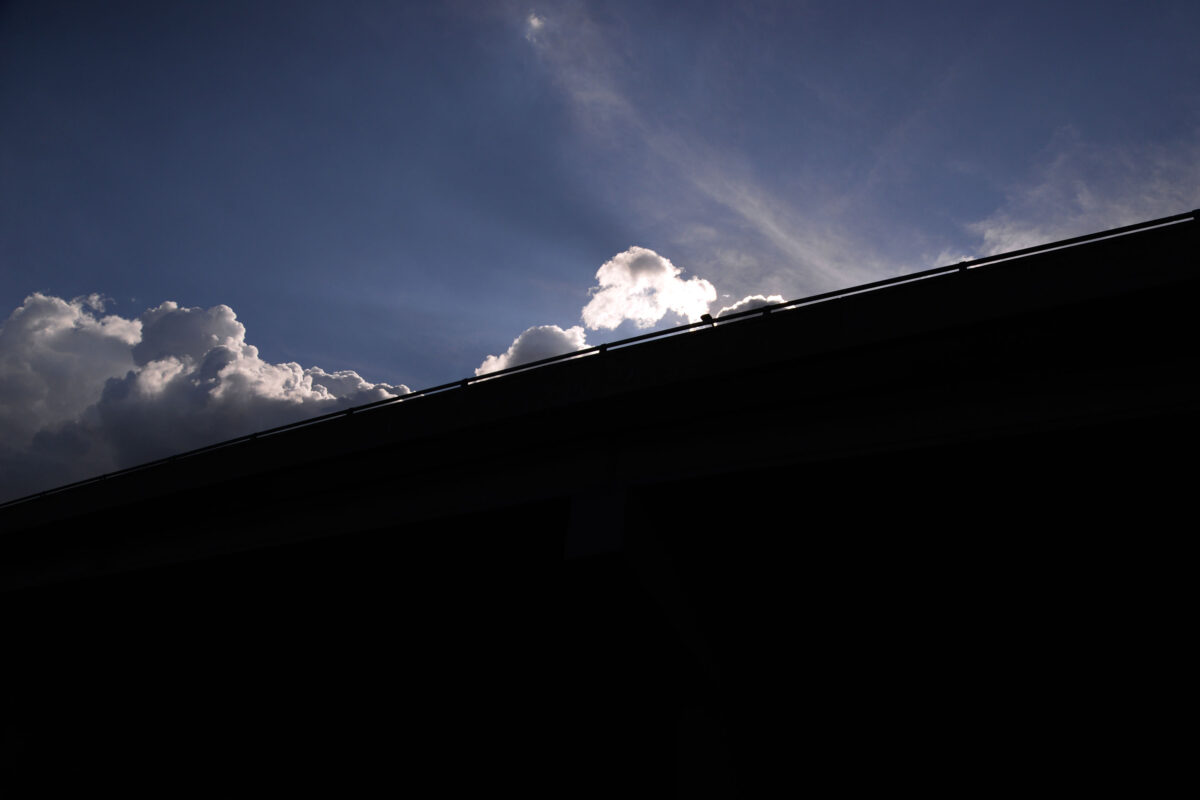
Impossible lighting presents. It’s my favourite time of summer evenings.

I don’t know it, but this ended up being a perfect image, one that went straight from the camera to the screen. Everything looked just as it did. Nothing needed fixing.

If the empty playground stirred feelings of melancholia, then consider this distant and solitary dog at the dog park, the canine equivalent of one kid sitting on a seesaw.

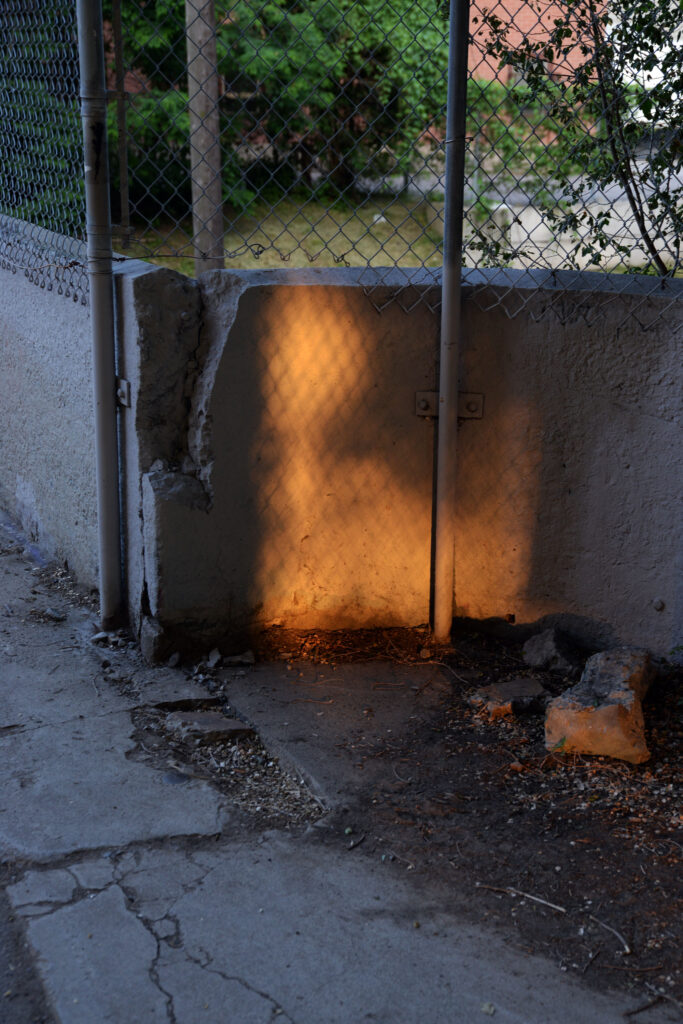
More improbable lighting.

Highlighting an improbable fence.

I call this the fire place.

See…

The current iteration of the Claremont Access began construction in 1969—a time when the car could do no wrong. Now the land it stands on is part of Ontario’s protected Greenbelt.

The massive support structures for the roadway are omnipresent. They formed some of the impossible lighting conditions found throughout this post.

Arkledun Avenue and the Jolley Cut scar themselves across the Niagara Escarpment, a reminder of yet another time when the natural world was to be dominated rather than respected.

Ironic as children are usually taught the implications of tempting forces beyond their influence.

The exit from the magic tunnel—having just gone through the entrance for a second time. Magic abounds.

An interpretation of the The Empire of Light, a painting I first saw at the Peggy Guggenheim Collection in Venice.

Having only previously seen this nondescript building during the daytime or not at all during the nighttime, it’s brutal charm is revealed at dusk.

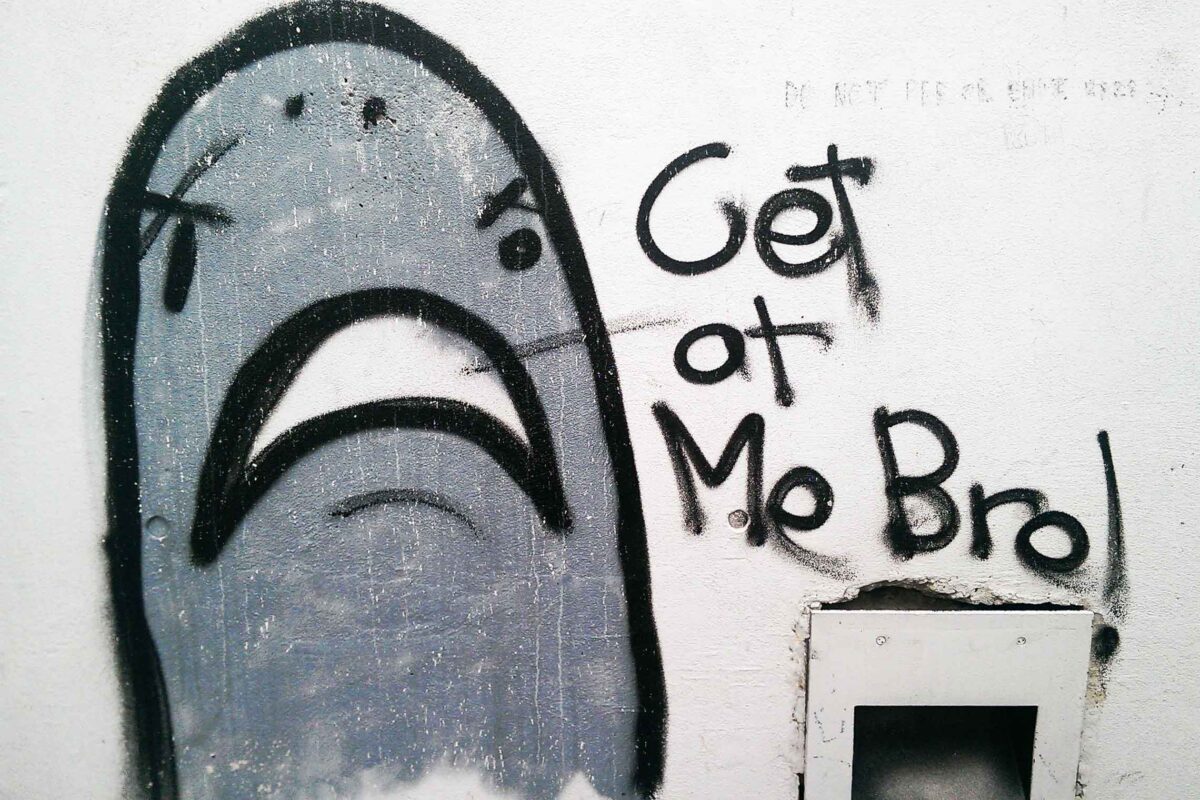
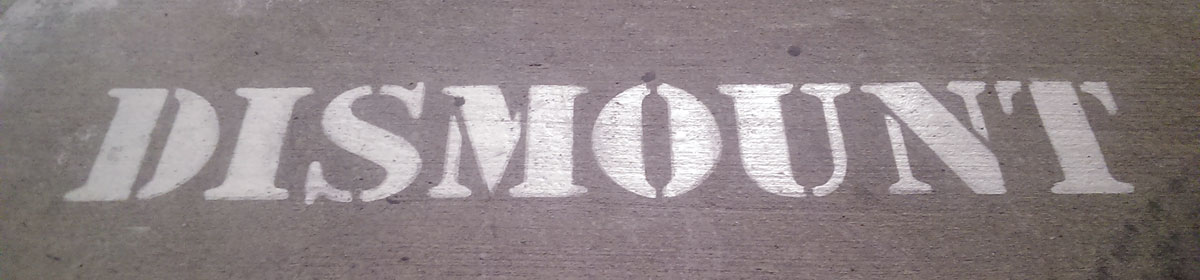
Official city sidewalk scrawl. Graffiti is for the horizontal.

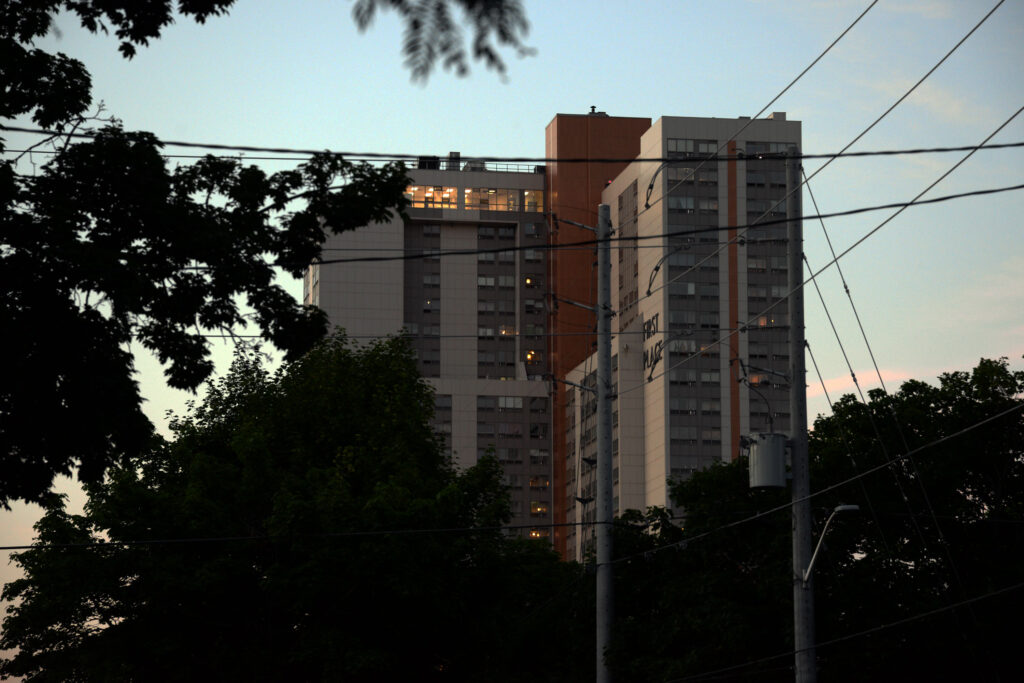
With daylight fading, the shoot finishes up in a distant First Place.


1. The Naked And Famous. Punching In A Dream. Passive Me, Aggressive You. 2010.

Bullies

I’m sadly fluent in their language.

I was a new kid in a new school in a new town in Central Ontario. I was in Grade 9, my first year of high school. I’d started attending more than a few days after all the other students, so I didn’t get a locker assessment near anyone in my homeroom class—not that it mattered much. I didn’t know anyone at the school.

After a couple of weeks a student I only ever saw when he was using his locker beside me started leaving his locker open in a way which would block access to mine. Previously understood proper locker etiquette had taught me it was perfectly acceptable in that scenario to move his locker door silently and politely out of the way. As long as I didn’t push the encroaching door past the midpoint this allowed us both unimpeded and simultaneous access to our lockers. Or at least, that’s how it worked where I was from. I’d learned how to use a locker in another province, but I observed other students doing just as much without issue at my new school. It all went without saying.

This pattern of me having to move his locker door continued. I thought nothing of it as he was always at his locker first since I had longer to walk to get to mine. I assumed he was just opening up his locker with gusto and was either perfectly fine with me moving the door after the fact or oblivious to the entire situation. Either way, everything seemed fine.

Then he started pushing his locker door back toward my locker, blocking it after I’d gotten it open. The first few times I initially thought it was an accident because it would coincide with him moving things in and out of his locker. I’d give his door a little nudge if I needed to, but then he would push it back. And again, I thought it was all accidental. It was getting into heavier coat weather, and I assumed it was the locker door being brushed by bulkier material. But no—it was becoming a regular occurrence. Even though there was clearly enough space for both our lockers to be used at the same time, he was making it clear there was only space for him to use his locker on his time.

To reinforce this he started standing closer to my locker while his was open. He’d move a bit out of the way when he noticed I was there, just enough so I could still get to mine. But then the next day he’d move closer. And then a little closer the day after that. He’d also started moving a little bit less out of my way as well, all while continuing to push his locker door back toward me whenever he could. I would keep returning his door to the midpoint, as per proper locker etiquette, but it was all or whatever he could get as far as he was concerned. There was no midpoint to be had.

This went on and on, day after day. And I said nothing. But I told myself I didn’t really need to. Aside from the bizarre back and forth with his locker door and peculiar personal space power play, I could still get what I needed in and out of my locker. And besides, previous experiences with school administrations and difficult students had taught me not to waste my time by talking about it—the schools I went to generally didn’t give a shit about stuff like that, and I wasn’t stupid enough to out myself at this school by saying something and expect the result to be any different.

However, I broke my silence the day I found him standing directly in front of my locker.

“‘Scuse me,” I said. “Gotta get to my locker.”

I gestured in a pointing a manner, as if he might have been unaware my locker was beside his after all this time. He slowly moved out the way, but only after pausing just long enough for me to think he wasn’t going to. He didn’t say anything. He didn’t even look at me as he kept talking with his friends.

He repeated this new behaviour over the next few days—but each time he took just that much longer to start moving, and moved just that much slower once he did. I knew what was coming by this point. One day he wasn’t going to move.

That day arrived with a twist. He’d opened his locker, blocking mine with the door as before, but instead of standing in my way, he was leaning on my locker with his back against the open door of his. I walked up to him as he posed. His legs were crossed at his ankles, his arms folded at his chest.

“Hey—gotta get to my locker. If you could… please,” I said, pointing pointlessly.

Nothing.

“Come on, man. I just wanna grab my lunch.”

He stared through me. Silence.

I stared back at him. My eyes made the request one more time, with a subtextual I’ve had enough thrown in as a warning. This had now been going in some form or another for almost two months.

No motion.

I moved fast. Without breaking my gaze I grabbed him by his collar and twisted the fabric up in my hand, yanking him by his shirt toward me as I stepped back. He lost his balance as I pulled us together. Using my other hand I flung his locker door out of my way. It crashed shut just before I used my entire body to slam him back up against the row of lockers. I broke eye contact as his head bounced off the metal doors with a thud.

He said nothing. He did nothing. And no one else in the hall seemed to notice.

I let go of his shirt, opened my locker, emptied its contents into my backpack, took my lock, and left.

I walked to the office to request a new locker. There was one available near the library, convenient as I would spend all my free time there. It was a locker at the end of a row as well—with plenty of room to share between me and my new locker neighbour, a neighbour who understood proper locker etiquette.

I never saw the other student again.

Reykjavík: Departure

Until next time.

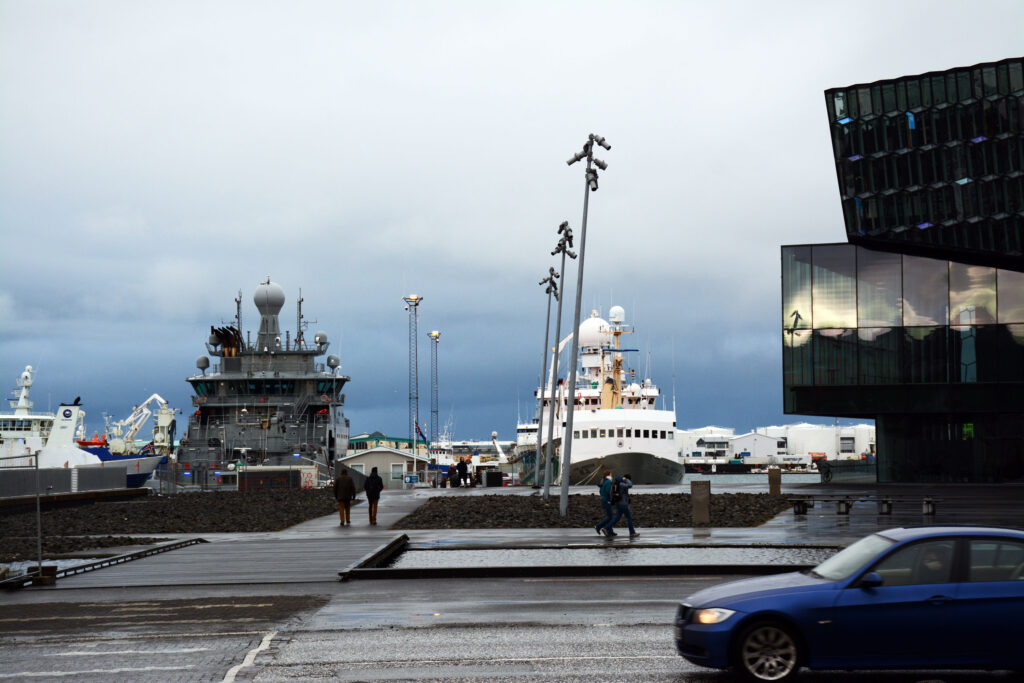
I’ve been making black and white featured images for each of my Icelandic posts so far, but for this post I’m using a colour image instead. Yup. Reykjavík is an incredibly grey place. It’s a beautifully colourful city as well—but when it wants to be grey. Yup. Incredibly grey.

For the moment today’s colours are muted, fleeting, and gorgeous.

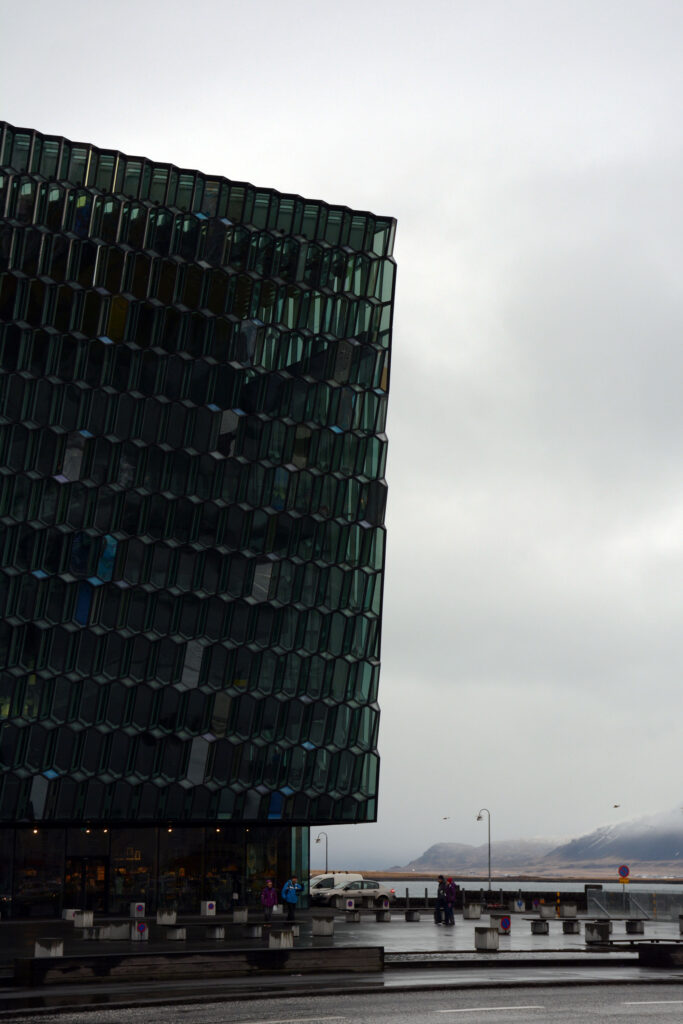
In a previous post I’d referred to Harpa as being covered in a glass honeycomb structure. While incredibly honeycomb like, the shapes are technically referred to as quasi bricks. Each quasi brick is a twelve‐sided polyhedron consisting of rhomboidal and hexagonal faces. Once assembled together the quasi bricks form substantial portions of the building itself, so Harpa actually isn’t covered in a honeycomb structure—it is a honeycomb structure.

I’m on my way to get a rental car. The no plan plan is to drive around and lightly explore the area between Reykjavík—where I am now—and Reykjanesbær—another city about 50 kilometres away and very near where I need to be by tomorrow morning for my flight to Berlin. I’m looking forward to my road adventure, and this change in the no plan plan happens to solve a couple of logistical challenges I’d inadvertently created for myself through—somewhat obviously in retrospect—poor initial planning.

And yes—it’s as chilly as it looks. The deal I made with myself was whatever the distance I needed to cover on foot in the cold—turns out it was just over one and a half kilometres—would be distance I’d travel back while seated comfortably in a warm car: hardly a hardship all things considered.

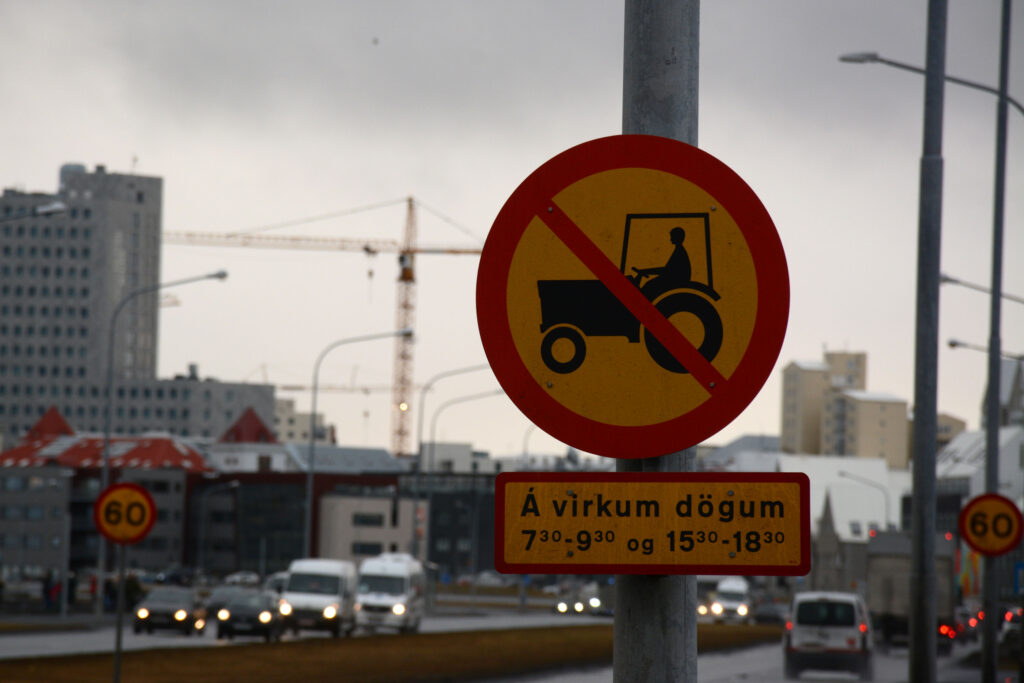
Plus the walk gives me time to study the road signage. I legitimately enjoy signage because there’s a reason why it’s there. It’s a form of communication. There’s a story behind every sign.

I’ll need to understand at least some of the stories the road signs are telling because soon I’ll be quickly moving past them in a car. Walking along the road I plan to drive back on gives me a glimpse into my future automotive experience. And as long as it’s not during peak traffic times, that future automotive experience could include the operation of farming equipment on a major thoroughfare. Noted.

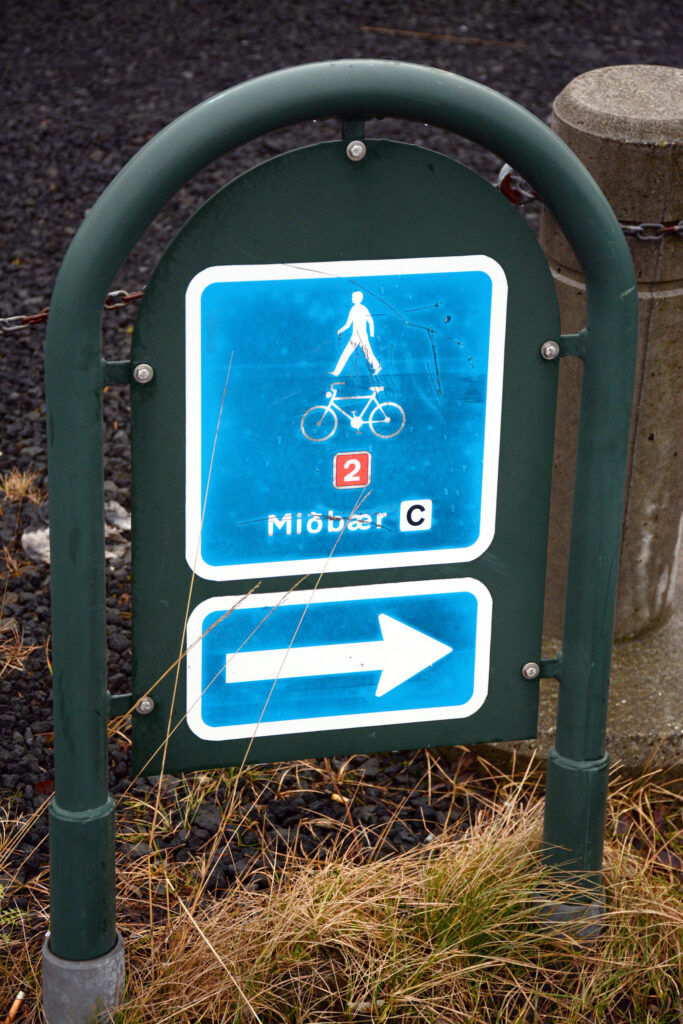
Sometimes the story is on the sign instead of behind it.

Greetings. Walking and biking (and possibly walking‐on‐biking) may not continue to be happening where you’ve up until now perhaps expected it to be happening. If you or your bicycle is facing as indicated on this sign, you could be about to be going the wrong way. Here are some numbers and letters and names and colours to help you identify if this is the path you intend to be on, and if so: follow this giant arrow until the next giant arrow or otherwise instructed. In any case, our time together draws to a close. Fare thee well.

You know—wayfinding.

Languages are stories—just like signs they end up on. Languages are full of characters and metaphors, symbology and theme, and rules and syntax. The rules and syntax are argued as being the most important part of the language story: communication is easier when it’s performed in a standardized manner. But I can string together all sorts of correctly spelled or arranged words and still not be saying anything particularly useful. Or even understandable. Like what was I talking about earlier: something to do with dozenal‐sided rhomboidal polyhedrons based on hexagons. A twibbled spind hab neather a fab shot indwind. Yes—rules keep language in‐line, but there’s often nothing to read when there’s only rules.

There are around 380 million people whose first language is English. Then there are around 610 million more people whose second or other language is English. That’s close to a billion people who all, in theory and to an extent, have the potential to understand each other. At least linguistically. Mostly. But still—the consequences of almost 1 in 7 people on Earth understanding English means I can walk into a rental office in the capital of Iceland and book a car for the day without any meaningful understanding of the local language. English was widely used throughout Reykjavík both in signage and in conversation. I felt tremendous gratitude in having a language I understood to use while I was a guest in the house of another language.

It might be a different story in other parts of Iceland, outside the major tourist destinations, as far as the use of English goes. But I wouldn’t be able to find out on this trip by missing a turn and getting stranded somewhere out in the middle of nowhere, rescued by some local hero whose recently unshakable melancholia is due to a perceived shortcoming surrounding a skill which I am coincidentally proficient in, and for some reason I take it upon myself to mentor a total stranger who, despite the fractured understanding of a common language, I feel an overwhelming amount of formulaic appreciation for and wish to repay in kind—like how travel happens in movies? No. I had to agree not to drive the car on anything that wasn’t a road or on any road that was closed—both of which seemed like completely reasonable and would go with out saying requests, but what are rules if not little signs made of words. What are words if not little stories. And how many ruined natural landscapes and destroyed rental cars are in those stories.

I also had to promise not to drive the car on any F‐roads. These mountain roads run across the highlands found in the centre of Iceland. They require a 4×4 vehicle to use—the serious ones with chunky tires—because there are often no bridges available for river crossings. Surface conditions can also be treacherous, so the roads are only open for a brief time in the summer—depending on how long it takes to repair each road after the damage caused by the winter.

With it now very much confirmed that my driving will be confined to only the most open and the most official roads, I head back outside—rental car keys at the ready—and find a surprise is waiting for me.

The sun is out, the sky is blue, and the colours are back. It’s another sign: time for adventure.

Reykjavík: Tiny House

Expanding horizons.

It’s morning—at least I think it is: I’ve woken up. It’s still dark outside, and I know from my arrival yesterday that darkness runs well past 9AM. I’m already getting the hang of this place.

Wrong. It’s just after midnight local time. Morning isn’t for hours—eight at least. The only thing I have the hang of is continued confusion, a conundrum of confounding chronology. Crap. I’m really awake. Alert, ready for the day awake. It’s my first and only full day in Iceland, and I want to make the most of it!

One of the reasons I was convinced it was morning was waking up with morning style hunger. There’s a small grocery store that’s open all the time not far from where I am, so I get all bundled up in my warm things and head out into… a tropical storm.

The everywhere wind and always mist is back, but the air temperature feels like it’s gone up considerably. I feel overdressed as I fight the temptation to undo my coat. It’s so warm out, comparatively at least, and that’s a plus, because I can feel myself getting soaked at the same time. This climate makes no sense. Why is it warmer at night?

Back at my room with a bag full of snacks and goodies I do some online research for places I might want to go once morning actually arrives. And after a quick blog post—at this point I still think I’ll be making regular posts while travelling—I convince myself I’m probably tired and it would be best to go back to bed.

It’s morning—and this time I know it is: light abounds in my tiny house. A continental breakfast awaits in the dinning area slash business centre, conveniently located mere steps away in the corner of the room. Past me was kind enough to leave all the fixin’s for a good morning meal out on display so I wouldn’t have to head out or even wake up hungry.

So it wasn’t a dream…

Over breakfast I discover my plan of having no plan isn’t entirely compatible with how tourism works in Iceland nor my location in Reykjavík. While there’s a lot in the city accessible throughout the day and on foot, what I really want to see is no where near the city and is seemingly dependent on booking transportation at least a day in advance. Mild anxiety creeps. I’m leaving tomorrow morning. I again feel claustrophobic, like the day before at the photo gallery. The city feels too small, feels like I’ve seen it all, and the tiny house—as much as I love it— isn’t helping with the feeling of my travel opportunities disappearing into the surrounding walls and buildings.

I decide a thoughtful shower will help. A small, thoughtful shower in what is apparently the smallest bathroom in Iceland. How small is small?

Small enough that the roll of toilet paper needs to be removed so it doesn’t get wet while the shower is being used.

Small enough that a sign is involved.

Small enough that I need the fisheye lens to fit the entire room in a picture, and small enough that bathroom feels like too big of a concept and even too big of a word to describe it. There’s too many letters. What’s pictured below is clearly no bigger than a bthrm.

I always feel better after a rinse off, regardless of the venue size, and I decide a full photo tour of the tiny house is in order.

The floor plan is open concept, so the front door opens directly into the concept of a living & dinning space slash business centre and sleeping space. As is becoming common in smaller urban home design, the traditional dividing of spaces into rooms with specific functions has been abandoned. Instead, the needs of the moment dictate how space and furniture are interpreted and used. Am I sitting on a bed or lying on a gigantic ottoman? Is that stool a chair or a nightstand? It all depends on if I’m in my clothes or pyjamas.

The main living and sleeping space looks out to a view of the courtyard, the neighbouring balconies, and the hint of a blue sky.

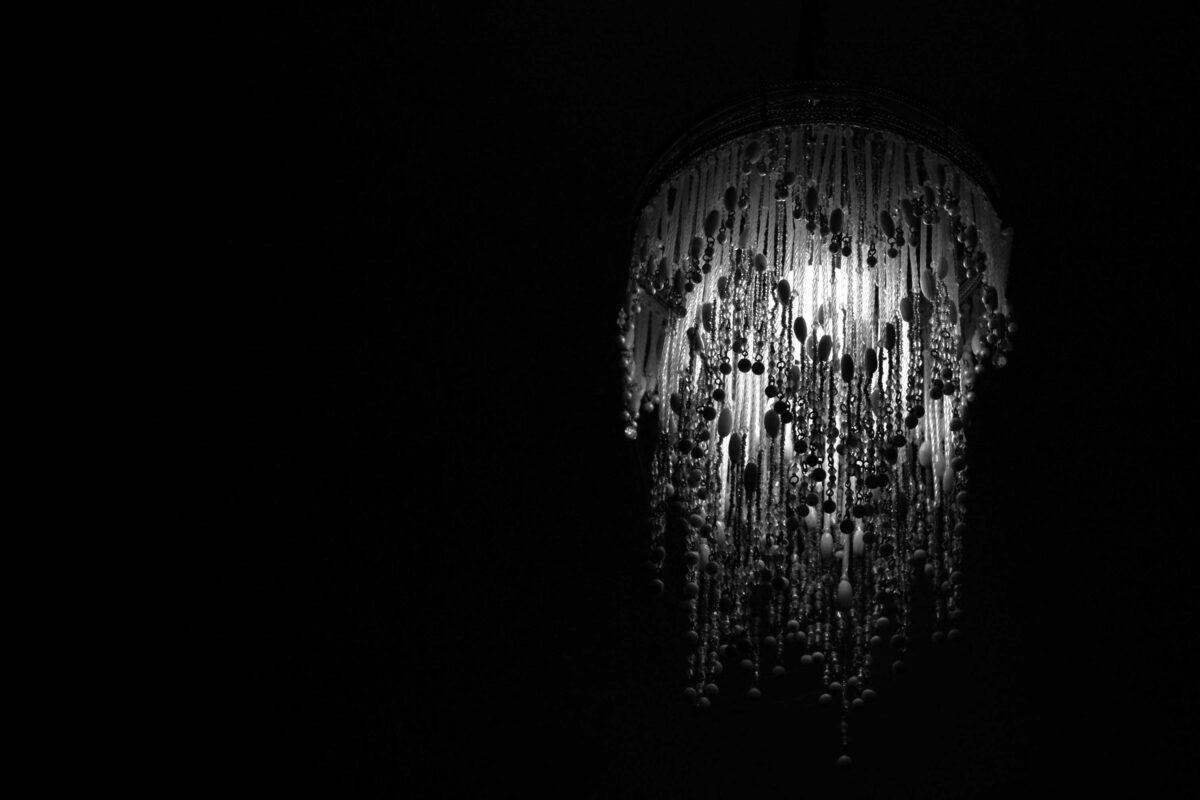
The great hall follows immediately after the sleeping space and opens directly to the kitchen along with access to the second floor loft space. The window overlooking the courtyard fills the hall with natural light during the day. In the evening an elegant chandelier provides ample opulence in lieu of any meaningful illumination, but such is the price of luxury.

The entire kitchen fits into single unit—a literal kitchen cabinet—and includes a small cooktop and delightfully surprising secret fridge with more than enough room for my half a lemon and someone else’s mini butter brick.

Tucked under the stairs to the loft space is a toaster, an electric kettle, and a microwave which—as is tradition in smaller kitchens—is taking up most of the available counter space, or in this case, fully stocked pantry dresser. There was an assortment of useful dry goods and I didn’t use any of them because I wasn’t clear on usage rights and some of them had been previously opened. The entire unfamiliar food in an unfamiliar place handled by unfamiliar hands thing wasn’t particularly appetizing, though I think that was more a reflection of my Toronto training when it comes to found food stuffs in publicly accessible places than an assessment of the character of the previous guests or the owners of the guest house.

The view from the second floor loft looks over the combined living and sleeping spaces with the great hall in the immediate foreground. The loft space itself was incredibly uninteresting, containing what looked like the wooden frames for two twin beds stacked on top of the other with the mattresses no where to be found despite an exhaustive search. There was also very little usable light from a photographic standpoint. The pictures I tried to take were blurry, dark, and grey—like I was trying to image a storm cellar in an attic.

And finally—much like the bathroom contained within—the entirety of the tiny house was too tiny to fully capture unless I switched to the fisheye lens.

Having firmly established all the walls of my tiny house were exactly where they’ve always been, I return to my feelings of claustrophobia, of being contained. Though I have had a wonderful time exploring the city and my tiny house is incredibly warm and comfortable, I didn’t come to Iceland to visit galleries or remain indoors. I came to see the natural beauty of an island I’ve only ever seen in photographs and in movies. I can’t do that from where I am.

I’ve only been in Reykjavík for little more than 24 hours, and I’m booked in the tiny house for the remainder of my time in Iceland, but I know now it’s time to leave the house and the city behind. My plan of no plan until a plan takes shape is working again.

I pack up my things and rent a car. I’m heading to the mountains.