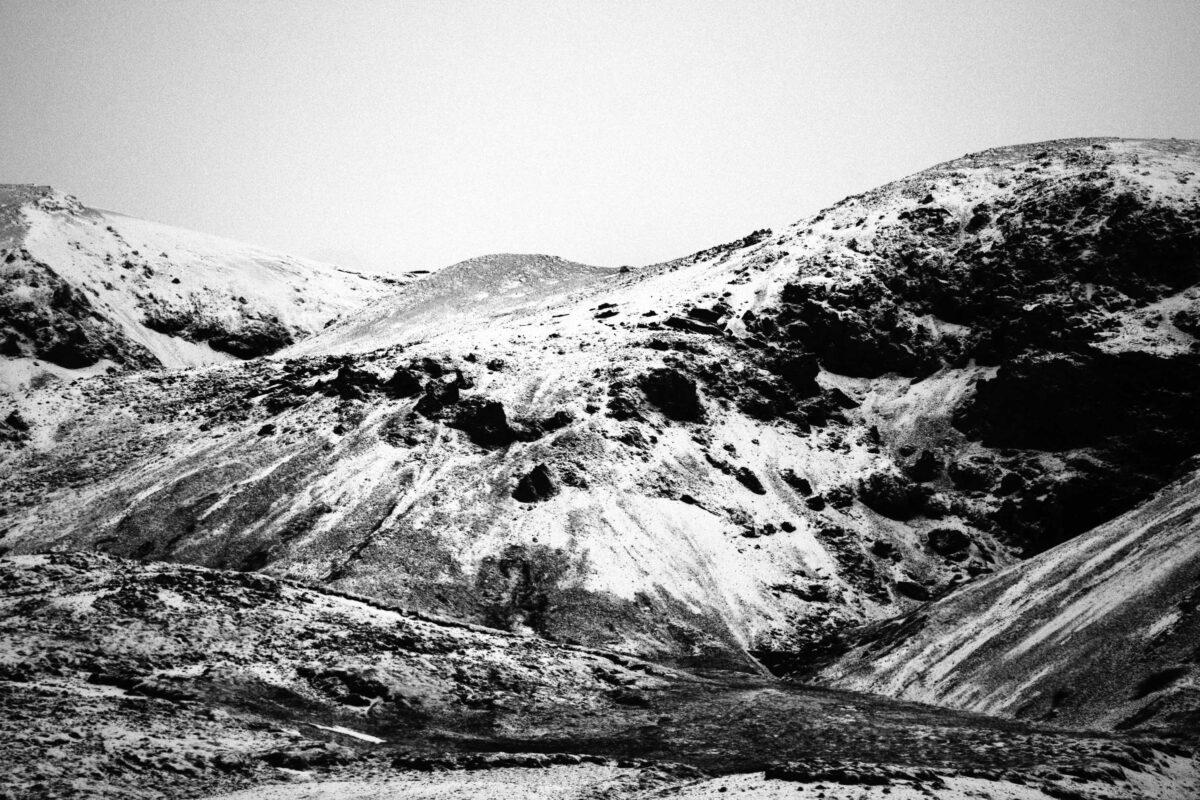
Reykjanesskagi: Mountains

Into another world.

“If we go by the book, like Lieutenant Saavik, hours could seem like days.”

Spock understood the peculiar consequences of time dilatation. And why wouldn’t he? This is the same guy who could calculate the coefficient of elapsed time in relation to an acceleration curve while accounting for the variable mass of whales and water in a time reentry program. Granted, some of the parameters were programmed from memory: the availability of nuclear fuel components; the mass of a 23rd century Klingon bird of prey vessel through a time continuum; and the probable location of humpback whales on Earth—but even he had to make a best guess at some of the values when it came down to it. Yet I, like Kirk, would tend to place more confidence in Spock’s best guesses than in some other people’s facts, a confidence formed long before Spock returned from the dead.

Today it will be four years since I visited the mountains in Iceland, but it’s only been a couple of months since I headed toward them from this narrative’s perspective. Time is strange: a peculiar consequence of motion. Yet sometimes it feels exceedingly like it’s going nowhere. I’ve been trying to finish this post for weeks now, each time slowing to a halt after only a few sentences, after only a few moments. There’s no movement—I find myself blocked in a place of infinite time.

It’s incredible the difference a little direct sunlight can make. Without it there are no shadows. Contrast fades and colours recede, as if everything is being lit by a single, dismal bulb screwed into an imaginary ceiling that’s both everywhere and nowhere. What’s doubly funny about noticing how grey and monotonous the light was in Reykjavík is knowing now what was waiting for me in Berlin—but I’m not there yet. Instead, I’m in a parking lot noticing the changing light as I get into a rental car.

Driving back along my walking route I find it transformed. Up until now, I found Reykjavík to be cold and damp, but above all: grey. It set a strong tone. I wasn’t having a bad time because of it by any means, but I was certainly on my way to forming a similarly monochromatic impression of the place. Now, as I went back to my room, as I went past the metallic, cold harbour, past the dark, imposing Harpa, past the grey clouds, rocks, cement, and grass… I found everything was as it was—but with more. The hard lines of the boats stood out against the water and made perfect sense. Harpa shimmered as its glass honeycomb structure reflected colourful sunlight in all directions. There were gaps in the clouds. The rocks were full of holes. The cement was covered in texture. And the grass was never grey to start with, but now there was no doubt: it shone brilliant brown.

Back in my temporary neighbourhood, the morning sun confirms a population of colourful buildings at full volume. The air itself is bright. My tiny house fills with light.

Before heading out, I use the WiFi included with my room to download a map of the route I’ll be following out of Reykjavík. I’ll be using my tablet as an offline GPS so I don’t have to depend on—or pay for—an unknown mobile data network while driving, plus I can keep my phone fully charged just in case there’s an emergency. I also download all the road maps for Reykjanesskagi, the name of the Iceland’s southern peninsula and the area I’ll be travelling through on my adventure.

As I am leaving a day early, I stop to let my host at the front desk know that the room was very comfortable, that I was indulging in a flight of fancy, and that I was departing before check‐out time hoping someone else might be able to stay in the room that evening. I’d prepaid for two nights anyway, and I knew there was no partial refund possible, and I also knew I didn’t have to do or say any of what I did that morning, but also didn’t want to just disappear.

With the car packed, I drive down the street and away from the tiny house. I roll down the window and listen: though not as pronounced as on the cobblestone roads in the city centre, I can hear the muffled tap dancing of the car’s studded snow tires on the pavement.

The clouds are all but gone as I leave my familiar walking streets behind and am guided through places unknown. Reykjavík is revealed in new light, full of foreign shapes and colours and configurations. It’s a beautiful sendoff, one I’m happy to have experienced after arriving in the city during the middle of the night. There is no denying I am in another place now. I feel far away. It’s wonderful. I turn on the radio. Of Monsters and Men is playing—I smirk and feel immediately at home again, as if I’d stumbled across a Tragically Hip track while driving through rural Ontario.

In just a few minutes I’m outside the city and arrive at the junction with the secondary road which will take me into the mountains. As soon as I complete the turn, the landscape transforms again.

There is nothing of Ontario here.
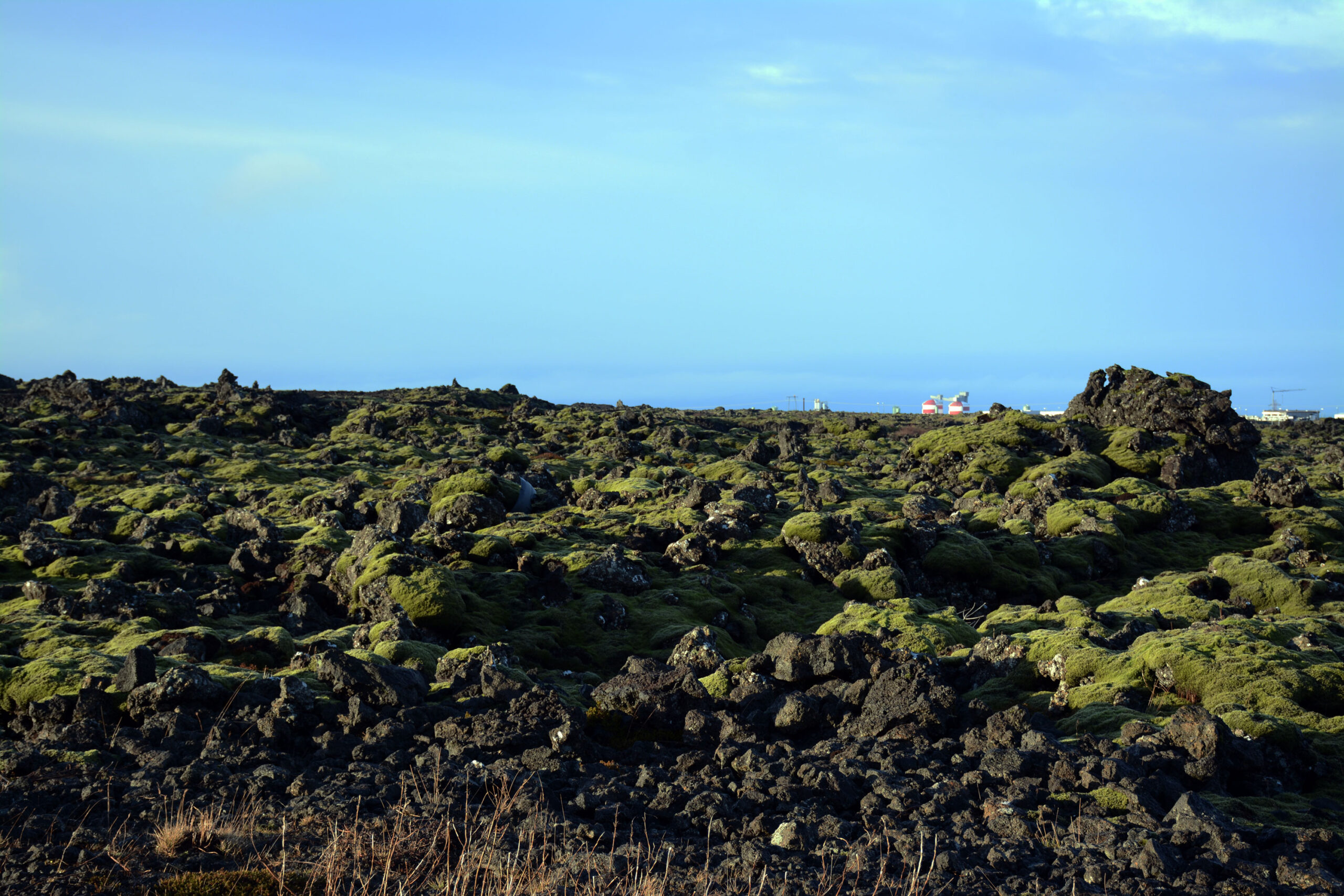
I pull over into the bottom of a driveway—pausing just for a moment to wonder if I’m already in violation of my rental agreement before reassuring myself that by definition a drive way is a road. But I still confine the car to an area I am comfortable to consider the most road‐like as the driveway itself appears to trail off into a vagueness of definition I’d rather not deal with.
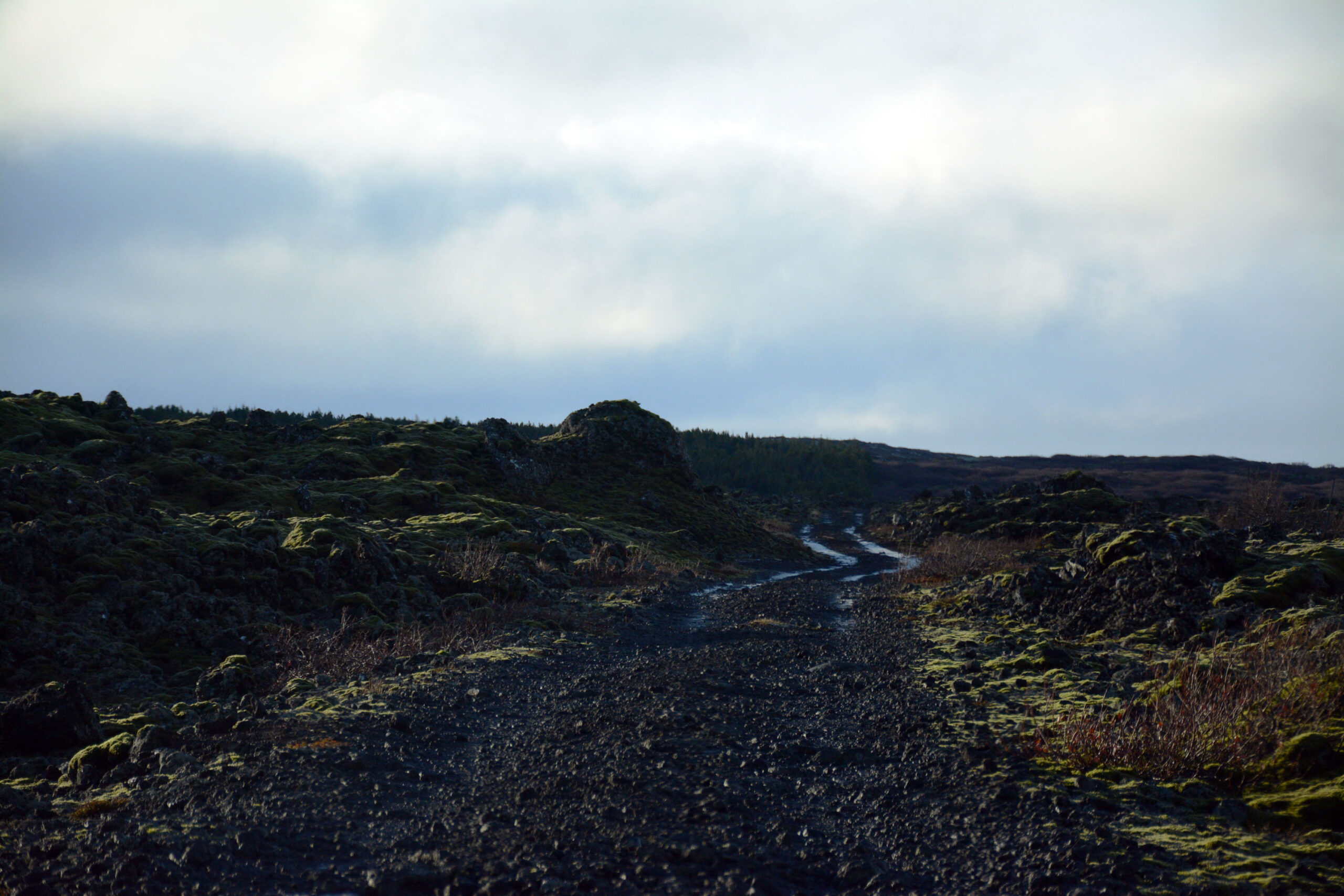
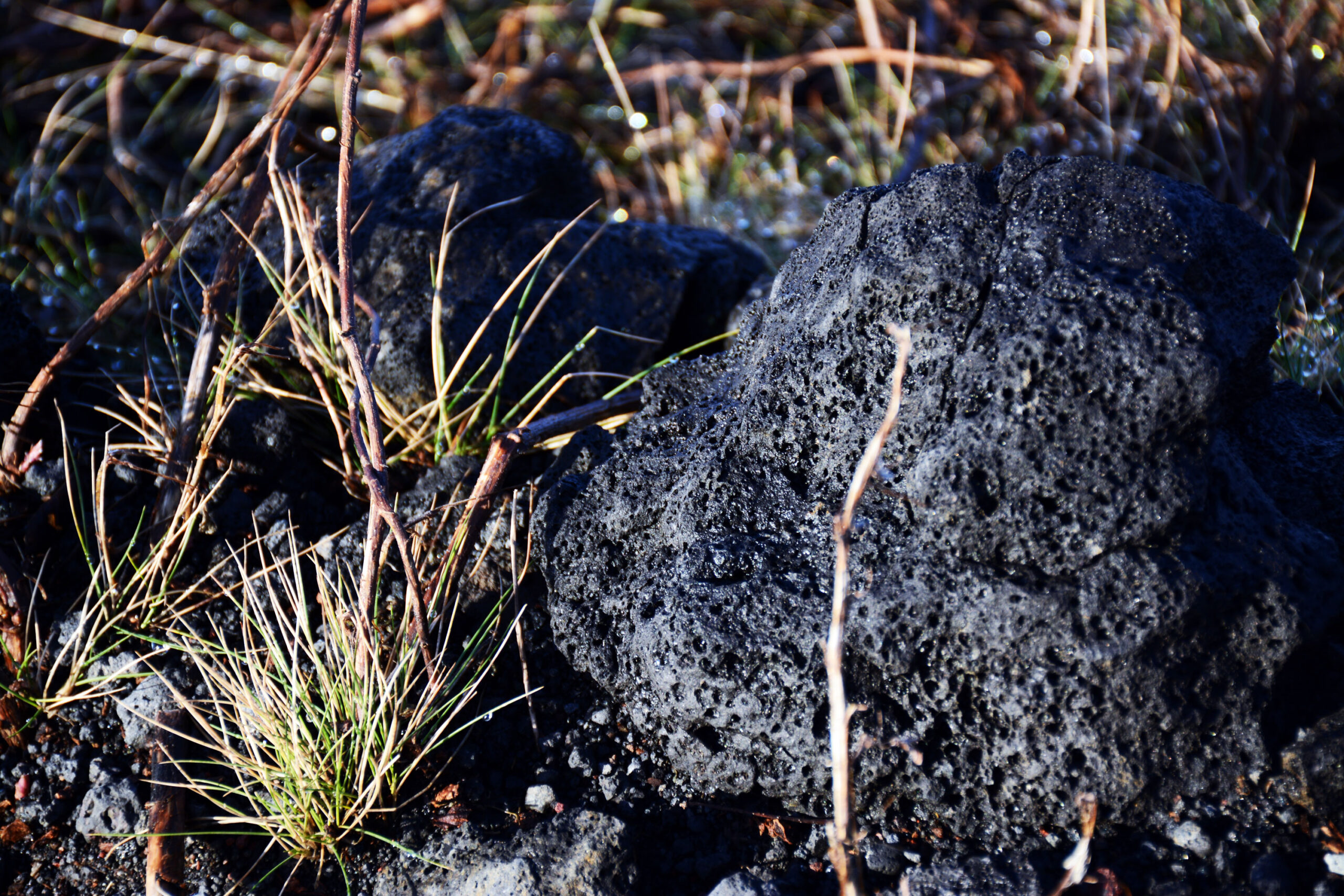
The land is covered in dark volcanic rock covered in green fluffy moss. Even the rocks themselves look soft and comfortable up close, like sea sponges under water, and I imagine being able to climb in among them, pull some of the fuzzy green blanket over me, and enjoy a nap in the sun.
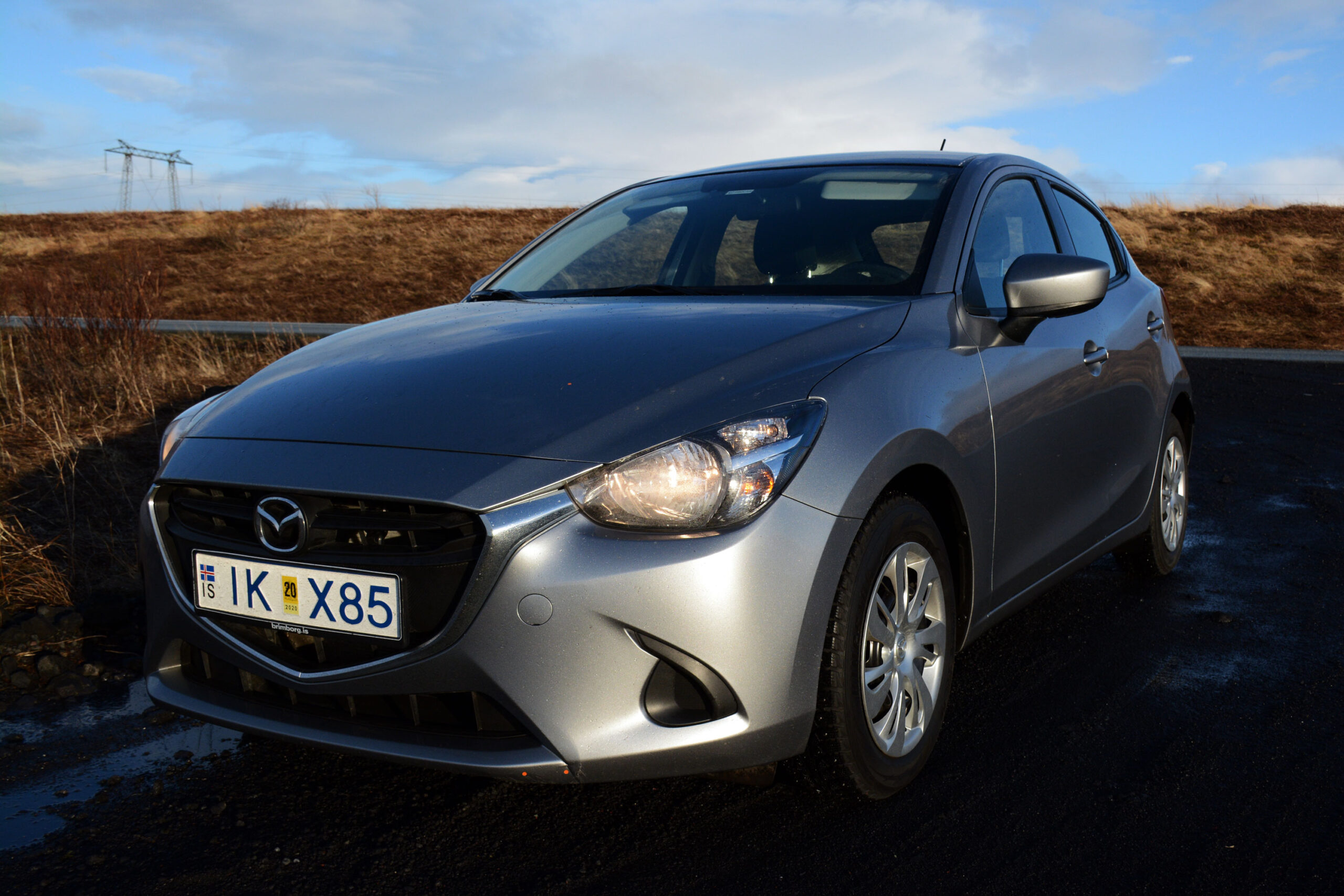
My travelling companion is a 4th generation Mazda 2 in silver—which is another way of saying it was grey. The 3rd generation of the 2 was sold in Canada for about seven years until being discontinued around 2014. Tracing its linage back, this little Mazda is related to the original Ford Festiva, a car Mazda designed and built during a time when the two companies were working together, a partnership that lasted just over 40 years. Now Mazda and Toyota are working together, a fact reflected in Canada’s more recent Toyota Yaris hatchbacks: under the surface they’re the same Mazda I drove in Iceland.
Also at the bottom of the driveway is this sign facing the main road. Apparently the next 5 kilometres will have something to do with vatn, or water, which is what the first part of the second word is referring to.
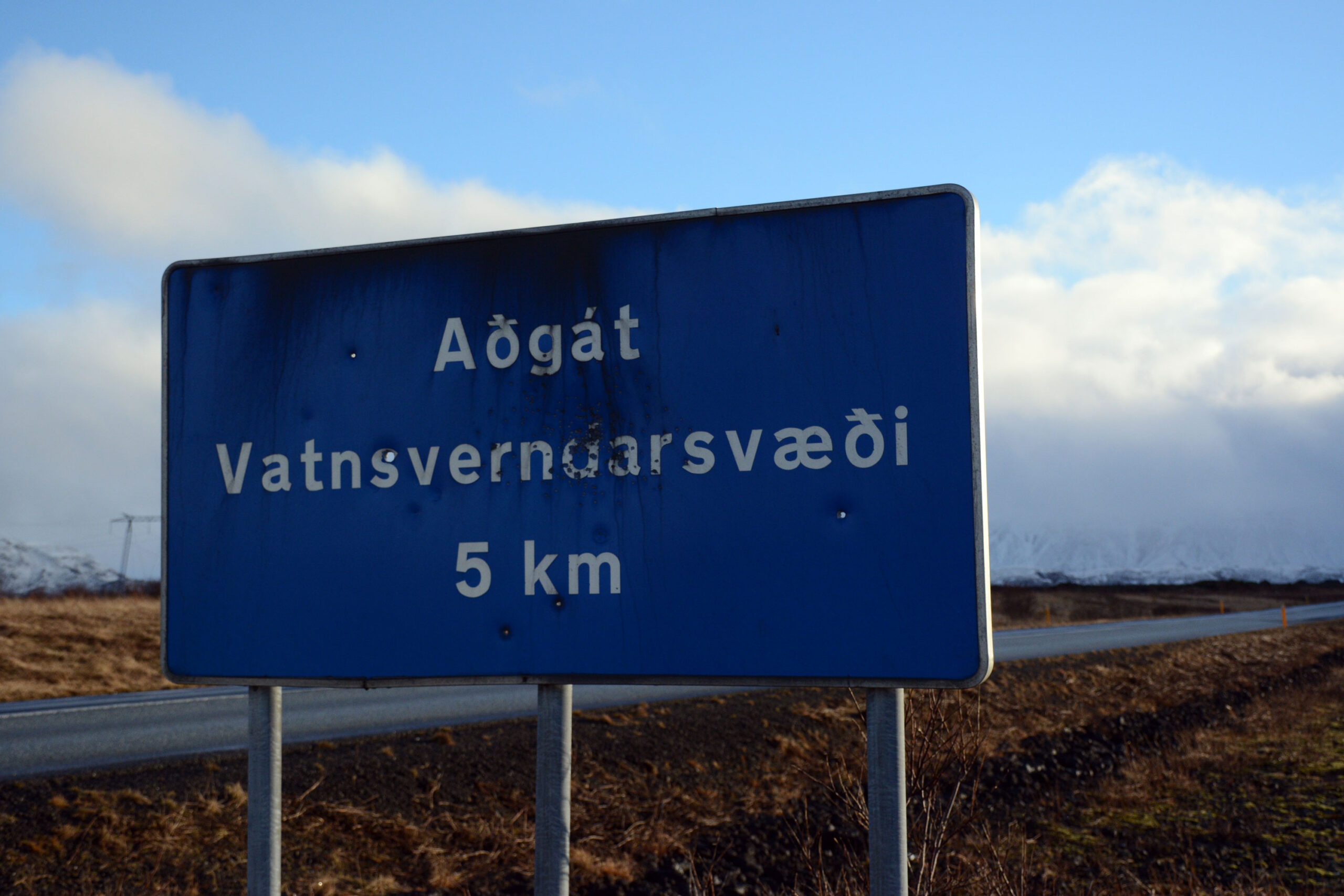
There is an amount of making words with other words in Icelandic, a trait the language shares with its distant, distant German cousin, although words might be too literal in this instance. Making and reinforcing concepts out of other concepts could be more accurate, like my pínulítið hús back in Reykjavík. The Icelandic word for tiny looks like puny and little mashed together, and it sits beside a concept so universal it’s understood by two languages which diverged anywhere from fifteen hundred to over nineteen hundred years ago. That said—other than appearing to have attracted bullets for it—I had no idea at the time what the rest of the sign was taking about. I later found out it was to do with being in a protected watershed.

Armed critiques of resource conservation areas aside, I was more interested in what was literally—and that’s literally literally, not metaphorically literally—behind the sign. In the background, the snow and cloud covered background, are the mountains I’m headed to.
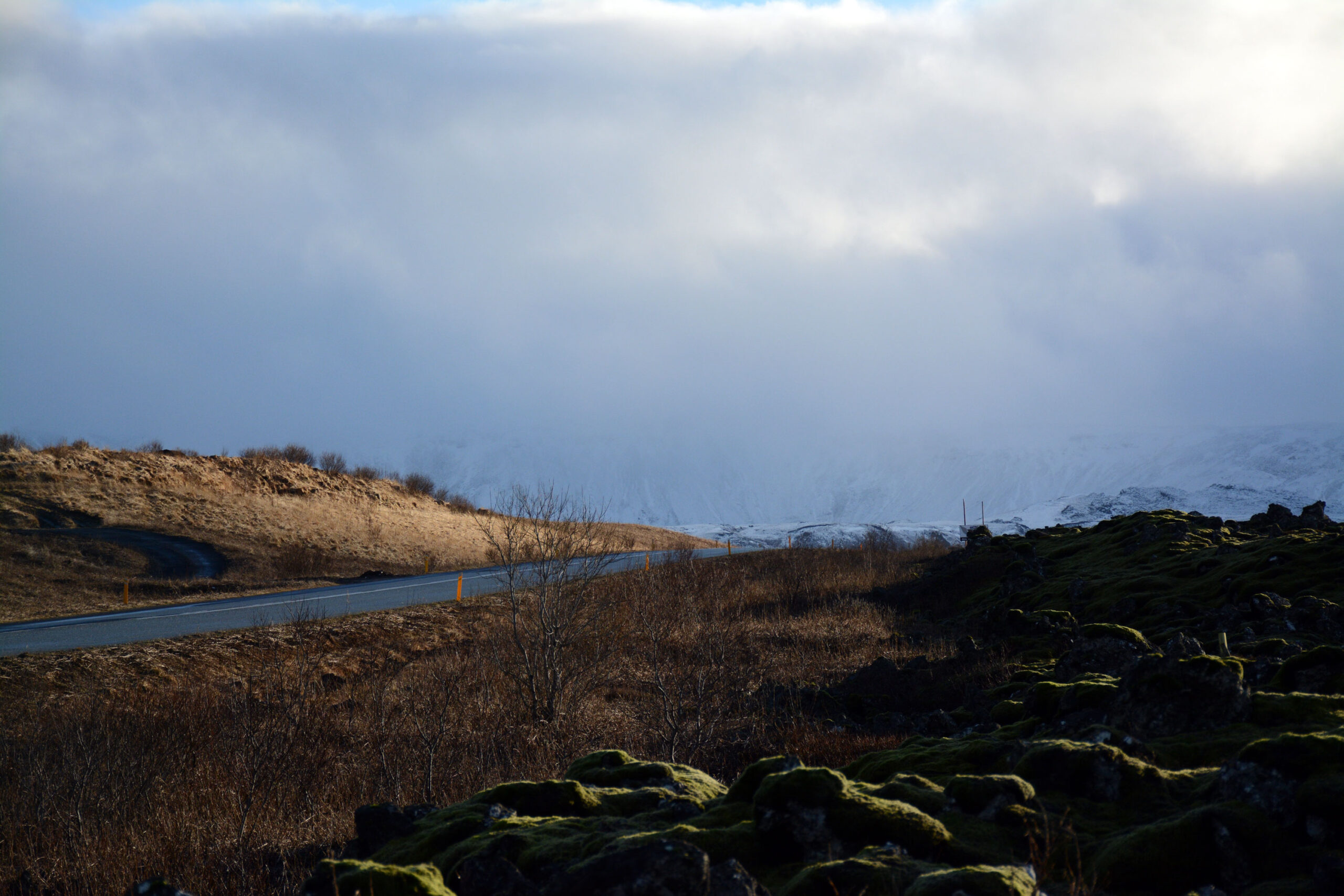
The weather is changing. I can feel it getting colder. The cloud cover is increasing and the sunlight and shadows from moments ago are fading. It’s happening faster than I’ve ever experienced before. Back toward the main road I try to take a few more pictures of my impossibly lit destination, but in the couple of steps it’s taken to get there, the blue sky is gone, filled instead with heavy grey and white clouds.

I get back in the car and continue driving. The landscape transforms again.
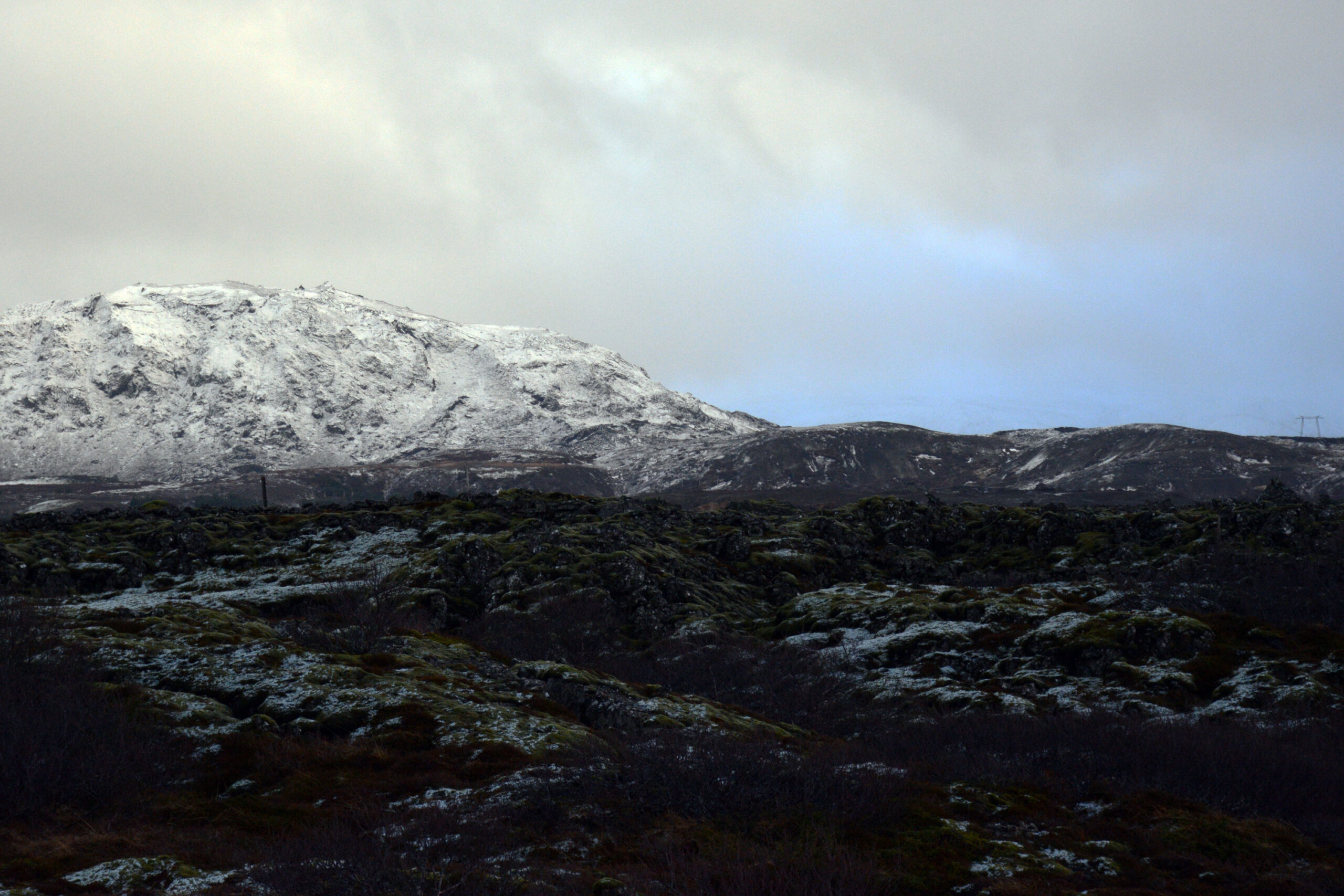
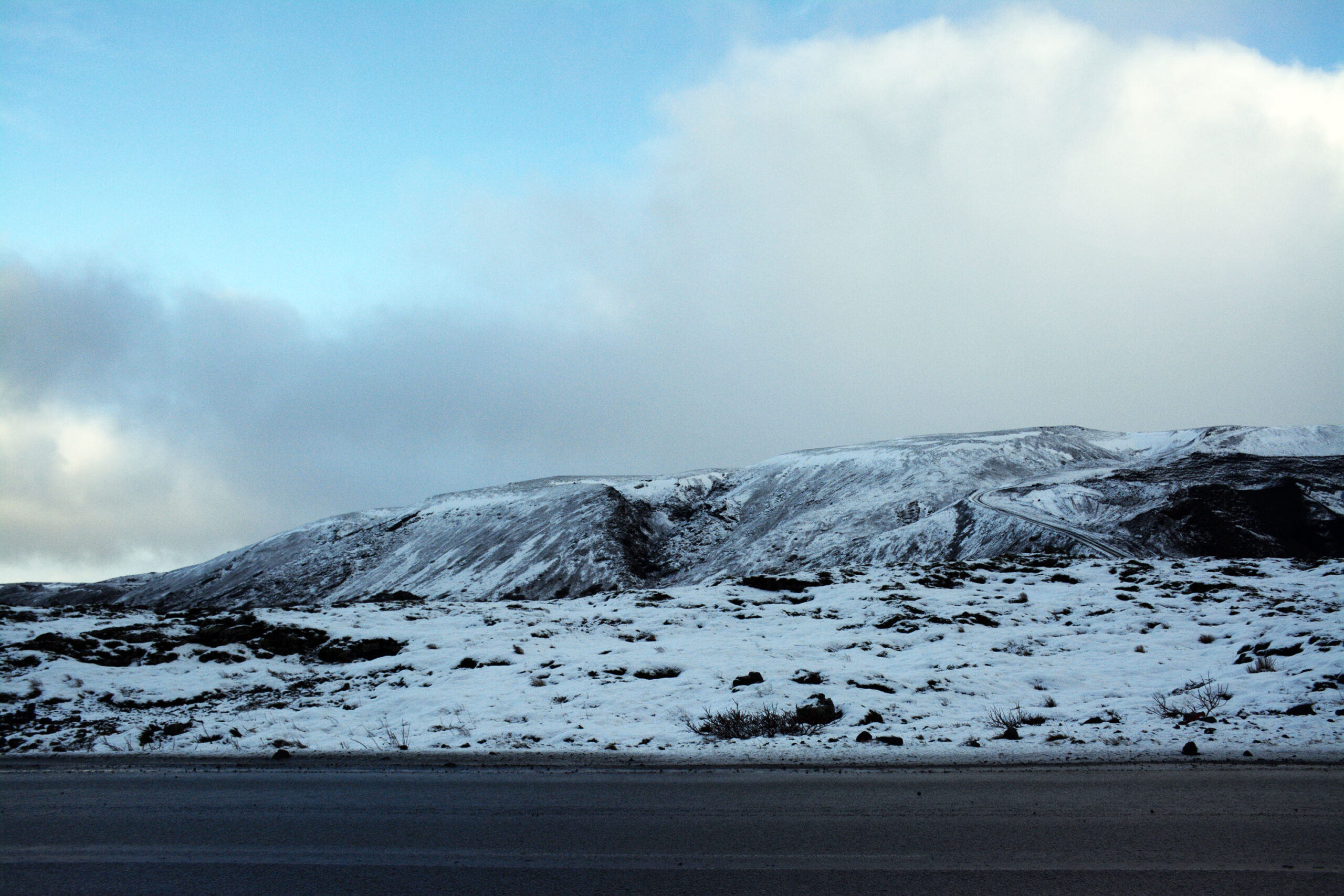
The weather closes in around me as the mountains grow larger in front of and then along side of the road, where I’ve stopped to take these pictures.
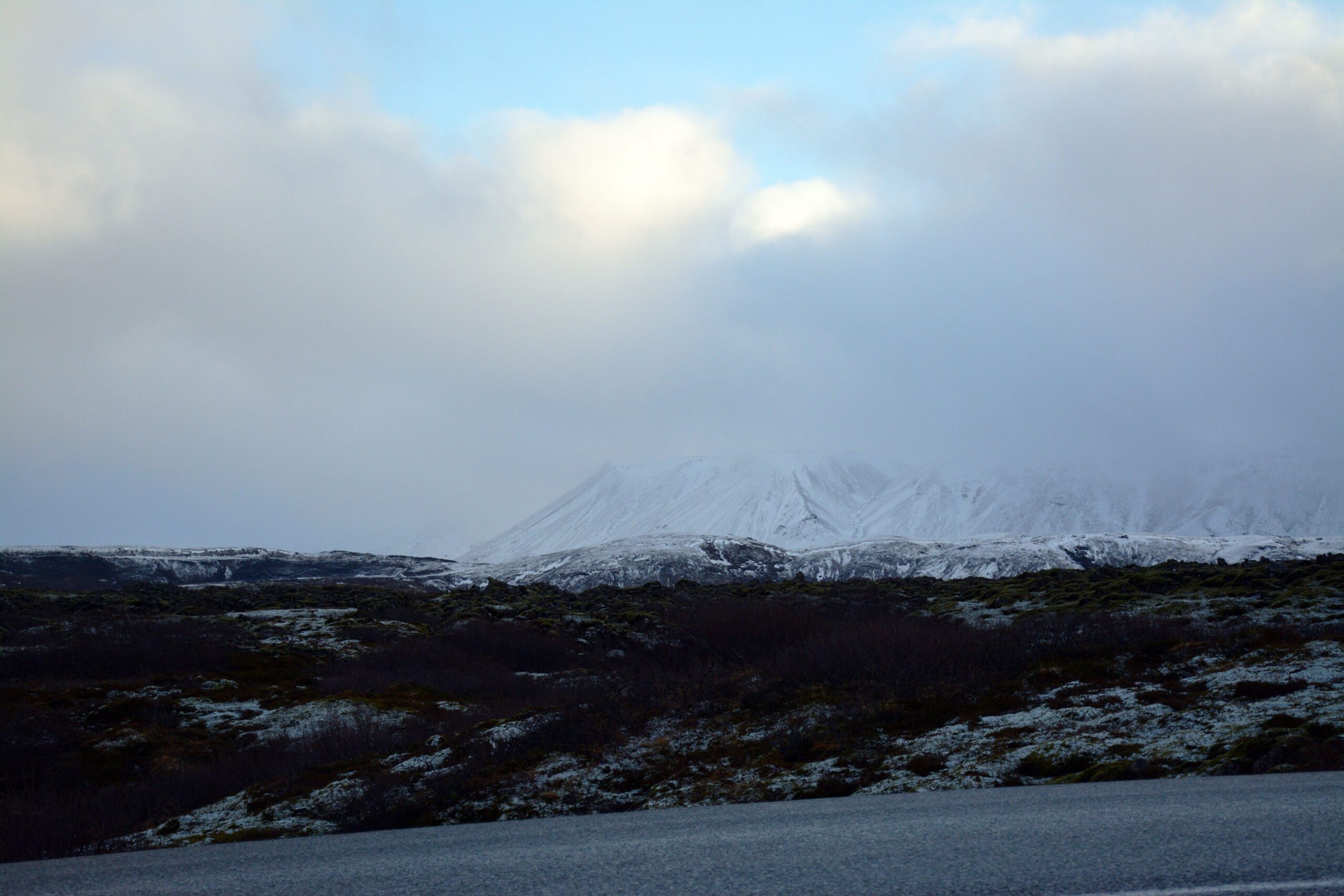
I’m climbing. The snow creeps closer and closer to the edge of the road before it’s all around me, covering more and more. I realize I haven’t seen another car since I left the main road. I’m not sure if that’s a reflection of me being in an isolated place or having stupidly driven to one, but for all their changeableness, the road and weather conditions are still not nearly as poor as what I’ve encountered in Canada.

I continue on, but it’s at this point in 2017 that I stopped taking pictures.
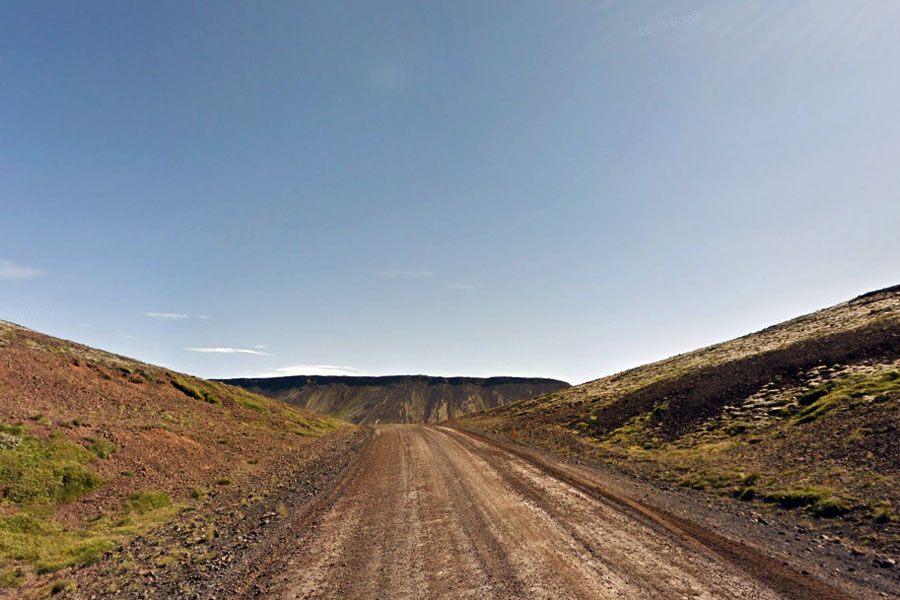
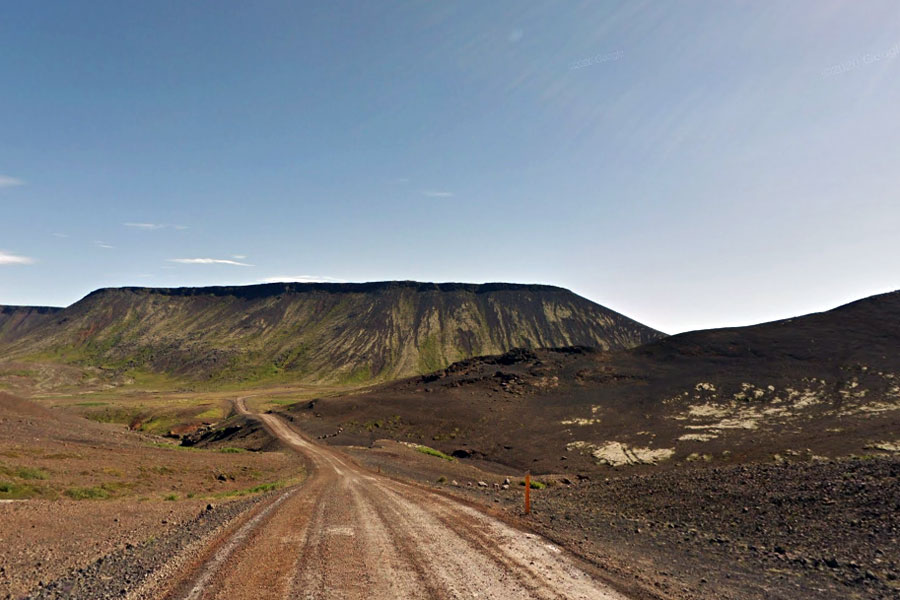
I’ve tracked down some Google Street View photography to show the road from my perspective instead. Everything isn’t covered with snow in these images, which is too bad. I think seasonal viewing options would be a great addition to Street View. Are you listening, Google? Yes—of course you are. You always are…

As I reach the top of the climb, the unfamiliar road completely disappears into the snow—leaving just a few polite marker posts with reflectors on them as hints to its whereabouts.
And on the other side of the climb, a goosebumps inspiring mountain decent—with snow. Lots of snow. Only snow, actually—sprinkled with just a few more marker posts that I both aim the car at and avoid simultaneously. I remember the road felt like it dropped out from under me as I went over the crest. I remember laughing out loud. I had no idea where I was.
It was an absolute thrill to drive on that snow‐covered road. If I could do it again, I would. Again and again and again. I don’t know what happened to the sky: I was too busy wondering what happened to the road. But I felt like I was inside a snow cloud, driving around in my own personal blizzard. This is what I’d wanted to do while I was in Iceland. This is why I was feeling claustrophobic back in Reykjavík.

After a few minutes of attentive driving, tire tracks appear in the snow ahead of me. The road continues to descend. I can see the paths of other cars, wherever they are. I still haven’t seen a single vehicle. There’s more landscape to see as well, dark forms against where snow and sky overlap. It’s hard to resolve any more detail. Everything is either very bright or very dark—it all averages out to grey in the camera. I don’t know what to make of it either. This place is like no other. I am somewhere else.

Farther ahead, a lake begins to appear up out of the snow. I sense its magic as I approach.

I slow the car and find a small parking area near the entrance to a trail. Weather and light move at unfamiliar speeds as I come to a stop. I open the door and step out as the landscape changes with the clouds. All the sound around me is consumed by the idling car. I don’t know why I’ve left it running—something about not being stranded, I think? I don’t really remember the reason anymore as I look out over the surface of the water. Now I feel like I’m supposed to be here—so I can’t be stranded if that’s true. I turn off the engine. Quiet rushes. I can hear the air moving.
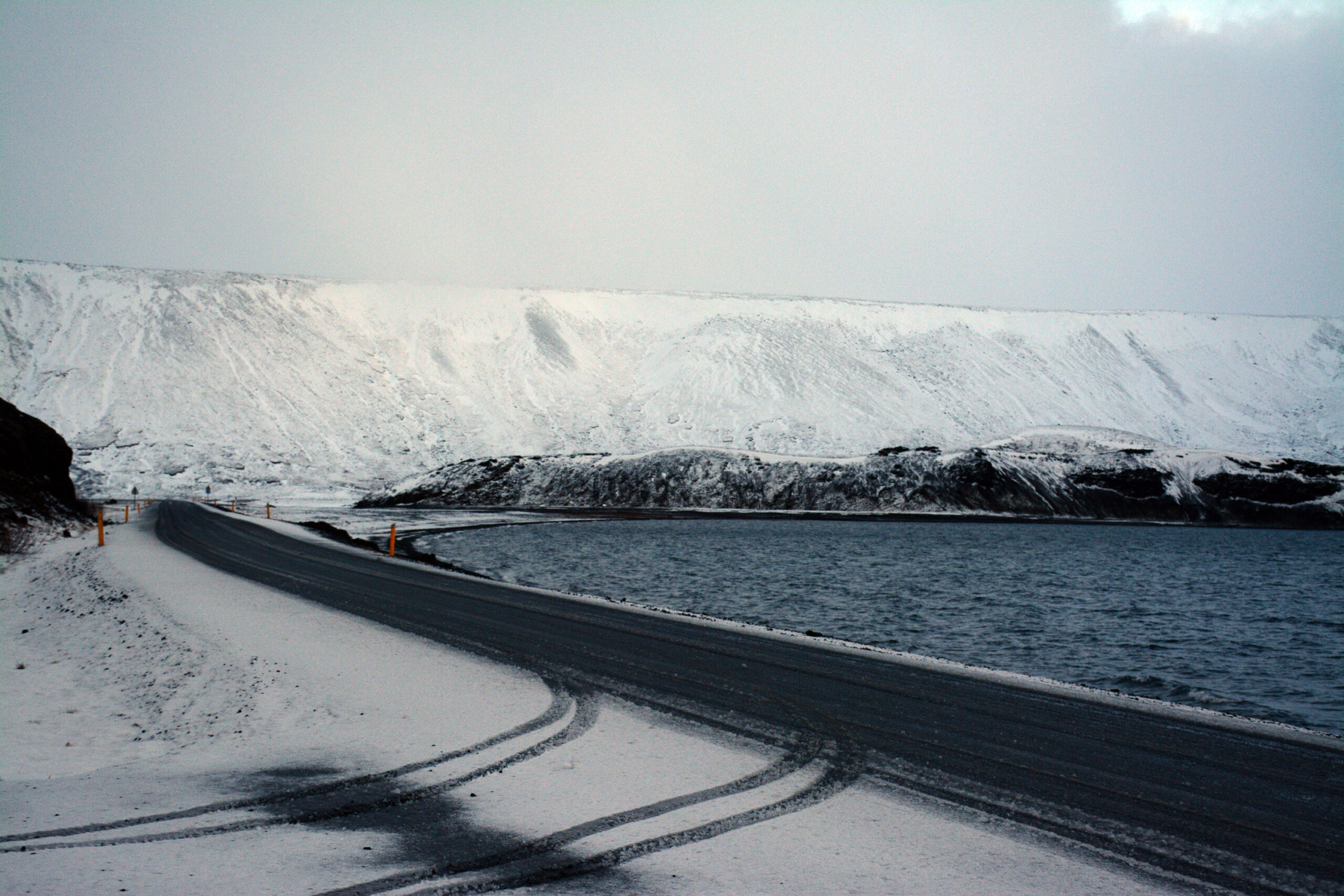
It’s rare to be in a place with such a presence. I am delighted. The lake sits across the road, its deep colour radiating against the black and white and grey surroundings, its waves rolling softly over onto the pebbly shore. Everything is peaceful. No purpose is wasted. I can hear the last of the snow as it falls, feel each flake on my face. It’s a familiar feeling. I smile for no one but myself and maybe the lake. Wisps of sky move through the clouds. The sun is up there somewhere.

I later found out this is Kleifarvatn. It’s the largest lake in Reykjanesskagi and is almost 100 metres (just over 300 ft) deep in some places. There are no visible inlets or outlets. Water moves underground to and from the lake. After a strong series of earthquakes in 2000, Kleifarvatn slowly lost about 20% of its surface area before gaining it back just as slowly.

From where I am I can see the road following the shoreline of the lake, right up against the rock cuts at the base of the mountain foothills—just like home. There’s a sharp rise in the road and an outcropping of rock into the lake. I know there will be a good view.

And there is.
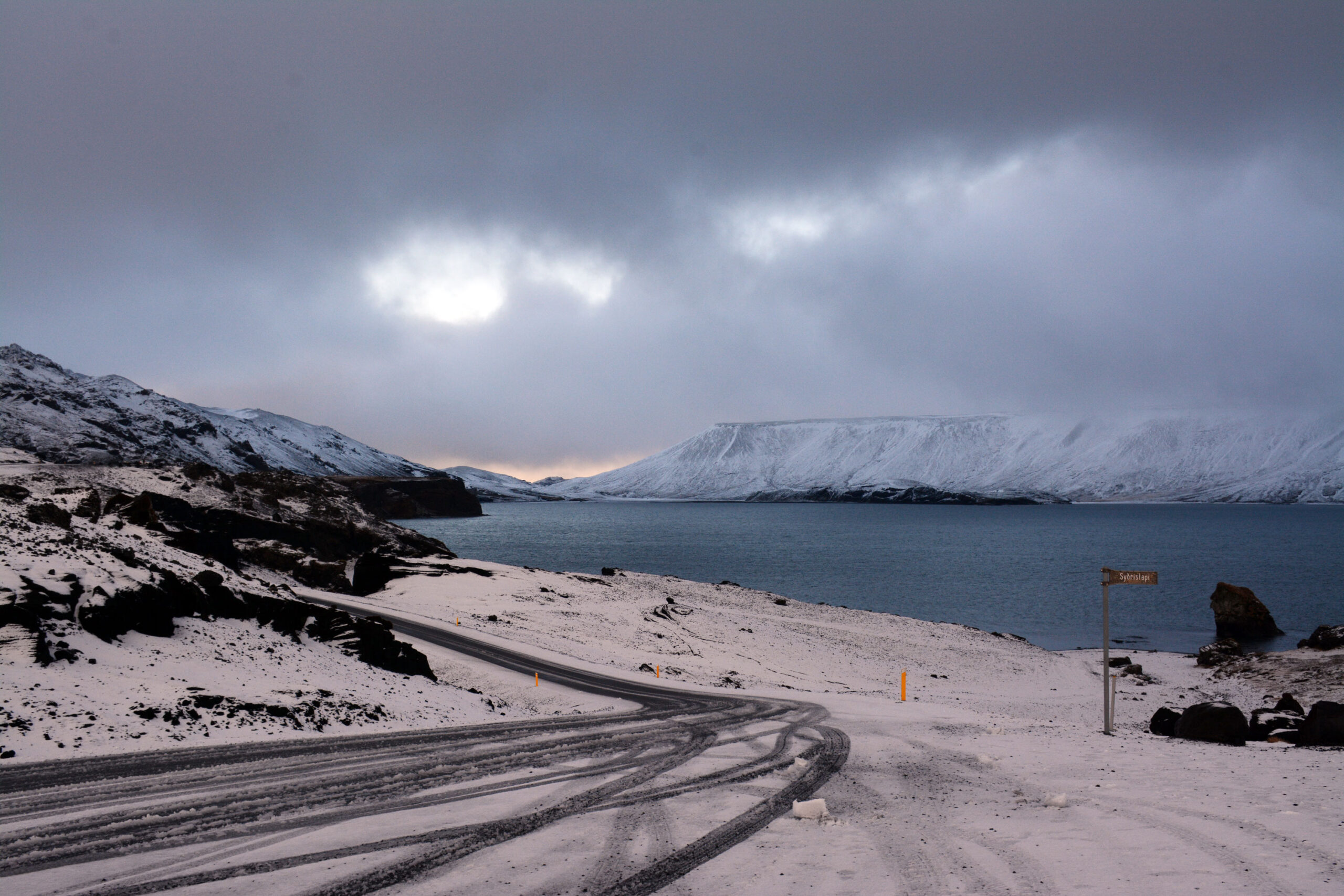
This indeed is a magic place.
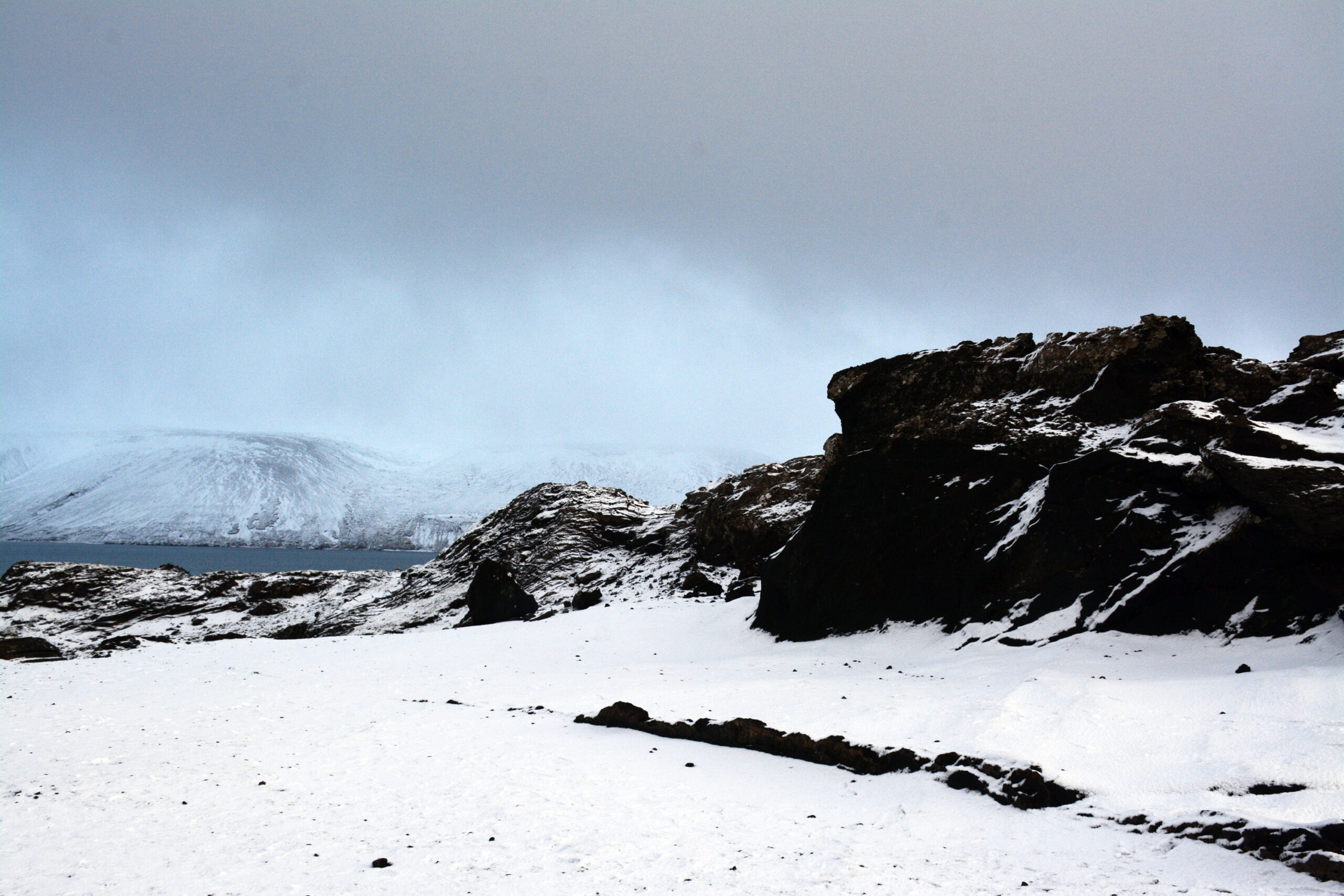
This is Syðristapi, one of the highest points along Kleifarvatn. It’s possible to see the entire lake from here, though not entirely all at once. The light changes again. Colours arrive with the sun and sky. I have absolutely no idea where I am anymore—there is no frame of reference for what I’m seeing—it’s impossible, and I love it. I don’t know how to leave this moment, or if I even want to.
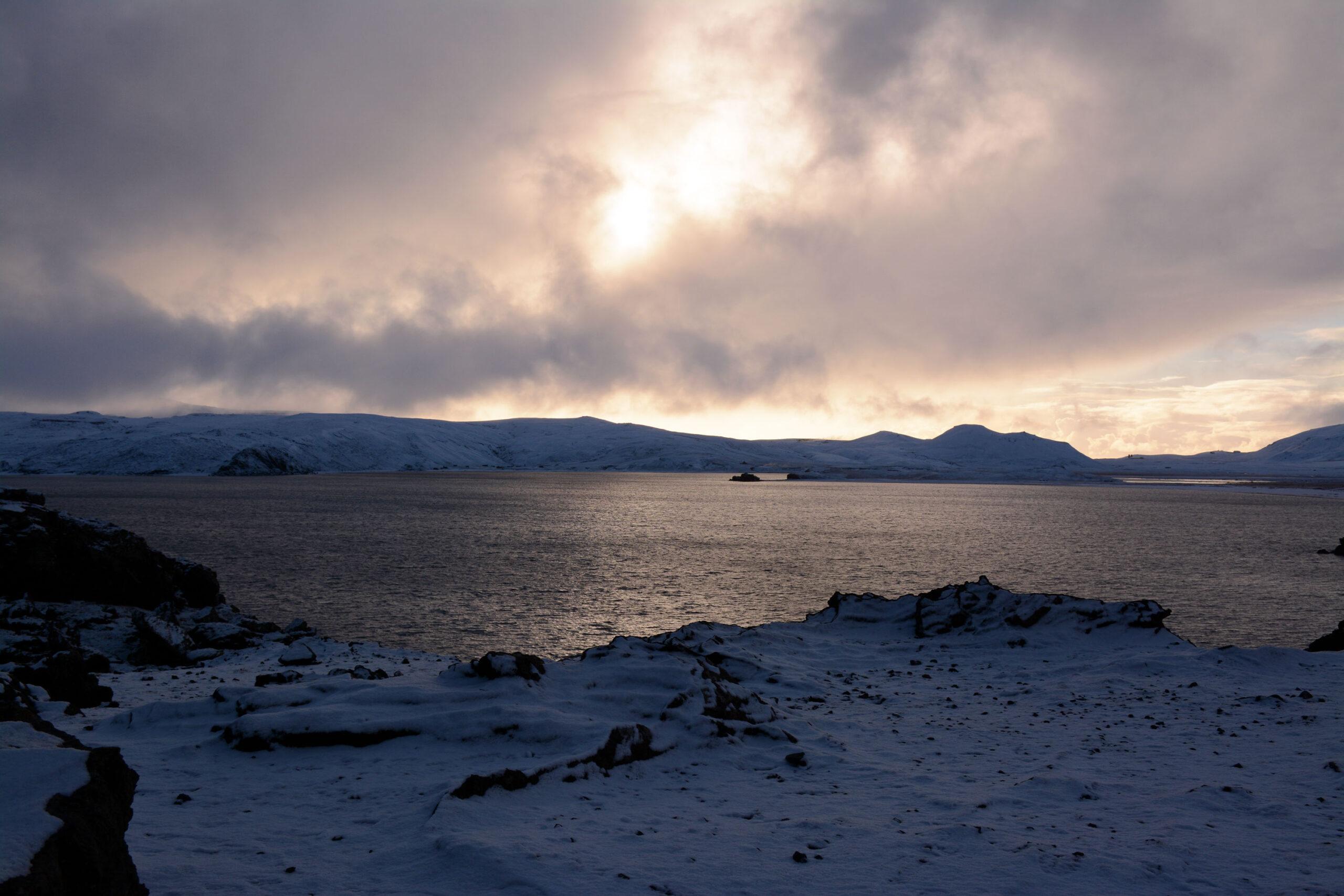
But it is just a moment. And I can also see the road ahead of me, the path I’d set out on this morning. I have lost track of what time it is now, but I feel like I’ve travelled through it rather than with it ever since I left Reykjavík.
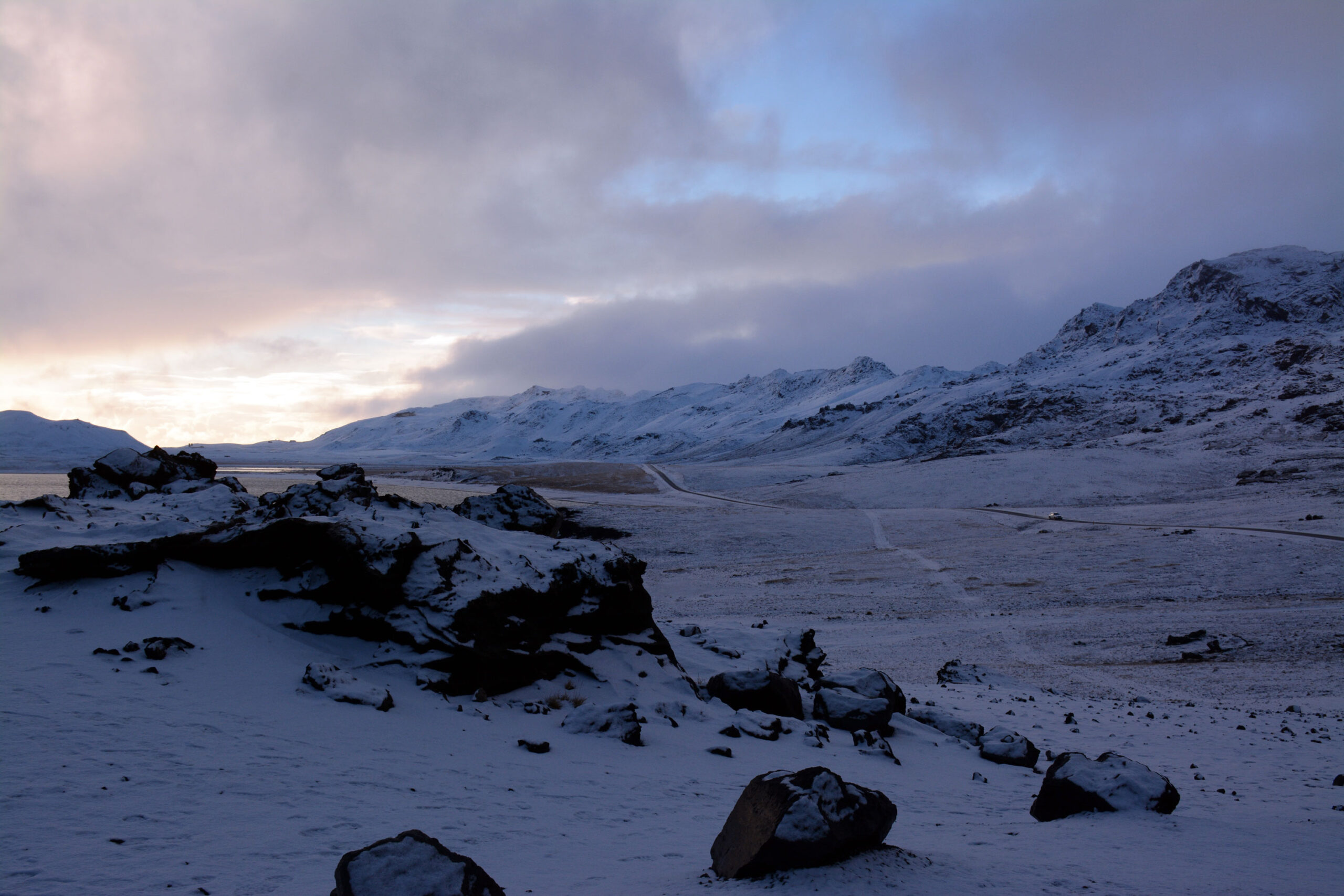
I look again at the road. There is a single car moving along it in the distance, slowly heading toward me. I hadn’t noticed it before, but seeing just that one car made me realize I hadn’t at any point felt alone during my time in this expansive place of solitude. It was difficult not to feel alone back in the city—it was always just me surrounded by other people. But in this place, I didn’t feel surrounded by anyone. Or by anything. I felt among the snow and the lake, felt among the rocks and the mountains. And I felt among peace in a way I didn’t realize was possible.

I decide to leave this moment before the other car can arrive in it. There is a timelessness I would like to maintain in my memory of this place, a purity of experience I would like to both keep for myself and offer to the occupants of the approaching vehicle, should they find themselves stopping here that is. And I don’t want to hear the sound of passing car should they not.

But I never see the other car again. I expected to encounter it sometime after I headed down the road. I thought for sure it would be coming in the other direction—it seemed to have disappeared instead.

It didn’t feel like a lonely thought, or even a sad or creepy thought, mostly because it didn’t feel like anything at all. In hindsight, it was a thought driven by distant, sleep‐deprived logic. It was the thought of one possible explanation, as absurd as it was, that happened to align with my confounding observations. If all I could see were the tracks of vehicles that didn’t seem to exist, and I was in the only vehicle that did, then perhaps I was the one who had disappeared.
AWD

A little faster now.

I’ve made another mix, and this one is legit quick—there are no sneaky speed adjustments like on Digitigrade. Did you know it started at 106 BPM and gained 28 more throughout the mix? The idea was to start from a mellow, disco‐like vibe and move to a more, uh, pie‐eyed pace by the end. I detoured instead and included a couple of nods to one of my favourite mixes of all time, Sasha’s Involver. Then I stuck a mashup mix I’d done at the beginning, and the ending was something that caught my ear at the last minute and had to be included as well. Though it started off and ended up roughly where I planned, Digitigrade still felt like it was all over the place—but I learned a lot by making it. I’m generally pleased with the way it came out, all things considered.

But this time around, I’m genuinely pleased with the result—mostly because it was unplanned. A couple weeks ago I was messing around with the DJ software I’d used for the last mix along with whatever I could find on my computer to practice with. Things evolved from there, and I ended up with just about 45 minutes of me essentially goofing around. My mindset was one of but will it blend? I tidied up after.

It reminded me, oddly, of learning to ride a bicycle. I had been instructed on how to ride one a few times, but to no avail—I remember always almost falling over. I don’t believe there was anything fundamentally incorrect about the way I was being taught—I just wasn’t getting it. It wasn’t until one day, when I had no one showing me, that I figured out how to ride a bicycle without falling over—eventually. I fell over a lot that afternoon as well. I bounced my chest off the handlebars a few times, once so badly I experienced the sensation of not being able to breathe properly. I’d never felt that before, so I actually ended up learning two things by the end of the day.

Similarly, I had been instructed on how to mix music together a few times, but it never really landed until now, when I’ve had the opportunity to quietly figure it out at my own pace.

And if this all sounds like too many words and not enough music, consider this the release party for the album, and I’m just another MC who won’t get off the mic. If I’m pretending to have an audience for these mixes, then I’m pretending to have launch events for them as well. It’s just more practice.

That said, I might take a little break from mixing. While it was really excellent to have something I could eagerly work on for hours at a time, day after day, there are some other creative projects I would like to spend as much time on and with as much singular dedication. Kerouac wrote the first draft of On the Road in three weeks. I don’t know what I’d be capable of writing in three weeks, but there’s only one way to find out—handlebars to the chest be damned.

Here’s mix number three in the meantime.

Track List

  1. Fasten Your Seatbelt — Pendulum ft. The Freestylers
  2. Intruder — Armin van Buuren ft. M.I.K.E
  3. Ghosts’n’Stuff (Original Instrumental) — Deadmau5
  4. Umbrella Beach – Owl City
  5. Love You More – Armin van Buuren ft. Racoon
  6. Wall of Sound (Parc Mix) – Airbase ft. Justine Suissa
  7. Superfabulous (RS Edition) – BT
  8. Purple Haze – Mesh
  9. Children – Robert Miles
  10. Tears After the Rainbow (2020) – Planet Funk

America

The Divided State Of

The temptation to digitally pen a strongly worded rebuke of conservatism and its divisive nature is strong, but I’ve already written about it. I also have no suitable frame of reference in this case. Though there are some areas of overlap, conservatism in America is not the same as it is in Canada. Besides, now’s moment is about progress—at least in theory. In practice, the clear and 81 million vote mandate for progress in America is complicated by the static inertia of almost 74 million Americans who—given the choice—decided progress was better embodied by an arrogant, ignorant, sexist, bigoted, racist, traitorous, white supremacist.

It’s important to acknowledge the voters who indeed voted for Trump. But it’s also important to acknowledge some of those voters were actually voting for not Biden. It’s a subtle but meaningful distinction: these are the voters who will vote for anyone—Trump, Dr. Octaviusas, a heteronormative dumpster fire, a half-eaten sandwich—as long as he’s not a Democrat. These voters won’t necessarily not vote, but their intention is more about prevention than participation. Their level of civic engagement follows suit, ranging from arm’s-length indifference to face-painted fanaticism. A similar situation exists on the other side, but with far less TV-friendly flare or flair. Biden did receive the most votes for any presidential candidate in the history of America, but some of those votes weren’t for Biden—they were for not Trump.

These not votes are symptomatic of a winner-take-all electoral system approaching the end of its serviceable life. As it runs its course, the system produces the illusion of majority rule as it converges on a two-party and eventually politically deadlocked state. Sound familiar?

A similar scenario is developing in Canada, and the results are just as distorting when it comes to indicators of progress. It probably wasn’t Trudeau who was elected in a landslide in 2015: it was more likely not Harper. Jump ahead four years and the results are just as distorted: not Scheer forms a minority government while not Trudeau wins the popular vote. But again, I’ve already written about it…

Initially confounding on the surface, and overlooking a worn out electoral process, the result of America’s 2020 presidential election makes more sense if one allows for an uncomfortable premises: America as a whole is still not as progressive as it might look. While the United States has embraced pockets of progress before, the level of resistance during the lead‐up and obvious begrudgement after the fact risks trumping any apparition of an entirely progressive nation.


US and Canadian politicians usually refer to their respective nations as being friends. I’ve always found this analogy to be overly simplified and slightly patronizing. Friendship implies certain levels of similarity, camaraderie, solidarity, and reciprocity exist between two or more entities. I don’t often see those qualities in the proportions I would consider befitting a friendship, not in the sort of friendship I would want at least. Personally, I view the two nations as neighbours—because they are. It’s ideal to have a good relationship with one’s neighbour, and certainly a friendly relationship helps as well. But a neighbour isn’t supposed to start building rooms in the other’s house, or try to take it over entirely, so it’s important to know when to draw the line with the relationship. And as far as the US and Canada go, that was in 1775, 1812, 1818, and again in 1846.


I’ve met a few people from all over the United States, people from New York, Pennsylvania, California, Washington, Florida, Michigan, Illinois, New Hampshire, Missouri, Oklahoma, and Nevada. Both of my brothers are married to Americans, so now I have family from Colorado and Ohio. And I’m directly related to Americans as well: I have a grandmother who was from Minnesota and ancestors who were from Pennsylvania.

As a child, I remember travelling across the norther boarder states, through North Dakoda, Idaho, and Montana. My family would also sometimes make trips from British Columbia to Spokane, a city in Washington state.

I’ve been to a few places in the United Stats as well, places like San Jose, Chicago, Pittsburgh, Buffalo, Philadelphia, Orlando, Jacksonville, and Washington. I’ve also passed through countless other American towns and cities—Scranton included—on my way to other places, most notably on a grand road trip to and from Florida with stops in Richmond, Cocoa Beach, Charlotte, and Philadelphia.

Despite all this American experience, and I do wonder now if I’ve seen as much of Canada as I’ve previously thought, I know I’ve only experienced a fraction of what America is. But despite having experienced only this fraction, I know America is a land of extremes. America is always turned up to ten, something I’m saying both literally and metaphorically. Its population is ten times that of Canada’s. It’s a magnitude of scale captured in America’s relative successes and failures—a simultaneous state of inspiring awe and terror, a nation of beautiful horrors.


I was driving west through northern Ohio many years ago. It was near the end of a midsummer day, and I was nearing the last quarter of 1200 km trip around Lake Erie via Pittsburgh. The light of the sunset was bouncing off some of the taller buildings in distant downtown Cleveland. Linkin Park’s The Little Things Give You Away was playing through the car stereo. I think it was the first time I had ever heard the song after listening to it so many times before.

Perfect moments are fleeting, their criteria impossible for me to define. All I know of them is when I’m in one of them—and I found myself in one of them on whatever mile it was of whatever unending interstate highway it was while a far away sadness gently filled my eyes.

...Hope decays
Generations disappear
Washed away
As a nation
Simply stares...

Little things are harder to script, and I think that’s why they stand out in my mind more often and with more impact than the most choreographed interactions I’ve had with others. I used to ask a lot of questions as I got to know someone, but questions are tricky. Answers are easily scripted once the question is asked. Now I ask very few, preferring instead to watch and to listen, to see which words match up with which actions.


Earlier that day in Ohio, in the parking lot of an amusement park, some of my local travelling companions found out I was driving a rented car. They wanted to know why I wasn’t driving my own. At the time I didn’t have a car of my own, so I told them as much. They wanted to know how I got around without one. Other than renting one when I needed one, I also at the time I lived in downtown Toronto, where there was public transit all around me. I told them as much again.

“You live downtown and don’t have a car? Are you poor?”

It was at this point I asked about the numerous signs reminding patrons not to bring guns into the park. I wondered aloud if this was an ongoing issue, and that if someone should somehow accidentally bring a gun with them to the park if they were just supposed to leave it in their car.

“Well, yeah…” was the response. “Where else would you leave it?”

Where else indeed.

“Are there guns in your car?” I asked, point blank.

“Just one.”

A few weeks before then, someone I knew had a friend visiting them from Minnesota. He made it a point to mention how strange it felt to be unarmed while in Canada. I took the bait, mostly because I didn’t feel strange to be unarmed anywhere. As it turned out, not only would he have been armed with a handgun whenever possible back home, he had a concealed carry license. As a concept, a private citizen being able to legally carry and conceal a handgun in Canada is so restrictive it may as well be prohibited, but I took the bait again and asked why he had a concealed carry license.

“Because it’s my right as an American. It’s part of my freedom.”

Fair enough—but I couldn’t help but wonder if the same righteous attitude toward freedom was in any way responsible for him having been denied entry into Canada just days prior.


One thing gleamed from my American experiences is the variable and strange relationship its citizens have with the concept of freedom. It can be interpreted quite differently, viewed as something one possesses rather than respects. Freedom is viewed in granular detail on an individualistic level—its roll in the broader community an occasional afterthought. Its application can be highly contextual despite its claim of universality.

As applied in daily life, American freedom expresses itself through amusing and generally benign cross-cultural exchanges, such as when I was buying a noticeable amount of American breakfast cereal to bring back home while I was in Buffalo. The cashier wondered why I was getting so much at once, so I told her I was just visiting and picking up the kinds I couldn’t buy in Canada anymore. She stopped mid-scan, put down one of the boxes of chocolate frosted Lucky Charms, appeared to brace herself on the counter with both hands, and looked me dead in the eye.

“They took your cereal away from you? I hope you did something about that.”

I hadn’t, other than to cross an international border to get some more. But I think about that exchange almost every time I see breakfast cereal at the store. It never fails to crack a smile, the idea of a total stranger in another country standing at the ready to champion my sweet, sugary freedom.

The expression of American freedom in other cases is more sinister, speaking to a hypocrisy still hung over the heads of millions of its own citizens. A friend of mine returned from a conference in Nashville. She’d had a wonderful time, but relayed an odd experience she had as well. The conference was over, and she’d gone out to do some shopping at a mall near the convention centre. She was finding all sorts of great things and commented to one of the store employees on how much she was enjoying the selection. The employee looked curiously at her, and asked if she was from out of state—not from out of town, out of state. My friend said yes, that she was visiting from Canada, from Toronto. In the most matter of fact way possible, the employee responded.

“Ah—yes. Look—if you start to feel uncomfortable, the white mall is just a few miles up the road.”

My friend told me at no point did she feel uncomfortable where she was—until it was suggested that she might be. I think about my friend’s exchange almost every time I find myself in a place where there are only white people, and I find myself uncomfortable every time I do. After over twenty years of living in the Toronto area, I’m accustomed to seeing everyone everywhere. I notice when everyone isn’t. The guy from Minnesota with the concealed carry license noticed everyone when he was here as well, but he added his own, bizarre spin.

“You’ve got, like, no Mexicans here—and way less Black people.”

I really wasn’t interested in finding out what he meant, and I never saw him again after that. He ended up going back to Minnesota. Weeks later they pulled his rolled SUV out of a river. He barely survived because he wasn’t wearing a seat belt, something he never did, and something he was ticketed for not doing twice while visiting Toronto.


Meanwhile, back in Ohio, and the next day, in Sandusky, I was looking to buy a road map—yes, this was a while ago. I found some for sale at a corner gas station, in a rotating metal display frame, beside the beer fridge. The 4th of July weekend was approaching, and on the way out of town I noticed how understandably patriotic the streets looked. But there was a growing sense as I drove past flag after flag after flag that most of these flags hadn’t been recently put up and most of them wouldn’t be coming down. I don’t want to say there was a fascist amount of flags, but that I found myself wondering if there was spoke to the tone of their unending presence. Then again, back home, I find the flying of a giant Canadian flag over a big box retail complex to be a bit much. The lack of any sign reminding me to leave my gun in the car is all I need tell me where I am.


What happened at the United States Capitol earlier this week was upsetting, but it wasn’t surprising. It’s disheartening to say it was inevitable, but after witnessing a president who either sidestepped or slaughtered any traditional expectations regarding presidential obligations, I didn’t see why a peaceful transition of power would be treated any differently. Writers are sometimes claimed by others as being able to predict the future. I tend to think of it as merely being able to recognize a plot, understand its characters, and then follow the plot through to a reasonable conclusion, no matter how unreasonable a conclusion it may seem. Any future is possible, as long as it’s possible to imagine that future and understand how to get there—on paper at least. Off the page, especially when multiple authors are involved, crafting a counter-reality narrative can produce plots which are inherently unstable, and they can grow dangerously unpredictable. Results can be deadly.

And they were.

What happened in Georgia, in the United States Senate run-off elections, simultaneous with the US Capitol riot, was a display of inspired, hard-fought progress, a strong statement made against a precarious yet persistent counter-reality narrative. It demonstrated the power of a correctly authored story, the resiliency of what is genuine against what is concocted. It was beauty among horror.

It was America.


This post has always been a bit of a split decision on what direction to take it in, a fitting state as I started working on it a week after the American election. Though the election was over, it also wasn’t. In what otherwise might have been a standard set of run-off elections after the fact, two US Senate seats in Georgia became just as important as the presidential election itself. The structure of American government appears, to me at least, to favour blending power as it balances it. Ideally applied this results in bipartisan cooperation, but when cynically manipulated it stalls progress for years. Some of this cynicism crept into my own head—the post suffered: America had constructed and then backed itself into a well-deserved corner.

But as the run-off elections approached, as the formal peculiarities of the US constitution confirmed what had already been apparent for months, it felt like I could complete this post no matter what the result was in Georgia, because no matter the result, America would still be a deeply divided nation. That said, I am deeply pleased the result in Georgia is what it was. Division is far easier to heal when it is seen rather than seized, so I rewrote the entire post as something more reflective than conclusive.

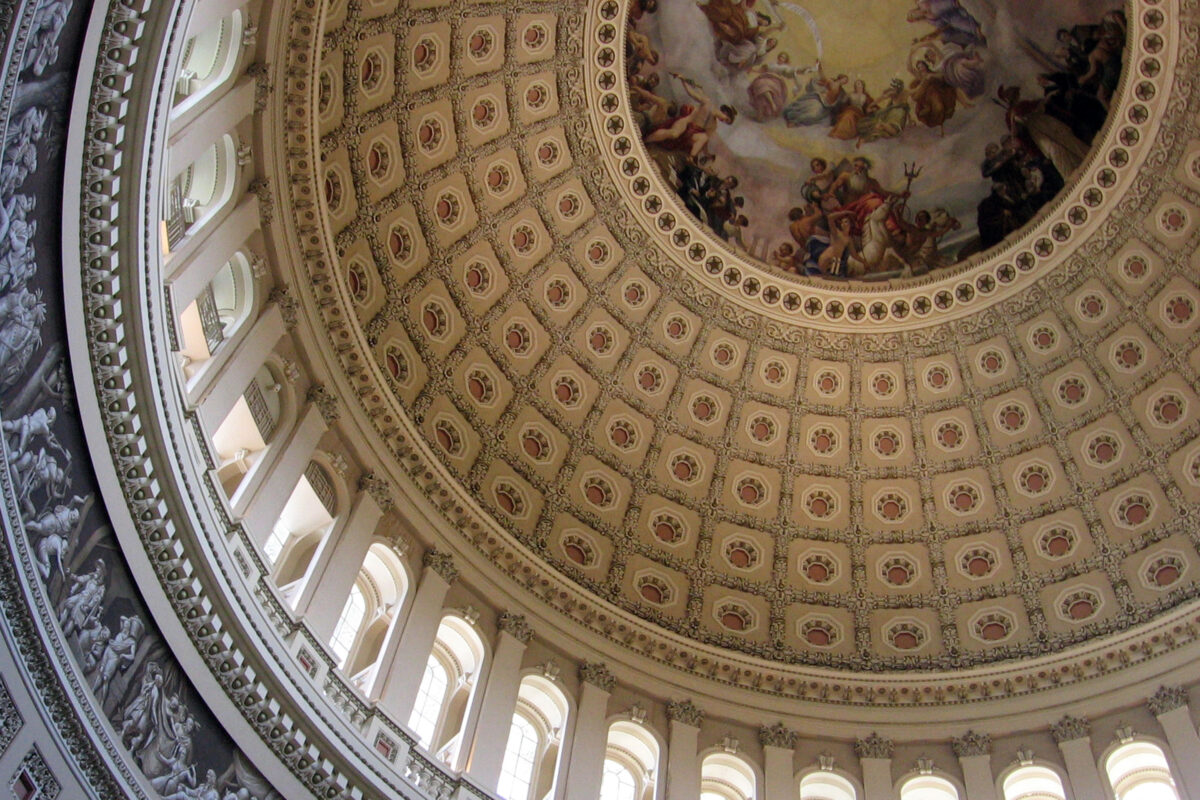
During the time I started the rewrite and my checking on the Georgia results, the Capitol building was overrun. It was a surreal and eerie sensation. I had just been working on the photograph for this post’s featured image, a picture of the Capitol rotunda from when I visited in 2011. I had been remembering the quality of the light as it moved from surface to surface, the soft echoes of voices and footsteps on the stone, even just recalling the immensity of the interior volume alone—it was a quiet memory of a peaceful place. To then be jarred while in such a place, to have it violently filled with confusion, fear, and hatred—all of it vibrating and reverberating off the same surfaces I had been with just moments before—it felt like an insurrection against my own mind. It was awe inspired terror.

I realized I needed to rewrite the rewrite.


Progress is never easy, but as I’ve understood it, America’s never been about doing things because they were easy. And I can’t help but wonder if my fondness for that famous sentiment stems from what it inspired in the Unites States then or what it inspires in me now. In rewriting this post three times in the last few days, I’ve found myself with renewed awareness of my many connections and many memories with the United States. Perhaps I’m better friends with America than I thought. But I’m also aware whatever friendship there might be has become strained and fragile by a divided state. Genuine actions are required to begin the repair. And I’ll be watching for them—though, admittedly, from a distance at this time.

Up until recently, I’ve always had the luxury of experiencing America outside of itself along with isolated and somewhat controlled internal exposure. In that respect, the relationship has felt quite ordinarily neighbourly. But I’ve felt America’s fights from my house—I always have. I’ve heard the screams and the shots. I’ve seen the smoke and the fire. The entire neighbourhood has. The only temper to the rage and sorrow I feel toward my neighbour is a recent promise of progress made this November past, a promise that’s been reaffirmed multiple, multiple times since then.

But America will face a familiar obstacle when it comes to keeping this promise: itself—a nation of many and one simultaneously. The monumental undertaking of America is spelled out in its own name: it’s not the United State, it’s the United States. The plurality matters, and it must find expression. There is no one, correct way to be American—unless that one way is not divided.

Digitigrade

One more for the road.

Back in August, I made Transformer. It was part mix tape, part dj set, and part something else. It was the something else part which made it the most challenging to classify—that and my abhorrence of labels in general when it comes to matters of expression. If it were possible to take years of thoughts and feelings, as well as all the observations in between, and then distill them into a single blog post, what would it look like? Easy: it would look like Transformer, an hour of music.

I’ve been at it again, musically, but this time it’s something a little more traditional: a 45 minute dj set. It’s a recording of a live performance from my living room on New Year’s Eve. It was my largest audience to date despite an incredibly exclusive guest list. Crowd estimates were upwards of one cat—whom I understand slept through most of it.

To further simulate a performance in real life—as 2020 dragged itself out of frame—I agreed with myself there would be just one recording attempt. I could practice all I wanted, but it was all or nothing after that. My first album was produced from the extreme comfort of a studio over a few days. My second would be produced all at once in less than an hour.

But why? Why would I do that to myself? It’s completely unnecessary. It’s way too much stress. And for what? I’m not even getting a cut of the cover or bar for my effort.

It’s all one take, but took a few takes. So that’s my 2020 compromise. And I left in some of the mistakes, including a massive one! But that’s my 2020 realism.

This is a club affair, so each track does play into the next. It’s supposed to be danced to, so the beat is more constant, and there is a touch of relentlessness to it. Under‐powered speakers need not apply. I engineered the file to be loud and be turned up loud, so there’s no clipping this time—life’s nash‐tastic enough as it is.

Track List

  1. Rabbit Facts (Legoshi Mix) — Grand National
  2. High Above the Clouds — Astronaut Ape
  3. Talk Amongst Yourselves (Involver Mix) — Grand National
  4. Pain Is My Relief — Airwave
  5. Belong (Sasha Remix & Prankster Edit) — Spooky
  6. This World Is Watching Me — Rank 1 & Kush
  7. Shivers (Redlight Dub) — Susana & Alex M.O.R.P.H.
  8. Soar — Eco

Same as with Transformer, listening is by request only for the time being. Again, most of this awkwardness stems from my intense desire for privacy, so if I know who you are then there’s a good chance you already know how to contact me, or perhaps you know someone who knows how to contact me.

There’s no need to listen too hard to this album, but dancing is suggested and strongly recommended. It’s been a tough one.

Happy New Year.

2020: In Review

Yes—it’s that time of year, again. Let’s just get it over with.

January

I was genuinely excited about the start of the year. There was no mistaking it for anything other than a year to mark the beginning of the future. Gone were the tedious pronunciations of the earlier years of the millennia. Did I have to acknowledge all the numbers—like I was writing a cheque—as in the year two thousand and eight? With an and? Years don’t have ands, and the future doesn’t use cheques. So clunky. Or what about twenty‐oh‐eight? What was that? Did anyone ever say that? Or the ‘aughts? Is this a hundred years ago? And the linguistic travesty awaiting the awkward teen years: the twenty‐teens? Abysmal.

It was the start of the year 2020 in January. It was now twenty‐twenty. The year finally sounded correct. The future was here. And I couldn’t have been happier. Let’s do this.

February

Okay—so things were not really going as smoothly as expected, mostly because the unexpected is traditionally not smooth, and yes—by definition—there’s always an amount of the unexpected present in the future. But, on the bright side, there was Leap Day to look forward to, a holiday I constructed for my own amusement because I didn’t think the day had received proper acknowledgement for being amazing.

It literally takes four years to create Leap Day, conjured out of nothing more than the second version of a still not so precise calendar. And then sometimes Leap Day isn’t a day and takes another four years to arrive. But it’s not a catastrophe, because it was all known in advance—it was just everything else that wasn’t. Life’s on the edge as a pandemic goes global. But it’ll be okay. Just grin and bear it.

Marpril? Munuly? Augustemvober!

A’ight—fuck it. I’m out.

See you in 2021.