I came across the following web comic a while back.
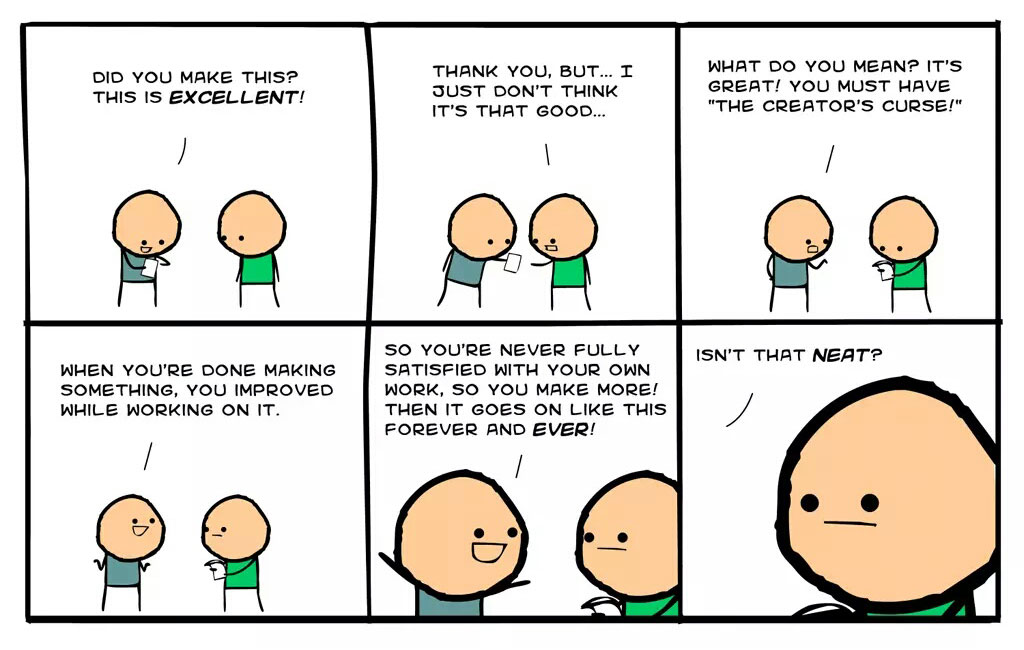
What has taken just as many years for me to fully appreciate is neatly summed up in six small panels. It’s representative of a previous relationship with creativity I didn’t understand, a peculiar mix of success that fuelled the desire for future success as it simultaneously sowed doubt over the legitimacy of previously success. Put more simply: was it really talent, or just luck?
Determining the answer tempted obsession. But the question itself was flawed. It assumed success was the need my creativity satisfied. But I don’t pursue creativity because I need to feel success. I pursue creativity because I need to be creative. Success got tangled up in the act, mistaken for a motive when it’s actually a result—not an unfair conclusion when, in general, my most successful feeling creative projects tend been the ones I felt the most need to pursue. But that’s only when viewed in retrospect. Correlation does not demonstrate causation. I don’t start a project because I think it’s going to be great when it’s complete. History has shown this precarious path to success is highly dependant on if the project is completed at all. But when is a project completed? Is it when I can’t advance the work any further because everything I wanted to do with it has been accomplished? Or is it when I can’t advance the work any further because I’ve trapped myself in a creative corner and am sick of the sight of it? In either case, the work will end up published for all to see, or lurk—possibly forever—in the shadows of past drafts. And if I’m honest, the outcome in either case resolves my need to be creative.
Or as the great Mitch Hedberg once posited: Did you find your wallet? Yeah—but I kept looking for it.
I’ve been sitting on a number of images I took with my dad back in June. He’d come to visit just before Father’s Day and we took advantage of some recently relaxed public health restrictions to enjoy walking around outside on a sunny day while we did some photography. It had been a few years since our last photo adventure together, and after weeks of not being able to see each other, I was happy we got the opportunity. The afternoon walk and subsequent pizza dinner stand out as some of the most usually expected memories of a summer that hardly existed in any usual way otherwise.
Later, as I was looking through the images I’d taken, the undeniable unusuality of the situation surrounding them was apparent. Some of this was due to a technical error I’d made. I’d inadvertently locked the camera into ISO 400 mode. I didn’t notice this until almost the end of the afternoon. I ought to have noticed it earlier—particularly as the camera itself was trying to alert me to my mistake by constantly proposing bizarre exposure settings—but it had been a long time since I’d used any camera other than the one in my phone. The weather on the day of was warm with an initial mix of brilliantly bright and blue skies producing wonderful shadows, but cloud cover later intensified and blocked out direct sunlight. The shadows disappeared and were replaced with defused, uniform light. Colour receded. It was workable, but it wasn’t ideal as my earlier error was akin to having loaded a camera with indoor film and then using it outside to take pictures on a bright day.
All the pictures looked a bit off as a result. I’m usually happy enough with what comes directly out of a digital camera that I’ll use the images as they are, perhaps only with minimal brightness adjustments, a purist nod to my learning photography on film first. But in this case, accidentally simulating a film photographic experience failed me. I really wasn’t happy with most of the pictures. Nothing looked correct. Colours were weird. In‐camera attempts at coaxing details from the monotonously lit day would blow‐out the sky and kill contrasts. It was all very frustrating and unnatural. Not at all unlike the circumstances created by the pandemic I’d sought to escape from, if only for an afternoon.
But there was no escape. There still isn’t. And as the prospect of a second lockdown looks less looming and more likely, the unnatural quality to my pictures from June makes much more sense. That some of them feel weird is correct. That there’s always something off about them is accurate. If there’s tension or discomfort or strangeness—it’s all good, ’cause it actually wasn’t. Not by a long shot.
In previous posts I’ve shared photo shoot photos as a single gallery arranged in chronological order. The visual narrative is literal: the viewer sees the images in the same order I took them in, free to construct any additional narrative on their own. This post is different. This time is no time for anyone to be left figuring things out on their own.
So—off into the world of outside…
But first, a couple of sighting laps with the camera to be sure I’m still familiar with the controls before leaving.


Under‐exposed and out of focus—zeitgeistic perfection.
This is the entrance to a magic tunnel, connecting a residential cul‐de‐sac to a city park.


A small wooded area is just off the park, joined by old alleyways where cars roamed free.


And train coaches rest quietly among the trees.

Greenery gaps crumbling infrastructure.


In the midst of despair, hope can be a tricky sight. Its light is fleeting. Like punching in a dream.


All the lights go down as I crawl into the spaces…

…Fight, flight, or the screams, life tearing at the seams1


The clouds are turning out. The sky is changing.


The grass in another park is sprinkled with regal and exploded clover.


And a playground sits silent and empty on a warm and sunny Saturday. Merriment and nonsense is still forbidden.


But there is a sense of something else.


A departure of sorts.

A reimagining of structure, of future.

And on another path, they appeared as they always did—among the vegetation and fencing surrounding the industrial bakery. They were beautiful, these donuts in the brush. But the greatest sight of all had to have been the sliced bread.


Or perhaps this antennaed heart and friendly decapus sharing a moment of prohibited proximity.

Hey sky. What’s going on up there?

Or over there—where a train car full of cars blocks a road blocked to cars. Delightful.

And while this red light shines for no one, I for one want to get in on this hamburger loop.


The shadows are back as the sun sets.


Impossible lighting presents. It’s my favourite time of summer evenings.

I don’t know it, but this ended up being a perfect image, one that went straight from the camera to the screen. Everything looked just as it did. Nothing needed fixing.

If the empty playground stirred feelings of melancholia, then consider this distant and solitary dog at the dog park, the canine equivalent of one kid sitting on a seesaw.

More improbable lighting.

Highlighting an improbable fence.


I call this the fire place.

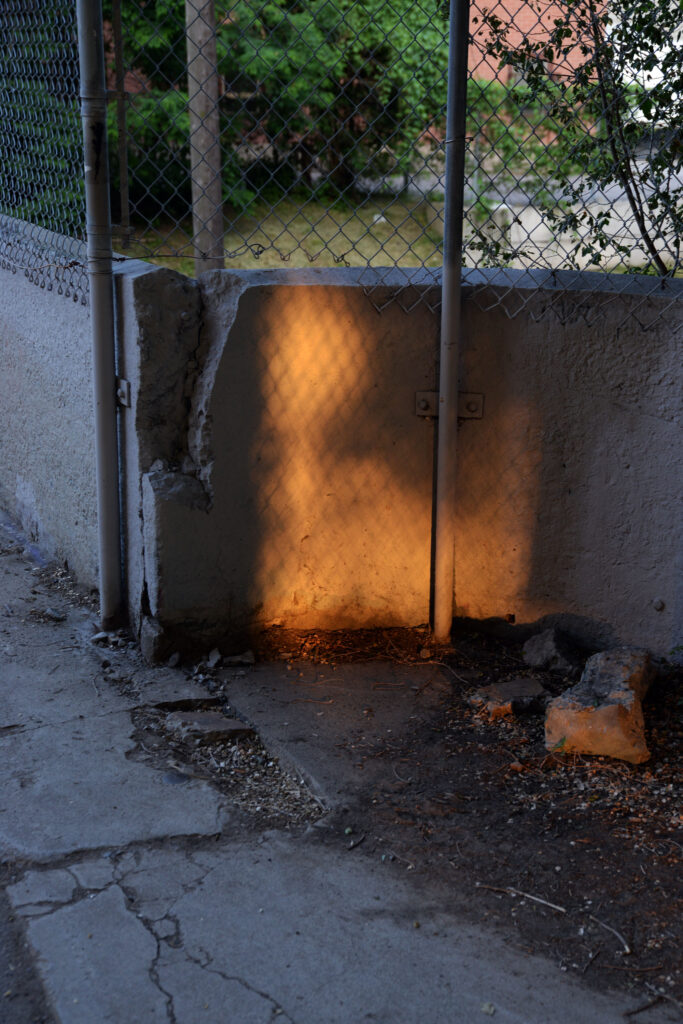
See…

The current iteration of the Claremont Access began construction in 1969—a time when the car could do no wrong. Now the land it stands on is part of Ontario’s protected Greenbelt.

The massive support structures for the roadway are omnipresent. They formed some of the impossible lighting conditions found throughout this post.


Arkledun Avenue and the Jolley Cut scar themselves across the Niagara Escarpment, a reminder of yet another time when the natural world was to be dominated rather than respected.

Ironic as children are usually taught the implications of tempting forces beyond their influence.

The exit from the magic tunnel—having just gone through the entrance for a second time. Magic abounds.

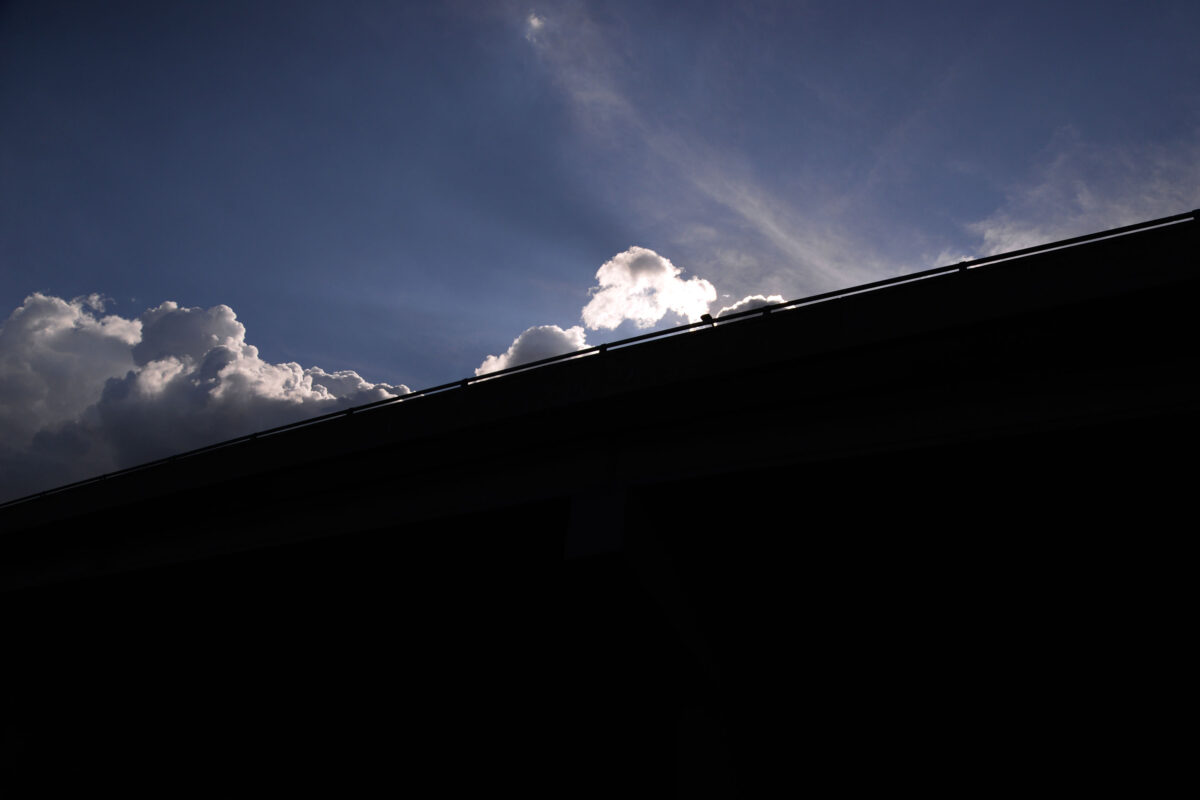
An interpretation of the The Empire of Light, a painting I first saw at the Peggy Guggenheim Collection in Venice.

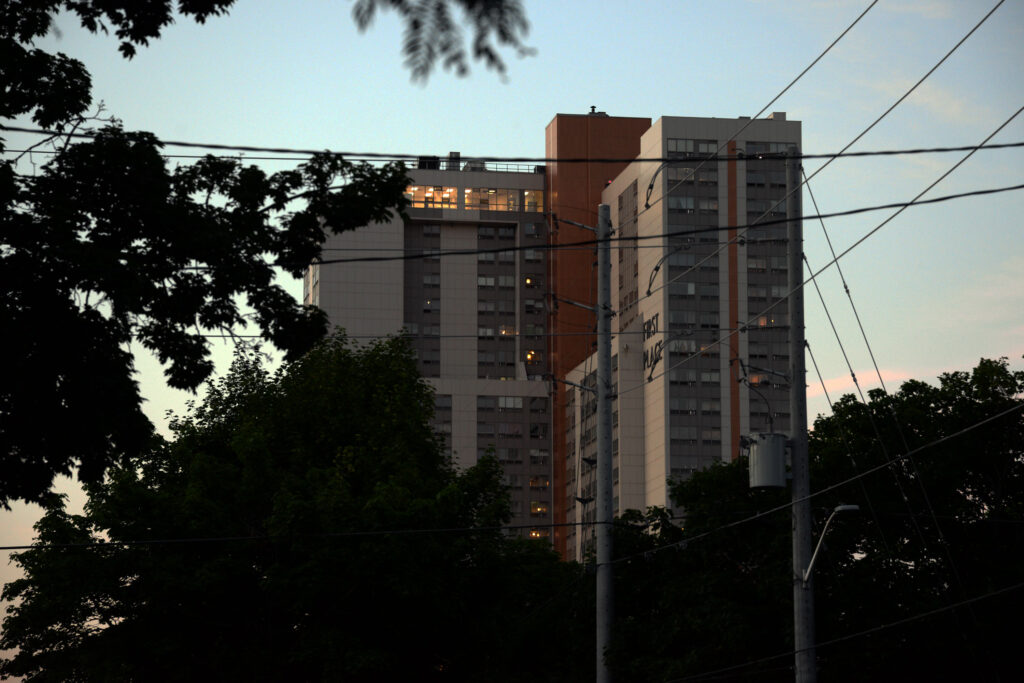
Having only previously seen this nondescript building during the daytime or not at all during the nighttime, it’s brutal charm is revealed at dusk.

Official city sidewalk scrawl. Graffiti is for the horizontal.

With daylight fading, the shoot finishes up in a distant First Place.
1. The Naked And Famous. Punching In A Dream. Passive Me, Aggressive You. 2010.