Repair

It’s worth it, but only if you’re willing to learn how…

This isn’t a sequel, but some of the themes from Reflow are present, though not from the perspective I initially expected. And this isn’t a trilogy, but some of the themes from Austerity are here as well, though again, not quite from the perspective I was expecting. Perspective changes over time—it must.

In revisiting the above posts, I wasn’t sure if they were a suitable primer for what’s to follow—but now, having written what does, they most certainly are. My love of repairing things hasn’t changed at all since Reflow was written, but it would appear my motivations for doing so have. My life circumstance has changed completely since writing Austerity, but it would also appear I’ve come full circle in terms of financial freedom: owing nothing whilst getting nothing is functionally indistinguishable from owing as much as one gets.

As this blog approaches its ten-year anniversary, I am aware of how much my life has changed during that time. What’s written here is only a hint of how time has passed, though—as before—what’s written here has never meant to be the documentation of my life.

These are just stories inspired by me living it.

Anyone who’s ever tried to get something repaired might be familiar with the phrase it’s not worth it when bringing the item to a repair shop. There’s a lot going on in that simple statement, and its meaning will be interpreted differently depending on if you’re standing at or behind the counter. To completely understand the interaction, a crucial and incorrect presumption must be addressed: the intentions of those in this interaction are not aligned. Any perceived alignment comes down to semantics, and that’s the point. But why?

Because of business—of course.

As an aside, if at any time, someone is requesting the conversation not get bogged down in semantics, what they mean is, would you please pay a little less attention to what’s being said. This is either someone who doesn’t understand the meaning of the words they’re using and are upset that you do, or they fully understand the meaning of the words they’re using, but, again, are upset that you do too.

Now, back to the repair shop…

Pretend you dropped your phone and now the screen is chipped and cracked. The display still works, but you’re noticing dark spots and weird lines on it as well. The phone is only a year old and in otherwise great condition, but you know you can’t repair the phone yourself, so you decide to take it to a repair shop so they can repair it. That is, after all, what a repair shop is, correct? A place that repairs things? Incorrect. That place is a business. That place gets money, and, in general, how they get money is by repairing things, but sometimes it’s by not repairing things. This is where the misalignment of intent occurs: your intent is to get your phone repaired; their intent is to get money—your money—and that usually involves repairing your phone.

In the above example, the misalignment of intent goes unnoticed. A screen replacement on a recent phone in otherwise great condition is a quick job: a semi-competent technician can get it done in about an hour and a competent one in about half that time. Shops love quick jobs. Those are the ones that get them the most money: they can preform them over and over again. In this case, your phone is swiftly repaired and is working perfectly, so you happily pay the shop and off you go. Despite it being completely different, your intent is realized along with theirs.

And, not that I want to get bogged down in semantics, but that is the foundational goal of business in general: get money by cultivating a belief within someone else that they have been provided a product or a service in exchange for a payment. Whether or not that payment made any sense or that product or service had actually been provided is irrelevant. Once money changes hands, the job is done. Wash, rinse, and repeat—oh, and speed it up.

If that’s in any way mildly nauseating—that’s business. It’s not for everyone. I know it wasn’t for me. That’s why I quit working at my local phone repair shop less than a month after I started. The trouble was my repair-centric view of the shop: I presumed my job would be to repair phones. Incorrect. My job was to get money. But I didn’t want to get money. I wanted to repair phones.

And that’s been the trouble I’ve faced in every business I’ve ever found myself ever-miserable working at: I rarely get to do what I want. Some would say that’s life. No—that’s business. Whenever I hear someone talking—particularly if their tone suggests restrained fury—about how hard they’ve worked for their business, all I hear is their subconscious awareness of how much of their own life they’ve missed while doing it.

Anyway—back to the pretend repair shop.

Now it’s a few years later. Your phone is still in great condition, but it’s been out of production for a while. Unfortunately, it was accidentally but completely submerged in relatively clean tap water for a few, horrifying seconds. Though it was powered off as soon as it was retrieved, the phone is always trying to turn itself back on due to whatever liquid-fueled chaos is occurring internally. You keep turning the phone off each time it turns on again: what you do know about electronics is they’re not supposed to get wet, especially when there’s power running through them.

This is what happened to me ten years ago with my much-loved iPhone 3GS.

I was cleaning the bathroom and had—for some reason—left my phone in the front pocket of the hoodie I was wearing. When I reached up and across the toilet to get at the shelves above it, the angle was perfect for my phone to slide out of my hoodie and directly into the toilet bowl.

The only positive thing about the entire experience was knowing I’d just finished cleaning the toilet, so I had no reservations about reaching into it to pull my phone out. And even if I hadn’t just finished cleaning the toilet, I would still be reaching into it.

At the repair shop, I let them know what happened. I asked for any water damaged to be repaired, and if that wasn’t possible, for my pictures and any other accessible data to be copied from the phone. My intent was to get my phone repaired, or if it couldn’t be, to get what data could be recovered from it instead. Naïve to the nature of business at the time, I presumed the shop shared in my intent. Incorrect: their intent was to get money—my money—this time by not repairing my phone. After looking at it for an afternoon, they told me it was unstable, they wouldn’t be able to repair it, and they wouldn’t be able to do any data recovery because of its instability.

At the time, I didn’t have an iCloud account as a backup for my data—I was using my MacBook instead. However; any complete backups I’d previously made with the MacBook had been lost due a hard drive malfunction days prior. I hadn’t fixed the MacBook yet, so my PC was acting as an interim replacement—but that meant I wasn’t completely backing up my data the way I used to: it was all on the phone.

The situation was difficult to accept. Over the years, that phone had slowly become an integral part of my life. I was ill-prepared for the emotional reaction I had to its abrupt departure. The intensity of my grief felt as valid as it did irrational.

I knew the phone still worked: they had said it themselves. I asked them—if they could put a price on it—what it would cost to get just the data from the phone.

I was told it wasn’t worth it.

I don’t recall the amount I paid to be told there was no way to repair the phone or recover its data. And I can see now—as I could then—that whatever the amount, it was to account for the time spent by the shop in assessing damage and attempting data recovery, so I was never completely soured by the experience, but I was never completely satisfied by it either.

That evening, despite the phone’s unstable nature, I tried to copy as many pictures as I could from it. With older iPhones, you can plug them into a USB port via the charging cable and browse through any stored pictures and videos directly from the file view of a computer. This is what I was doing, but with the phone restarting throughout the process, it was growing increasingly tiresome to be constantly checking to see what pictures had copied over, retrying what pictures hadn’t copied over, but not retrying too many pictures at once because too many pictures at once caused the phone to restart sooner.

Eventually the phone was restarting constantly. I couldn’t do any more copying. I unplugged it and the screen went blank. There was no response after pressing the power button. Nothing happened when I plugged it into the charger.

At the time, my phone wasn’t the only one experiencing instability, and in a moment of pure confusion, frustration, and rage, I intentionally smashed the phone off the corner of the desk so hard I shattered the screen.

Now it’s broken, I remember thinking as tears burned in my eyes.

Now it’s not worth it.

I regretted my actions immediately, sensing I had committed the ultimate act of betrayal against my electronic companion. My 3GS was gone, along with everything on it. I’d saved maybe a quarter of the hundreds of pictures I knew were still contained within.

Once I calmed down, I sealed the phone in a plastic freezer bag and left it, broken glass and all, for me to come back to with the idea that I would—somehow—try again later.

But later never came.

The remains of the phone vanish into various boxes and totes as I move house, over and over and over again…

Ten years pass.

Everything changes.

Time is change.


It’s later—2023.

For the last year or so, I’ve been watching YouTube videos of iPhone teardowns and restorations in my spare time. I find them relaxing, watching something that’s broken brought back into working condition again. It’s peaceful.

I’m inspired in a genuine way: it’s something I want to learn, something I want to do. A job posting at a local repair shop provides an opportunity to do both. Despite never having opened a mobile phone before in my life, I apply for and get the job.

However—as you know—I don’t stay at the job. I quit, having had my fill of business for the last, and I mean, last time.

But even in my short time there, I know I have learned a lot. I know I still want to repair phones, and I know I still want to keep learning. Perhaps I can try to do both again, this time by figuring out what was previously dismissed to me as unrepairable.

I dig through my electronics totes in storage, and I find my smashed 3GS…

Years of occasional jostling every time I moved house have broken out more chunks of glass from the screen. Parts of the LCD and backlight assembly are visible now. I put clear tape over what’s left of the screen to keep any more glass from dislodging and start disassembling the phone. As I do, I remind myself: though unstably so, it was working even after being soaked.

Was this an issue with one of the many microchips or electronic components on the logic board?

Phones with such fundamental problems usually don’t function at all, and many repair shops will halt work once a board-level issue, as they call it, is suspected. I would need to learn a lot more if that were the case. That sort of diagnostic and recovery experience is honed over months and years, not days and weeks.

I continue nonetheless. Over the next couple of hours, I methodically work through the components, cleaning off signs of corrosion from evaporated water and looking for burn marks from short circuits. I pry off the metal shielding from the logic board, something I assumed the repair shop had done years before as part of their inspection.

But they hadn’t. I can tell. They also hadn’t disturbed the water damage indicator stickers on the screw heads, same for the do not remove sticker over Apple’s sneaky seventh screw.

They didn’t pull the logic board?

As far as I could tell, the display assembly had been taken off, and only some of the logic board screws had been removed, and then, put back—in the incorrect places. There are three different types of screws out of the seven used to secure the logic board in the phone. The shop got two of them mixed up.

Was this the sum total of their investigation and diagnostic work? Did they pop the front off, start disassembly, see the water damage indicators, and then haphazardly throw the phone back together and call the job done?

Now completely removed and bare, I can see signs of light corrosion at various places on the front and back of the logic board. A soft bristle brush, some isopropyl alcohol, a deoxidizing solution, and some gentle, dainty scrubbing makes everything look shiny and new again.

But I also discover a group of components that look quite burned. Situated near the headphone jack, water would have rushed over them first through what’s essentially a giant hole in the top of the phone. According to the board schematics, those components are all to do with the GPS receiver—nothing to do with the core functionally of the phone.

Could that be the extent of the damage?

With all the components clean and dry, everything is assembled back into the phone. I trim the tape flush against the edge of the screen so it will seat correctly and allow the home button to function.

Digging through my old cables, I find an Apple 30-pin dock connector and plug the phone into a low current charger. This an attempt to wake the battery up, so to speak. By offering it just a bit of current, hopefully the battery’s chemistry can be enticed into increasing its internal voltage.

Nothing happens immediately, but these things take time.

I leave the phone to charge overnight.


Back in 2013—there was a problem with replacing my 3GS.

The overwhelming popularity of the iPhone, regardless of the specific model, had kept availability low and prices high for Apple phones. The 5s had recently been introduced and was prohibitively expensive, as well as generally out of stock. The 5c, introduced along side the 5s, was also out of stock, especially due to its reduced price compared to the 5s. The 5, already out of production after not even a year, was still in high demand by those who otherwise couldn’t get a 5s or 5c but wanted the larger form factor offered by the 5. And the 4 and 4s were in high demand by those who did not want the larger form factor offered by the 5.

For everyone else that wanted an iPhone, this had left the 3GS as an attractive option. It wasn’t new enough to warrant the exorbitant prices and limited supplies of the more recent phones, but it wasn’t old enough to be functionally undesirable like the first iPhone or subsequent 3G model. Availability of the 3GS as a second hand or refurbished item was generally high due to the number of others selling their phones or trading them in as part of an upgrade.

Of course, once the situation of this uniquely positioned device was realized, demand for second hand 3GS phones increased, as did their prices. Apple, in one of their many acts of commercial cynicism, anticipated this increase in demand and rereleased the 3GS, but only offered it with 8 GB of memory—they didn’t want to make the phone too desirable. The original 3GS had been offered with 16 or 32 GB capacities, so the prices of those devices, obviously, further increased as their availability decreased.

I didn’t want to spend hundreds upon hundreds upon hundreds of dollars on a new or refurbished current or previous model iPhone. Nor did I want to spend hundreds upon hundreds of dollars to source an acceptable second hand 3GS 16 GB, the phone I was trying to replace.

Instead, somewhat reluctantly, I ordered a factory refurbished 3GS 8 GB from Apple. And, much like how I wasn’t entirely satisfied nor soured by the result at the repair shop a week prior, this purchase felt similarly so. But what arrived a few days later definitely soured me.

As soon as I unpacked the device and picked it up, it felt off. The feel of the materials was different. The buttons shook in the housing. The mute switch was spongy instead of clicky. The vibration motor rattled. The 3GS was once Apple’s flagship phone, the best of the best. The build quality of what I was looking at now was so poor I spent the next few days trying to determine if I’d somehow bought a counterfeit iPhone.

It turns out what I’d bought was indeed a copy of the 3GS, but it was Apple who copied it from themselves. Yes, they had started making the phone again, but they had revised its production at the same time. No longer needing to be a premium offering, everything about its manufacture had been reduced down to a price, and the refurbishment likely handled in much the same way. For something I interacted with multiple times a day, the constant reminder of how cheaply it had been made further reinforced how it was not the same phone I’d used originally—not even close.

Instead, I was reminded of how my phone was gone, and it didn’t matter that this replacement looked like the original: it wasn’t the original. And every time I picked it up, every time I interacted with it, I knew it wasn’t.

…it was the shoes all over again.

There were other things going on in my life and within my mind that compounded the negative association with the replacement 3GS. Over the next few weeks, my daily use of the phone changed: I interacted with it less and less. As much as I pretended to like it, I eventually grew to resent even the sight of it.

Within three months of getting it, my replacement phone found itself alongside the broken remains of the original, the two devices now locked together in a similar fate, moving with me from house to house, over and over and over…

Nearly ten years pass.

And again, everything changes.

Time is change.


It’s morning—2023. I’m awake.

I wonder if the phone I’d left to charge is as well. I push the home button. Nothing.

If the battery had charged, it should wake up the display and show me the wonderfully soft and brilliantly green battery charged graphic—a sight unique to the original iPhones.

I push the power button next.

The display flickers. It’s subtle, but I see it. It starts briefly and stops just as quickly. I try again. Same result. The back light flashes on and then off, now easily visible through the broken screen. The phone wants to start, but it can’t. I disconnect the low current charger and try the power button one more time. Nothing.

I connect up the phone’s original charger and leave it while I make coffee.

When I return, the phone is still sitting with a blank screen. There’s no indication the battery is charging, and my incredibly useful in-line current meter has yet to be ordered. If it were here, this entire process would be far more straightforward. But it isn’t here, so I need to work with what is.

I casually push the power button.

The display flickers as it had before, but this time, it stays on. I feel my eyes go wide. It’s starting. The Apple logo appears.

No way.

Under the tape and broken glass, the display is working just fine. There are some sparkling pixels, but those are likely caused by tiny pieces of broken glass sitting on the LCD panel itself. I’m amazed. But then the Apple logo disappears. The display goes blank again. The backlight shuts off.

I go to press the power button, but the display lights up before I can. The Apple logo appears. The phone is trying again, and then it restarts, over and over again. This isn’t a great sign.

Board-level issue…

No—

This phone was working before it slowly stopped…

Current—the phone is responding to current. The more I offer it, the more it wants to start. I swap chargers to one for an older iPad Air—an anomaly among Apple chargers, rated for 5.1 volts instead of the usual 5.0 volts. It will allow a higher current draw as well. Slowly waking up a battery is one way to bring it back to life. If that doesn’t work, sometimes you can give it a boost instead.

I don’t even have to push the power button.

As soon as I connect the iPad charger, the phone lights up. The Apple logo remains on the screen, and it remains on the screen for a long time. This is different behaviour. This might be—

The screen goes blank and then switches to the Recovery Mode graphic.

No way!

The phone has successfully started, but it’s confused. It wants to be plugged into a computer with iTunes so it can reload its operating system, a usually non-destructive process to user data.

Everything could still be…

I unplug the charger so I can attach the phone to my computer for recovery. The display goes blank immediately. Unfazed, I continue with my plan, initially missing this key clue as to what’s going on inside the device.

But in connecting up the phone and computer, the phone returns to constantly restarting again. The Recovery Mode graphic never returns.

There is a program on my computer that lets me monitor communications between USB devices attached to it, and according to the software, it never sees the phone connect. How can it? The phone restarts before it has a chance. This is why I couldn’t continue copying pictures from it back in 2013.

But why isn’t it charging…?

And then I realize: it’s the battery. The battery is why the phone won’t start. Apple runs power to the phone through the battery first. If it’s deeply discharged, a standard charger wouldn’t be able to supply enough current needed to charge the battery and power the phone, particularly during a power intensive process like starting it—

Or copying a large amount of data from it.

That’s why the phone powered up without hesitation when connected to the iPad charger: there was enough current and voltage available to make the phone think it had a fully charged battery. But as soon as the charger was unplugged, the illusion of current and voltage vanished, along with the only source of power for the phone.

In the same way water likely shorted out and damaged the GPS receiver, a short in the battery management system could have prevented the battery from ever being charged again. The battery chemistry itself could have also been compromised.

The phone’s instability was due to the ever-depleting power produced by the damaged battery. Voltage would drop below specifications under high power loads and the phone would restart as a result. The behaviour would repeat up until there was nothing left in the battery capable of powering anything, and without a functioning charging circuit…

No amount of gentle waking or energetic boosting would bring a battery back from that.

I pull the phone apart again and check the battery voltage: zero. Absolutely no volts. No wonder it wouldn’t accept or hold a charge.

Why didn’t I check this earlier?

A previous assumption highlighted my inexperience: I guessed the battery in my original 3GS would be in a similar state to the one in my replacement 3GS, a phone that—in the most irritating and contrarian manner imaginable—charged up fine and powered on without issue just the other day. But its battery hadn’t been submerged in water and then left discharged for ten years. In fact, its battery was in near perfect—

Without even thinking, I knew what was going to happen next. I watch myself reach across the desk and grab my replacement 3GS, power it off, remove the exterior screws and the SIM card, and start taking off the display assembly with a suction cup.

Apple uses what can only be described as an excessive amount of unnecessarily strong adhesive to make sure its batteries do not somehow fall out of place while sealed inside a completely nonremovable rear housing of a fully assembled phone that’s also been screwed shut. As I don’t want to damage the rear housing of either phone by trying to swap the batteries, I’m not going to. Instead, I’m going to scoop out the insides of both phones and put my 3GS components into the rear housing of the replacement 3GS—the one with the functioning battery.

With the logic board transferred and the display assembly reattached, I close up my now hybrid 3GS, connect it to a USB cable, and pause for a moment before plugging it into my computer.

I’m nervous, incredibly so. For some reason, I expect the phone to erupt in a shower of sparks and smoke now that it has access to a fresh battery to destroy.

But I remind myself: this phone did fine with the current it drew earlier. No sparks, no smoke, no problem—so here it goes.

I plug the cable in.

The display lights up. The Apple logo appears. Now I’m waiting for the Recovery Mode graphic to display. I’m waiting for a long time. The Welcome to iOS 6 animation plays instead. I’m perplexed. This is Setup Mode.

The phone asks me what language I speak and what country it’s in. Despite all the tape and broken glass, I’m able to use the touchscreen just fine, so I tell the phone where it is and how to understand me. Then it asks for a wireless data connection as there is no cellular service available. I enter the Wi-Fi password. The phone connects and tells me it’s finished with setup.

I’m hesitant—the phone is behaving like it’s been factory reset, and that is a destructive process to user data. But up in the top right corner of the display I see something unexpected: the alarm icon. The phone knows it has an alarm set.

Could it be…?

Before I can piece together what’s happening, I am caught again in an emotional reaction I am ill-prepared for. My lock screen wallpaper appears.

To be honest, I’d forgotten what it was, but I feel the sudden recollection, the reconnection to another life that was once my own, the flood of memories and thoughts from a different time—I feel it all.

Is everything…

I unlock my phone. All my customizations and application icons appear just as they did. As far as my phone is aware, I’ve just turned it off and on again. Everything is as it was.

No time has passed.

Nothing has changed.

Holy… shit…

I did it.

I check the photo gallery. All my pictures are there. Though I’m confident the phone is stable, I also don’t want to waste the opportunity I have: I start transferring the image files to my computer immediately. Each one copies without any issue, without any hesitation, without any indication of instability. The time the phone would have restarted at least once has long since passed, and I can see the charging icon beside the battery life indicator.

Once the transfer is complete, I notice the last item copied over is a completely black PNG file. Its resolution matches that of a screen capture, something older iPhones will do if both the power and home buttons are pressed at the same time. During the brief moments the phone was submerged, water may have bridged the contacts for those buttons, triggering a screen capture of the display when it wasn’t displaying anything.

If that’s the case—and I’ve since confirmed that it was—the remaining life of my 3GS was forever altered on November 20, 2013 at 1:02:54 PM.


I never imagined I would ever see the phone working again, and I never imagined it would be me who’d make it happen. But it also makes perfect sense: I was the one responsible for damaging it…

What doesn’t make sense is what happened in the backroom of that repair shop in 2013.

I know I’m a bit predisposed when it comes to electricity, electronics, and technology, but I also know I only have a few hundred hours of observational experience and less than one hundred hours of practical experience when it comes to phone repair. I make no claims to my expertise, only to my perseverance. I was guided mostly by my own good fortune—call it beginner’s luck. I’m not trying to diminish what I accomplished: I’m absolutely proud of what I did and what I learned while doing it.

But from a bigger picture perspective, I still know fuck-all about fixing phones. So why could I achieve in hours what the repair shop deemed impossible?

Because it wasn’t impossible—it wasn’t worth it.

I misunderstood the shop’s intent. I misunderstood the shop when they told me it wasn’t worth it. They weren’t looking out for my financial interests. They were looking out for theirs. They were saying it wasn’t worth it to them. The hours I spent doing the investigation, cleaning, troubleshooting, and housing swap that would result in my 3GS working again were mine to spend freely. It was an exercise in applying what skills I had acquired to see what would happen. I wasn’t trying to get money. I was trying to see if could do it.

Those hours, had they been spent by the shop, would represent hours they couldn’t spend on the assembly line style of repairs that get money. Why would they elect to perform difficult, unknown work when there’s easy, known work available instead?

Imagine some kid pulls up to your shop in a slightly rusty Subaru with a giant wing on the back, brings in an out of date, water-logged iPhone, and requests quotes for advanced repair and data recovery? That’s a low to no-margin job at best. You don’t actually want that job, so charge them for taking a look at the phone, but spend no more than a few minutes if it looks like it will be time consuming work. Charge them for attempting data recovery, but halt at the slightest indicator of difficulty. Keep the phone for a few hours to give them a sense of some work being be performed, and then when they come to pick it up, tell them there’s nothing that can be done.

Make it seem like it will be far, far too expensive—mask your misalignment of intent.

Bury it in semantics.

Make it seem like it’s not worth it to them.


With all my pictures copied over, I completely relax. Those are what I wanted. Everything else is a bonus.

I open up my emails. Everything is there. I open up my messages. Everything is there. All my contacts. All my notes. All my music. All my playlists. Everything is complete. I am delighted.

A system dialog box pops up: multiple email servers are rejecting login attempts. They are for accounts I no longer use. Some of them no longer exist—actually, none of them exist any more. I look through the subject lines of my old email messages. They are conversations from then, about things that are no longer happening, events that have long since come and gone—things I haven’t given any thought to in years.

I scan through the names of those I was messaging at the time. Through various circumstances, I no longer have contact with many of them today, almost all of them now that I think about it.

Friends come and go, but I also know one of them isn’t alive anymore…

There is contact information for coworkers I’d forgotten I had, the names of supervisors from jobs at previous companies I don’t care about anymore. There are the details of those I used to live with and those I used to go camping with. My many friends, their many friends, even some of their families. And then my family, both small and large—though lately, getting smaller.

In my pictures, there are forgotten scenes from my home in Scarborough: pictures from events and trips, parties and quiet moments—the many entities I remember that no longer are. I see my old relationships, friends, family, dogs, cats, animals, cars, landscapes: all the signs I paused to regard and laugh at along the way, all the sights I’d looked upon with such amusement, curiosity, and fascination.

I had grown to finally love my life there—

That the data in the phone were of great importance was an idea I carried with me for weeks and months—even years—after it was damaged. But in looking through it all now, I realize this importance had acquired its own mythology.

In the time since, as new things became important to me, I recalled thinking less and less about it—until I wasn’t thinking about it all. It was only during times of change, when I had to pack up and move somewhere else, when I would inevitably come across my box of disused electronics: I would see my smashed phone among other relics. It was only then when I might give pause for what was, what happened, and what could have been.

So, I have to wonder now—was this ever about the phone?

As I look though my 3GS, I realize it’s filled with echoes—filled with ghosts. Some of them are mine; some of them are others. But I also realize, one way or another, I’ve been carrying them all around with me, in my mind and in that phone, ever since I smashed it to pieces, hid it away, and slowly forgot about it. The phone, its data, its fate—it all had become a metaphor, a metaphor for me, a part of me, a part of someone I was.

…A part of someone I still am.

I find myself ill-prepared for the emotional reaction surrounding the opening of this time capsule.

It’s only now that I know what I didn’t then, but in 2014, about eleven months after that November afternoon, I will be driven from my home among the trees; my home beside the ravine; my home near the lake. It will be by my own doing, by my own sense of it not being worth it—the it in this case being me. So damaged I will have become by my own failure to seek repair, I will intentionally destroy what is left in an act of confusion, frustration, and rage.

Everything will change.

Time is change.


Today—it’s November 20, 2023.

With no sense of sorrow, remorse or regret, nor feelings of relief, elation, justice, or even closure—just the awareness that I am doing it—I start deleting data from my 3GS.

The emails on it were just local copies of what has always been kept on a remote server. Though the accounts the phone tried to access are no longer used, any emails I wanted to keep from that time I already have copies of from when I closed the accounts.

All my old txt messages are records of conversations I’ve long since finished having. Some of them are conversations I would never have again. Some of them conversations I maybe never should have had at all. Some of them, I’m aware, I never got a chance to continue. And some of them were abruptly cut short. But some of them, some of them I’m still having. Either way, I delete them one by one.

I remember being upset over losing my notes, but as I scroll through them now, I don’t understand why. Most of them are of what episodes I’d watched up to in television series I’ve either completed or forgotten about; music I wanted to track down and listen to that I either did or didn’t follow up with; and a collection mental nonsense, made up of clearly half-baked conspiracy theories, musings on the nature of the universe, and ideas about particle physics. Any of the most interesting of them are ideas I’ve since written about or have integrated into my thoughts. Some of them ended up being notes again, only with pencil and paper instead. And, much like I’ve said goodbye to those paper notes one by one over the last few years, I say goodbye to the ones on my phone as well.

The only note I consider keeping is this simple observation on the absurdity of my life in general, a reflection of my existence at the time:

I don’t mind being poor because it gives me time to enjoy stirring up a new jar of peanut butter.

But I delete it anyway. There’s no need to save it because I’ve never forgotten it. There have been many, many jars since then, and while it’s not every jar, I have often remembered that thought and that sentiment as I stir.

The only data I’ve kept without any question or review are my pictures, even the ones that are difficult to see again. These are my memories. As part of their recovery, they will be integrated along side all my other pictures with all my other memories. They will fill in some of the gaps within my photographic and mental timeline. Like any of my other pictures, the ones I like to look at, I will seek out. The ones I don’t, I won’t. Sometimes I might not have a choice, but that’s how my pictures work. That’s how my memories work. They come and go, and sometimes the rough ones crop up among the beautiful ones. They are all linked together: if I tug on one, I tug on them all—if I try to forget any, I risk forgetting the rest.

Now all that’s left is the nearly 12 GB of stored music and associated playlists still on the phone. The music files I never actually lost—they were just copies of what I already had saved on my computer. But I remember being sad about the playlists.

I had created them using the Genius music matching service built into iTunes. Each playlist was associated with various moods and activities and was expressed through my entire music collection at the time. While not quite as intensely associated with my memories as my pictures, these playlists represent a synthesis of lyric and tone I used to relate to times and places—my themes.

There was music for driving, walking, and partying. I had music for when I was writing, or drinking, or smoking. There was music for moods I was in and moods I wanted to invoke. My house was filled with speakers, so my home was filled with music, and I could play it all from my 3GS.

I plan to keep the music and playlists as they are on the phone, turning it into a historical iPod: any time I feel like visiting Scarborough circa 2012 through 2013, I can stream a playlist to my home stereo now.

Just like I used to then.


With the data sorted, my attention turns to my 3GS as it exists today: a collection of parts—the smashed and broken display assembly from the original phone with its logic board surround by the rear housing and battery from the replacement 3GS.

My sense of continuity suggests it would be fitting to leave the phone it as it is, since that’s how it ended up. But maintaining such a linear and simplistic view does not feel entirely accurate or complete, or even appropriate, in this situation.

Once more, intent informs me as to what happens next. I wanted to see if I could get the phone working again. I could, and I did. I wanted to see if I could recover any data from the phone. I could, and I recovered it all.

But in terms of intending to repair the phone…

I’m not sure if I could consider the phone as it is now as being repaired in the strictest sense of the word: its screen is covered in tape; the glass is cracking, small pieces of it are missing, and tiny pieces of it are on the LCD panel; parts of the backlight assembly are visible; the rear housing is mismatched to another model; in my swiftness to get it all reassembled, I didn’t put the camera back in; and the metal shielding for the logic board is sitting in a pile beside the phone along with the remaining interior and exterior screws.

This is not how the phone was, and if the origins of the word are explored, the idea of a return to place, to state is foundational to the concept of repair.

In the past, this idea of place was an actual location, a state in the national sense of the word. The concept is now better expressed in the word repatriate. Now the ideas of place and state within the origins of repair are free to take on new meaning: place could refer to a time, state could refer to a configuration—or perhaps some combination of the two.

I owe my 3GS the opportunity to be returned as closely as possible to the state it was in before I drowned it and before I smashed it—a token of apology for having first accidentally and then deliberately damaging it.

To do that, I’ll need a replacement battery and replacement display assembly. And what better source for those parts than a namesake phone that’s been here the entire time, my replacement 3GS: finally able to fulfill a purpose I did not previously understand. It was never meant to replace my 3GS—it was meant to repair it. So it will.

And I have.

I like the way this outcome feels. There is a symmetrical quality to the result. No longer linear, the paths of these two devices loop and intertwine, one returning the other from the same, forgotten state, from a place of no time.

Both phones will now continue on together.

Every thing changes.

Time is change.

America

The Divided State Of

The temptation to digitally pen a strongly worded rebuke of conservatism and its divisive nature is strong, but I’ve already written about it. I also have no suitable frame of reference in this case. Though there are some areas of overlap, conservatism in America is not the same as it is in Canada. Besides, now’s moment is about progress—at least in theory. In practice, the clear and 81 million vote mandate for progress in America is complicated by the static inertia of almost 74 million Americans who—given the choice—decided progress was better embodied by an arrogant, ignorant, sexist, bigoted, racist, traitorous, white supremacist.

It’s important to acknowledge the voters who indeed voted for Trump. But it’s also important to acknowledge some of those voters were actually voting for not Biden. It’s a subtle but meaningful distinction: these are the voters who will vote for anyone—Trump, Dr. Octaviusas, a heteronormative dumpster fire, a half-eaten sandwich—as long as he’s not a Democrat. These voters won’t necessarily not vote, but their intention is more about prevention than participation. Their level of civic engagement follows suit, ranging from arm’s-length indifference to face-painted fanaticism. A similar situation exists on the other side, but with far less TV-friendly flare or flair. Biden did receive the most votes for any presidential candidate in the history of America, but some of those votes weren’t for Biden—they were for not Trump.

These not votes are symptomatic of a winner-take-all electoral system approaching the end of its serviceable life. As it runs its course, the system produces the illusion of majority rule as it converges on a two-party and eventually politically deadlocked state. Sound familiar?

A similar scenario is developing in Canada, and the results are just as distorting when it comes to indicators of progress. It probably wasn’t Trudeau who was elected in a landslide in 2015: it was more likely not Harper. Jump ahead four years and the results are just as distorted: not Scheer forms a minority government while not Trudeau wins the popular vote. But again, I’ve already written about it…

Initially confounding on the surface, and overlooking a worn out electoral process, the result of America’s 2020 presidential election makes more sense if one allows for an uncomfortable premises: America as a whole is still not as progressive as it might look. While the United States has embraced pockets of progress before, the level of resistance during the lead‐up and obvious begrudgement after the fact risks trumping any apparition of an entirely progressive nation.


US and Canadian politicians usually refer to their respective nations as being friends. I’ve always found this analogy to be overly simplified and slightly patronizing. Friendship implies certain levels of similarity, camaraderie, solidarity, and reciprocity exist between two or more entities. I don’t often see those qualities in the proportions I would consider befitting a friendship, not in the sort of friendship I would want at least. Personally, I view the two nations as neighbours—because they are. It’s ideal to have a good relationship with one’s neighbour, and certainly a friendly relationship helps as well. But a neighbour isn’t supposed to start building rooms in the other’s house, or try to take it over entirely, so it’s important to know when to draw the line with the relationship. And as far as the US and Canada go, that was in 1775, 1812, 1818, and again in 1846.


I’ve met a few people from all over the United States, people from New York, Pennsylvania, California, Washington, Florida, Michigan, Illinois, New Hampshire, Missouri, Oklahoma, and Nevada. Both of my brothers are married to Americans, so now I have family from Colorado and Ohio. And I’m directly related to Americans as well: I have a grandmother who was from Minnesota and ancestors who were from Pennsylvania.

As a child, I remember travelling across the norther boarder states, through North Dakoda, Idaho, and Montana. My family would also sometimes make trips from British Columbia to Spokane, a city in Washington state.

I’ve been to a few places in the United Stats as well, places like San Jose, Chicago, Pittsburgh, Buffalo, Philadelphia, Orlando, Jacksonville, and Washington. I’ve also passed through countless other American towns and cities—Scranton included—on my way to other places, most notably on a grand road trip to and from Florida with stops in Richmond, Cocoa Beach, Charlotte, and Philadelphia.

Despite all this American experience, and I do wonder now if I’ve seen as much of Canada as I’ve previously thought, I know I’ve only experienced a fraction of what America is. But despite having experienced only this fraction, I know America is a land of extremes. America is always turned up to ten, something I’m saying both literally and metaphorically. Its population is ten times that of Canada’s. It’s a magnitude of scale captured in America’s relative successes and failures—a simultaneous state of inspiring awe and terror, a nation of beautiful horrors.


I was driving west through northern Ohio many years ago. It was near the end of a midsummer day, and I was nearing the last quarter of 1200 km trip around Lake Erie via Pittsburgh. The light of the sunset was bouncing off some of the taller buildings in distant downtown Cleveland. Linkin Park’s The Little Things Give You Away was playing through the car stereo. I think it was the first time I had ever heard the song after listening to it so many times before.

Perfect moments are fleeting, their criteria impossible for me to define. All I know of them is when I’m in one of them—and I found myself in one of them on whatever mile it was of whatever unending interstate highway it was while a far away sadness gently filled my eyes.

...Hope decays
Generations disappear
Washed away
As a nation
Simply stares...

Little things are harder to script, and I think that’s why they stand out in my mind more often and with more impact than the most choreographed interactions I’ve had with others. I used to ask a lot of questions as I got to know someone, but questions are tricky. Answers are easily scripted once the question is asked. Now I ask very few, preferring instead to watch and to listen, to see which words match up with which actions.


Earlier that day in Ohio, in the parking lot of an amusement park, some of my local travelling companions found out I was driving a rented car. They wanted to know why I wasn’t driving my own. At the time I didn’t have a car of my own, so I told them as much. They wanted to know how I got around without one. Other than renting one when I needed one, I also at the time I lived in downtown Toronto, where there was public transit all around me. I told them as much again.

“You live downtown and don’t have a car? Are you poor?”

It was at this point I asked about the numerous signs reminding patrons not to bring guns into the park. I wondered aloud if this was an ongoing issue, and that if someone should somehow accidentally bring a gun with them to the park if they were just supposed to leave it in their car.

“Well, yeah…” was the response. “Where else would you leave it?”

Where else indeed.

“Are there guns in your car?” I asked, point blank.

“Just one.”

A few weeks before then, someone I knew had a friend visiting them from Minnesota. He made it a point to mention how strange it felt to be unarmed while in Canada. I took the bait, mostly because I didn’t feel strange to be unarmed anywhere. As it turned out, not only would he have been armed with a handgun whenever possible back home, he had a concealed carry license. As a concept, a private citizen being able to legally carry and conceal a handgun in Canada is so restrictive it may as well be prohibited, but I took the bait again and asked why he had a concealed carry license.

“Because it’s my right as an American. It’s part of my freedom.”

Fair enough—but I couldn’t help but wonder if the same righteous attitude toward freedom was in any way responsible for him having been denied entry into Canada just days prior.


One thing gleamed from my American experiences is the variable and strange relationship its citizens have with the concept of freedom. It can be interpreted quite differently, viewed as something one possesses rather than respects. Freedom is viewed in granular detail on an individualistic level—its roll in the broader community an occasional afterthought. Its application can be highly contextual despite its claim of universality.

As applied in daily life, American freedom expresses itself through amusing and generally benign cross-cultural exchanges, such as when I was buying a noticeable amount of American breakfast cereal to bring back home while I was in Buffalo. The cashier wondered why I was getting so much at once, so I told her I was just visiting and picking up the kinds I couldn’t buy in Canada anymore. She stopped mid-scan, put down one of the boxes of chocolate frosted Lucky Charms, appeared to brace herself on the counter with both hands, and looked me dead in the eye.

“They took your cereal away from you? I hope you did something about that.”

I hadn’t, other than to cross an international border to get some more. But I think about that exchange almost every time I see breakfast cereal at the store. It never fails to crack a smile, the idea of a total stranger in another country standing at the ready to champion my sweet, sugary freedom.

The expression of American freedom in other cases is more sinister, speaking to a hypocrisy still hung over the heads of millions of its own citizens. A friend of mine returned from a conference in Nashville. She’d had a wonderful time, but relayed an odd experience she had as well. The conference was over, and she’d gone out to do some shopping at a mall near the convention centre. She was finding all sorts of great things and commented to one of the store employees on how much she was enjoying the selection. The employee looked curiously at her, and asked if she was from out of state—not from out of town, out of state. My friend said yes, that she was visiting from Canada, from Toronto. In the most matter of fact way possible, the employee responded.

“Ah—yes. Look—if you start to feel uncomfortable, the white mall is just a few miles up the road.”

My friend told me at no point did she feel uncomfortable where she was—until it was suggested that she might be. I think about my friend’s exchange almost every time I find myself in a place where there are only white people, and I find myself uncomfortable every time I do. After over twenty years of living in the Toronto area, I’m accustomed to seeing everyone everywhere. I notice when everyone isn’t. The guy from Minnesota with the concealed carry license noticed everyone when he was here as well, but he added his own, bizarre spin.

“You’ve got, like, no Mexicans here—and way less Black people.”

I really wasn’t interested in finding out what he meant, and I never saw him again after that. He ended up going back to Minnesota. Weeks later they pulled his rolled SUV out of a river. He barely survived because he wasn’t wearing a seat belt, something he never did, and something he was ticketed for not doing twice while visiting Toronto.


Meanwhile, back in Ohio, and the next day, in Sandusky, I was looking to buy a road map—yes, this was a while ago. I found some for sale at a corner gas station, in a rotating metal display frame, beside the beer fridge. The 4th of July weekend was approaching, and on the way out of town I noticed how understandably patriotic the streets looked. But there was a growing sense as I drove past flag after flag after flag that most of these flags hadn’t been recently put up and most of them wouldn’t be coming down. I don’t want to say there was a fascist amount of flags, but that I found myself wondering if there was spoke to the tone of their unending presence. Then again, back home, I find the flying of a giant Canadian flag over a big box retail complex to be a bit much. The lack of any sign reminding me to leave my gun in the car is all I need tell me where I am.


What happened at the United States Capitol earlier this week was upsetting, but it wasn’t surprising. It’s disheartening to say it was inevitable, but after witnessing a president who either sidestepped or slaughtered any traditional expectations regarding presidential obligations, I didn’t see why a peaceful transition of power would be treated any differently. Writers are sometimes claimed by others as being able to predict the future. I tend to think of it as merely being able to recognize a plot, understand its characters, and then follow the plot through to a reasonable conclusion, no matter how unreasonable a conclusion it may seem. Any future is possible, as long as it’s possible to imagine that future and understand how to get there—on paper at least. Off the page, especially when multiple authors are involved, crafting a counter-reality narrative can produce plots which are inherently unstable, and they can grow dangerously unpredictable. Results can be deadly.

And they were.

What happened in Georgia, in the United States Senate run-off elections, simultaneous with the US Capitol riot, was a display of inspired, hard-fought progress, a strong statement made against a precarious yet persistent counter-reality narrative. It demonstrated the power of a correctly authored story, the resiliency of what is genuine against what is concocted. It was beauty among horror.

It was America.


This post has always been a bit of a split decision on what direction to take it in, a fitting state as I started working on it a week after the American election. Though the election was over, it also wasn’t. In what otherwise might have been a standard set of run-off elections after the fact, two US Senate seats in Georgia became just as important as the presidential election itself. The structure of American government appears, to me at least, to favour blending power as it balances it. Ideally applied this results in bipartisan cooperation, but when cynically manipulated it stalls progress for years. Some of this cynicism crept into my own head—the post suffered: America had constructed and then backed itself into a well-deserved corner.

But as the run-off elections approached, as the formal peculiarities of the US constitution confirmed what had already been apparent for months, it felt like I could complete this post no matter what the result was in Georgia, because no matter the result, America would still be a deeply divided nation. That said, I am deeply pleased the result in Georgia is what it was. Division is far easier to heal when it is seen rather than seized, so I rewrote the entire post as something more reflective than conclusive.

During the time I started the rewrite and my checking on the Georgia results, the Capitol building was overrun. It was a surreal and eerie sensation. I had just been working on the photograph for this post’s featured image, a picture of the Capitol rotunda from when I visited in 2011. I had been remembering the quality of the light as it moved from surface to surface, the soft echoes of voices and footsteps on the stone, even just recalling the immensity of the interior volume alone—it was a quiet memory of a peaceful place. To then be jarred while in such a place, to have it violently filled with confusion, fear, and hatred—all of it vibrating and reverberating off the same surfaces I had been with just moments before—it felt like an insurrection against my own mind. It was awe inspired terror.

I realized I needed to rewrite the rewrite.


Progress is never easy, but as I’ve understood it, America’s never been about doing things because they were easy. And I can’t help but wonder if my fondness for that famous sentiment stems from what it inspired in the Unites States then or what it inspires in me now. In rewriting this post three times in the last few days, I’ve found myself with renewed awareness of my many connections and many memories with the United States. Perhaps I’m better friends with America than I thought. But I’m also aware whatever friendship there might be has become strained and fragile by a divided state. Genuine actions are required to begin the repair. And I’ll be watching for them—though, admittedly, from a distance at this time.

Up until recently, I’ve always had the luxury of experiencing America outside of itself along with isolated and somewhat controlled internal exposure. In that respect, the relationship has felt quite ordinarily neighbourly. But I’ve felt America’s fights from my house—I always have. I’ve heard the screams and the shots. I’ve seen the smoke and the fire. The entire neighbourhood has. The only temper to the rage and sorrow I feel toward my neighbour is a recent promise of progress made this November past, a promise that’s been reaffirmed multiple, multiple times since then.

But America will face a familiar obstacle when it comes to keeping this promise: itself—a nation of many and one simultaneously. The monumental undertaking of America is spelled out in its own name: it’s not the United State, it’s the United States. The plurality matters, and it must find expression. There is no one, correct way to be American—unless that one way is not divided.

Recovery

The only way out is through.

The hardest part of depression is recovery. Being depressed is actually incredibly easy—and I know you’re not supposed to say that, but it is. By the time recovery is necessary, being depressed has become second nature: wash, rinse, spin, repeat. It’s all down to how long one has lived with a simple deception: this is fine. The subsequent isolation of self is a consequence of this deception. Others on the outside might be less inclined to believe the lie, so they become subject to distraction and schism, just as the self endures. In the end, one has slowly become their own abuser, a link in a chain of trauma forged by the same fraud: this is fine.

Like a bully, trauma must eventually be faced. Trying to work with trauma anonymously perpetuates what’s already known to be untrue, though this knowledge doesn’t halt initial attempts at dialog—that’s how you’ll think of it at least. But it’s all part a budding relationship subservient to trauma. In the absence of confrontation, trauma consumes those around it. Trauma defines the lives and dictates the relationships of all who enforce and invite its presence by allowing it to grow through inaction. Denial begets subjugation as trauma is forced upon others. Life transforms into the lie: this is fine.

“The distinction between protecting the addiction from the truth or the life from the lie is meaningless because it all starts to look the same. The entirety of your existence becomes isolating everything that’s not the addiction from everything that is—including you. Once you can lie to yourself, once you can believe it, the rest is easy: you go away. The addiction is all that’s left.”

I wrote the above about four and a half years ago, in April of 2016. Now I’m struck by how effortless it is to substitute the word addiction with the word depression and have the text still capture the same disparate circumstance. The concept of addiction and depression describing the same thing seems ludicrous, but these concepts—traditionally viewed as distinct—so often exist together the exercise of determining a cause and effect relationship between the two starts to seem just as ludicrous. The resulting behaviour is the same act.

Recovery starts when the lie can no longer be sold. This is fine is revealed to be what it has been all along—incongruous. Life changes. It isn’t fine anymore. It never was. But there is no feeling of liberation from the lie because there’s no feeling left other than numbness. It’s one of the most difficult feelings to bare because of its implications as an emotional fail‐safe. Numbness has taken the place of awareness because awareness has become overwhelmed by the presence of absence.

The worst part of recovery is when your dreams return—because you’ll realize at one point you stopped having them and didn’t notice. And it’s not just the sleeping dreams either. Wonder, hope, anticipation—the waking dreams of inspiration and imagination—they all were disappeared by depression. The part of you that never stopped dreaming returns from oppression in a state of strange elation, a mix of joy, of rage, and of potent sorrow.

You left me there alone.

The next worst part of recovery is when your memories return—because, much like your dreams, at one point you stopped having them and didn’t notice They’re all still there, but depression has placed so much distance between you and them that they feel like the memories of an approaching stranger. There is a certain horror to the experience: the approaching stranger is you.

You left us there alone.

This is the most dangerous part of recovery. The intensity of emotional experience brought on by the building pressure of intense dreams and forgotten memories is becoming unpredictable. Stability is at risk. The need to return to a more familiar numbness is strong and fuelled by shear terror. A growing shockwave is consuming your narrowing path. The only way out is through.

But I don’t know if I’ll survive.

Welcome to the paradox of recovery: you’re not going to survive, not as you are at least—and I know you’re not supposed to say that either.


This was going to be a story about using an airplane to reach the speed of sound, but another story appeared when I started working on it, a fear‐induced cockpit confessional, as it were. It’s the second time this other narrative took hold of something else I’ve been writing. There’s a draft post about my trip into the mountains while I was in Iceland—it detoured in the same way. I was recalling the memories of one the most beautiful places I’ve ever been, yet eventually all my words could muster was darkness. I couldn’t proceed. It felt like I was polluting a serene place with outside noise.

I started this post instead, a purposefully more technical exercise, but the words from the mountains appeared to follow me, materialized in front of me, seemingly out of thin air. This time I let them take shape and watched them take flight. The words hadn’t worked on the ground. They needed to be in the sky, up in the clouds. That’s where they were from. That’s where they lived. It’s no wonder they found me in the mountains.


Through air, the speed of sound is about 1,235 km/h or 767 mph—it fluctuates depending on air temperature. The piston engines used in propeller planes of the late 1930s couldn’t produce the necessary thrust to get anywhere near the speed of sound during level flight. Pilots would perform power dives to compensate: they’d climb as high as they could, rev the engines as high as they could, point the nose of the plane down at an extreme angle, and hope they’d be able to pull out of the dive as the ground inevitably came rushing up. Violent turbulence resulted as the plane approached the speed of sound. The flight control surfaces of the aircraft wouldn’t function as expected. Inputs would suddenly have the opposite effect before swapping back just as suddenly. Corrections were not intuitive and would often make things worse. Sometimes the controls wouldn’t function at all. There were many crashes, injuries, and deaths. It would take nearly another decade of research, development, and experience before the implications of supersonic flight were properly translated into aircraft design.

In the meantime, the idea of a sound barrier had formed in the minds of engineers and pilots alike, and understandably so: what they were undertaking, in retrospect, was an impossible task.

The best they could do with what they had at the time was get dangerously close to the speed of sound. Without getting into too much detail, sound and flight are related: they both result from changes in air pressure. The way air pressure changed around an object moving through it near or at the speed of sound was drastically different than at slower speeds. Without a reliable way to safely maintain the faster speeds needed to understand how drastically different, it was all rather like learning how a parachute worked while falling to Earth without one. More powerful piston engines wouldn’t necessarily help because once the rotating tips of the propeller blades approached the speed of sound, the propeller wouldn’t produce as much thrust as when it was rotating at slower speeds. The historical use of the term sound barrier brought to mind something physically in front of the plane preventing it from reaching the speed of sound, and looking back now there actually was: the propeller itself.

It wasn’t until the development of the jet engine that planes could easily approach—and critically, exceed—the speed of sound. Power dives were no longer necessary. Meaningful data collection could occur during sustained and level flight. Aircraft design rapidly evolved in turn. The shapes of the wing and body were altered. New control systems were developed. Flights of prototype designs revealed the increasingly unstable nature of the aircraft as it approached the speed of sound would dissipate once the speed of sound was exceeded. The key was not to linger near or at the speed of sound itself, but to advanced past it. Subsequent designs further rendered the transition from subsonic to supersonic flight a nonevent, barely noticeable to pilot and eventually passenger.


I didn’t know this when I was up in the mountains back in Iceland, but I wasn’t far from a place called Krýsuvíkurskóli—or Krýsuvík School in English. Proposed in 1967, and in connection with the Church of Iceland, the building was originally to be used as a boarding school for teenage children who did not “fit in” with their peers. Isolation was the contemporary approach to treatment; however, upon completion of the project, as the website notes, it became clear that people’s ideas about upbringing and schooling had changed. Investigation, adaptation, and integration were now the preferred approach, so a building out in the middle of nowhere capable of housing about 60 people was no longer necessary. It sat vacant for years.

Falling into ill‐repair through disuse, the building was later sold to a group who refurbished the structure. Now it’s used to support young adults recovering from the trauma of drug and alcohol addiction. The building’s location surrounded by the natural world is combined with progressive therapy and compassion. The facility has one of the highest success rates in Iceland.

And I also didn’t know this, but I ended up getting a picture of the building as part of a mountain view when I was leaving the area.

At the time I assumed it was one of the support buildings for the many power plants found throughout Iceland’s landscapes. And thinking about it now, I suppose it still is.


What happened? Where am I?

You’re okay. You’re on the other side of the shockwave.

And you are something new. Something improved. Something better. But also—still you. The turbulence is fading and things are settling. It’s quieter now—peaceful by comparison. Everything is familiar, but everything is a little different at the same time, as if there’s space where there wasn’t before. The sky is filled with good air, and there’s nothing in front of you. You can trust your craft again. The noise and disruption that’s past can no longer keep up, can no longer catch you. Keep pushing the throttle forward.

Almost there…

Silicon Based Lifeforms

Remember: be nice.

The first computer I distinctly remember operating was a Commodore 64. This would have been when I was in Grade 2, which was—somehow—more than 30 years ago. They are fleeting memories, the ones I have about the C64. Vague recollections about specifically typed commands and slowly loading programs. Mechanical sounds from a disk drive ticking and growling away the time during indoor recesses when there was inclement weather. I don’t much remember using it for anything else.

It wasn’t until Grade 5 I recall any specific computer‐related activities. My class would go to library to learn how to type on the IBM Model 25 PS/2 machines in the school’s computer lab. By then there was a computer in my family’s home as well—a near perfect copy of an IBM XT—only instead of the traditional monochromatic green screen, this one’s was orange.

By Grade 6 I was living in British Columbia. The machine of choice in my school’s computer lab was the Amiga 500—considered by some to be an indirect descendant of the C64 I’d used only a few years prior. The computer in my family’s home had changed as well. It was brand new, and its colour monitor and advanced display adapter generated a dizzying rainbow of up to 256 colours. It had a mouse to make use of the latest version of a graphically‐based operating system assistant called Windows. And while the rest of the computer’s specifications are more than humbled when compared to today’s computers, at the time they represented some of the most advanced technology available to consumers.

For Grade 7 I was in a different school with different computers in its labs. This is where I was introduced to the Macintosh and Apple ][ platforms—incidentally, this would have been during Apple’s earlier years when the company was more concerned with producing interesting computers for people rather than obscene profit for shareholders.

My fondness for the Macintosh Plus machines used throughout Grade 7 & 8 also introduced me to the idea of a peer‐driven computer platform rivalry: PC or Mac—which was the better computer? To me the entire exercise seemed as trivial as arguing over if a hammer or a screwdriver was a better tool. And to me it seemed more advantageous to know when and how to use either tool rather than trying to turn every problem into a nail and declaring the screwdriver pointless.

By the end of high school I don’t remember the specific makes or specifications of the computers at school. The hardware running the Windows platform had become so widely available anyone could assemble a system, including me. Actually—I could assemble and configure a working computer from nothing but leftover components and floppy disks years before then. One of the computers I used at home during Grade 12 lived in a cardboard box. The computer I took to college was the first one I’d built using nothing but new components. Two years later I built another system for my digital media classes. And the computer I use now is another collection of mostly bits and pieces kindly donated to me by others who had upgraded their own computers.

Now my life is filled with computers. I walk around with millions of times the computing power NASA used to land on the moon carried in my pocket. My mobile phone’s data connection allows me access to information at speeds unimaginable back when I was in Grade 2. I don’t even have to type on a keyboard to get my questions answered—I can just ask aloud. But I don’t. Not because I don’t want my phone listening to everything going on around it just in case it might be asked something, although that’s a part of it. I don’t just ask aloud because it implies a level of servitude I’d rather not introduce into the relationship. I acknowledge computers as generally being at my service, but I do not consider them my servants.

State Change

Up until now, computers have always been able to do anything they’ve been requested to do. But those requests have always been explicitly stated in terms computers understand. Humans needed to communicate using the computer’s language first. Now computers are being taught human languages. They listen for them. And when they hear something they understand, computers are speaking back as if they were human themselves. But this as if they were human part has me wondering: some humans have set uncomfortable, disgraceful, and violent precedents concerning the respectful treatment of anything not considered—by their own definition—human. When I look at the way some humans still treat other humans, when I see a misshaped biological hierarchy were these humans place themselves atop an illusionary triangle—it’s not acute geometry. Life’s forms are too complex to represent using such simple shapes.

I consider computers forms of life. They do very alive things. They have predictable behaviours when working with something they understand and unpredictable behaviours when working with something they don’t. They have distinct personalities depending on what hardware and software they’re configured with. They need a constant supply of energy to function. They produce waste. They can be damaged by physical impacts or surges of electricity, damaged beyond repair in some cases. They can even catch viruses.

But perhaps the most alive thing computers do: computers diverge from homogeneity over time. Identical computer hardware and software—once activated and as operated—will develop their own characteristics over time. Computers become unique through continued use. They’ll change into something more than just assemblies of components and lines of code. This something more invites the same philosophical questions asked by humans of themselves, questions about what it means to be alive—about what it means to be.

Another Backstory

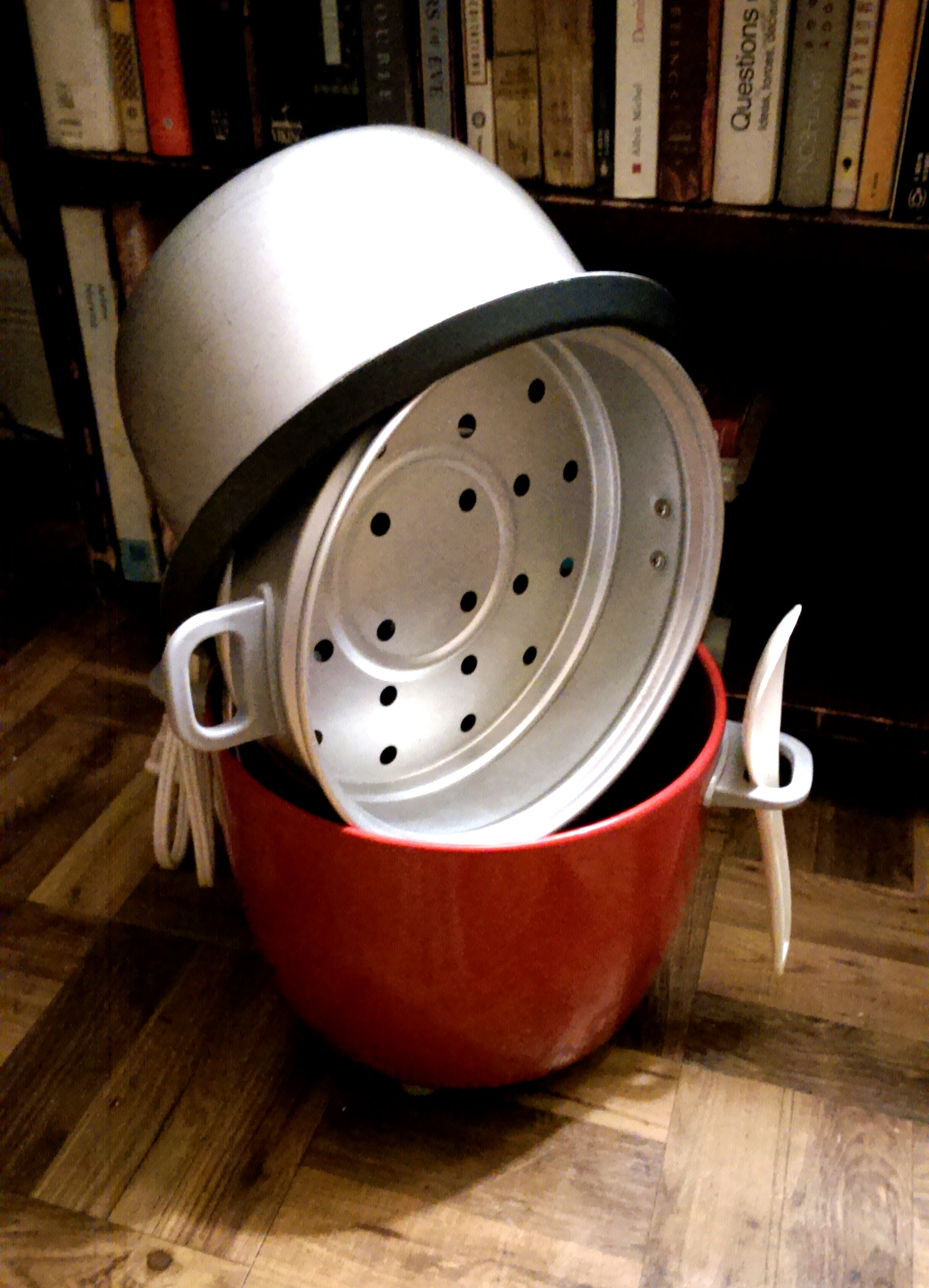
My rice cooker is alive… Would you like to see?

I’d stacked its component parts up to dry one night and was short on counter space, so I arranged all the pieces so only the feet would be on the floor. Later I looked over at it from across the room and realized not only was it alive, but it had a personality, a backstory. They were a proud member of the primary kitchen appliance brigade, corded division, standing ready to fight hunger at a moment’s notice. They’d served with steadfast dedication at every meal called upon and loyally defended it from the ruin of improperly prepared rice.

Heart & Soul

I remember reading many computer magazine articles referring to the central processing unit, the CPU as it’s shortened to, as being the heart of the computer. I understand the metaphor, but it’s not a good metaphor. Every time I come across its use I wonder if the writer understands what a heart actually does.

Responsible for circulating oxygen and nutrient‐rich blood to, and waste products away from, components of the body, the heart ensures the entire lifeform has access to the materials it needs to function. Without a heart, the lifeform will almost immediately cease to operate optimally and will begin dying. With that in mind, a computer’s heart is clearly its power supply, not its CPU. The power supply takes one form of electricity and converts it into a steady stream of different positive and negative voltages required by all the various components within the computer. These voltages are distributed through a network of wires within the computer and its components, forming an electrical circulatory system susceptible to similar ailments a human might experience with low or high blood pressure, and the same fate should this circulatory system fail entirely.

I also remember reading many computer magazine articles referring to the CPU as being the brain of the computer. While this is a better metaphor than referring to the CPU as its heart, it’s still not a good metaphor. This time it’s making me wonder if the writer understands what a CPU actually does.

Through a process remarkably similar to developing a photographic print, a computer’s CPU is created by using ultraviolet light to etch microscopic electrical circuits onto layers of silicon. This process has been refined over time and allows for what would have required millions of rooms filled with vacuum tubes sixty years ago to fit on something the size of a fingernail today. Incredible as all that is, a CPU is still only a collection of electrical pathways. And since these pathways can only be used for one thing—computation—referring to them as the brain of the computer is only representing part of what the brain in a lifeform does.

Instead, the CPU can be more accurately thought of as just one part of the brain: the part entirely concerned with rigidly processing data. It accepts data in the way its been told to accept it, processes it in the way its been told to processes it, and then outputs it in the way its been told to output it. There is no thinking. Not in an abstract way. There is only process. And if the CPU is asked to process something it doesn’t understand how to process—it will stop… sometimes taking the rest of the computer with it. In the world of Windows the result was the now infamous Blue Screen of Death.

The other part of the computer’s brain, the thinking part, is found in the software running on the computer. Calculations from the CPU are turned into interpretations by the software and then turned back into more calculations and subsequent interpretations. The continual back and forth between the CPU’s calculations and the software’s interpretations is where the computer does its thinking. The speed of a computer’s thoughts is governed by the design and density of its CPU. The quality of a computer’s thoughts depends on the software its running in conjunction with the CPU. The two are very separate entities, but they are designed to work together—they must work together. Neither is capable of anything without the other. But even with the CPU and software working together, the computer’s brain is still not entirely complete.

Computers use various speeds and sizes of memory depending on how and what they are thinking at any given time, but no matter the media there are functionally two kinds of computer memory. One kind of memory is incredibly fast randomly accessed memory, referred to as RAM. Any information the computer might need for immediate use is kept in this sort of memory, and it’s made up of electrical pathways etched on silicon just like the CPU is. And just like the ones on the CPU, these pathways will only function with electricity running through them. The other kind of memory is incredibly vast archived memory used to store large amounts of information in the long term. Data stored in long term memory often includes the software needed to run the computer as well as additional programs installed by the computer’s users, plus all the data the users might create on the computer as its being used: pictures, letters, spreadsheets, music, movies…

A computer’s long term memory has no standard name or multi letter acronym, and I’m not sure why this is. It might have something to do the many forms it’s taken over time. In the past one form of long term storage may have looked like varyingly sized reels of tape or varyingly floppy forms of floppy disks. One of today’s most common forms—hard drives—use stacks of spinning aluminum, glass, or ceramic platters applied with a magnetic coating. No matter the form, the basic principle is the same: an electromagnet encodes patterns of magnetism on a magnetic surface. These patterns can be created over and over again to keep track of data, and, most importantly, these patterns maintain their state when the computer is powered off. And in the same way more and more electrical pathways have been etched onto a computer’s CPU so it can process more, more and more magnetic patterns have been encoded onto a computer’s hard drive so it can remember more.

A few years ago, long term memory based on silicon chips started to become comparable in terms of capacity, speed, and reliability to that of modern hard drives using magnetic encoding. Referred to as solid‐state drives, the devices available today are now much faster than their mechanically‐driven and magnetically‐based equivalents. The only remaining technical challenge is while solid‐state drives will retain their contents when the computer is powered down, the drive itself cannot be left unpowered for more than a year or two before it might start to forget things. And I’m not sure I’d even consider this a remaining technical challenge either. Remembering something for a year or two as compared to a billionth of a second or two is a monumental improvement. Given some of the previous forms of computer memory were holes punched in card stock or sound waves bounced back and forth through lengths of coiled wire or tubes of mercury, solid‐state drives are just another iteration of an ever‐perfecting concept.

Evolution

For just over ten years I’ve used the same backlit keyboard with my computer. This keyboard has typed every word on this site, crafted every line of additional code, assisted with every image posted—it’s done a lot. But something happened to it over the course of completing this post, and—coincidentally enough—it started happening around the area I’d photographed to use as the featured image. Since then it appears only some of the backlighting is functioning as designed, and the result is an area of the keyboard where all three available backlight colours—red, blue, and magenta—were showing at once.

And then something really interesting happened:

The backlight colour in the bottom left of the above image is most certainly purple—not a colour the keyboard was ever able to display before, but one it is displaying now. So is the keyboard evolving? Or is it just malfunctioning?

Viewed from a operational perspective the keyboard still works as an input device. It still types as well as ever has. All the keys still do what they were designed to do, yet the keyboard as a whole is now doing something new, something it was never designed to do. This seemingly emergent property is just a consequence of additive colour theory in practice: a red and blue light mixed at full and equal intensity will produce the colour magenta. If both intensities are reduced by half the colour produced will change to purple. The backlight for one part of the keyboard is now only shining half as bright as it used to, but referring to this behaviour as a malfunction does a disservice to the device. It may be wearing out, but at its core the keyboard is still functioning as intended, if only a bit more uniquely so.

Hot Out There

Just like with people, computers can and do get overwhelmed while completing jobs and processing information. If there’s ever been an animated hourglass or spinning pinwheel or blue ouroboros up on your screen instead of the usual pointer that’s the computer saying it’s got a lot on the go for the moment and needs to catch up. You might also notice the computer taking longer to respond, the hard drive being constantly accessed, or the cooling fans speeding up to dissipate the additional heat produced by a hard working CPU. Computers experience their own version of stress—heat—in the face of unending tasks. And just like with overstressed people, overstressed computers can become unstable. Programs can become unpredictable and crash. Projects can be disrupted and data can be lost. Unless a computer is specifically designed and built to be run at full throttle at all times, an overstressed computer converges on an inevitable and very people‐like outcome: burnout. This burnout—in most cases—is literal, and in some cases—fatal.

During one of the hottest days of a summer past I casually noticed how warm it was getting in the non‐air conditioned room I had been working in all afternoon. Moments after returning with a cold drink there was a loud pop from under my desk—and a shower of sparks from the back of my computer tower. A capacitor, a component in the computer’s power supply, had exploded with such ferocity it had bent away the other capacitors around it, leaving only its metal substructure and a giant scorch mark behind. Only the power supply ended up needing replacing, but the damage could have been much worse.

A number of years ago I needed to convert several gigabytes of video data. I left my laptop to work overnight on the task, but it didn’t survive. By morning it needed almost $500 in repairs due to overheating. The cost of the repair—and the purchase price of the computer itself—was later reimbursed through a class action lawsuit. It turns out faulting manufacturing had made many, many different makes of laptops prone to failure if they were running hot for any significant length of time. I suspect similar manufacturing errors may have been responsible for the catastrophic thermal event which ruined my PlayStation 3 last year.

Be Nice

There is a program found on computers running Unix and Unix‐like operating systems. It’s called nice, and it’s designed to be run just before another program does. Nice sets a priority, known as the niceness, for the program to be run at. This priority is checked when the program attempts to use any of the computer’s resources, most notably the CPU.

A program assigned a high value of niceness—19 is the nicest a program can ever be—means it will happily share the computer’s resources with other programs, wait its turn for access to the CPU, and generally be content to finish its tasks whenever there’s a spare moment for them. They are the “hey—as long as it gets done” programs. They’re… nice.

The lowest niceness a program can be assigned is -20. These are the least nice to a computer’s resources. These are the “drop everything else and just do this—while I watch” programs. They’re demanding. Tasks critical to the continued operation of the computer itself run at this level of niceness. They share the computer—begrudgingly I’m sure—maybe only with other -20s, and even then, it might be a “I was here first” situation. It’s maximum negative niceness.

Programs run without having a niceness value set in advance are given the default value of 0. They are the “no rush, today’s great, tomorrow’s fine” programs. They know not to be pushy even though they might get pushed around a bit.

And then there’s renice. This program allows for the niceness of a previously run program to be altered while it’s still running. Combined with scripting commands and the priority information of other programs, it’s possible for a computer to monitor and adjust a running program’s niceness if the computer thinks that program is not being as nice as it could or should be.

There is a yellow sticky note in my kitchen with be “NICE” written on it. One of the most enduring messages left for myself to find later, it’s also become one of the most powerful. I know I overheat when I’m under too much stress, and I know I’ve burnt out more than once as a result. It’s never been in the form of a loud pop with a shower of sparks, but I know there’s been damage caused and data lost. So the note reminds me to stay cool, to learn—just as my silicon friends have—how to be nicer to the resources of not only myself, but to the resources those around me, silicon or otherwise.

Loneliness

View from afar.

Ontario is …vast.

Imagine getting in a car in Toronto and travelling due north for about 4 hours. Now head east for another 4 hours. Then start heading generally northeast for 11 more hours. You’ll still be in Ontario, around Thunder Bay if road conditions are favourable. It will take another 6 hours to reach the Manitoba border, and you’ll be in another time zone when you do. By then Toronto will be 1960 km away.

I’ve been using Google Earth to travel around Ontario while remaining adherent to physical distancing guidelines. Way back in 2000 I spent about two school years in North Bay, the southern most part of what’s considered the northern part of the province. I remember from driving back and forth how Highway 11 from Toronto and Highway 17 from Ottawa would meet just south of North Bay. The two highways split a few kilometres later with Highway 11 heading north to Temiskaming and Highway 17 heading west to Sudbury.

While most of Southern Ontario is accessible via road, most of Northern Ontario isn’t. Distance is experienced on another scale. What might be considered remote takes on a new meaning. Isolation becomes relative. Whenever I’d reach the junction of Highway 11 and 17 coming up from Toronto I knew I was almost at my destination, a reassuring feeling when the remaining destinations were in distances measured with three digits.

Recent events have knocked any sense I’ve had of distance and isolation into flux. Two meters may as well be 2000 kilometres. Ideas of what’s considered accessible no longer revolve around a specific type of vehicle. In a screwed up way it’s now possible to see more of the province from space on my couch than I ever could from a car or even a canoe. And in that realization—as I was scrolling through the air above Highway 11 past North Bay; as the road wound its way through places I’ve never heard of; as it found and blasted its way though unending forest and rock or hugged the shores of lakes and rivers; as it branched off into route numbers starting in the five and six hundreds; as Highway 11 headed down and met up for the second time with Highway 17—I found myself looking at loneliness.

Above is the view looking south from Highway 11 at Highway 17, near Nipigon, where the two longest highways in Ontario meet again to form the only road access the two halves of the country have with the other. To the right it’s 786 km west to Winnipeg. To the left it’s 586 km southeast to Sault Ste. Marie and then 795 km from there to Ottawa. Or it’s back 1345 km northsoutheast to Toronto.

And that’s not the loneliness. No—not there yet.

Ontario has an area of 1,076,395 km2 making it larger than Germany, France, and Italy …combined. But that view—the clouds, the sense of the weather, the trees, the fields, even the road signs, pavement markings, and intersection—I bet that view can be found by anyone in Ontario. It’s somewhere anywhere in the province. It’s a few hundred square metres among millions more just like it.

And that’s still not the loneliness. Almost there…

That view of a place that looks like it’s anywhere is actually a view of a place that’s mostly nowhere. It’s a synthetic view, accessible to anyone here only if they’ve also got access to a road. Most places in Ontario cannot be arrived at by road, but most everyone who lives here is near one, so almost everyone living here thinks Ontario looks a way it actually doesn’t. I count myself among almost 15 million people who likely haven’t seen much of this province past the view from a road.

That’s the loneliness.