The temptation to digitally pen a strongly worded rebuke of conservatism and its divisive nature is strong, but I’ve already written about it. I also have no suitable frame of reference in this case. Though there are some areas of overlap, conservatism in America is not the same as it is in Canada. Besides, now’s moment is about progress—at least in theory. In practice, the clear and 81 million vote mandate for progress in America is complicated by the static inertia of almost 74 million Americans who—given the choice—decided progress was better embodied by an arrogant, ignorant, sexist, bigoted, racist, traitorous, white supremacist.
It’s important to acknowledge the voters who indeed voted for Trump. But it’s also important to acknowledge some of those voters were actually voting for not Biden. It’s a subtle but meaningful distinction: these are the voters who will vote for anyone—Trump, Dr. Octaviusas, a heteronormative dumpster fire, a half-eaten sandwich—as long as he’s not a Democrat. These voters won’t necessarily not vote, but their intention is more about prevention than participation. Their level of civic engagement follows suit, ranging from arm’s-length indifference to face-painted fanaticism. A similar situation exists on the other side, but with far less TV-friendly flare or flair. Biden did receive the most votes for any presidential candidate in the history of America, but some of those votes weren’t for Biden—they were for not Trump.
These not votes are symptomatic of a winner-take-all electoral system approaching the end of its serviceable life. As it runs its course, the system produces the illusion of majority rule as it converges on a two-party and eventually politically deadlocked state. Sound familiar?
A similar scenario is developing in Canada, and the results are just as distorting when it comes to indicators of progress. It probably wasn’t Trudeau who was elected in a landslide in 2015: it was more likely not Harper. Jump ahead four years and the results are just as distorted: not Scheer forms a minority government while not Trudeau wins the popular vote. But again, I’ve already written about it…
Initially confounding on the surface, and overlooking a worn out electoral process, the result of America’s 2020 presidential election makes more sense if one allows for an uncomfortable premises: America as a whole is still not as progressive as it might look. While the United States has embraced pockets of progress before, the level of resistance during the lead‐up and obvious begrudgement after the fact risks trumping any apparition of an entirely progressive nation.
US and Canadian politicians usually refer to their respective nations as being friends. I’ve always found this analogy to be overly simplified and slightly patronizing. Friendship implies certain levels of similarity, camaraderie, solidarity, and reciprocity exist between two or more entities. I don’t often see those qualities in the proportions I would consider befitting a friendship, not in the sort of friendship I would want at least. Personally, I view the two nations as neighbours—because they are. It’s ideal to have a good relationship with one’s neighbour, and certainly a friendly relationship helps as well. But a neighbour isn’t supposed to start building rooms in the other’s house, or try to take it over entirely, so it’s important to know when to draw the line with the relationship. And as far as the US and Canada go, that was in 1775, 1812, 1818, and again in 1846.
I’ve met a few people from all over the United States, people from New York, Pennsylvania, California, Washington, Florida, Michigan, Illinois, New Hampshire, Missouri, Oklahoma, and Nevada. Both of my brothers are married to Americans, so now I have family from Colorado and Ohio. And I’m directly related to Americans as well: I have a grandmother who was from Minnesota and ancestors who were from Pennsylvania.
As a child, I remember travelling across the norther boarder states, through North Dakoda, Idaho, and Montana. My family would also sometimes make trips from British Columbia to Spokane, a city in Washington state.
I’ve been to a few places in the United Stats as well, places like San Jose, Chicago, Pittsburgh, Buffalo, Philadelphia, Orlando, Jacksonville, and Washington. I’ve also passed through countless other American towns and cities—Scranton included—on my way to other places, most notably on a grand road trip to and from Florida with stops in Richmond, Cocoa Beach, Charlotte, and Philadelphia.
Despite all this American experience, and I do wonder now if I’ve seen as much of Canada as I’ve previously thought, I know I’ve only experienced a fraction of what America is. But despite having experienced only this fraction, I know America is a land of extremes. America is always turned up to ten, something I’m saying both literally and metaphorically. Its population is ten times that of Canada’s. It’s a magnitude of scale captured in America’s relative successes and failures—a simultaneous state of inspiring awe and terror, a nation of beautiful horrors.
I was driving west through northern Ohio many years ago. It was near the end of a midsummer day, and I was nearing the last quarter of 1200 km trip around Lake Erie via Pittsburgh. The light of the sunset was bouncing off some of the taller buildings in distant downtown Cleveland. Linkin Park’s The Little Things Give You Away was playing through the car stereo. I think it was the first time I had ever heard the song after listening to it so many times before.
Perfect moments are fleeting, their criteria impossible for me to define. All I know of them is when I’m in one of them—and I found myself in one of them on whatever mile it was of whatever unending interstate highway it was while a far away sadness gently filled my eyes.
...Hope decays
Generations disappear
Washed away
As a nation
Simply stares...
Little things are harder to script, and I think that’s why they stand out in my mind more often and with more impact than the most choreographed interactions I’ve had with others. I used to ask a lot of questions as I got to know someone, but questions are tricky. Answers are easily scripted once the question is asked. Now I ask very few, preferring instead to watch and to listen, to see which words match up with which actions.
Earlier that day in Ohio, in the parking lot of an amusement park, some of my local travelling companions found out I was driving a rented car. They wanted to know why I wasn’t driving my own. At the time I didn’t have a car of my own, so I told them as much. They wanted to know how I got around without one. Other than renting one when I needed one, I also at the time I lived in downtown Toronto, where there was public transit all around me. I told them as much again.
“You live downtown and don’t have a car? Are you poor?”
It was at this point I asked about the numerous signs reminding patrons not to bring guns into the park. I wondered aloud if this was an ongoing issue, and that if someone should somehow accidentally bring a gun with them to the park if they were just supposed to leave it in their car.
“Well, yeah…” was the response. “Where else would you leave it?”
Where else indeed.
“Are there guns in your car?” I asked, point blank.
“Just one.”
A few weeks before then, someone I knew had a friend visiting them from Minnesota. He made it a point to mention how strange it felt to be unarmed while in Canada. I took the bait, mostly because I didn’t feel strange to be unarmed anywhere. As it turned out, not only would he have been armed with a handgun whenever possible back home, he had a concealed carry license. As a concept, a private citizen being able to legally carry and conceal a handgun in Canada is so restrictive it may as well be prohibited, but I took the bait again and asked why he had a concealed carry license.
“Because it’s my right as an American. It’s part of my freedom.”
Fair enough—but I couldn’t help but wonder if the same righteous attitude toward freedom was in any way responsible for him having been denied entry into Canada just days prior.
One thing gleamed from my American experiences is the variable and strange relationship its citizens have with the concept of freedom. It can be interpreted quite differently, viewed as something one possesses rather than respects. Freedom is viewed in granular detail on an individualistic level—its roll in the broader community an occasional afterthought. Its application can be highly contextual despite its claim of universality.
As applied in daily life, American freedom expresses itself through amusing and generally benign cross-cultural exchanges, such as when I was buying a noticeable amount of American breakfast cereal to bring back home while I was in Buffalo. The cashier wondered why I was getting so much at once, so I told her I was just visiting and picking up the kinds I couldn’t buy in Canada anymore. She stopped mid-scan, put down one of the boxes of chocolate frosted Lucky Charms, appeared to brace herself on the counter with both hands, and looked me dead in the eye.
“They took your cereal away from you? I hope you did something about that.”
I hadn’t, other than to cross an international border to get some more. But I think about that exchange almost every time I see breakfast cereal at the store. It never fails to crack a smile, the idea of a total stranger in another country standing at the ready to champion my sweet, sugary freedom.
The expression of American freedom in other cases is more sinister, speaking to a hypocrisy still hung over the heads of millions of its own citizens. A friend of mine returned from a conference in Nashville. She’d had a wonderful time, but relayed an odd experience she had as well. The conference was over, and she’d gone out to do some shopping at a mall near the convention centre. She was finding all sorts of great things and commented to one of the store employees on how much she was enjoying the selection. The employee looked curiously at her, and asked if she was from out of state—not from out of town, out of state. My friend said yes, that she was visiting from Canada, from Toronto. In the most matter of fact way possible, the employee responded.
“Ah—yes. Look—if you start to feel uncomfortable, the white mall is just a few miles up the road.”
My friend told me at no point did she feel uncomfortable where she was—until it was suggested that she might be. I think about my friend’s exchange almost every time I find myself in a place where there are only white people, and I find myself uncomfortable every time I do. After over twenty years of living in the Toronto area, I’m accustomed to seeing everyone everywhere. I notice when everyone isn’t. The guy from Minnesota with the concealed carry license noticed everyone when he was here as well, but he added his own, bizarre spin.
“You’ve got, like, no Mexicans here—and way less Black people.”
I really wasn’t interested in finding out what he meant, and I never saw him again after that. He ended up going back to Minnesota. Weeks later they pulled his rolled SUV out of a river. He barely survived because he wasn’t wearing a seat belt, something he never did, and something he was ticketed for not doing twice while visiting Toronto.
Meanwhile, back in Ohio, and the next day, in Sandusky, I was looking to buy a road map—yes, this was a while ago. I found some for sale at a corner gas station, in a rotating metal display frame, beside the beer fridge. The 4th of July weekend was approaching, and on the way out of town I noticed how understandably patriotic the streets looked. But there was a growing sense as I drove past flag after flag after flag that most of these flags hadn’t been recently put up and most of them wouldn’t be coming down. I don’t want to say there was a fascist amount of flags, but that I found myself wondering if there was spoke to the tone of their unending presence. Then again, back home, I find the flying of a giant Canadian flag over a big box retail complex to be a bit much. The lack of any sign reminding me to leave my gun in the car is all I need tell me where I am.
What happened at the United States Capitol earlier this week was upsetting, but it wasn’t surprising. It’s disheartening to say it was inevitable, but after witnessing a president who either sidestepped or slaughtered any traditional expectations regarding presidential obligations, I didn’t see why a peaceful transition of power would be treated any differently. Writers are sometimes claimed by others as being able to predict the future. I tend to think of it as merely being able to recognize a plot, understand its characters, and then follow the plot through to a reasonable conclusion, no matter how unreasonable a conclusion it may seem. Any future is possible, as long as it’s possible to imagine that future and understand how to get there—on paper at least. Off the page, especially when multiple authors are involved, crafting a counter-reality narrative can produce plots which are inherently unstable, and they can grow dangerously unpredictable. Results can be deadly.
And they were.
What happened in Georgia, in the United States Senate run-off elections, simultaneous with the US Capitol riot, was a display of inspired, hard-fought progress, a strong statement made against a precarious yet persistent counter-reality narrative. It demonstrated the power of a correctly authored story, the resiliency of what is genuine against what is concocted. It was beauty among horror.
It was America.
This post has always been a bit of a split decision on what direction to take it in, a fitting state as I started working on it a week after the American election. Though the election was over, it also wasn’t. In what otherwise might have been a standard set of run-off elections after the fact, two US Senate seats in Georgia became just as important as the presidential election itself. The structure of American government appears, to me at least, to favour blending power as it balances it. Ideally applied this results in bipartisan cooperation, but when cynically manipulated it stalls progress for years. Some of this cynicism crept into my own head—the post suffered: America had constructed and then backed itself into a well-deserved corner.
But as the run-off elections approached, as the formal peculiarities of the US constitution confirmed what had already been apparent for months, it felt like I could complete this post no matter what the result was in Georgia, because no matter the result, America would still be a deeply divided nation. That said, I am deeply pleased the result in Georgia is what it was. Division is far easier to heal when it is seen rather than seized, so I rewrote the entire post as something more reflective than conclusive.
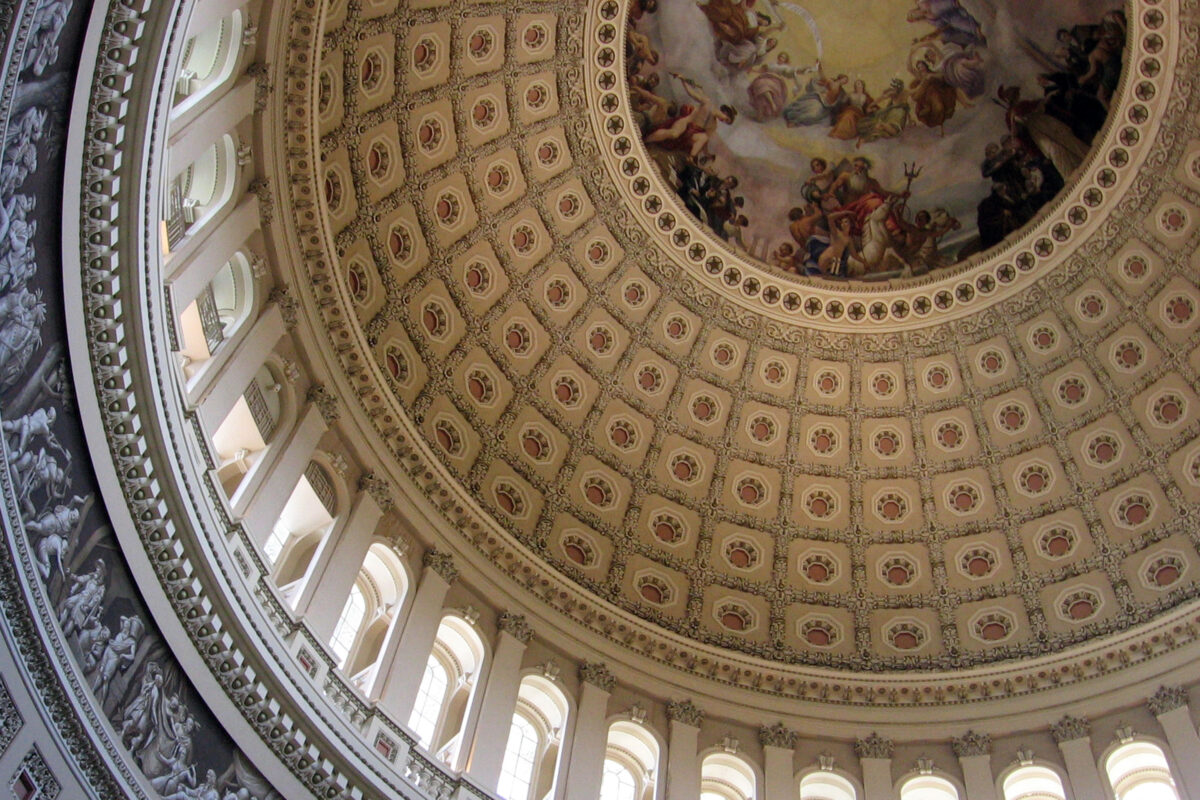
During the time I started the rewrite and my checking on the Georgia results, the Capitol building was overrun. It was a surreal and eerie sensation. I had just been working on the photograph for this post’s featured image, a picture of the Capitol rotunda from when I visited in 2011. I had been remembering the quality of the light as it moved from surface to surface, the soft echoes of voices and footsteps on the stone, even just recalling the immensity of the interior volume alone—it was a quiet memory of a peaceful place. To then be jarred while in such a place, to have it violently filled with confusion, fear, and hatred—all of it vibrating and reverberating off the same surfaces I had been with just moments before—it felt like an insurrection against my own mind. It was awe inspired terror.
I realized I needed to rewrite the rewrite.
Progress is never easy, but as I’ve understood it, America’s never been about doing things because they were easy. And I can’t help but wonder if my fondness for that famous sentiment stems from what it inspired in the Unites States then or what it inspires in me now. In rewriting this post three times in the last few days, I’ve found myself with renewed awareness of my many connections and many memories with the United States. Perhaps I’m better friends with America than I thought. But I’m also aware whatever friendship there might be has become strained and fragile by a divided state. Genuine actions are required to begin the repair. And I’ll be watching for them—though, admittedly, from a distance at this time.
Up until recently, I’ve always had the luxury of experiencing America outside of itself along with isolated and somewhat controlled internal exposure. In that respect, the relationship has felt quite ordinarily neighbourly. But I’ve felt America’s fights from my house—I always have. I’ve heard the screams and the shots. I’ve seen the smoke and the fire. The entire neighbourhood has. The only temper to the rage and sorrow I feel toward my neighbour is a recent promise of progress made this November past, a promise that’s been reaffirmed multiple, multiple times since then.
But America will face a familiar obstacle when it comes to keeping this promise: itself—a nation of many and one simultaneously. The monumental undertaking of America is spelled out in its own name: it’s not the United State, it’s the United States. The plurality matters, and it must find expression. There is no one, correct way to be American—unless that one way is not divided.