In time my dislike of gaps will make sense, but for now, December 1st, 2018 was the last time I wrote here—a gap of six months (seven months now since it took me weeks to finished editing this…). I don’t like gaps. When I don’t see anything filling them I can’t help but wonder what I’m missing.
So. Six months. What’s new? Everything is new. And it isn’t any more either. I have somehow started climbing my way out of austerity to assemble together a life out of the wreckage of so many previous ones.
I’ve left Toronto and the Greater Toronto Area. I needed to find a place where the city wasn’t. And I found it. Now I live the Greenbelt—where Toronto, by definition, can never and will never be. But it’s important to note: I didn’t leave because I hated the city. I left because I didn’t want to start hating it. I left because I’d lost my ability to find peace.
I’ve also left school and my pursuit of renewable energy systems engineering. I discovered it wasn’t quite for me. And it was a no‐brainer in retrospect: I was acing the communications, literary, and social issues and awareness components of my program, but I was converging on just almost a pass in technical analysis and applied mathematics—despite doing well in physics and statics. It was clear my interests and skills were not fully aligned with the program I was in. I’m still puzzled by my ability to understand the implications of approaching the speed of light as it relates to the perception of time and space, but couldn’t always properly factor a trinomial, particularly if it contained a cubed variable. I did enjoy working with radians in trigonometry—a curious place were an irrational number (π) becomes the base unit of a number system…
Instead I find myself back where I started in the spring of 2016 as a warehouse worker: back to food, back to agriculture, back to the land, and, of course, back to politics. The politics of food dwarf the politics of renewable energy, yet they are oddly related.
…more on that and the land later.
This time I’m not packing and wrapping skids, even though I’d initially gone back to do just that the spring after my first year of school. Late into the summer my employer made me an offer on a new position they’d created in the office. It was a good offer. And since one of the reasons I’d gone back to school was to be able to get offers like this, I took it.
Now I assist with the day to day operations that keep the company running smoothly. I help with sales tasks, handle customer service issues, enter sales orders into our database, and run reports. I work with numbers and spreadsheets and chat with suppliers, chefs, and my coworkers to make sure everything ends up where it’s supposed to without anyone noticing all the bumps along the way.
I absolutely love it.
And I didn’t realize it at the time, but I’d saved myself 1‐2 years more in school that (thank you, Mr. Ford, you fucker…) I financially wouldn’t have been able to continue with anyway, to then try and find a job in an industry that was scrapped in 2017 in favour of cheap beer for misogynists and their wives.
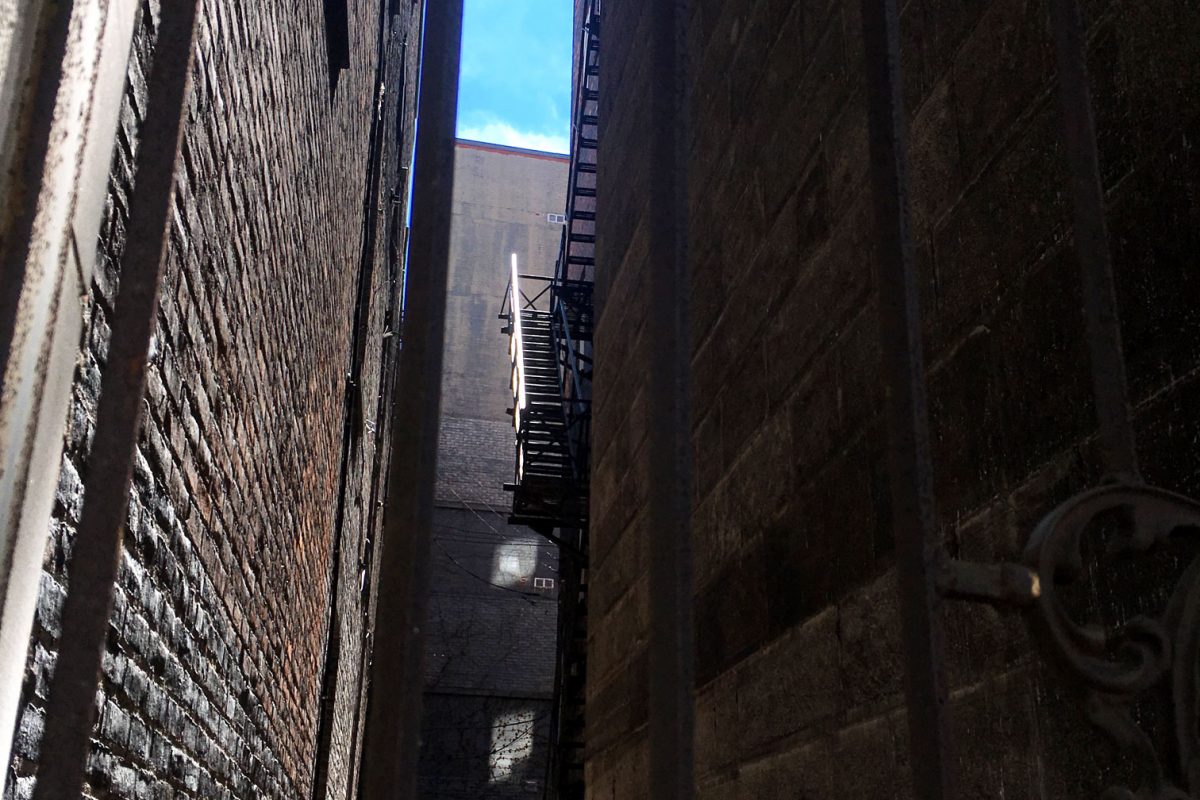
Now—austerity: the titular topic of this post. What is austerity? I’m not going to risk the point being missed‐it’s too important that it’s not. So I’m making a rare move and dispensing with subtlety: look at this post’s featured image. That is austerity.
So when I say I’m somehow climbing my way out, I believe it, yet at the same time, I’m not sure how I’m doing it. The only thing I can liken it to is that instead of spending the rest of my life looking for the non-existent base of a set of stairs that don’t actually go anywhere anyway, I’m slowly and carefully pulling myself up using the mortar gaps between the bricks themselves.
But I’m not out yet. True, I now have an apartment of my own that I share with Luna and the many, many things I have collected over the years. From my desk I can look out at Scooby-Too, my slightly crumbled but certainly character‐filled twelve year old Subaru. The neighbourhood I live in is filled with the sounds of other people and other animals going about their lives. I can walk, bike, bus, or drive to anything I might need at any time of day. There are places both known and unknown ready and waiting to be explored. And there’s an entire area of southern Ontario that I’m discovering for the first time. It’s an incredibly fortunate life—one I am aware of and thankful for. But I must remember, I’m not out yet.
Just like when I was preparing for all this, when I was watching every dollar, I still must watch every dollar. It’s harder in some ways. Superficially it looks like I have arrived my financial destination and can relax. But I can’t. Before I was dependent and in debt. Now I am self‐sufficient and in debt. It’s a better situation, but it’s still a difficult situation. There is still a whiff of the austere to it.
The main issue I have with austerity is the true cost of it. Sure—more dollars are generated in the moment by cutting and deferring expenditures. But dollars still must be spent on some things, so the result is a financial hierarchy where the deciding factor on expenditure is one’s own determination of the “necessaryness” of the expenditure in the moment. This ends up skewing one’s financial reality because every financial decision becomes about what will or will not take dollars away from the moment. Other important expenditures could appear less necessary than they really might be.
Or put another way: not spending in the moment can end up being expensive in the long run.
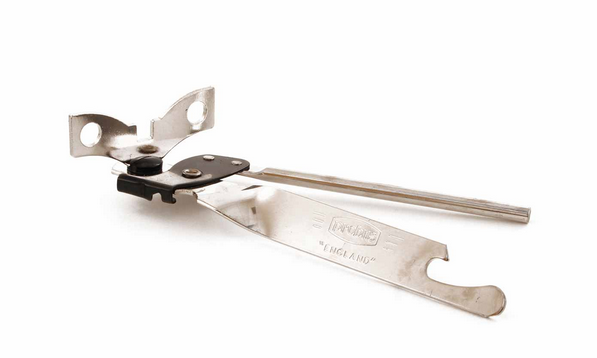
And my favourite example of this phenomena is from my childhood: the shitty can opener. You know the one I’m talking about. It’s sold in grocery stores on impulse strips beside cans of tuna fish and cat food. It’s got the one rounded rod for a handle for some reason and then the one flattened handle. The bit you’d turn to open the can would have sharp corners that would dig into your hand. Why? Because you had to turn hard so the dull blade would eventually yet still ineffectually drag itself through the can you would be trying to open. But you couldn’t turn too hard because then the soft metal gears would grind themselves into a metallic and previous‐can‐contents paste that would mix with bits of paper from the can’s label and would somehow end up in whatever now jagged edged can had just been opened.
I hated the shitty can opener. When I was asked what I wanted as a house warming present for one of my first places, I asked for a $20 can opener. That was in 2005. I still have that can opener. It still opens cans just as well as it did when it was new. And it will likely be passed on as part of my estate.
But—the shitty can opener may have only been a few dollars, or maybe even only a few cents, when I was a child. It saved dollars in the moment.
Let’s pretend in 2005 I decided to continue the shitty can opener tradition, skipped the $20 can opener, and bought the shitty one for $2.50 instead. So sure, it’s $17.50 less than the $20 one. But I remember as a child the shitty can opener having to be re-bought several times over. So let’s assume it has to be re-bought every six months. Now compare that to the $20 can opener I’ve had for almost fifteen years… Fascinating: the shitty can opener—whose continual re-purchase was justified because it saved money in the moment—has actually cost $75 in the long run. And that’s just dollars. Don’t forget the cost of the unpleasant experience of using the shitty can opener: the continual feelings of betrayal as the new shitty can opener slowly descends into the same familiar shittyness as its predecessor. Maybe this one will be different? Lies!
…just like the staircase out of it, the dollars saved in austerity can be an illusion.
When I finally was able to take Scooby-Too in for much deferred maintenance, the final invoice on what was expected to be a $65 service was $500. The words “clogged” and “sludge” came up often on the mechanic’s report. And I knew it was all true. Aside from filling him with gas and windshield washer fluid when needed, there wasn’t really much else I decided in all those moments I could spend in terms of proper car care, but saving that moment money cost me in the end. And it could have cost me a lot more: left to his own Scooby-Too had been headed for a sudden and violent death. The warning signs were there, but I was only looking at the dollars.
And that $500 was just the start. Over the next few weekends I spent another $300 on parts that needed replacing. The spark plugs I pulled out were, well, they evoked an unexpectedly strong empathetic response. Just by looking at them I knew ‘Too had not been running well for a long, long time. But he had kept going, somehow, despite me clearly not seeing how important the car taking me to and from where I earn my dollars be in reliable condition. He’d been running on sludge with a weak spark for way too long, but he’s running much better now. Better than ever.
And so am I.