Covid & Carbon

We’re all in this together, and we will be again.

Climate change was the global health emergency before a virus stole the show. As callous as that and the following may read, it’s difficult to unsee the disparity in response to Covid-19 as a public health threat compared to the health effects of climate change. Yes—at the time of this writing Covid-19 has killed over 121,000 people worldwide, and I’m not arguing the clear risk to public health as this disease continues to spread. But this pandemic, a respiratory illness, is occurring on a planet where the World Health Organization estimates about 7 million people die each year as a result of air pollution.

The impotence displayed by those who would continue to dirty the air with business as usual can no longer hold the economy hostage and threaten its destruction—a few fragments of RNA and some protein strands have taken care of that for them. And besides, how many times can the same dollar be passed around before it disappears anyway? It appears Alberta will be finding out. Using all the money its current government has saved by not paying the province’s healthcare workers, it will instead be investing over 1 billion dollars (that’s $1,000,000,000 or 1 gigadollar) in the incomplete Keystone XL pipeline, a project designed to carry oil now too expensive to get out of the ground because it’s worthless once it is.

Just as it wouldn’t be possible to burn yesterday’s wood to power today, it won’t be possible to burn today’s oil to power tomorrow. There’s no oil in the future. The party is over. The houselights are coming up, and they’re being powered by clean energy. An electric taxi waits silently outside. It’s time to go home.

If you’re here looking for the next hot stock tip, take whatever might still exist of your money out of oil and invest it in trees. While trees may not be capable of powering tomorrow in the traditional sense, they will be instrumental in saving it.

Carbon is the 6th element on the periodic table, the 4th most abundant element in the visible universe, and makes up approximately 18% of the mass of the average human body. In fact, carbon is present within the cells of every single currently understood form of life on this planet. So when massive amounts of sea creatures and algae are compressed by rock under tremendous amounts of time and pressure to create petroleum, all the carbon from all the sea creatures and algae ends up in the petroleum as well. Burning any fuel refined from petroleum will release the carbon either as a component of soot—a known carcinogenic—or as carbon dioxide—a known greenhouse gas.

Various technologies have already been developed to reduce soot emissions, so when people talk about carbon emissions, at least in Canada, what they’re usually referring to is the amount of carbon dioxide, the amount of CO2, that ends up in the atmosphere. And when these same people talk about carbon capture, or carbon offest, what they’re referring to are ways to take CO2 out of the atmosphere.


The substance of a tree is carbon, and where did that come from? That comes from the air; it’s carbon dioxide from the air. People look at trees and they think it comes out of the ground …the trees come out of the air.

—Richard Feynman


During the day, trees use the energy contained in sunlight to convert water from the ground and carbon dioxide from the air into sugar. During the night, trees use the energy contained in sugar for nourishment and growth. The chemistry involved in these processes produces a surplus of oxygen. Without any need for it, this oxygen is released back into the atmosphere by each tree. Referred to as the lungs of the planet, trees breathe in carbon dioxide and breathe out oxygen, and in light of increased global CO2 emissions, the planting of new trees is seen as one way to offset those emissions. The idea is, for situations where—for whatever reason—it’s impossible to not release carbon dioxide into the atmosphere, newly planted tress will convert an equivalent amount of CO2 already in the atmosphere into the growth of new forests. The carbon emission equation balances out, and the result is a coveted net–zero or carbon neutral sticker on whatever product or procedure is seeking acceptance as being beneficial for the environment.

While a good idea in theory, there’s one immediate practical problem with the idea of offsetting carbon emissions: there’s already too much carbon dioxide in the atmosphere. While not adding any more CO2 is certainly a step in the correct direction, it’s dangerous to assume not making things worse is any sort of long term solution. Things are worse as they are. If you’re already carrying too much stuff, finding out you won’t be asked to carry any more stuff only delays exhaustion’s inevitable arrival.

Right now—despite the illusions of comparatively advanced technology—the fundamental method used to generate large amounts of power hasn’t changed much in the last few hundred to few thousand years: make things hot by burning other things. This method, despite its inherent inefficiencies, produced relatively inconsequential emissions of carbon dioxide for thousands of years. But in less than 200 years, as more and more power has been generated using this inefficient method, global CO2 emissions have grown exponentially. Emissions in 1850 were estimated at about 200 million tonnes. By 2017 emissions had grown to about 38 billion tonnes—an increase of over 18,000%.

By the way—are you curious about what a tonne of an invisible gas looks like? I was. So were the creators of the following video. They used an American unit of measure—the metric ton—for their demonstration, but there’s no conversion needed. A metric ton is the same as a tonne: both are 1000 kg.

The estimated amount of carbon dioxide one tree is able to capture from the atmosphere is about 0.58 tonnes …over 80 years. Yup—the process takes time, though this shouldn’t come as a surprise to those who understand how a forest works.

To capture the amount of carbon released in 2017 would require a forest of 65 billion trees. There are an estimated 3 trillion trees (that’s 3,000,000,000,000 or 3 teratrees) on the planet right now. But—those trillions of trees have only now just finished capturing the carbon dioxide released in 1940. And in each year since 1940, more carbon dioxide has been released into the atmosphere than the year before it, which means more and more trees needed for carbon capture. But more and more trees have been cut down since 1940, cancelling out any future carbon capture capacity they provided. Additionally, some of these felled trees would have been burned for fuel, meaning all the carbon captured over the years the tree was alive would have been released back into the atmosphere. The 3 trillion trees today are what remain of an estimated 6 trillion thought to have existed before the advent of human civilization. And despite increased reforestation efforts, about 10–15 billion more trees are removed each year than are planted.

As an individual who uses electricity, drives a car, and is alive, I contribute to the emission of carbon dioxide into the atmosphere. My CO2 emissions will rank somewhere between someone who lives on the land and uses a fire for survival and someone who lives in a sprawling chalet mansion and uses a private jet for survival. Based on my utility bill I use an average of 5.7 kW/h worth of electricity per day, so for the year, as a resident of Ontario, I am responsible for about 0.23 tonnes of CO2 each year so I can make my coffee, charge my electronics, watch my TV, and run my computers. However, if I lived in Alberta, that same 5.7 kW/h worth of electricity per day results in about 2.08 tonnes of CO2 per year, about 9 times more.

Almost all the electricity in Alberta is generated by burning coal and natural gas. The province has the honour of operating the largest fleet of coal–fired power plants in Canada. Only about 8% of Alberta’s power comes from other sources. By comparison, about 60% of Ontario’s electricity is generated by using nuclear power. Only about 7% comes from burning natural gas. There are no longer any coal–fired power plants in the province, and the rest of Ontario’s power comes from hydroelectric dams, wind farms, and solar panels.

When making the comparison above, it must be noted the average of 5.7 kW/h of electricity per day is based on my usage. I use energy efficient lighting in an efficient way. I have configured my electronics to shutdown and save power whenever possible. I don’t have a large sized refrigerator or oven. I also don’t have a washer or dryer. But most importantly, my building uses a natural gas boiler to produce heat and hot water for my apartment. I have no idea how much gas the boiler uses to service my needs—so I’ll estimate it’s around half the average amount of natural gas burned for a home in Ontario. That works out to about 2.2 tonnes of CO2.

It also must be noted the disparity in emissions between the two provinces exists only in the world of generating electricity. When it comes to home heating and hot water, things are not as clear cut when it comes to reducing emissions. If I was living in Ontario and wanted to reduce my carbon emissions above all else, I might consider replacing my natural gas burning appliances with electrically powered equivalents. But—ignoring all other considerations for the sake of this example—swapping something out that burns natural gas for something that uses electricity instead will only save on carbon emissions if the method of generating electricity isn’t producing any carbon emissions either. Ontario’s electrical grid is mostly carbon–free. But if this example were to play out in Alberta, I’d be taking the emissions being made at my house and sweeping them under the rug somewhere else—into Saskatchewan I guess.

So far my carbon budget includes a reasonable estimate based the electricity I use to power the things in my life and a somewhat less precise estimate on the heat and hot water used by my apartment. At 2.42 tonnes per year I’ll round up and say I need 5 trees per year for carbon offset. Now it’s time to budget for my car. Using the average CO2 emissions for a gasoline powered compact car such as mine and a yearly average of 30,000 km (I drive a lot, or at least, I used to…) adds another 5.5 tonnes.

Yes—driving adds over 200% to my carbon budget.

Now I need about 14 tress to offset my yearly emissions of about 7.92 tonnes per year, and I’m not done yet. I haven’t bought anything to eat. I haven’t taken my car in for maintenance. I haven’t done anything for recreation. I haven’t even fed my cat. All these activities have an associated emission of carbon dioxide, and those emissions haven’t been factored in.

All–in the average Canadian emits 20.3 tonnes of CO2 per year. At 35 tress per person and 37.6 million people in Canada that’s about 1.1 billion tress needed to offset one year of the population’s carbon dioxide emissions. But—and I cannot stress this enough—that one year’s worth of carbon emissions is offset over 80 years.

Canada’s Liberal government recently campaigned on a promise to plant 2 billion tress if elected. They were elected, so the next step is for those trees to actually get planted. Two billion sounds like a large number of tress, likely because most people are used to either experiencing trees in small and relativity countable numbers or as scrolling landscapes of seemingly uncountable forest. But do 2 billion tress still sound like a lot when it’s unlikely they’d be able to capture just 2 years worth of the carbon dioxide emitted by the country planting them? How about if I told you those 2 billion trees will be planted over the next 10 years? That’s the plan when you read the fine print.

When I think back to the amount of carbon dioxide I produce, when I think back to what’s in my carbon budget, there’s one glaring line item: the car. Its estimated 5.5 tonnes of CO2 represent nearly 25% of the emissions I might make as an average Canadian. At the moment I’m not driving it unless absolutely necessary, perhaps only a few hundred kilometres per month.

If Canada could decrease the country’s average emissions per person by 25% the number of tress needed per person goes from 35 to 26. Now those 2 billion trees can offset just over two years of carbon dioxide—and I do mean just: it’s 2 years and 2 weeks plus 3 days.

So what would happen if the government double doubled down on its commitment and planted trees as if our lives depended on it—4 billion trees in just 5 years? Well, predictably, doubling the number of trees will double the amount of carbon able to be offset, but it’s still going to take 80 years in total, give or take 5 years. It’s a linear relationship, and this is why reducing CO2 emissions now is critical. The rate of CO2 emission tends to grow exponentially, but the mitigation effect of carbon offsetting doesn’t.

Think of rampant CO2 emissions as a pandemic spreading across the countries of the world. Every few days the emissions double, and then double again a few days later. The infection is growing exponentially. Now think of each country’s healthcare system as a forest, each forest a product of the care and support (or lack thereof) afforded by each country, each tree a healthcare worker. The system becomes overwhelmed almost immediately as it is unable to match the exponential growth of the infection it is treating. The only way to grow the capacity of the healthcare system is to add more healthcare workers, but training them takes time, and in that time, other healthcare workers become overworked—they become tired. Some become infected themselves. Now there are even less healthcare workers to treat yet more infection. Slowing the spread of the pandemic, reducing the amount of infection, is the most immediately impactful way to protect the current capacity of the healthcare system. Compassionate, deliberate, and meaningful investment in the healthcare system, in the contagion capturing forest of healthcare workers, is the most impactful way to protect and grow its future capacity.

One of the many things my sister is working on is a project to plant 1000 trees. In learning how to support her initiative, I came across the piece of information which inspired this post—how the average rural tree in Canada captures about 0.58 tonnes of CO2 from the atmosphere over 80 years. The 1000 trees she plants will capture about 580 tonnes of CO2, enough to offset about 28 average Canadian’s emissions for one year at today’s rates. And if every one of Canada’s 37.6 million inhabitants where able plant 1000 trees in the next 5 to 10 years, the resulting 37.6 billion tree forest would be able to capture Canada’s current yearly emissions for the next 34 years. Or, if these emissions were to be reduced by 25%, for the next 45 years.

But what if Canada looked beyond its own borders and inhabitants? What sort of forest might the world’s population plant? An average of 9 trees planted by every one of the world’s 7.53 billion human inhabitants produces about 65 billion trees—which happens to be the amount of trees needed to offset the CO2 emissions from 2017.

I’ve had to update the total number of people killed by Covid-19 several times since I decided to include the information at the start of this post. Back at the beginning of April the count was just over 50,000. It’s since more than doubled, and now the virus is present in all but a handful of the most isolated countries on the planet. The numbers of infections and deaths vary from country to country, as does the effort (or lack thereof) to contain the spread of infection. The media tend to focus on the status of individual countries, but this perspective diminishes the need for global cooperation and coordination. The healthcare workers of the world are putting in nothing but overtime during this pandemic. They’re operating at or beyond capacity, so they need everyone’s help in slowing the spread of the infection.

With day to day life placed on indefinite hold for an estimated third of the world’s population, emissions of carbon dioxide have dropped significantly. Covid-19 has provided a unique opportunity to study the immediate effects of CO2 reductions outside of theoretical models, perhaps the only sliver lining in an otherwise dark and deadly storm. The smog–choked skies of some cities are clearing to reveal what some residents have never seen before—distant mountains lost for decades behind unending air pollution. How strange it would be to rob these people of such a sight after telling them to remain indoors for months.

When the threat of one pandemic has passed, the threat of another will be waiting in newly freshened air. The comfortable and complacent choice of believing this is the only way will belong to another era. What will remain in its place will be the temptation to resume something known, yet also something known to be destructive.

But why embrace destruction as the first contact we have with each other after being apart for so long? Why not work together to create something new instead, something as yet unknown, but by definition, something where the sky’s the limit, and begins with clear views of forested mountains.

Please visit treecanada.ca if you’d like more information on how you can help trees capture carbon. There’s also a carbon calculator you can use to see where your carbon emissions are occurring and where there are opportunities for reduction.

Please also consider supporting Tree Canada through a direct donation or paying for one or more saplings to be planted in areas across the country. Municipalities within Ontario and beyond may also offer free tree planting programs to qualified property owners. Check and see if the one you live in does, and if they don’t, and you feel up to it, consider asking yours why not.

And finally, if nothing else, please find ways to support and encourage those around you who are working hard to make the world a greener and healthier place. Every unnecessary car trip not taken, every extra electric light turned off, and every sneeze caught in an elbow counts.

Politics

“…the passengers are diverse, and not always in harmony, yet they must depend on one another to live.”

This post was supposed to be completed almost a month ago. I didn’t want it to gather dust among the half dozen others sitting before it, but it did. Now it’s almost a month later and everything’s different—very different.

Whenever I’ve imagined an apocalypse there are no zombies, no atomic wastelands, no cities reduced to rubble. The cities remain built just as they are now, only they’re empty—just as they are now. I’ve wondered so many times as I move through the seeming endlessness of the constructed world around me: what would happen if, for whatever reason, one day it all just stopped? How close to the edge are we?

That question is being answered right now, right in front of us. And if the developing answer isn’t becoming clear, isn’t underscoring the imperative and immediate need for cooperation, for compassion, then I’m not really sure what the point of having an apocalypse would be.

The spirit in which I wrote this post is now one of the past, but it is vital it be understood if there is to be a better future for us all.

Here’s to the end of one world and the start of another…

You know it’s still going on, right? The election? Even though the ballots may have been counted for the 43rd Canadian Parliament back in October of 2019, the federal election is still happening. It’s always happening. The election never stops.

Especially if you’re losing.

Yes—it also never stops if you’re winning, but it extra especially never stops if you’re losing.

Right now, Andrew Scheer—by his own peculiar boasting—is currently the most popular loser in Canadian politics. He and some of his Conservatives are scratching their heads trying to figure out why, despite Canada’s exploitable first‐past‐the‐post electoral system, they failed to produce a Conservative majority in the style dubiously seen in Ontario’s latest provincial election.

…dubiously? Yeah—I’m calling it dubious. Look at the numbers.

In 2018 and with 40% of the votes, Ford’s Government for Some of the People got 61% of the seats in the legislature. Majority rule, right? Right.

In 2019 and with 34% of the votes, Scheer’s Conservatives only got 34% of the seats in the house. Compared to Ford’s result, Scheer’s result appears more aligned with reality, but I’m reasonably certain it wasn’t the result they were planning for. While Scheer’s votes may have been in all the right places, I’m guessing they weren’t the in right kind of right places. Not in the way Ford’s were. I might be comparing provincial apples to federal oranges, but depending on how cynically either electoral system is manipulated—sorry, how a party organizes its election effort—the difference between a precarious minority or crushing majority could be as little as 100,000 votes. It all depends on where those votes are cast.

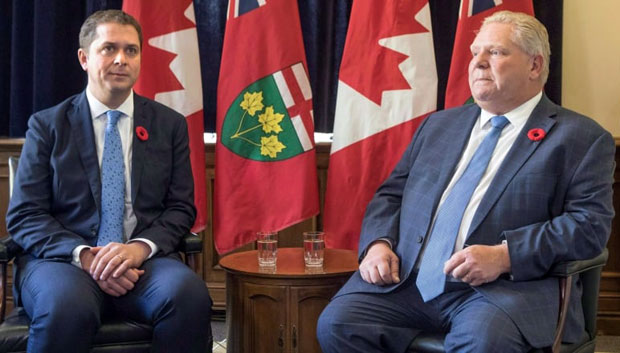
By the way, please enjoy this extra bonus content of Scheer (right) and Ford (right right) caught in a moment of rousing discourse.

I’m not sure how it’s possible over the deafening silence, but I can definitely hear the water evaporating out of those glasses. Even it doesn’t want to be there…

It’s important to keep in mind there are only ever 100% of the seats available to share in either the legislature or the house during an election. If one or more parties are getting more of their fair share, then other parties are getting less of their fair share. In 2015 and with 39% of the votes, Trudeau’s Liberals got 54% of the seats in the house. Some of those seats were taken, for example, from the NDP who with 20% of the votes only got 13% of the seats. Roll forward to 2019 and the Green Party gets the most votes they’ve ever received—about 1.1 million votes—but even with 6.5% of the votes, they got just 0.99% of the seats.

It’s also important to keep in mind the 2015 election was to be the last general election held using the first‐past‐the‐post system. Only it wasn’t. This abandoned change was not only an election promise made by the subsequently elected Liberal party, it was a change supported by all the major federal parties except one: the Conservative Party—who I’m guessing now might be a little more interested in an electoral system based on proportional representation than they were in 2015. While they didn’t get the most seats in 2019, they did get the most votes. How’s that shoe fit, eh?

I recently received the following text message on my mobile phone:

It's the Conservative Party of Canada.
We are choosing a new leader. Are you interested in having your voice heard?
Reply:
Yes
No

It’s a curious message to receive over text. But among the many curious texts I receive, it’s also a highly suspicious message. The sending phone number traces back to a landline in Kingston, but there’s no online reference to the number linking it to any party office. And why would there be? Political messaging is exempt from Canada’s anti‐spam legislation, so there’s no need to respect an opt‐out list. The clumsiness of execution and lack of authenticity suggest it’s not legit. Yet the clumsiness of execution and lack of authenticity also suggest it may be an official communiqué.

However, in the moment, I feel like I’m being passed a note during high school:

It's Tammy from 2nd period social studies.
I might know someone who likes you. Do you want to have lunch together?
Check:
♡ Yes
♡ No

And in considering Tammy’s—uh—the Conservative Party’s request, I’m reminded of a series of graphics I’d saved from the CBC website last October. There was a questionnaire on how one’s own political views aligned with the policies of the major federal parties. I often feel underrepresented in federal politics, but I completed the questionnaire anyway to confirm if my feeling had any basis in reality, or at least in political reality.

The results were interesting, so I saved some of the more interesting ones to compile into what would have been a timely election‐themed post… and then, like an election promise to myself, I considered it thoughtfully before allowing it the dignity of being quietly forgotten. But with an election that’s never truly over, and the issue I found the most relevant last October even more relevant today, now’s the time to be timely.

The Spectrum

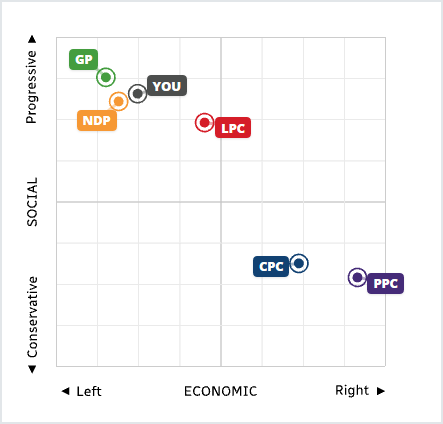
To start, the questionnaire produced a quadrant graph illustrating where I sit in reference to socioeconomic issues as compared to the 2019 election platforms of the major federal political parties except for one: the Bloc Québécois. I didn’t think to check if the Radio‐Canada website produced their own version of the questionnaire and included the party, but I’m guessing it was omitted from CBC’s since no one outside Quebec could vote for a Bloc candidate.

I was not entirely surprised by the above. In fact I was relieved to discover my feelings of underrepresentation in Ottawa were not imagined. The gap between myself and the Liberal Party explains why I’ve never been fully impressed by their socioeconomic polices. They all feel like they’d be standard stuff in a modern and progressive society, something Canada claims to be. But the chasm between myself and the parties on the right—yeah. No wonder I have so much difficulty seeing things the same way they do. We’re nowhere near the other on anything.

The Parties

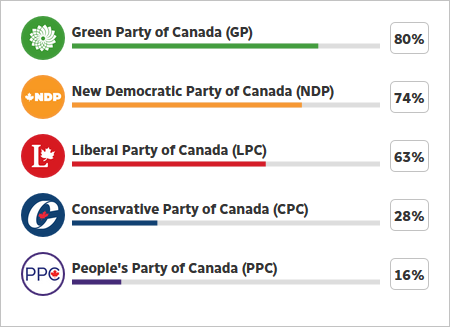
Next, the questionnaire produced a percentage‐based bar graph where parties and their policies were ranked as they aligned with my own views.

This time I was little surprised. First, while I am closer to the New Democratic Party on the political quadrant graph than I am to the Green Party, it appears the Green Party does a slightly better job of creating policy I tend to agree with compared to the NDP.

And second, while the quadrant graph demonstrates a clear ideological disconnect with the Conservative and People’s Party of Canada, it also appears there might be a few small areas where our views are similar. I’m immediately creeped out and curious about where those small areas are, so I started looking for them in the subsequent results of the questionnaire.

The Leaders

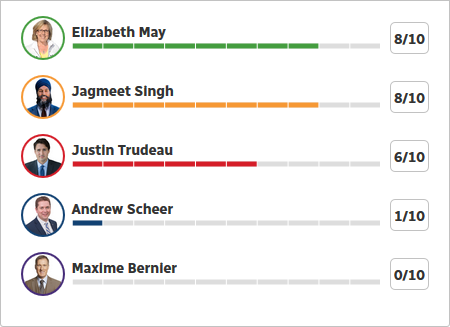
But before those results, these results are the questionnaire’s assessment of each party’s leadership as being likely to represent the issues which matter most to me.

No surprises here, other than Andrew Scheer’s possible 1/10. …what was he going to do for me? I guess I’ll never know. He gets an F.

I’m not entirely sure why I’m giving Elizabeth May and Jagmeet Singh the same leadership ranking despite the differing scores on each of their party’s policies. Perhaps the numbers average to suggest I view them as equally capable of representing my interests overall. An A- for both.

Embarrassingly, I must admit, I did buy into Trudeaumania-lite back in 2015. But since then Justin Trudeau has become a bit of a bumbling goofball, and it’s looking like he perhaps always was. He gets a C- for mediocre performance and poor behaviour.

And Maxime Bernier—oops. Having no knowledge of where Bernier came from or his political background, I remember initially reading the party name months ago and thought a heavily left‐leaning party had come out of nowhere and was running candidates in almost every riding. Seconds later I found out just how wrong I was. He gets an F+ for a perfectly complete failure.

The Issue

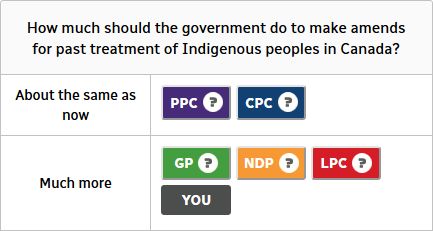
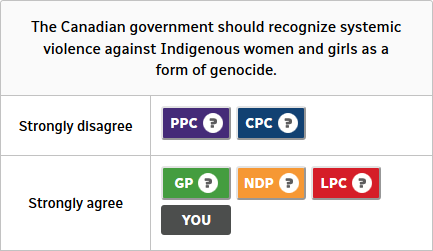
For me there was only one issue on election day in 2019: the continued advancement of Indigenous reconciliation.

From my perspective it will not be possible to completely or genuinely address contemporary issues of climate change and energy policy, nor issues of social inequities, sexism, or racism, until the fundamental contradiction of Canada’s existence as a nation is acknowledged and moves toward resolution. Today’s environmental and socioeconomic issues are faced by all who live on this land, but it’s obvious to me there is an imbalance between those who are facing those issues and those who are not. There is an imbalance between those who are living and experiencing those issues and those who are not. This imbalance is the contradiction.

With the above in mind, I’m calling out the source of the contradiction: Canada’s conservative politics.

It’s incredibly challenging to advance an issue when those who hold a balance of power fail to acknowledge there’s any more issue to advance. As an example, the Truth and Reconciliation Commission of Canada, in response to an investigation into the abuse present in Canada’s residential school system, produced 94 calls to action in 2015, 94 declarations that what was being done at the time was not enough. And that’s just one example, one set of findings. In 2008, Stephen Harper, then prime minister, apologized to the survivors of the residential school system. But a year later, Harper claimed there was no history of colonization in Canada.

The scope of denial is chilling, and the hypocrisy of it all the more challenging. These parties have no qualms aggressively underscoring the importance of protecting Canada from terrorism abroad, but they do nothing to acknowledge the most heinous forms of it occurring right here. Yet when the subject of natural resource development arises, suddenly the right strikes a reconciliatory tone, or at least their version of it. Suddenly there’s interest in acknowledging and consulting with land title holders. Suddenly there’s interest in sharing golden opportunities for economic development. It’s a foul double standard.

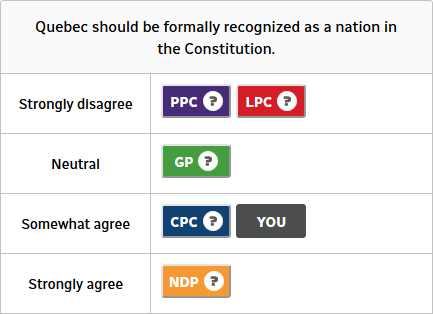
However, when it comes to broad strokes interpretations of Quebec sovereignty, it would appear I somewhat agree with the Conservatives on the idea of recognizing Quebec as a nation within Canada’s constitution. I’m perplexed but relieved: this happens to be the only time I agree with the Conservatives.

I didn’t expect to see both the Liberal and People’s Party strong resistance to the idea. Perhaps it would set an uncomfortable‐for‐some precedent. But I suspect this overlap in policy resulted in 16% of my views aligning with those of the People’s Party—although alignment via proxy might be more accurate as there was never a situation where the questionnaire suggested I agreed with the People’s Party about anything. And even this alignment via proxy is a stretch as it would suggest I’m somewhat in agreement with something I’m strongly against. Ah—politics.

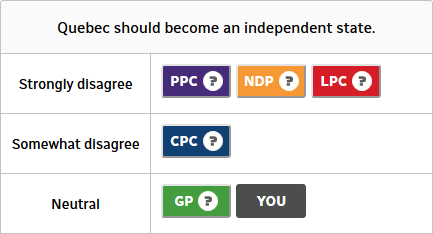
But what about Quebec as an independent state?

Now a resounding Conservative maybe has flipped to an emphatic perhaps not, I’ve joined the Greens who don’t have strong feelings one way or the other, leaving the Liberals, People’s Party, and now the NPD firmly saying non.

Looking back, the Green Party’s neutral position on Quebec’s sovereignty feels like the most appropriate, particularly within the context of reconciliation. It’s not up to English Canada to decide what French Canada can or cannot be.

And Finally

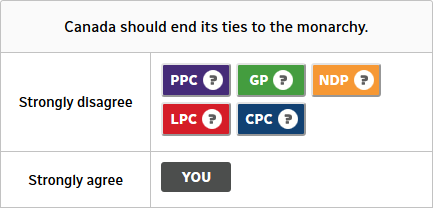
I was hoping there might be at least one instance where all the parties were able to agree on something. And there was!

They all don’t agree with me.

Perhaps tradition dictates any party intending to form Her Majesty’s Government would need to support the monarchy, the Crown. But again, in the context of reconciliation, does maintaining this traditional yet metaphorical power structure provide a suitable framework for the future relationship between Canada and Indigenous nations?

In Canada the Crown represents the foundational core of the federal and provincial executive, legislative, and judicial branches of government. While it technically forms the authority of the nation itself, from my perspective it’s just an outdated idea. I have no tangible relationship to the Crown other than its peculiar placement perched atop road signs or fancying up license plates. So detached am I in my relationship to the Crown I’ve given myself the bizarre privilege of being able to poke fun at it. Lucky me.

Indigenous nations have a markedly different relationship with the Crown, one that has seen it subverting, outlawing, and replacing the many and varied forms of Indigenous governance with its own ideas of what those forms should be. For hundreds of years the Crown has sought to frame and reframe the relationship Indigenous nations were permitted to have with their own cultures, their own traditions, and their own ancestral lands. The consequences have been appalling. A collective trauma is now experienced by Indigenous communities and their land as a result. To acknowledge and participate in the healing of this trauma is the collective responsibility of all Canadians, of all who come here to share this land together. And one good first step might be to take off the invisible crown some don’t even know they’re wearing.

The End

The featured image for this post is a concoction. It’s based on a much bigger picture, but I’ve cropped it so you only see one part of it. I’ve also pushed the contrast into an unreal place, where textured and subtle colours are replaced with brash black and white. Now lightness and darkness appear where they didn’t before. It’s a derived, distorted, and selective view designed to illustrate a point. It’s manipulation, pure and simple. And for some, manipulation is just politics. But to me there’s nothing just about it: manipulation is manipulation. It’s bad politics.

Now, despite my own attempt at bad politics, you still might know the source of the image from my fabrication. There’s a good chance you came across it every day in its entirety about 10 to 15 years ago, right at your fingertips. It’s the Spirit of Haida Gwaii, a sculpture featured on the reverse side of a Canadian $20 bill circulated between 2004 and 2012.

A bronze cast of the sculpture is also displayed at The Embassy of Canada in Washington, which is where I photographed it—or at least tired to. The courtyard surrounding the sculpture is filled with bright concrete and reflective glass. This along with the white bottomed pool of water under the sculpture, a late sunny summer day, and the position of the courtyard meant there was intense yet indirect light reflecting everywhere. It was difficult to authentically represent such an intricately detailed sculpture cast in such a contrasted material without either under or overexposing the work. Doubly difficult was representing the presence of the sculpture within the courtyard itself. It all looked perfectly balanced to my eye, but the perspective changed once viewed though the camera. The background and foreground collapsed into the other and everything went flat. Distance appeared where there was none before. It wasn’t the greatest lens for the situation, but it was all I had at the time.

The political landscape of Canada is one of a battlefield, and it’s littered with combative language. News articles are filled with campaigns, victories, opponents, adversaries, and defeats… It’s all a polite way of disguising one antiquated mindset, one concept that drives traditional, conservative politics: might is right.

And while that might feels right to those with the might, to those without and to those who have been left out, that might can feel like something else. That might can feel like control, like manipulation, like degradation, like humiliation. It can feel like there’s nothing right about it at all. A manufactured majority of might can believe it’s doing the right thing all it wants, but that’s no guarantee it’s doing the correct thing, especially if that majority is—for all intents and purposes—penalizing those who dare disagree.

An approach to politics based on winners and losers will produce combative results. It’s a consequence of language, and given enough time a combative approach will make losers of us all. Right now I primarily hear the language of combative politics spewing from Canada’s federal and provincial conservative parties. That’s not to say I don’t hear the other parties engaging in their own combat, but I’ve noticed a pattern in terms of who often fires the first shot. See—I do it as well. That’s how embedded this language is.

In a previous post I wrote of the need to listen before anything else. Listening takes time. Listening takes work. And listening can even be frightening. But it’s not ever something one experiences in solitude, because listening connects. Listening brings together to here.

So, Conservative Party of Canada—in asking if I’m interested in having my voice heard, you’re going to have to first consider the one lingering doubt I have about the spirit of the question. While I’m sure you’re willing to listen to my voice, what will happen when I ask you to listen to the voices of others? This is a land filled with diverse voices, yet many of them have been ignored, some for far too long. And if you’ve forgotten how to listen—it’s okay. Now’s the time to remember.

Just don’t take too long, because now is rapidly becoming all the time that’s left.

Reflow

Criteria for successful failure.

I like to repair things.

There’s an incredible sense of satisfaction looking at something that wasn’t functioning as intended and seeing it’s now working just fine. It’s magical. To repair something, to bring it back, there is an amount of understanding that must be gained first. There’s an amount of learning that comes with it. That’s magical, too. And as I so often recall from Zen and the Art of Motorcycle Maintenance: solutions are easy—problems are hard.

The challenge isn’t found in the repair itself.

Over the Labour Day long weekend I was going to have a friend visit. Not really sure what we might get up to, I decided to charge the controllers for my PlayStation 3 so we’d have the option of playing video games. The console and controllers hadn’t been used for a while, so I didn’t want the batteries to go flat in the middle of a game.

For some reason only understood by what I’m sure must be the most intelligent designers at Sony, the controllers will only charge if they are connected a console that is running. Plugging the controllers into the unit while it’s in standby mode will do nothing. So I leave the entire system—the most powerful computer in my apartment—idling all night so it can act as nothing more than a mobile phone charger.

The next day I discover the PlayStation has turned itself off at some point during the night. A blinking red light on the front of the console is telling me—after looking up what it means—the system realized it was getting too hot and powered down before any internal components were damaged from excess heat. Perplexed as to just how the system could possibly overheat while it was doing nothing other than slowly charging two controllers, I restart it.

The console spins up, beeps three times, spins down, flashes a yellow light at me, and then goes silent as the blinking red light returns. So I look up what that means, and the answer isn’t great. Referred to as the Yellow Light of Death on the internet, the console has experienced a “catastrophic thermal event” as one site delightfully articulates. In other words, the system realized it was getting too hot, powered down before any internal components were damaged from excess heat, and damaged its internal components anyway.

I’m… immediately irritated. Not because the system is ruined—no. It’s because the system is ruined for such a menial reason. To me a catastrophic thermal event means the console cooked itself as it entered hour eight of a reckless night of video games, or just as the final disc of a Harry Potter marathon was wrapping up. That’s a catastrophic thermal event. But to go out while idling all night, being asked to do nothing more than quietly charge a couple of controllers? It didn’t feel a befitting end to such a fine machine.

I also don’t like wasting things.

This, together with liking to repair things, means I’m not quick to replace something just because it’s stopped working. Chances are I’ll take it apart, figure out what’s gone wrong, figure out how to make it go right again, put it all back together, and it will be working. And this is what I told myself was going to happen with my ruined PlayStation. I wasn’t going to go spend money I didn’t really have to replace something that wasn’t really broken. Instead I was going to save money, which would be good for me, and keep one more piece of consumer electronics out of the waste stream, which would be good for the environment. A win for me and a win the environment—the best result ever!

But it didn’t happen. Not even close. The entire project literally went up in smoke. Acrid, apartment‐filling smoke. It was a perfect failure. Not only did I fail to repair the console, but on reflection, even if I had repaired it, I still would have failed to fulfill the criteria I’d used to justify repairing instead of replacing the console. …Wait, what?

Let’s break it down—

Criterion № 1: Save Money

A brand new PlayStation 3—yes, they are still for sale new—is around $150 to $200 depending on how you want to spec it out. For a used console you’d be looking anywhere from $20 and up.

All‐in, I spent $77 trying and failing to repair the console. Some of the supplies I needed, tin foil, cotton swabs, an oven thermometer, I will use for other things, so in fairness, let’s say I spent $65. It’s still $65 spent under the guise of saving money that actually ended up costing me more money in the end—especially since in the end the console was still ruined. Had I learned nothing from the story of the shitty can opener?

There’s also my time. I spent about 10 hours in total on this project—no, wait: that’s just actual time spent on the repair attempt itself. There were hours of research prior, and I would leave for work early to detour to stores to collect what I needed. Taking that into account, my time investment might be closer to 15 hours. That’s just under two days of paid work time. Not that it’s possible to put a dollar value on someone’s time—despite it being attempted day in and day out all over the world—but this was time I may have spent otherwise visiting friends and family, reading peacefully, or working on writing projects.

So even if the repair had been successful, I would still have to ask myself: was 15 hours of my time plus $65 actually saving me money? The answer is no. I could have spent up to an hour looking around online for a used console for $50 and have spent up to another hour picking it up.

But that’s just looking through the money lens. My more altruistic goal of saving the environment surly justifies the extra hours of my time plus a few more of my dollars invested in trying to repair something versus replacing it.

Only it doesn’t. Because it didn’t.

Criterion № 2: Save the Environment

This is a counterintuitive conclusion, but—in hindsight—I believe it’s the correct conclusion. My reasoning for wanting to repair the console was to prevent it from ending up in the waste stream, but that didn’t happen. I dropped it off for recycling just the other day.

I also wanted to repair the console to preclude the need to manufacture another one, thereby saving energy and resources that could be put to other uses. But that didn’t happen either. Even if I had repaired the console, any energy and resources I would have saved from the manufacture of a new one are cancelled out by the energy and resources I needed to repair mine. The solder flux I used was shipped from Greece. It had to be transported thousands of kilometres, and it was full of nasty chemicals when it got here. I bought a roll of aluminum foil that required massive amounts of electricity to make. I used sticky tack manufactured in China using rubber, cotton swabs manufactured in America using cotton. All these materials spent time on airplanes, container ships, and trucks before they got to me. The environmental footprint I was hoping to reduce by repairing versus replacing may have just been an illusion.

A used console has already been made. The environmental footprint has already been realized. And if I’m buying a used console from someone that may otherwise have just thrown it out, that fulfills both my desire to prevent one more new console being manufactured and to prevent one more used console from ending up in the waste stream. But that used console I could have bought has possibly ended up in the waste stream. I know for sure mine did. And I’ve used just as many, if not more resources in trying to repair my console than it would have taken to make a new one. The environment is no better off, in fact the environment might be worse off.

Criterion № 3: Functioning PlayStation

There’s no debate on this one, no thoughtful consideration and reflection. Attempting to use a kitchen oven to reflow the solder joints on the CPU, GPU, and other TLA chips on the motherboard was not successful. The smoke point of the solder flux was reached before the proper melt point of the solder was, so the entire process had to be aborted as clouds of chemical smoke filled my apartment. As the board was cooling at least one component became unseated and dropped off, and I found a “secret” battery not included on the tutorial I was following had exploded and melted into its holder. These were both irrecoverable events and meant the console was now completely ruined.

So—three unfulfilled project criteria: one failed project.

This brings a curious question to mind: what was the threshold for this project’s success? In retrospect it’s clear there were three project objectives and as none of them were achieved the project was unsuccessful. But were there three objectives to this project? Or was there just one? The objective was to save money. The objective was the save the environment. The objective was to have a functioning PlayStation. However; in determining overall success, I was only considering the results of last objective, of the console being functional. The status of the other two objectives of the project become lost and begin to appear as successful, an illusion reinforced through a singular view of an agreeable end result.

And the worst part about this? I’m only looking this hard at the project because it failed. I’ve never looked this hard at a project that resulted in success. Why would I need to? The project worked. I congratulate myself and move on to the next project. But this is not ideal. How many “successful” projects have I walked away from which may have ended up completely off the rails? Had the console been repaired I would have concluded the project was successful having only evaluated 1 out of 3 criteria. A full evaluation would reveal only 1 out of 3 criteria were achieved. Is 34% a passing grade? Not even close. So what happened?

Let’s go back to Motorcycle Repair: what was my problem? Obviously it was my broken PlayStation.

Incorrect.

Let’s try that again: what was my problem? …I was broke.

Correct.

I couldn’t afford to have someone else properly repair what was broken, I certainly couldn’t afford to replace what was broken with something new, and I doubted I could even replace what was broken with something used.

In the moment the idea of repairing the console myself solved both the real problem of being broke and the tangential problem of having a broken PlayStation. So as much as I fault the false economy of continually re-buying the same shitty can opener, I find myself with new insight into why it was purchased in the first place: cans needed opening. Why? Because kids and cats were hungry.

Criterion № 4: Learn

…to repair something, to bring it back, there is an amount of understanding that must be gained first.

Last Year’s Words

Displaced.

It’s 2019 out there somewhere. It’s also 2231, 1832, 1974 …

Pick a year. Pick a time. It’s all happening somewhere. Sorry, spoilers, but yes, out there, way out there, is all time and all things. Everything is always happening everywhere. I used to think time is what kept everything from happening all at once, but it turns out its distance, or perhaps more accurately, displacement. What keeps 1756 from stepping on the toes of 1358 or 2149? Hundreds of years of time you say? No. Displacement. The 14th century is still happening. Just like the 18th, and the 22nd century. Our distance, our displacement, from those years is what keeps them from being here, wherever here is.

So if you want to travel through time…

  1. throw away your watch—it’s only reinforcing the illusion
  2. learn to navigate through spacetime displacement

…simple enough, right? I think so.

But if I’m completely honest, I suspect any answers thought to be found in the future or past will result in the same questions attempting to be dodged in the present. Remember: no matter where you go, there you are…

George Orwell, sometimes known as Eric Arthur Blair, and certainly never known as Orson Welles as I had confusedly thought, was a time traveller. He wrote out of time, something I tend to believe most writers do. How else—other than just by flipping the last two numbers around could—could Orwell see 1984 in 1948? Imagination? Sure. Displacement? Isn’t imagination is just another way of encapsulating displacement? Think about it. Imagine it. Displace the thoughts you have about now… What takes their place? Your imagination.

I’ve been working on an unofficial goal to produce approximately one post every week. Last week’s double post certainly helped shore up the numbers as the initial flood of inspiration has receded slightly. The ebb and flow of my tidal waves of words need all the help they can get—though it would appear I’m filled to brim in terms of aqua‐based allusions.

To help plug some of the gaps, I’m going to be posting things that are already written—this week’s original post is proving incredibly difficult to complete, so this post now is also something of a twofer: it helps me toward my weekly post goal, and it also concludes a draft post started quite some time ago. Just how quite ago will become clear at the end.

But first—Orwell and a hanging:

It was in Burma, a sodden morning of the rains. A sickly light, like yellow tinfoil, was slanting over the high walls into the jail yard. We were waiting outside the condemned cells, a row of sheds fronted with double bars, like small animal cages. Each cell measured about ten feet by ten and was quite bare within except for a plank bed and a pot of drinking water. In some of them brown silent men were squatting at the inner bars, with their blankets draped round them. These were the condemned men, due to be hanged within the next week or two.

One prisoner had been brought out of his cell. He was a Hindu, a puny wisp of a man, with a shaven head and vague liquid eyes. He had a thick, sprouting moustache, absurdly too big for his body, rather like the moustache of a comic man on the films. Six tall Indian warders were guarding him and getting him ready for the gallows. Two of them stood by with rifles and fixed bayonets, while the others handcuffed him, passed a chain through his handcuffs and fixed it to their belts, and lashed his arms tight to his sides. They crowded very close about him, with their hands always on him in a careful, caressing grip, as though all the while feeling him to make sure he was there. It was like men handling a fish which is still alive and may jump back into the water. But he stood quite unresisting, yielding his arms limply to the ropes, as though he hardly noticed what was happening.

Eight o’clock struck and a bugle call, desolately thin in the wet air, floated from the distant barracks. The superintendent of the jail, who was standing apart from the rest of us, moodily prodding the gravel with his stick, raised his head at the sound. He was an army doctor, with a grey toothbrush moustache and a gruff voice. “For God’s sake hurry up, Francis,” he said irritably. “The man ought to have been dead by this time. Aren’t you ready yet?”

Francis, the head jailer, a fat Dravidian in a white drill suit and gold spectacles, waved his black hand. “Yes sir, yes sir,” he bubbled. “All iss satisfactorily prepared. The hangman iss waiting. We shall proceed.”

“Well, quick march, then. The prisoners can’t get their breakfast till this job’s over.”

We set out for the gallows. Two warders marched on either side of the prisoner, with their rifles at the slope; two others marched close against him, gripping him by arm and shoulder, as though at once pushing and supporting him. The rest of us, magistrates and the like, followed behind. Suddenly, when we had gone ten yards, the procession stopped short without any order or warning. A dreadful thing had happened — a dog, come goodness knows whence, had appeared in the yard. It came bounding among us with a loud volley of barks, and leapt round us wagging its whole body, wild with glee at finding so many human beings together. It was a large woolly dog, half Airedale, half pariah. For a moment it pranced round us, and then, before anyone could stop it, it had made a dash for the prisoner, and jumping up tried to lick his face. Everyone stood aghast, too taken aback even to grab at the dog.

“Who let that bloody brute in here?” said the superintendent angrily. “Catch it, someone!”

A warder, detached from the escort, charged clumsily after the dog, but it danced and gambolled just out of his reach, taking everything as part of the game. A young Eurasian jailer picked up a handful of gravel and tried to stone the dog away, but it dodged the stones and came after us again. Its yaps echoed from the jail wails. The prisoner, in the grasp of the two warders, looked on incuriously, as though this was another formality of the hanging. It was several minutes before someone managed to catch the dog. Then we put my handkerchief through its collar and moved off once more, with the dog still straining and whimpering.

It was about forty yards to the gallows. I watched the bare brown back of the prisoner marching in front of me. He walked clumsily with his bound arms, but quite steadily, with that bobbing gait of the Indian who never straightens his knees. At each step his muscles slid neatly into place, the lock of hair on his scalp danced up and down, his feet printed themselves on the wet gravel. And once, in spite of the men who gripped him by each shoulder, he stepped slightly aside to avoid a puddle on the path.

It is curious, but till that moment I had never realized what it means to destroy a healthy, conscious man. When I saw the prisoner step aside to avoid the puddle, I saw the mystery, the unspeakable wrongness, of cutting a life short when it is in full tide. This man was not dying, he was alive just as we were alive. All the organs of his body were working — bowels digesting food, skin renewing itself, nails growing, tissues forming — all toiling away in solemn foolery. His nails would still be growing when he stood on the drop, when he was falling through the air with a tenth of a second to live. His eyes saw the yellow gravel and the grey walls, and his brain still remembered, foresaw, reasoned — reasoned even about puddles. He and we were a party of men walking together, seeing, hearing, feeling, understanding the same world; and in two minutes, with a sudden snap, one of us would be gone — one mind less, one world less.

The gallows stood in a small yard, separate from the main grounds of the prison, and overgrown with tall prickly weeds. It was a brick erection like three sides of a shed, with planking on top, and above that two beams and a crossbar with the rope dangling. The hangman, a grey-haired convict in the white uniform of the prison, was waiting beside his machine. He greeted us with a servile crouch as we entered. At a word from Francis the two warders, gripping the prisoner more closely than ever, half led, half pushed him to the gallows and helped him clumsily up the ladder. Then the hangman climbed up and fixed the rope round the prisoner’s neck.

We stood waiting, five yards away. The warders had formed in a rough circle round the gallows. And then, when the noose was fixed, the prisoner began crying out on his god. It was a high, reiterated cry of “Ram! Ram! Ram! Ram!”, not urgent and fearful like a prayer or a cry for help, but steady, rhythmical, almost like the tolling of a bell. The dog answered the sound with a whine. The hangman, still standing on the gallows, produced a small cotton bag like a flour bag and drew it down over the prisoner’s face. But the sound, muffled by the cloth, still persisted, over and over again: “Ram! Ram! Ram! Ram! Ram!”

The hangman climbed down and stood ready, holding the lever. Minutes seemed to pass. The steady, muffled crying from the prisoner went on and on, “Ram! Ram! Ram!” never faltering for an instant. The superintendent, his head on his chest, was slowly poking the ground with his stick; perhaps he was counting the cries, allowing the prisoner a fixed number — fifty, perhaps, or a hundred. Everyone had changed colour. The Indians had gone grey like bad coffee, and one or two of the bayonets were wavering. We looked at the lashed, hooded man on the drop, and listened to his cries — each cry another second of life; the same thought was in all our minds: oh, kill him quickly, get it over, stop that abominable noise!

Suddenly the superintendent made up his mind. Throwing up his head he made a swift motion with his stick. “Chalo!” he shouted almost fiercely.

There was a clanking noise, and then dead silence. The prisoner had vanished, and the rope was twisting on itself. I let go of the dog, and it galloped immediately to the back of the gallows; but when it got there it stopped short, barked, and then retreated into a corner of the yard, where it stood among the weeds, looking timorously out at us. We went round the gallows to inspect the prisoner’s body. He was dangling with his toes pointed straight downwards, very slowly revolving, as dead as a stone.

The superintendent reached out with his stick and poked the bare body; it oscillated, slightly. “He’s all right,” said the superintendent. He backed out from under the gallows, and blew out a deep breath. The moody look had gone out of his face quite suddenly. He glanced at his wrist-watch. “Eight minutes past eight. Well, that’s all for this morning, thank God.”

The warders unfixed bayonets and marched away. The dog, sobered and conscious of having misbehaved itself, slipped after them. We walked out of the gallows yard, past the condemned cells with their waiting prisoners, into the big central yard of the prison. The convicts, under the command of warders armed with lathis, were already receiving their breakfast. They squatted in long rows, each man holding a tin pannikin, while two warders with buckets marched round ladling out rice; it seemed quite a homely, jolly scene, after the hanging. An enormous relief had come upon us now that the job was done. One felt an impulse to sing, to break into a run, to snigger. All at once everyone began chattering gaily.

The Eurasian boy walking beside me nodded towards the way we had come, with a knowing smile: “Do you know, sir, our friend (he meant the dead man), when he heard his appeal had been dismissed, he pissed on the floor of his cell. From fright. — Kindly take one of my cigarettes, sir. Do you not admire my new silver case, sir? From the boxwallah, two rupees eight annas. Classy European style.”

Several people laughed — at what, nobody seemed certain.

Francis was walking by the superintendent, talking garrulously. “Well, sir, all hass passed off with the utmost satisfactoriness. It wass all finished — flick! like that. It iss not always so — oah, no! I have known cases where the doctor wass obliged to go beneath the gallows and pull the prisoner’s legs to ensure decease. Most disagreeable!”

“Wriggling about, eh? That’s bad,” said the superintendent.

“Ach, sir, it iss worse when they become refractory! One man, I recall, clung to the bars of hiss cage when we went to take him out. You will scarcely credit, sir, that it took six warders to dislodge him, three pulling at each leg. We reasoned with him. “My dear fellow,” we said, “think of all the pain and trouble you are causing to us!” But no, he would not listen! Ach, he wass very troublesome!”

I found that I was laughing quite loudly. Everyone was laughing. Even the superintendent grinned in a tolerant way. “You’d better all come out and have a drink,” he said quite genially. “I’ve got a bottle of whisky in the car. We could do with it.”

We went through the big double gates of the prison, into the road. “Pulling at his legs!” exclaimed a Burmese magistrate suddenly, and burst into a loud chuckling. We all began laughing again. At that moment Francis’s anecdote seemed extraordinarily funny. We all had a drink together, native and European alike, quite amicably. The dead man was a hundred yards away.

I quote myself in response:

Many interesting readings were covered this semester—but my favourite by far was George Orwell’s “A Hanging.” His writing above all others was the most artful in its presence. On one hand is his literal narration of the hanging of a condemned man. On the other is a subtle commentary on the ugliness of empire‐building, how it attempts to render futile any moral objections brought against its progress. It is in this subtle purpose where I appreciate good writing. Good writing need not make its point with a sledgehammer, and I’ve found the writing I enjoy the most will appear, at least superficially, to be making no point whatsoever—it is simply there for the reader to read.

Orwell could have written an essay in the style of Paul Harrison’s “The Westernization of the World”, assembling bits and pieces from other moments in time into a single commentary on a broad topic. Harrison took a much larger story and turned it into smaller ones so he could make his point, as if he were talking to me directly about it. Orwell did the reverse. He used small moments from a single time to tell a much larger story. Orwell created a world I felt a part of, as if I was there with him watching the dead man walking around the puddle of water, as if wet feet were going to matter in a few minutes. Orwell wasn’t saying anything directly to me—he didn’t need to. Instead it was as if his writing itself turned to me on the morning of the hanging to catch my eye, in that moment of Kierkegaardian absurdity, to confirm if I was indeed seeing the same moment.

So as we lift our glasses to the passing of 2018 to 2019, as we raze one year and raise another, give pause for displacement and consider: time is but only another form of distance.

Safe travels.

So You Want to Talk About Race?

You’re going to have to listen first.

It’s happened: I’ve started listening to CBC radio on the drive into work.

This isn’t a tongue‐in‐cheek commentary on trading youth for maturity, whatever that means. It’s a declaration: my mind is craving conversation. It wants to be engaged. It wants to be challenged. It wants to consider and expand its understanding of the issues and implications of what’s going on around it. It wants to be free.

And so do I.

Commercial radio was not providing any of the above. Commercial radio is just commercials. The music? Listen carefully. Those are also commercials. A commercial radio station is just one big packaged advertisement. I would jokingly refer to garbage pop songs as junk food for my ears. But things are a little more serious now: what sits between my ears? Like I said, listen carefully.

Yesterday I was listing to an interview with Ijeoma Oluo, a Seattle‐based author whoes book title I have used for the title of this post. I wouldn’t dare attempt a summary of a book I haven’t read based solely on a 45 minute conversation with its author. But from what I heard on the radio, one theme of the book surrounds white privilege. I’m paraphrasing now, but at the core of any racist structure will be privilege. Racism requires privilege, and privilege requires the uninformed. Or as Oluo puts it:

Being privileged doesn’t mean that you are always wrong and people without privilege are always right. It means that there is a good chance you are missing a few very important pieces of the puzzle.

In 2014 I challenged myself to honestly examine the privileged life I’ve been afforded, a life I didn’t even know I was living for the majority of it.

In retrospect, the first few years of examination went nowhere. I was in denial, groundlessly congratulating myself for believing I was aware and intune with something I was actually preventing myself from seeing. I subtly pushed back on any suggestions of privilege in my life, subconsciously allowing this privilege to continue through some deeply embedded cultural fail‐safe mechanism. I talked a lot of talk.

But something changed in early 2018. I stopped talking—I started to listen.

The voice constantly reaffirming I wasn’t part of the problem was instructed to sit quietly in the back row of the theatre of my mind. I listened to the words my family would say, the words my friends and neighbours would say, the words my classmates and coworkers would say. I would listen to all the words the newsreaders and politicians would say. I’d listen to the words of strangers on their cellphones speaking in other languages, the tone of their talk acting as a translator.

I began to hear something…

In the second semester of my Energy Systems Engineering program, as part of the communications component, I was asked to write responses to a number of readings as part of my assignments. I found myself unable to respond to one reading in the same ease I’d become accustomed to with the others. I wrote of this difficulty, this unease:

Brent Staples in 1986 wrote an essay entitled “Just Walk On By” where he chronicles his experiences growing up as a black man in America during the 1960s and onward. He found himself viewed as a threatening menace, or potentially violent, and undeserving of the benefit of the doubt. People would cross to the other side of street to avoid him or question the reasons for him to be in legitimate places, such as the lobbies of office buildings or even just browsing an open store. Staples—a softy by his own admission—realized it didn’t matter how legitimate his reasons for being anywhere were, the perception was, based on his appearance, that he must somehow be in the wrong place at best, and a threat at worst.

As upsetting as it is to read of what he experienced then, it is equally if not more upsetting to know his experiences are still mirrored today over thirty year later. I recall listening to an address by President Obama in 2013 where he spoke candidly on the need for context in understanding what black Americans, black American men in particular, experience as part of racism:

There are very few African American men in this country who haven’t had the experience of being followed when they were shopping in a department store. That includes me. There are very few African American men who haven’t had the experience of walking across the street and hearing the locks click on the doors of cars. That happens to me—at least before I was a senator. There are very few African Americans who haven’t had the experience of getting on an elevator and a woman clutching her purse nervously and holding her breath until she had a chance to get off. That happens often.

I find myself lacking the context to respond in what I feel is an honest, meaningful way. In what context can I claim to understand or know what it feels like to have to assert myself as a nonviolent individual when I have the luxury of it being assumed? I would have to expend effort to be considered dangerous. I would have to on purpose act intimidating and threatening. Staples only had to arrive where he was supposed to be—the effortlessness of a silent assumption robbing him of his dignity and assassinating his character before he’s had a chance to do or say otherwise. This in part must be why Staples would whistle melodies from Beethoven and Vivaldi at times when he wanted to ease potential tensions—as a way to chase away the silence, as a way to swap one assumption for another.

That lack of context for understanding what Staples experienced in his life, that unease I experienced in attempting to relate to something I found unrelatable: that is my privilege. That is the uninformed part of me where racism is perpetuated. The privilege I experience as a white man is one of context. This context in turn drives circumstance around me in a different manor as compared to someone who isn’t a white man. Don’t believe me?

What did the media say white people were doing in Houston during the aftermath of Hurricane Harvey as they were trying in desperation to secure the means survive? Scavenging for food. And black people who were doing the same in New Orleans after Katrina? Looting.

Like I said, listen carefully.

As the radio interview concluded, as I converged on one of the most multicultural cities in the world, I felt my eyes brimming. Any understanding I thought I had gained in the last five years surrounding the breadth and depth of my privilege had been challenged as insufficient in less than an hour. I realized there was still so much to hear—and I wanted to hear it.

I will be listening carefully.