Reflow

Criteria for successful failure.

I like to repair things.

There’s an incredible sense of satisfaction looking at something that wasn’t functioning as intended and seeing it’s now working just fine. It’s magical. To repair something, to bring it back, there is an amount of understanding that must be gained first. There’s an amount of learning that comes with it. That’s magical, too. And as I so often recall from Zen and the Art of Motorcycle Maintenance: solutions are easy—problems are hard.

The challenge isn’t found in the repair itself.

Over the Labour Day long weekend I was going to have a friend visit. Not really sure what we might get up to, I decided to charge the controllers for my PlayStation 3 so we’d have the option of playing video games. The console and controllers hadn’t been used for a while, so I didn’t want the batteries to go flat in the middle of a game.

For some reason only understood by what I’m sure must be the most intelligent designers at Sony, the controllers will only charge if they are connected a console that is running. Plugging the controllers into the unit while it’s in standby mode will do nothing. So I leave the entire system—the most powerful computer in my apartment—idling all night so it can act as nothing more than a mobile phone charger.

The next day I discover the PlayStation has turned itself off at some point during the night. A blinking red light on the front of the console is telling me—after looking up what it means—the system realized it was getting too hot and powered down before any internal components were damaged from excess heat. Perplexed as to just how the system could possibly overheat while it was doing nothing other than slowly charging two controllers, I restart it.

The console spins up, beeps three times, spins down, flashes a yellow light at me, and then goes silent as the blinking red light returns. So I look up what that means, and the answer isn’t great. Referred to as the Yellow Light of Death on the internet, the console has experienced a “catastrophic thermal event” as one site delightfully articulates. In other words, the system realized it was getting too hot, powered down before any internal components were damaged from excess heat, and damaged its internal components anyway.

I’m… immediately irritated. Not because the system is ruined—no. It’s because the system is ruined for such a menial reason. To me a catastrophic thermal event means the console cooked itself as it entered hour eight of a reckless night of video games, or just as the final disc of a Harry Potter marathon was wrapping up. That’s a catastrophic thermal event. But to go out while idling all night, being asked to do nothing more than quietly charge a couple of controllers? It didn’t feel a befitting end to such a fine machine.

I also don’t like wasting things.

This, together with liking to repair things, means I’m not quick to replace something just because it’s stopped working. Chances are I’ll take it apart, figure out what’s gone wrong, figure out how to make it go right again, put it all back together, and it will be working. And this is what I told myself was going to happen with my ruined PlayStation. I wasn’t going to go spend money I didn’t really have to replace something that wasn’t really broken. Instead I was going to save money, which would be good for me, and keep one more piece of consumer electronics out of the waste stream, which would be good for the environment. A win for me and a win the environment—the best result ever!

But it didn’t happen. Not even close. The entire project literally went up in smoke. Acrid, apartment‐filling smoke. It was a perfect failure. Not only did I fail to repair the console, but on reflection, even if I had repaired it, I still would have failed to fulfill the criteria I’d used to justify repairing instead of replacing the console. …Wait, what?

Let’s break it down—

Criterion № 1: Save Money

A brand new PlayStation 3—yes, they are still for sale new—is around $150 to $200 depending on how you want to spec it out. For a used console you’d be looking anywhere from $20 and up.

All‐in, I spent $77 trying and failing to repair the console. Some of the supplies I needed, tin foil, cotton swabs, an oven thermometer, I will use for other things, so in fairness, let’s say I spent $65. It’s still $65 spent under the guise of saving money that actually ended up costing me more money in the end—especially since in the end the console was still ruined. Had I learned nothing from the story of the shitty can opener?

There’s also my time. I spent about 10 hours in total on this project—no, wait: that’s just actual time spent on the repair attempt itself. There were hours of research prior, and I would leave for work early to detour to stores to collect what I needed. Taking that into account, my time investment might be closer to 15 hours. That’s just under two days of paid work time. Not that it’s possible to put a dollar value on someone’s time—despite it being attempted day in and day out all over the world—but this was time I may have spent otherwise visiting friends and family, reading peacefully, or working on writing projects.

So even if the repair had been successful, I would still have to ask myself: was 15 hours of my time plus $65 actually saving me money? The answer is no. I could have spent up to an hour looking around online for a used console for $50 and have spent up to another hour picking it up.

But that’s just looking through the money lens. My more altruistic goal of saving the environment surly justifies the extra hours of my time plus a few more of my dollars invested in trying to repair something versus replacing it.

Only it doesn’t. Because it didn’t.

Criterion № 2: Save the Environment

This is a counterintuitive conclusion, but—in hindsight—I believe it’s the correct conclusion. My reasoning for wanting to repair the console was to prevent it from ending up in the waste stream, but that didn’t happen. I dropped it off for recycling just the other day.

I also wanted to repair the console to preclude the need to manufacture another one, thereby saving energy and resources that could be put to other uses. But that didn’t happen either. Even if I had repaired the console, any energy and resources I would have saved from the manufacture of a new one are cancelled out by the energy and resources I needed to repair mine. The solder flux I used was shipped from Greece. It had to be transported thousands of kilometres, and it was full of nasty chemicals when it got here. I bought a roll of aluminum foil that required massive amounts of electricity to make. I used sticky tack manufactured in China using rubber, cotton swabs manufactured in America using cotton. All these materials spent time on airplanes, container ships, and trucks before they got to me. The environmental footprint I was hoping to reduce by repairing versus replacing may have just been an illusion.

A used console has already been made. The environmental footprint has already been realized. And if I’m buying a used console from someone that may otherwise have just thrown it out, that fulfills both my desire to prevent one more new console being manufactured and to prevent one more used console from ending up in the waste stream. But that used console I could have bought has possibly ended up in the waste stream. I know for sure mine did. And I’ve used just as many, if not more resources in trying to repair my console than it would have taken to make a new one. The environment is no better off, in fact the environment might be worse off.

Criterion № 3: Functioning PlayStation

There’s no debate on this one, no thoughtful consideration and reflection. Attempting to use a kitchen oven to reflow the solder joints on the CPU, GPU, and other TLA chips on the motherboard was not successful. The smoke point of the solder flux was reached before the proper melt point of the solder was, so the entire process had to be aborted as clouds of chemical smoke filled my apartment. As the board was cooling at least one component became unseated and dropped off, and I found a “secret” battery not included on the tutorial I was following had exploded and melted into its holder. These were both irrecoverable events and meant the console was now completely ruined.

So—three unfulfilled project criteria: one failed project.

This brings a curious question to mind: what was the threshold for this project’s success? In retrospect it’s clear there were three project objectives and as none of them were achieved the project was unsuccessful. But were there three objectives to this project? Or was there just one? The objective was to save money. The objective was the save the environment. The objective was to have a functioning PlayStation. However; in determining overall success, I was only considering the results of last objective, of the console being functional. The status of the other two objectives of the project become lost and begin to appear as successful, an illusion reinforced through a singular view of an agreeable end result.

And the worst part about this? I’m only looking this hard at the project because it failed. I’ve never looked this hard at a project that resulted in success. Why would I need to? The project worked. I congratulate myself and move on to the next project. But this is not ideal. How many “successful” projects have I walked away from which may have ended up completely off the rails? Had the console been repaired I would have concluded the project was successful having only evaluated 1 out of 3 criteria. A full evaluation would reveal only 1 out of 3 criteria were achieved. Is 34% a passing grade? Not even close. So what happened?

Let’s go back to Motorcycle Repair: what was my problem? Obviously it was my broken PlayStation.

Incorrect.

Let’s try that again: what was my problem? …I was broke.

Correct.

I couldn’t afford to have someone else properly repair what was broken, I certainly couldn’t afford to replace what was broken with something new, and I doubted I could even replace what was broken with something used.

In the moment the idea of repairing the console myself solved both the real problem of being broke and the tangential problem of having a broken PlayStation. So as much as I fault the false economy of continually re-buying the same shitty can opener, I find myself with new insight into why it was purchased in the first place: cans needed opening. Why? Because kids and cats were hungry.

Criterion № 4: Learn

…to repair something, to bring it back, there is an amount of understanding that must be gained first.
An Apology

In defense of the ceramic cooktop.

Keen followers may recall a particular post I made a few years ago where I attacked the ceramic cooktop and the implied lack of culinary appreciation their owners possessed.

…yikes.

To any and all who may have taken my comments to heart: I offer a sincere apology. The comments I made came from my own biased experiences with this sort of appliance. It turns out—and this might come as a shocker—my negative opinion of the ceramic cooktop stemmed from solely negative experiences with a ceramic cooktop.

In hindsight, as stupid, irritatingly obvious, and frustratingly satirical the feelings I had regarding the ceramic cooktop were, they—at the time—also felt like correct feelings. But in all honesty: I formed a negative opinion of the cooktop because it was different than what I was used to. I was unable to use it as effectively, no, as successfully, as what I was used to.

…yikes.

Why the change in attitude? Why the admission of ego‐based ignorance? My apartment now has a ceramic cooktop. And in learning how it behaves I’ve retroactively realized something odd: the first ceramic cooktop I was introduced to couldn’t have been real. It had to have been fake. A dangerous fake.

Back in 2011 I’d moved into a house with a ceramic cooktop. What I didn’t know then is someone must have taken a ceramic cooktop surface and installed it into the frame of a stove that was never designed for it. All the electronics and sensors that make it possible and safe for a ceramic cooktop to work were not there. This is why and how I would burn pots, ruin sauces, and eventually melt the glass surface itself. How could I have anything other than a horrible opinion of the ceramic cooktop? All the appliance did was ruin cooking I knew I could do better using any other sort of cooktop.

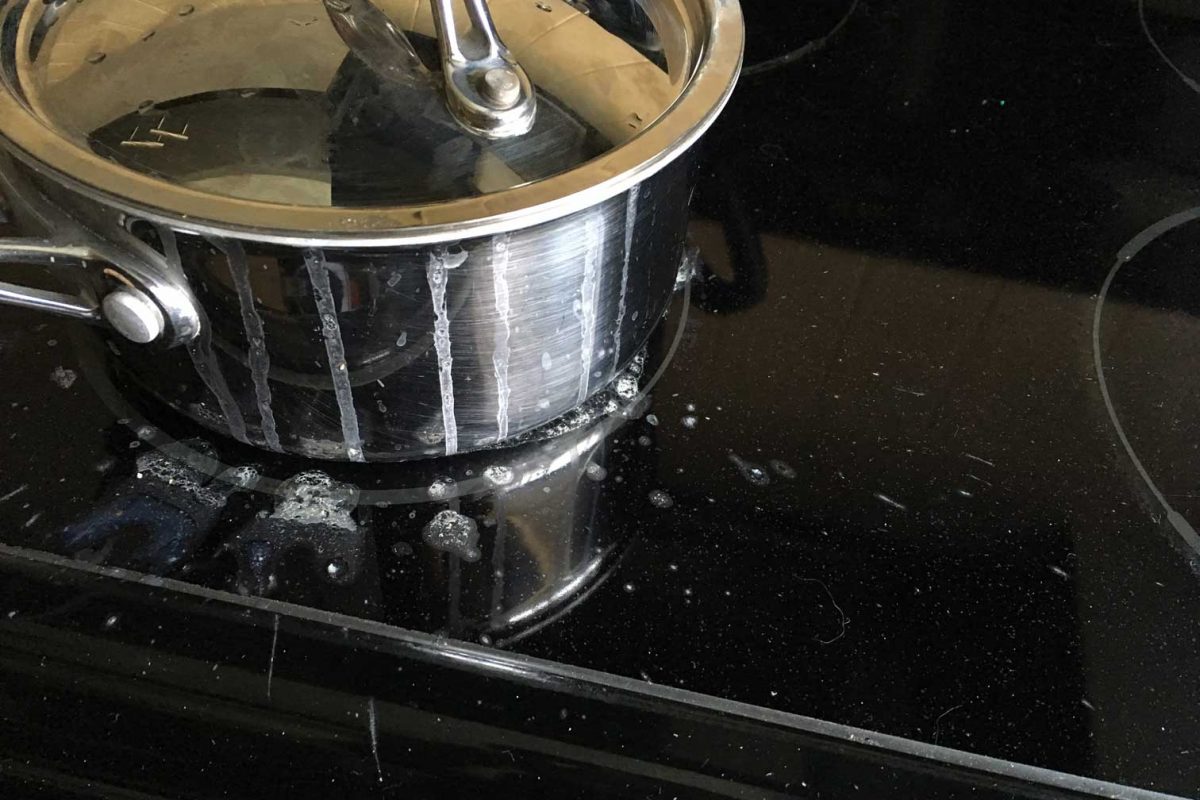
So how do I know the one at my old house was fake? Because my apartment now has the same cooktop, but this time it’s attached to the correct frame. It’s all electronically controlled. There are surface temperature sensors and rheostats designed for the ceramic elements. I hear them clicking away. Yes, there was a learning curve, but it’s one I’ve had time to appreciate and understand now that I’m not constantly burning everything. I can produce the results I’m expecting. I’m succeeding.

What are things people like in their life? Are they things that generate feelings of clueless and inept idiotic failure? Generally—no. The things people like in their life tend toward flattery. And I’ll admit it: I was little different in that regard when it came to the ceramic cooktop. Why have something in life that confounds when it can be ignorantly pushed aside under a flawed guise and have something comforting and familiar take its place instead. Sounds good, right?

Actually—no. Scale that thought up, warp severely with xenophobia, sprinkle liberally with racism, and that’s how genocide works.

…yikes.

Last Year’s Words

Displaced.

It’s 2019 out there somewhere. It’s also 2231, 1832, 1974 …

Pick a year. Pick a time. It’s all happening somewhere. Sorry, spoilers, but yes, out there, way out there, is all time and all things. Everything is always happening everywhere. I used to think time is what kept everything from happening all at once, but it turns out its distance, or perhaps more accurately, displacement. What keeps 1756 from stepping on the toes of 1358 or 2149? Hundreds of years of time you say? No. Displacement. The 14th century is still happening. Just like the 18th, and the 22nd century. Our distance, our displacement, from those years is what keeps them from being here, wherever here is.

So if you want to travel through time…

  1. throw away your watch—it’s only reinforcing the illusion
  2. learn to navigate through spacetime displacement

…simple enough, right? I think so.

But if I’m completely honest, I suspect any answers thought to be found in the future or past will result in the same questions attempting to be dodged in the present. Remember: no matter where you go, there you are…

George Orwell, sometimes known as Eric Arthur Blair, and certainly never known as Orson Welles as I had confusedly thought, was a time traveller. He wrote out of time, something I tend to believe most writers do. How else—other than just by flipping the last two numbers around could—could Orwell see 1984 in 1948? Imagination? Sure. Displacement? Isn’t imagination is just another way of encapsulating displacement? Think about it. Imagine it. Displace the thoughts you have about now… What takes their place? Your imagination.

I’ve been working on an unofficial goal to produce approximately one post every week. Last week’s double post certainly helped shore up the numbers as the initial flood of inspiration has receded slightly. The ebb and flow of my tidal waves of words need all the help they can get—though it would appear I’m filled to brim in terms of aqua‐based allusions.

To help plug some of the gaps, I’m going to be posting things that are already written—this week’s original post is proving incredibly difficult to complete, so this post now is also something of a twofer: it helps me toward my weekly post goal, and it also concludes a draft post started quite some time ago. Just how quite ago will become clear at the end.

But first—Orwell and a hanging:

It was in Burma, a sodden morning of the rains. A sickly light, like yellow tinfoil, was slanting over the high walls into the jail yard. We were waiting outside the condemned cells, a row of sheds fronted with double bars, like small animal cages. Each cell measured about ten feet by ten and was quite bare within except for a plank bed and a pot of drinking water. In some of them brown silent men were squatting at the inner bars, with their blankets draped round them. These were the condemned men, due to be hanged within the next week or two.

One prisoner had been brought out of his cell. He was a Hindu, a puny wisp of a man, with a shaven head and vague liquid eyes. He had a thick, sprouting moustache, absurdly too big for his body, rather like the moustache of a comic man on the films. Six tall Indian warders were guarding him and getting him ready for the gallows. Two of them stood by with rifles and fixed bayonets, while the others handcuffed him, passed a chain through his handcuffs and fixed it to their belts, and lashed his arms tight to his sides. They crowded very close about him, with their hands always on him in a careful, caressing grip, as though all the while feeling him to make sure he was there. It was like men handling a fish which is still alive and may jump back into the water. But he stood quite unresisting, yielding his arms limply to the ropes, as though he hardly noticed what was happening.

Eight o’clock struck and a bugle call, desolately thin in the wet air, floated from the distant barracks. The superintendent of the jail, who was standing apart from the rest of us, moodily prodding the gravel with his stick, raised his head at the sound. He was an army doctor, with a grey toothbrush moustache and a gruff voice. “For God’s sake hurry up, Francis,” he said irritably. “The man ought to have been dead by this time. Aren’t you ready yet?”

Francis, the head jailer, a fat Dravidian in a white drill suit and gold spectacles, waved his black hand. “Yes sir, yes sir,” he bubbled. “All iss satisfactorily prepared. The hangman iss waiting. We shall proceed.”

“Well, quick march, then. The prisoners can’t get their breakfast till this job’s over.”

We set out for the gallows. Two warders marched on either side of the prisoner, with their rifles at the slope; two others marched close against him, gripping him by arm and shoulder, as though at once pushing and supporting him. The rest of us, magistrates and the like, followed behind. Suddenly, when we had gone ten yards, the procession stopped short without any order or warning. A dreadful thing had happened — a dog, come goodness knows whence, had appeared in the yard. It came bounding among us with a loud volley of barks, and leapt round us wagging its whole body, wild with glee at finding so many human beings together. It was a large woolly dog, half Airedale, half pariah. For a moment it pranced round us, and then, before anyone could stop it, it had made a dash for the prisoner, and jumping up tried to lick his face. Everyone stood aghast, too taken aback even to grab at the dog.

“Who let that bloody brute in here?” said the superintendent angrily. “Catch it, someone!”

A warder, detached from the escort, charged clumsily after the dog, but it danced and gambolled just out of his reach, taking everything as part of the game. A young Eurasian jailer picked up a handful of gravel and tried to stone the dog away, but it dodged the stones and came after us again. Its yaps echoed from the jail wails. The prisoner, in the grasp of the two warders, looked on incuriously, as though this was another formality of the hanging. It was several minutes before someone managed to catch the dog. Then we put my handkerchief through its collar and moved off once more, with the dog still straining and whimpering.

It was about forty yards to the gallows. I watched the bare brown back of the prisoner marching in front of me. He walked clumsily with his bound arms, but quite steadily, with that bobbing gait of the Indian who never straightens his knees. At each step his muscles slid neatly into place, the lock of hair on his scalp danced up and down, his feet printed themselves on the wet gravel. And once, in spite of the men who gripped him by each shoulder, he stepped slightly aside to avoid a puddle on the path.

It is curious, but till that moment I had never realized what it means to destroy a healthy, conscious man. When I saw the prisoner step aside to avoid the puddle, I saw the mystery, the unspeakable wrongness, of cutting a life short when it is in full tide. This man was not dying, he was alive just as we were alive. All the organs of his body were working — bowels digesting food, skin renewing itself, nails growing, tissues forming — all toiling away in solemn foolery. His nails would still be growing when he stood on the drop, when he was falling through the air with a tenth of a second to live. His eyes saw the yellow gravel and the grey walls, and his brain still remembered, foresaw, reasoned — reasoned even about puddles. He and we were a party of men walking together, seeing, hearing, feeling, understanding the same world; and in two minutes, with a sudden snap, one of us would be gone — one mind less, one world less.

The gallows stood in a small yard, separate from the main grounds of the prison, and overgrown with tall prickly weeds. It was a brick erection like three sides of a shed, with planking on top, and above that two beams and a crossbar with the rope dangling. The hangman, a grey-haired convict in the white uniform of the prison, was waiting beside his machine. He greeted us with a servile crouch as we entered. At a word from Francis the two warders, gripping the prisoner more closely than ever, half led, half pushed him to the gallows and helped him clumsily up the ladder. Then the hangman climbed up and fixed the rope round the prisoner’s neck.

We stood waiting, five yards away. The warders had formed in a rough circle round the gallows. And then, when the noose was fixed, the prisoner began crying out on his god. It was a high, reiterated cry of “Ram! Ram! Ram! Ram!”, not urgent and fearful like a prayer or a cry for help, but steady, rhythmical, almost like the tolling of a bell. The dog answered the sound with a whine. The hangman, still standing on the gallows, produced a small cotton bag like a flour bag and drew it down over the prisoner’s face. But the sound, muffled by the cloth, still persisted, over and over again: “Ram! Ram! Ram! Ram! Ram!”

The hangman climbed down and stood ready, holding the lever. Minutes seemed to pass. The steady, muffled crying from the prisoner went on and on, “Ram! Ram! Ram!” never faltering for an instant. The superintendent, his head on his chest, was slowly poking the ground with his stick; perhaps he was counting the cries, allowing the prisoner a fixed number — fifty, perhaps, or a hundred. Everyone had changed colour. The Indians had gone grey like bad coffee, and one or two of the bayonets were wavering. We looked at the lashed, hooded man on the drop, and listened to his cries — each cry another second of life; the same thought was in all our minds: oh, kill him quickly, get it over, stop that abominable noise!

Suddenly the superintendent made up his mind. Throwing up his head he made a swift motion with his stick. “Chalo!” he shouted almost fiercely.

There was a clanking noise, and then dead silence. The prisoner had vanished, and the rope was twisting on itself. I let go of the dog, and it galloped immediately to the back of the gallows; but when it got there it stopped short, barked, and then retreated into a corner of the yard, where it stood among the weeds, looking timorously out at us. We went round the gallows to inspect the prisoner’s body. He was dangling with his toes pointed straight downwards, very slowly revolving, as dead as a stone.

The superintendent reached out with his stick and poked the bare body; it oscillated, slightly. “He’s all right,” said the superintendent. He backed out from under the gallows, and blew out a deep breath. The moody look had gone out of his face quite suddenly. He glanced at his wrist-watch. “Eight minutes past eight. Well, that’s all for this morning, thank God.”

The warders unfixed bayonets and marched away. The dog, sobered and conscious of having misbehaved itself, slipped after them. We walked out of the gallows yard, past the condemned cells with their waiting prisoners, into the big central yard of the prison. The convicts, under the command of warders armed with lathis, were already receiving their breakfast. They squatted in long rows, each man holding a tin pannikin, while two warders with buckets marched round ladling out rice; it seemed quite a homely, jolly scene, after the hanging. An enormous relief had come upon us now that the job was done. One felt an impulse to sing, to break into a run, to snigger. All at once everyone began chattering gaily.

The Eurasian boy walking beside me nodded towards the way we had come, with a knowing smile: “Do you know, sir, our friend (he meant the dead man), when he heard his appeal had been dismissed, he pissed on the floor of his cell. From fright. — Kindly take one of my cigarettes, sir. Do you not admire my new silver case, sir? From the boxwallah, two rupees eight annas. Classy European style.”

Several people laughed — at what, nobody seemed certain.

Francis was walking by the superintendent, talking garrulously. “Well, sir, all hass passed off with the utmost satisfactoriness. It wass all finished — flick! like that. It iss not always so — oah, no! I have known cases where the doctor wass obliged to go beneath the gallows and pull the prisoner’s legs to ensure decease. Most disagreeable!”

“Wriggling about, eh? That’s bad,” said the superintendent.

“Ach, sir, it iss worse when they become refractory! One man, I recall, clung to the bars of hiss cage when we went to take him out. You will scarcely credit, sir, that it took six warders to dislodge him, three pulling at each leg. We reasoned with him. “My dear fellow,” we said, “think of all the pain and trouble you are causing to us!” But no, he would not listen! Ach, he wass very troublesome!”

I found that I was laughing quite loudly. Everyone was laughing. Even the superintendent grinned in a tolerant way. “You’d better all come out and have a drink,” he said quite genially. “I’ve got a bottle of whisky in the car. We could do with it.”

We went through the big double gates of the prison, into the road. “Pulling at his legs!” exclaimed a Burmese magistrate suddenly, and burst into a loud chuckling. We all began laughing again. At that moment Francis’s anecdote seemed extraordinarily funny. We all had a drink together, native and European alike, quite amicably. The dead man was a hundred yards away.

I quote myself in response:

Many interesting readings were covered this semester—but my favourite by far was George Orwell’s “A Hanging.” His writing above all others was the most artful in its presence. On one hand is his literal narration of the hanging of a condemned man. On the other is a subtle commentary on the ugliness of empire‐building, how it attempts to render futile any moral objections brought against its progress. It is in this subtle purpose where I appreciate good writing. Good writing need not make its point with a sledgehammer, and I’ve found the writing I enjoy the most will appear, at least superficially, to be making no point whatsoever—it is simply there for the reader to read.

Orwell could have written an essay in the style of Paul Harrison’s “The Westernization of the World”, assembling bits and pieces from other moments in time into a single commentary on a broad topic. Harrison took a much larger story and turned it into smaller ones so he could make his point, as if he were talking to me directly about it. Orwell did the reverse. He used small moments from a single time to tell a much larger story. Orwell created a world I felt a part of, as if I was there with him watching the dead man walking around the puddle of water, as if wet feet were going to matter in a few minutes. Orwell wasn’t saying anything directly to me—he didn’t need to. Instead it was as if his writing itself turned to me on the morning of the hanging to catch my eye, in that moment of Kierkegaardian absurdity, to confirm if I was indeed seeing the same moment.

So as we lift our glasses to the passing of 2018 to 2019, as we raze one year and raise another, give pause for displacement and consider: time is but only another form of distance.

Safe travels.

So You Want to Talk About Race?

You’re going to have to listen first.

It’s happened: I’ve started listening to CBC radio on the drive into work.

This isn’t a tongue‐in‐cheek commentary on trading youth for maturity, whatever that means. It’s a declaration: my mind is craving conversation. It wants to be engaged. It wants to be challenged. It wants to consider and expand its understanding of the issues and implications of what’s going on around it. It wants to be free.

And so do I.

Commercial radio was not providing any of the above. Commercial radio is just commercials. The music? Listen carefully. Those are also commercials. A commercial radio station is just one big packaged advertisement. I would jokingly refer to garbage pop songs as junk food for my ears. But things are a little more serious now: what sits between my ears? Like I said, listen carefully.

Yesterday I was listing to an interview with Ijeoma Oluo, a Seattle‐based author whoes book title I have used for the title of this post. I wouldn’t dare attempt a summary of a book I haven’t read based solely on a 45 minute conversation with its author. But from what I heard on the radio, one theme of the book surrounds white privilege. I’m paraphrasing now, but at the core of any racist structure will be privilege. Racism requires privilege, and privilege requires the uninformed. Or as Oluo puts it:

Being privileged doesn’t mean that you are always wrong and people without privilege are always right. It means that there is a good chance you are missing a few very important pieces of the puzzle.

In 2014 I challenged myself to honestly examine the privileged life I’ve been afforded, a life I didn’t even know I was living for the majority of it.

In retrospect, the first few years of examination went nowhere. I was in denial, groundlessly congratulating myself for believing I was aware and intune with something I was actually preventing myself from seeing. I subtly pushed back on any suggestions of privilege in my life, subconsciously allowing this privilege to continue through some deeply embedded cultural fail‐safe mechanism. I talked a lot of talk.

But something changed in early 2018. I stopped talking—I started to listen.

The voice constantly reaffirming I wasn’t part of the problem was instructed to sit quietly in the back row of the theatre of my mind. I listened to the words my family would say, the words my friends and neighbours would say, the words my classmates and coworkers would say. I would listen to all the words the newsreaders and politicians would say. I’d listen to the words of strangers on their cellphones speaking in other languages, the tone of their talk acting as a translator.

I began to hear something…

In the second semester of my Energy Systems Engineering program, as part of the communications component, I was asked to write responses to a number of readings as part of my assignments. I found myself unable to respond to one reading in the same ease I’d become accustomed to with the others. I wrote of this difficulty, this unease:

Brent Staples in 1986 wrote an essay entitled “Just Walk On By” where he chronicles his experiences growing up as a black man in America during the 1960s and onward. He found himself viewed as a threatening menace, or potentially violent, and undeserving of the benefit of the doubt. People would cross to the other side of street to avoid him or question the reasons for him to be in legitimate places, such as the lobbies of office buildings or even just browsing an open store. Staples—a softy by his own admission—realized it didn’t matter how legitimate his reasons for being anywhere were, the perception was, based on his appearance, that he must somehow be in the wrong place at best, and a threat at worst.

As upsetting as it is to read of what he experienced then, it is equally if not more upsetting to know his experiences are still mirrored today over thirty year later. I recall listening to an address by President Obama in 2013 where he spoke candidly on the need for context in understanding what black Americans, black American men in particular, experience as part of racism:

There are very few African American men in this country who haven’t had the experience of being followed when they were shopping in a department store. That includes me. There are very few African American men who haven’t had the experience of walking across the street and hearing the locks click on the doors of cars. That happens to me—at least before I was a senator. There are very few African Americans who haven’t had the experience of getting on an elevator and a woman clutching her purse nervously and holding her breath until she had a chance to get off. That happens often.

I find myself lacking the context to respond in what I feel is an honest, meaningful way. In what context can I claim to understand or know what it feels like to have to assert myself as a nonviolent individual when I have the luxury of it being assumed? I would have to expend effort to be considered dangerous. I would have to on purpose act intimidating and threatening. Staples only had to arrive where he was supposed to be—the effortlessness of a silent assumption robbing him of his dignity and assassinating his character before he’s had a chance to do or say otherwise. This in part must be why Staples would whistle melodies from Beethoven and Vivaldi at times when he wanted to ease potential tensions—as a way to chase away the silence, as a way to swap one assumption for another.

That lack of context for understanding what Staples experienced in his life, that unease I experienced in attempting to relate to something I found unrelatable: that is my privilege. That is the uninformed part of me where racism is perpetuated. The privilege I experience as a white man is one of context. This context in turn drives circumstance around me in a different manor as compared to someone who isn’t a white man. Don’t believe me?

What did the media say white people were doing in Houston during the aftermath of Hurricane Harvey as they were trying in desperation to secure the means survive? Scavenging for food. And black people who were doing the same in New Orleans after Katrina? Looting.

Like I said, listen carefully.

As the radio interview concluded, as I converged on one of the most multicultural cities in the world, I felt my eyes brimming. Any understanding I thought I had gained in the last five years surrounding the breadth and depth of my privilege had been challenged as insufficient in less than an hour. I realized there was still so much to hear—and I wanted to hear it.

I will be listening carefully.

Ratios

The Apollo atmospheric reentry corridor & truck balls.

Math and I have a curious relationship. On one hand, I am delighted by it as a language written in numbers, fascinated by it as tool in interpreting large amounts of data, and humbled by it as converges on correctness when properly applied. On the other hand, I’m sometimes terrible with it—making simple and highly embarrassing errors. 3 + 2 = 6 is one of my most common. 3 x 4 = 7 comes in third.

Ratios though—I love ratios. They make perfect sense. They’re a part of geometry, so they’re a part of shapes, so they’re a part of art. And in keeping with the idea of the language of math, ratios are like similes, constructions to help relate the unknown to the known.

But as often is the case with things I love, ratios can be interpreted—intentionally or not—incorrectly. Inaccurate understandings of the unknown can result. Oh—and being inaccurate versus being incorrect are different things in the language of math, just so you know. Much like they are in the language of English…

In the movie Apollo 13, a ratio is used to relate one of many mounting challenges facing the returning crew and their spacecraft: reentering the Earth’s atmosphere. Even when everything else on a mission is going well, the return into the atmosphere is arguably one of the most dangerous tasks facing any crew and spacecraft, second only to the rocket launch that took them all out of the atmosphere in the first place.

You know those beautiful and fleeting streaks of light seen during meteor showers? Those streaks of light are caused by the immense heat generated as space rocks fall into and through the Earth’s atmosphere. Smaller rocks are vaporized into the atmosphere itself under the pressure generated by the steadily thickening air. Go outside tomorrow and you’ll be lightly sprinkled with the atomic remains of one of the many space rocks vaporized every day by Earth’s atmosphere.

Larger rocks make it though the atmosphere and either splash into the ocean or leave variously sized impact creators on the Earth’s surface. The largest of the larger rocks sometimes suddenly break apart before impact with such force that the shock wave through the atmosphere levels anything below. This is what was suspected and later confirmed to have caused the Tunguska event in 1908. A remote forested area of Russia was found completely destroyed by an apparent explosion so powerful it flatted over two thousand square kilometers of trees.

Remember, the stuff we’re talking about either vaporizing entirely, cratering into the Earth’s surface, or violently exploding was mostly made of solid rock. The returning Apollo command module was mostly made of a manufactured aluminum honeycomb structure with a protective stainless steal base filled with a magical new compound known then as phenolic epoxy. The derivative of this compound is known now as plastic.

In simplified terms, the only thing preventing the destruction of the spacecraft—essentially at reentry a falling ball of aluminum foil and Bakelite with three people inside it—was the angle it was coming in at. Meteors entering the Earth’s atmosphere come in at whatever angle they do and take their chances. If it’s a steep angle the small ones burn up and the bigger ones break apart. If it’s a shallow angle then there’s a chance the meteor won’t even make it past the thicker parts of the atmosphere. It will deflect back into space. Mass and velocity play into all of this as well, but for the sake of keeping things simple, let’s just consider the angle. The angle allowing the Apollo command module to survive the entry back into atmosphere is referred to as the reentry corridor.

In the movie, a newsreel clip needs to highlight how this reentry corridor isn’t very wide, so they come up with an example to illustrate the situation. This is where the amazing power of the ratio can help relate through an exercise in distorted reality:

In order to enter the atmosphere safely, the crew must aim for a corridor just two and a half degrees wide … The re-entry corridor is in fact so narrow, that if this basketball were the earth, and this softball were the moon, and the two were placed fourteen feet apart, the crew would have to hit a target no thicker than this piece of paper.

No thicker than a piece of paper? How did they or indeed anyone else returning from space ever survive such a narrow chance for success?

Because it’s not as narrow as the example might initially suggest. Sure, the image of a piece of piece held up thin‐wise was fantastic drama and added wonderful suspense to the movie. But that piece of paper isn’t real, not real as it relates to the size of the actual Earth. It’s just a ratio, part of an example that only works if the Earth is the size of a basketball—which it isn’t. Remember: the perspective of the observer and participant is tied to the ratio as well. Everyone goes along for the ride, and on an Earth the size of basketball you’re much, much smaller than even the smallest piece of dust on the surface of the ball. In fact, however small you think you are on that basketball surface, you are much smaller than that.

But with an Earth the size of the Earth, this terrifyingly narrow piece of paper’s worth of corridor is actually a terrifyingly narrow half a kilometer wide target once it gets scaled back to what the full‐sized crew of Apollo 13 needed to hit. No one would have ever made it back if they had to hit a corridor the size of the thickness of a piece of paper as compared to the entire Earth. But it’s also no small thing to have successfully hit something that’s half a kilometer wide compared to the entire Earth either. The trouble is something that’s half a kilometer wide sounds pretty wide, and the diameter of the Earth may not be known to most people off the top of their head. To express the scenario as‐is renders it unrelatable. It might even end up sounding easier than it is.

By the way, to be fair to most people, I had to look up the diameter of the Earth when I was working out the numbers for all this. It’s 12,742 km. But anyone watching the movie would understand the size of a basketball. They’d understand the thickness of a piece of paper and could understand the relationship of width and scale between the two…

…Which brings me to truck balls.

You’ve seen these, right? Trucks with balls on them? …No?

…Enjoy!

Aside from every other question I have regarding these delightfully silly fashion accessories for the man who clearly has everything, the main question I have is about scale. The truck to balls ratio isn’t correct, not correct in terms of the message I’m assuming is trying to be sent. From everything I understand about base biological mathematics as applied to testicles, the formula is simple: bigger = better.

So why are the owners of these little things hanging them daintily off their large vehicles? They’re effectively announcing their truck is packing what would equate to a pair of shelled peas lost somewhere in a teabag.

If I was telling the world—for whatever well‐rationed reason I’m sure I have—that my truck had balls I’d bronze an empty bean bag chair after stuffing it with two oversized Rand McNally globes. I’d want those fuckers to drag down the road and shower onlookers with sparks. That’s the intended communique, right boys? Ratios!

And since I’m feeling highly analytical on the issue, wouldn’t the correct place for a truck’s balls to hang be off the differential, between the rear wheels? As pictured above, that truck is wearing its under what I could only assume would be some sort of hilarious “Kick Me” sign just a below the tailbone…

I understand everyone is going to have their own way of announcing to the world that they exist. For some that way might be a little set of fake nuts hanging off the same truck that’s got a decal of Calvin peeing on Bernie Sanders. For others that way might be successfully piloting a returning spacecraft through a target less than 4% the width of the Earth while falling to it at 11 kilometres per second. And for everyone else that way might be some mix of the previous two ways.

But I have a feeling there were and still are no trucks parked outside any NASA facility with anything dangling off of them. There certainty wasn’t anything extra hanging off the Apollo command module. And even if there was—it would have burned up on reentry.