This post was supposed to be completed almost a month ago. I didn’t want it to gather dust among the half dozen others sitting before it, but it did. Now it’s almost a month later and everything’s different—very different.
Whenever I’ve imagined an apocalypse there are no zombies, no atomic wastelands, no cities reduced to rubble. The cities remain built just as they are now, only they’re empty—just as they are now. I’ve wondered so many times as I move through the seeming endlessness of the constructed world around me: what would happen if, for whatever reason, one day it all just stopped? How close to the edge are we?
That question is being answered right now, right in front of us. And if the developing answer isn’t becoming clear, isn’t underscoring the imperative and immediate need for cooperation, for compassion, then I’m not really sure what the point of having an apocalypse would be.
The spirit in which I wrote this post is now one of the past, but it is vital it be understood if there is to be a better future for us all.
Here’s to the end of one world and the start of another…
You know it’s still going on, right? The election? Even though the ballots may have been counted for the 43rd Canadian Parliament back in October of 2019, the federal election is still happening. It’s always happening. The election never stops.
Especially if you’re losing.
Yes—it also never stops if you’re winning, but it extra especially never stops if you’re losing.
Right now, Andrew Scheer—by his own peculiar boasting—is currently the most popular loser in Canadian politics. He and some of his Conservatives are scratching their heads trying to figure out why, despite Canada’s exploitable first‐past‐the‐post electoral system, they failed to produce a Conservative majority in the style dubiously seen in Ontario’s latest provincial election.
…dubiously? Yeah—I’m calling it dubious. Look at the numbers.
In 2018 and with 40% of the votes, Ford’s Government for Some of the People got 61% of the seats in the legislature. Majority rule, right? Right.
In 2019 and with 34% of the votes, Scheer’s Conservatives only got 34% of the seats in the house. Compared to Ford’s result, Scheer’s result appears more aligned with reality, but I’m reasonably certain it wasn’t the result they were planning for. While Scheer’s votes may have been in all the right places, I’m guessing they weren’t the in right kind of right places. Not in the way Ford’s were. I might be comparing provincial apples to federal oranges, but depending on how cynically either electoral system is manipulated—sorry, how a party organizes its election effort—the difference between a precarious minority or crushing majority could be as little as 100,000 votes. It all depends on where those votes are cast.
By the way, please enjoy this extra bonus content of Scheer (right) and Ford (right right) caught in a moment of rousing discourse.
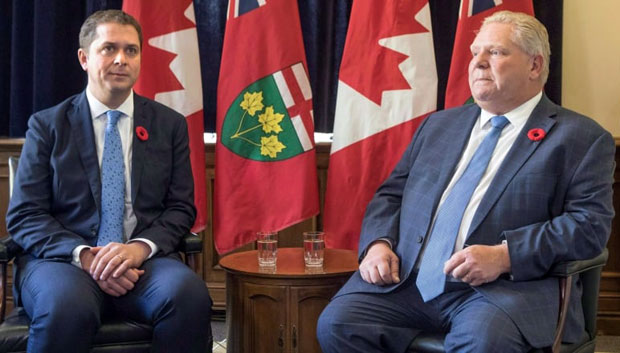
I’m not sure how it’s possible over the deafening silence, but I can definitely hear the water evaporating out of those glasses. Even it doesn’t want to be there…
It’s important to keep in mind there are only ever 100% of the seats available to share in either the legislature or the house during an election. If one or more parties are getting more of their fair share, then other parties are getting less of their fair share. In 2015 and with 39% of the votes, Trudeau’s Liberals got 54% of the seats in the house. Some of those seats were taken, for example, from the NDP who with 20% of the votes only got 13% of the seats. Roll forward to 2019 and the Green Party gets the most votes they’ve ever received—about 1.1 million votes—but even with 6.5% of the votes, they got just 0.99% of the seats.
It’s also important to keep in mind the 2015 election was to be the last general election held using the first‐past‐the‐post system. Only it wasn’t. This abandoned change was not only an election promise made by the subsequently elected Liberal party, it was a change supported by all the major federal parties except one: the Conservative Party—who I’m guessing now might be a little more interested in an electoral system based on proportional representation than they were in 2015. While they didn’t get the most seats in 2019, they did get the most votes. How’s that shoe fit, eh?
I recently received the following text message on my mobile phone:
It's the Conservative Party of Canada.
We are choosing a new leader. Are you interested in having your voice heard?
Reply:
Yes
No
It’s a curious message to receive over text. But among the many curious texts I receive, it’s also a highly suspicious message. The sending phone number traces back to a landline in Kingston, but there’s no online reference to the number linking it to any party office. And why would there be? Political messaging is exempt from Canada’s anti‐spam legislation, so there’s no need to respect an opt‐out list. The clumsiness of execution and lack of authenticity suggest it’s not legit. Yet the clumsiness of execution and lack of authenticity also suggest it may be an official communiqué.
However, in the moment, I feel like I’m being passed a note during high school:
It's Tammy from 2nd period social studies.
I might know someone who likes you. Do you want to have lunch together?
Check:
♡ Yes
♡ No
And in considering Tammy’s—uh—the Conservative Party’s request, I’m reminded of a series of graphics I’d saved from the CBC website last October. There was a questionnaire on how one’s own political views aligned with the policies of the major federal parties. I often feel underrepresented in federal politics, but I completed the questionnaire anyway to confirm if my feeling had any basis in reality, or at least in political reality.
The results were interesting, so I saved some of the more interesting ones to compile into what would have been a timely election‐themed post… and then, like an election promise to myself, I considered it thoughtfully before allowing it the dignity of being quietly forgotten. But with an election that’s never truly over, and the issue I found the most relevant last October even more relevant today, now’s the time to be timely.
The Spectrum
To start, the questionnaire produced a quadrant graph illustrating where I sit in reference to socioeconomic issues as compared to the 2019 election platforms of the major federal political parties except for one: the Bloc Québécois. I didn’t think to check if the Radio‐Canada website produced their own version of the questionnaire and included the party, but I’m guessing it was omitted from CBC’s since no one outside Quebec could vote for a Bloc candidate.
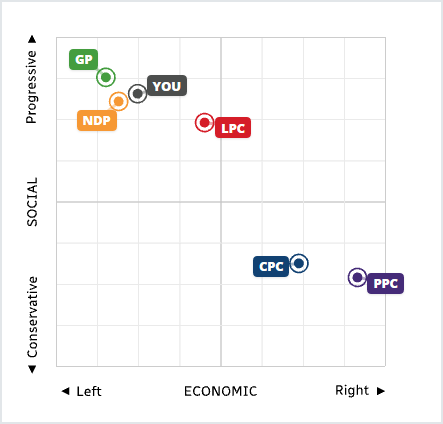
I was not entirely surprised by the above. In fact I was relieved to discover my feelings of underrepresentation in Ottawa were not imagined. The gap between myself and the Liberal Party explains why I’ve never been fully impressed by their socioeconomic polices. They all feel like they’d be standard stuff in a modern and progressive society, something Canada claims to be. But the chasm between myself and the parties on the right—yeah. No wonder I have so much difficulty seeing things the same way they do. We’re nowhere near the other on anything.
The Parties
Next, the questionnaire produced a percentage‐based bar graph where parties and their policies were ranked as they aligned with my own views.
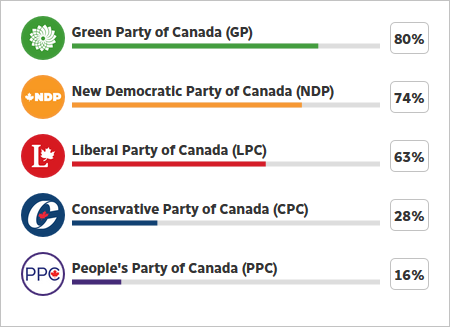
This time I was little surprised. First, while I am closer to the New Democratic Party on the political quadrant graph than I am to the Green Party, it appears the Green Party does a slightly better job of creating policy I tend to agree with compared to the NDP.
And second, while the quadrant graph demonstrates a clear ideological disconnect with the Conservative and People’s Party of Canada, it also appears there might be a few small areas where our views are similar. I’m immediately creeped out and curious about where those small areas are, so I started looking for them in the subsequent results of the questionnaire.
The Leaders
But before those results, these results are the questionnaire’s assessment of each party’s leadership as being likely to represent the issues which matter most to me.
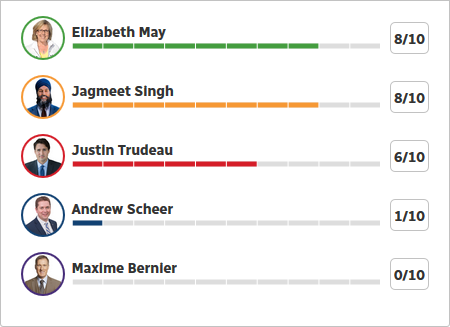
No surprises here, other than Andrew Scheer’s possible 1/10. …what was he going to do for me? I guess I’ll never know. He gets an F.
I’m not entirely sure why I’m giving Elizabeth May and Jagmeet Singh the same leadership ranking despite the differing scores on each of their party’s policies. Perhaps the numbers average to suggest I view them as equally capable of representing my interests overall. An A- for both.
Embarrassingly, I must admit, I did buy into Trudeaumania-lite back in 2015. But since then Justin Trudeau has become a bit of a bumbling goofball, and it’s looking like he perhaps always was. He gets a C- for mediocre performance and poor behaviour.
And Maxime Bernier—oops. Having no knowledge of where Bernier came from or his political background, I remember initially reading the party name months ago and thought a heavily left‐leaning party had come out of nowhere and was running candidates in almost every riding. Seconds later I found out just how wrong I was. He gets an F+ for a perfectly complete failure.
The Issue
For me there was only one issue on election day in 2019: the continued advancement of Indigenous reconciliation.
From my perspective it will not be possible to completely or genuinely address contemporary issues of climate change and energy policy, nor issues of social inequities, sexism, or racism, until the fundamental contradiction of Canada’s existence as a nation is acknowledged and moves toward resolution. Today’s environmental and socioeconomic issues are faced by all who live on this land, but it’s obvious to me there is an imbalance between those who are facing those issues and those who are not. There is an imbalance between those who are living and experiencing those issues and those who are not. This imbalance is the contradiction.
With the above in mind, I’m calling out the source of the contradiction: Canada’s conservative politics.
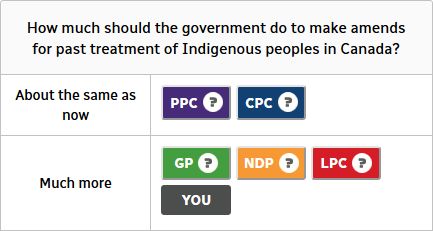
It’s incredibly challenging to advance an issue when those who hold a balance of power fail to acknowledge there’s any more issue to advance. As an example, the Truth and Reconciliation Commission of Canada, in response to an investigation into the abuse present in Canada’s residential school system, produced 94 calls to action in 2015, 94 declarations that what was being done at the time was not enough. And that’s just one example, one set of findings. In 2008, Stephen Harper, then prime minister, apologized to the survivors of the residential school system. But a year later, Harper claimed there was no history of colonization in Canada.
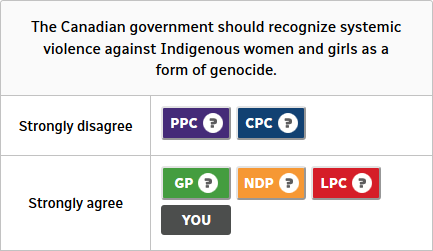
The scope of denial is chilling, and the hypocrisy of it all the more challenging. These parties have no qualms aggressively underscoring the importance of protecting Canada from terrorism abroad, but they do nothing to acknowledge the most heinous forms of it occurring right here. Yet when the subject of natural resource development arises, suddenly the right strikes a reconciliatory tone, or at least their version of it. Suddenly there’s interest in acknowledging and consulting with land title holders. Suddenly there’s interest in sharing golden opportunities for economic development. It’s a foul double standard.
However, when it comes to broad strokes interpretations of Quebec sovereignty, it would appear I somewhat agree with the Conservatives on the idea of recognizing Quebec as a nation within Canada’s constitution. I’m perplexed but relieved: this happens to be the only time I agree with the Conservatives.
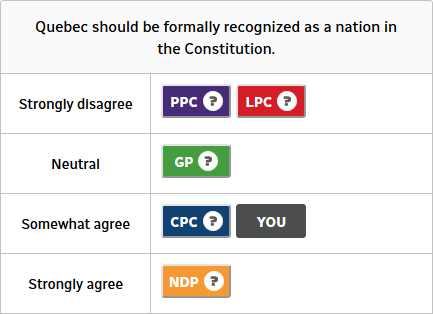
I didn’t expect to see both the Liberal and People’s Party strong resistance to the idea. Perhaps it would set an uncomfortable‐for‐some precedent. But I suspect this overlap in policy resulted in 16% of my views aligning with those of the People’s Party—although alignment via proxy might be more accurate as there was never a situation where the questionnaire suggested I agreed with the People’s Party about anything. And even this alignment via proxy is a stretch as it would suggest I’m somewhat in agreement with something I’m strongly against. Ah—politics.
But what about Quebec as an independent state?
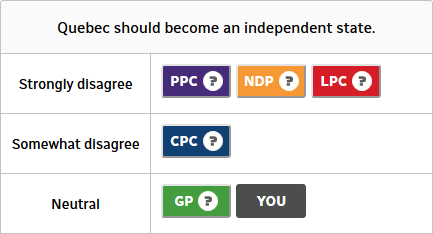
Now a resounding Conservative maybe has flipped to an emphatic perhaps not, I’ve joined the Greens who don’t have strong feelings one way or the other, leaving the Liberals, People’s Party, and now the NPD firmly saying non.
Looking back, the Green Party’s neutral position on Quebec’s sovereignty feels like the most appropriate, particularly within the context of reconciliation. It’s not up to English Canada to decide what French Canada can or cannot be.
And Finally
I was hoping there might be at least one instance where all the parties were able to agree on something. And there was!
They all don’t agree with me.
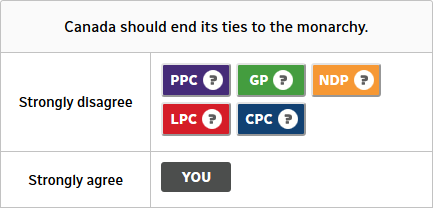
Perhaps tradition dictates any party intending to form Her Majesty’s Government would need to support the monarchy, the Crown. But again, in the context of reconciliation, does maintaining this traditional yet metaphorical power structure provide a suitable framework for the future relationship between Canada and Indigenous nations?
In Canada the Crown represents the foundational core of the federal and provincial executive, legislative, and judicial branches of government. While it technically forms the authority of the nation itself, from my perspective it’s just an outdated idea. I have no tangible relationship to the Crown other than its peculiar placement perched atop road signs or fancying up license plates. So detached am I in my relationship to the Crown I’ve given myself the bizarre privilege of being able to poke fun at it. Lucky me.
Indigenous nations have a markedly different relationship with the Crown, one that has seen it subverting, outlawing, and replacing the many and varied forms of Indigenous governance with its own ideas of what those forms should be. For hundreds of years the Crown has sought to frame and reframe the relationship Indigenous nations were permitted to have with their own cultures, their own traditions, and their own ancestral lands. The consequences have been appalling. A collective trauma is now experienced by Indigenous communities and their land as a result. To acknowledge and participate in the healing of this trauma is the collective responsibility of all Canadians, of all who come here to share this land together. And one good first step might be to take off the invisible crown some don’t even know they’re wearing.
The End
The featured image for this post is a concoction. It’s based on a much bigger picture, but I’ve cropped it so you only see one part of it. I’ve also pushed the contrast into an unreal place, where textured and subtle colours are replaced with brash black and white. Now lightness and darkness appear where they didn’t before. It’s a derived, distorted, and selective view designed to illustrate a point. It’s manipulation, pure and simple. And for some, manipulation is just politics. But to me there’s nothing just about it: manipulation is manipulation. It’s bad politics.
Now, despite my own attempt at bad politics, you still might know the source of the image from my fabrication. There’s a good chance you came across it every day in its entirety about 10 to 15 years ago, right at your fingertips. It’s the Spirit of Haida Gwaii, a sculpture featured on the reverse side of a Canadian $20 bill circulated between 2004 and 2012.
A bronze cast of the sculpture is also displayed at The Embassy of Canada in Washington, which is where I photographed it—or at least tired to. The courtyard surrounding the sculpture is filled with bright concrete and reflective glass. This along with the white bottomed pool of water under the sculpture, a late sunny summer day, and the position of the courtyard meant there was intense yet indirect light reflecting everywhere. It was difficult to authentically represent such an intricately detailed sculpture cast in such a contrasted material without either under or overexposing the work. Doubly difficult was representing the presence of the sculpture within the courtyard itself. It all looked perfectly balanced to my eye, but the perspective changed once viewed though the camera. The background and foreground collapsed into the other and everything went flat. Distance appeared where there was none before. It wasn’t the greatest lens for the situation, but it was all I had at the time.
The political landscape of Canada is one of a battlefield, and it’s littered with combative language. News articles are filled with campaigns, victories, opponents, adversaries, and defeats… It’s all a polite way of disguising one antiquated mindset, one concept that drives traditional, conservative politics: might is right.
And while that might feels right to those with the might, to those without and to those who have been left out, that might can feel like something else. That might can feel like control, like manipulation, like degradation, like humiliation. It can feel like there’s nothing right about it at all. A manufactured majority of might can believe it’s doing the right thing all it wants, but that’s no guarantee it’s doing the correct thing, especially if that majority is—for all intents and purposes—penalizing those who dare disagree.
An approach to politics based on winners and losers will produce combative results. It’s a consequence of language, and given enough time a combative approach will make losers of us all. Right now I primarily hear the language of combative politics spewing from Canada’s federal and provincial conservative parties. That’s not to say I don’t hear the other parties engaging in their own combat, but I’ve noticed a pattern in terms of who often fires the first shot. See—I do it as well. That’s how embedded this language is.
In a previous post I wrote of the need to listen before anything else. Listening takes time. Listening takes work. And listening can even be frightening. But it’s not ever something one experiences in solitude, because listening connects. Listening brings together to here.
So, Conservative Party of Canada—in asking if I’m interested in having my voice heard, you’re going to have to first consider the one lingering doubt I have about the spirit of the question. While I’m sure you’re willing to listen to my voice, what will happen when I ask you to listen to the voices of others? This is a land filled with diverse voices, yet many of them have been ignored, some for far too long. And if you’ve forgotten how to listen—it’s okay. Now’s the time to remember.
Just don’t take too long, because now is rapidly becoming all the time that’s left.