Departures: Part IIII

CityPlace epilogue.

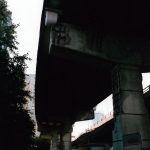
In a long ago post I mentioned shooting a roll of film that was already several years old. At some point I must have developed the roll, because I found the prints from it the other day. From an early October weekend in 2015, they’re pictures of my old neighbourhood in Toronto’s CityPlace.

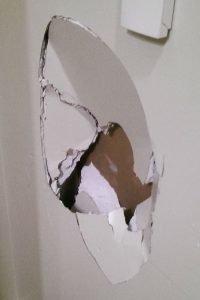
The circumstances I found myself in the day I went to take these pictures were troubled. The short version is the night before I stood up to someone who had been mentally abusing me for a long time. They physically attacked me for it. I was knocked into and partially through a wall in my apartment. My face and neck were scratched for my family to see on Thanksgiving the next day. Upsettingly it wasn’t the first time they’d attacked me—but it was the last time. This individual had slowly crept and creeped their way into my life, colonized my thoughts, and curated my experiences. I thought I was going insane, hanging on by just a thread at one point—such is the goal of a gaslighter.

But I got away.

When I found the prints I was struck by how far from ago they felt. The film stock itself was old and expired, likely responsible for some of the washed out colours and fuzzy details, though some of that look might be from me being out of practice with the exposure control. I generally use a camera’s aperture‐priority mode so I can influence the depth of field, but it can get tricky when using ISO 400 film outside on a brilliantly lit autumn afternoon. The rest of the look must come from the effect of scanning a photographic print—there’s something about the way a scanned picture looks… it’s gotta be the dust.

Nostalgia is something I have to watch out for. At times it’s still too easy for my mind to wander from a trip down memory lane to a detour up a cul‐de‐sac of regret or across a boulevard of unfinished business. Rampant nostalgia becomes a subtle gaslight of the past—tempting one to forget there’s usually a few reasons why it’s been left behind.


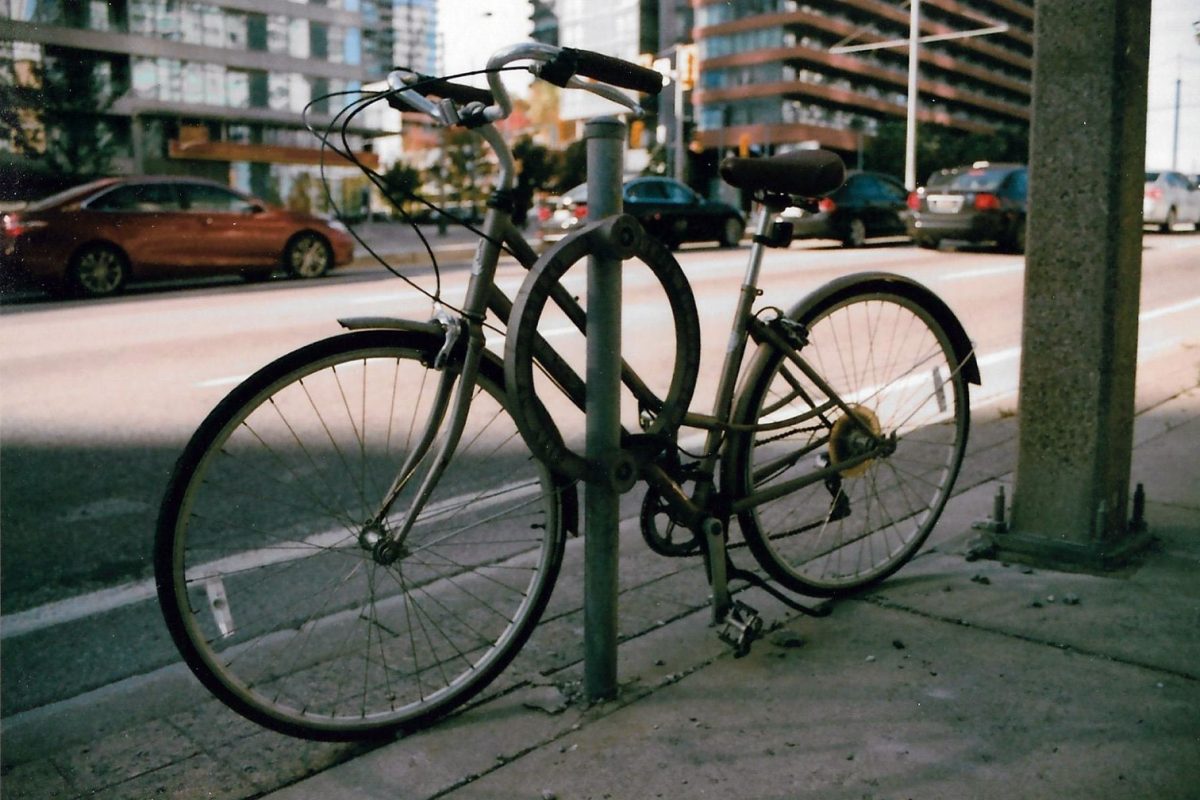
The bicycle used as the featured image for this post was always locked up in the same spot outside my old building on Spadina Avenue. It was there the day I moved in, and it was there the day I moved out. Archived Street View images confirm the bike has been there for years prior and years since—always in the same spot. I last saw it in 2018 when as I was passing through the neighbourhood on a streetcar.

The most recent Street View suggests the bicycle isn’t there anymore, but the images don’t make it clear. I’d need to visit the site itself and see for myself—though that’s assuming I care enough one way or the other about the bicycle’s status. Its location frozen not in time but in place is what was of interest to me, but I realize now the bike’s entire existence is irrelevant. It’s either there, or it isn’t, and either way I’m no where near it.

Perhaps my cautious thoughts of gaslit nostalgia or dead‐ended regret are misplaced. Something definitely feels over. Business feels finished.

The Sting

Nonsense. Reflection. Chaos.

What follows is another stale post from a long ago time, from last October, back when things were normal…

But were things really normal back then? No. How about in 2018? Normal then? Or 2017? Was that normal? Let’s go back further. How’s 2015? Or the year before that? Or even the year before that? Wind it back further. Perhaps 2010? Or was it more than ten years ago? An abnormal decade in disguise? When did anything last feel normal? Could it be as far back as then, as far back as October of 2008? Possibly. But another October, eh? Again with October! The 10th month of year that takes its name from the quality of eightness.

See—it’s not just me. Things haven’t been normal for a long, long time. Everyone’s just been too busy with subtle nonsense to notice.

Today was meant to be a writing day. It still is, but it’s not the writing day I had in mind when the day started.

I took the day off specifically to revisit and hopefully finish the backlog of posts I’d started since my few weeks of writing fury a few months ago fizzled out. It had been raining since Wednesday afternoon and showed no signs of stopping, so the conditions were perfect for me to sit inside all day working at my desk.

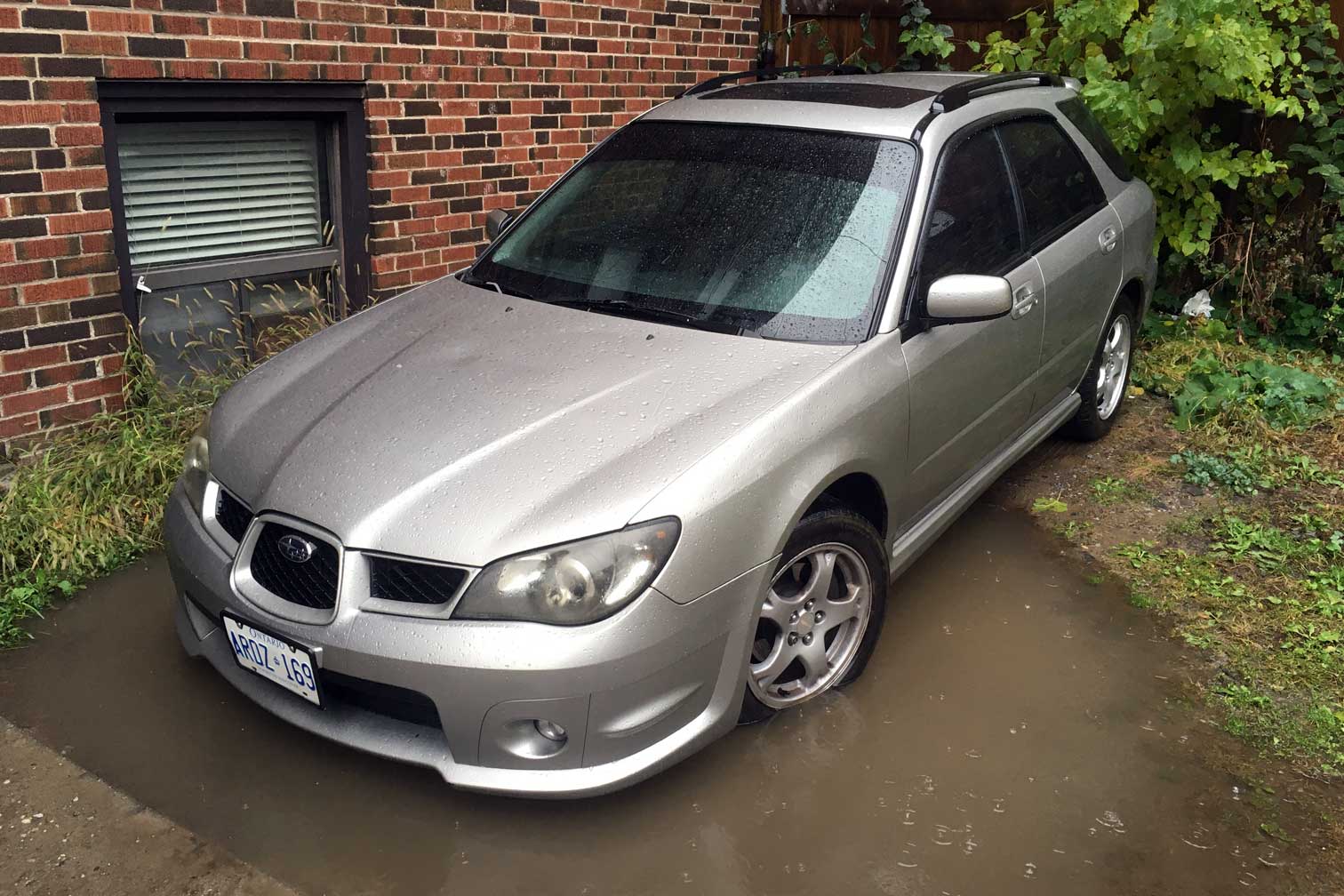
But first: a simple errand to run. I wanted to collect a few fancy things to make into a deluxe breakfast worthy of a bespoke day of writing. Normally I’d walk, because it’s a lovely walk, but after 24 hours of rain and wanting to get as much writing time as possible, I took the car for a quick and dry trip to the grocery store.

—except the windshield wipers stopped working at the first red light.

They stopped just as the car did, so I thought at first I’d stalled, but no, it was just the wipers, just stopped at the top of the screen as I sat feeling that familiar sinking feeling of realizing this car of mine was about to consume yet another day off, consume yet more of my patience, consume yet more of my dwindling spare cash…

Some of my best thoughts occur while I’m waiting to turn left, and the thought I had this time, as I felt myself being consumed by the moment, was a simple one: not this time. As the light changed I drove forward. Fuck the wipers. Fuck the car. I was getting breakfast. I was going to have my day off. And this Justin Trudeau of a car was not going to disappoint me. Not this time.

While I wouldn’t recommend driving for long distances without wipers in the rain, from a visibility point of view, it’s not unlike riding a motorcycle in the rain—although I wouldn’t necessarily recommend that for long distances either.

At the grocery store I ended up getting just two things for my deluxe breakfast: some local free‐range eggs and some wonderfully marbled prosciutto …from Spain. These would go with some potatoes I knew I had back at the apartment and then be dribbled with hot sauce.

I did some very brief diagnostics on the wipers in the parking lot. The fuse was okay. I could hear the wiper motor running. The wiper arms themselves moved freely and at the same time. It was looking like a simple mechanical problem, likely a broken linkage at the motor. Maybe, I thought, maybe I can do both. Maybe I can get the broken part off the car and replaced all before it gets too far into the middle of the afternoon and I could still feel as if I got my writing day.

Okay—deal. Let’s do it.

Parked back at the apartment I realize the deal is off:
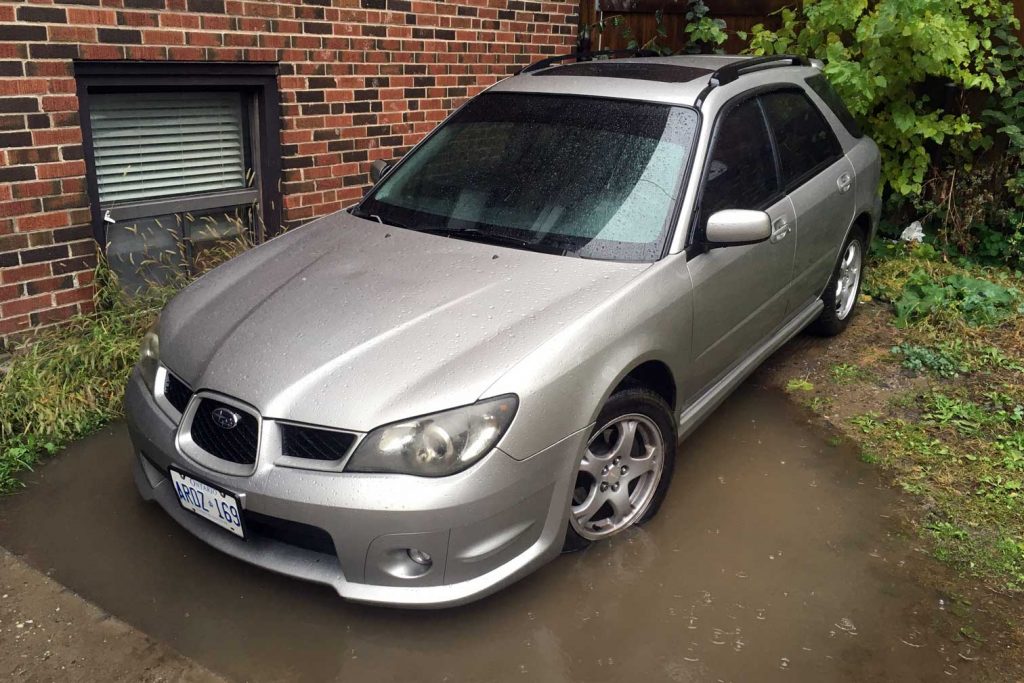
My parking space is now a puddle about ten centimetres deep. The water is up over the bottoms of the front tires, right where I’d need to be standing to fix the wipers. I could move the car so the puddle isn’t a problem, but it’s also still raining so I’m going to be soaked by the end of it all anyway. I’ll still have to drive the car sans wipers up the mountain to the dealership, still have to drive back again, still have to make sure I actually get the wipers fixed, still have to feel like I get to have my writing day—

Not this time.

Suddenly it all just leaves my head. The deal between my fixing the car and my spending the day writing vanishes. The feelings that were consuming me at the red light fade away. Fuck the wipers. Fuck the car. It’s time for breakfast.

As I’m making the eggs I was so pleased to have bought because they’re not from crate chickens I wonder two things: how do free‐range eggs work in Canada during the winter and why did I buy Spanish prosciutto when I know it’s an Italian thing. Do the chickens wear boots, and should I really be patting myself so hard on the back for choosing local eggs and then feasting upon imported cured meat I could have just as easily purchased from a producer that didn’t use a container ship to get it to me?

My mind wanders back outside, to my second Impreza, to soggy lil’ Justin sitting up to his tires in a giant puddle, and I laugh: I need to fix the wipers because it’s raining, but I can’t fix the wipers because it’s raining.

It’s called a dolly zoom. And while you may not know it by name, you’ve seen it in movies. The foreground subject will remain stationary as the background appears to move up behind or away from them. It’s visually striking because it defies traditional understanding of perspective. The foreground subject remains the same size relative to the frame despite everything your mind is telling you should be happening. It’s typically used to highlight some deep understanding the character is coming to realize, a shift in perspective.

In this case, in my kitchen, as I was frying up a super egg—which is three eggs mixed together and cooked sunny sides up in a small pan—my dolly zoom moment was one of pure paradox: what I do at work is make sense of nonsense. I spend 8+ hours for 5 days in a row refining chaos. It never ends. And when it does, my mind is fried. All I want to do is have a drink or a smoke, watch a movie, and go to sleep until I have to do it all over again. And for weeks on end, that’s what I’ve been doing. There’s been nothing left of my mind to spend on writing or photography. It’s goo by the time the week is over.

This mind full of goo place is an uncomfortable place for me. The words and images I work with to create posts and photographs bring me great peace and satisfaction. I feel it when I’m unable to write or take pictures for long periods of time. But as much as I want to sit down and finish what I know there is to finish, part of me just wants to relax. And isn’t a day off supposed to be just that? Do I really want to take a head full of goo and tell it to do more thinking?

I don’t. I really don’t. Not this time.

Not this time…

Besides, breakfast is ready. The super egg is perfectly done. The prosciutto is shredded and is now resting atop freshly made home fries. Hot sauce is at hand. And the dolly zoom moment is over.

With breakfast I decide to watch a specific episode of Futurama, one I’ve watched many, many times before: The Sting. It’s one of my favourite episodes of the series and sits among some of the best stories I’ve ever seen on screen. I cannot do the episode justice in attempting to summarize it here, so I’ll just say it’s one of the rare pieces of TV that will almost always at least have me thinking about shedding a tear or two by the end of it. My eyes are tingling even now.

What makes the episode so powerful is how it illustrates life’s great contradictions:

And that’s as far as I got… Yup. Now it’s June.

There was going to be more, of course—just look at that punctuation! But ending it where it happened to end and not coming back to it until now—near perfection. Absolute near perfection.

Now it’s months later, into the first few days of June, and the more I was thinking of adding doesn’t feel like it fits anymore. The job which brought me so much unending chaos and rendered my mind to such gooey goo no longer exists. The times where I found myself having to choose between relaxing and writing are not the fleeting moments they once were. Time itself instead sits omnipresent. Chaos intensifies.

In Futurama’s The Sting, one of the characters experiences a loss so tragic it begins to threaten their sanity. Increasingly vivid hallucinations undermine their perception of reality. Dream and wake states lose definition adding to the uncertainty of what’s really real and what’s really not. The chaos of what they were perceiving nearly consumes them—it is only in the last few moments of the episode where any clarity is derived, when the true nature of their reality is revealed. What they found was the power of companionship and compassion, the power of kindness.

In another instance I would have rewritten this post to bring cohesion to what I consider a disjointed mess of thought and expression. This desire to rewrite speaks to an old idea I’ve up until recently still clung to, an idea that as I experience the continued undermining of my own reality I could embrace the uncertainty of what was happening around me as a down payment against future clarity. But this deal I make with myself is a delusion. It’ll never amount to anything more than a pursuit. I will never wake from this particular chaos.


My wife was a true-crime writer and researcher, and the phrase she hated the most was, “You know, everything happens for a reason.” She’s like, “No, it fuckin’ doesn’t. It’s chaos. It’s all random. And it’s horrifying. And if you want to try to reduce the horror and reduce the chaos, be kind, that’s all you can do. It’s chaos. Be kind.” She would just say that all the… “It’s chaos. Be kind.”

Now… I would always… We’d have these huge philosophical arguments where I was like, “I don’t believe in an intelligent creator, per se. I think that there might be a lattice work of logic and meaning to the universe that maybe we’re too small to see.” And she was like, “Sweetie, it’s all random. It’s all chaos. It’s chaos. Be kind. It’s chaos. Be kind.”

And we would go back and forth. And then she won the argument in the shittiest way possible.

—Patton Oswalt
Annihilation


In one absurd and poignant sentence Oswalt referrers to the sudden and unexpected death of his wife.

I laughed out initially before the weight of his words caused my chest to collapse. A tightness in my throat tugged at the back of my eyes. The laughter evaporated out of my lungs. I could hear the audience experiencing the same peculiar sensation: two distinct and normally exclusive emotional states being felt simultaneously, a collective sorrow but with a smile. The joke stung like no other.

A few days after watching the stream of Oswalt’s performance I thought of this unfinished post for the first time in months—a usual indicator of a chance to finish something I’ve started. On June 1st I titled the post “The Sting” and began working on it again. And while doing some research I found out the original air date of the Futurama episode I’ve been referencing was June 1, 2003—17 years ago.

The temptation to draw connections through coincidence in this instance is strong. Yes I did resume working on a post which takes its title and theme from an episode of television which aired on the same day many years ago, and highlighting it would make for a somewhat satisfying circular conclusion. But as I’ve mentioned before, the further one goes back in time the more time starts to drift. And wouldn’t the more interesting coincidence be actually publishing the post on the same day rather than simply resuming work on it? I mean, I could fake it—make the post today and then immediately backdate it to the first of the month… But it hardly seems like a coincidence anymore after all that effort. And to be honest I didn’t even watch the original airing of the episode in 2003. It may not have been until at least 2008 before I saw it.

From a purely operational perspective everything happens for a reason—nothing would happen otherwise. What starts to cause confusion, what starts to cause pain, is when that reason reconciles into a comparatively senseless experience. That’s when the deals start. That’s when present nonsense is endured and banked in exchange for a promise of some future order because everything happens for a reason. What’s been made senseless will—somehow—make sense once that reason is known. But sometimes that reason is never known, and in waiting for something that will never be known, something else gets banked as well, something at least I never realized could be hidden away and lost at the same time: happiness.


And right now, I’m still wounded and I’m healing, but there’s people out there, especially the people in power. I’m sorry to get… I’ll leave you with this. There’s people that wanna create wounds that will not heal. That’s the turn-on for them, so just… I’m just gonna end this by quoting Michelle Eileen McNamara, “It’s chaos. Be kind.”

Thank you. Good night.

Bad Apples

A few is too many—especially when they’re everywhere.

It’s a line heard so many times before, and with each utterance of this trite response by someone—usually a stuffy white guy in a position of power—I wonder the same things: what draws white people to use food‐based metaphors to dismiss complex social issues? Are they aware in every instance where they default to this contemptuous idiom it makes them sound just a little bit more racist? Are they aware that in offering this sad and tired turn of phrase they’re actually admitting they don’t understand the situation—be it actual bad apples or institutionalized racism—at all?

In its entirety, the saying goes a bad apple spoils the bunch. Today it’s used to illustrate how the undesirable actions of a few individuals within a group can not only tarnish the reputation of the entire group, but, more importantly, could cause those undesirable actions to spread if left unchecked. This second part of the metaphor appears to be where the lesson has been lost, so perhaps a literal examination will help clear things up.

What happens to actual bad apples? They’re disposed of. Why? Because no one wants them. They’re not desirable or generally useful when compared to good apples. Bad apples don’t get to continue hanging around the other apples once they’re discovered. They don’t get a chance to attract flies as they continue to rot and stink up the place. And they don’t get promoted to be head of the apples or king of the pies. Would you accept a grocer’s explanation of there’s always a few bad apples when questioned about the declining quality of the apples in their store? If there’s indeed always a few bad apples, when does the conversation move away from acknowledging what’s already painfully known about the state of some of the apples to what’s going on at the orchard?

Throughout last week I had been watching videos by Amber Ruffin on her experiences with the police:

In Ruffin’s first video she shares an experience where she feared for her own life. As upsetting as it was to hear about her experience, it wasn’t the most upsetting thing she said in the video. That came near the video’s conclusion, when she said every black person she knew had a few stories like that. Not a few black people, but every. And not one story, but a few. That’s too many. That’s a few too many stories about a few bad apples.


I don’t know how many black people Ruffin knows. But does knowing either way make the situation any more or less horrible? Any number over zero starts to paint a grim picture almost immediately. How grim? Let’s look at some uncomfortable numbers and make some uncomfortable assumptions. Yeah—it might get a little uncomfortable. And if reading about this situation is uncomfortable then imagine what living it must be like.

But first… I am not a researcher, statistician, or sociologist. I am not a member of a traditionally marginalized racial community. I’m not even American. I am an outsider to a situation attempting to generalize the experiences of another individual and scale them up to gain a rough idea of what’s being experienced at a national level.

Data from the US Census Bureau shows 40.9 million people living in the Unites States who identify as African American. That’s more than the entire population of Canada, and amounts to about 12% of the total population of the United States. Ruffin says every black person she knows has a few stories like the ones she shared. She shared four stories out of what she said were thousands more. I would hope there was an amount of hyperbole in her statement, but—

Step into a hypothetical world where each of those 40.9 million people will each have a few experiences like the ones Ruffin had. In this world a few will mean 5 experiences. That’s 204.5 million frightening—possibly fearing for one’s life frightening—experiences with the police. These experiences will happen over time, and in this world that time will be 10 years, so that’s 20.45 million terrifying interactions with law enforcement per year. That works out to just over 56,000 people terrified per day, everyday, anywhere in the land of the free, for the next ten years. That’s just over 2000 people per hour, just under 40 people per minute. That’s a traumatic experience starting about every 1.5 seconds for the next decade.

Data from the US Department of Justice shows about 800,000 sworn officers (officers authorized to make arrests) working part and full‐time in state and local law enforcement. There are roughly 120,000 federal officers authorized to make arrests as well. That’s about 920,000 officers. How many of them are poorly trained, overly aggressive, violent sadists? Just a few? Is a few 1%? That would suggest 9,200 of America’s finest are responsible for 56,000 traumatic experiences per day.

—it’s just a few bad apples.

As Canadian it’s easy to see the blatant racism in America and condemn it—without hesitation. But as is often the case in Canada, this condemnation comes with its own set of national blinders. Canada too often pats itself on the back when it comes to progress on social issues, too often congratulates itself for being better than United States of America, too often forgets that being better than among the worst is still not great. The racism in Canada is different than the racism in the United States. It’s not nearly as blatant here. It sits just below the surface, cropping up just often enough to create the illusion of isolated incidents which reinforce a notion of it can’t happen here.

But it does happen here. The Ku Klux Klan registered their first provincial chapter in Toronto in 1925. Their activities spread throughout the still developing country, taking hold primarily in Saskatchewan where a membership of about 25,000 included Walter Davy Cowan, the Mayor of Regina. Cowan would later go on to serve as a federal MP for two different ridings under two different political parties, all while serving as the provincial treasurer for the KKK until his death in 1934. In Ontario, cross burnings took place outside of London and Kingston in the mid to late 1920s.

Racially segregated communities for black and white Canadians existed and were challenged in 1946 when Viola Desmond was removed from the whites only section of a theatre in Nova Scotia. Africville, also in Nova Scotia, was a predominately black segregated community whose history predates Canada’s. This settlement was left to crumble in the 1960s as the city of Halifax failed to provide such basic services as roads, water, and sanitation. The last segregated school in Halifax closed in 1983.

Black Canadians experience disproportionate levels of poverty and incarceration as compared to white Canadians, particularly in Toronto. Black Lives Matter protests have been held in Toronto since 2015 when Andrew Loku and Jermaine Carby were both shot to death during separate incidences with police. A major protest was held in 2016 at the headquarters of the Toronto Police Services. By then a deemed illegal yet still practised form of policing known as carding had overwhelmingly been demonstrated to target black people.

Doug Ford, the Premier of Ontario, said recently the racism in Canada had none of the systemic, deep roots that are present in America. Ford later retracted his comments. Perhaps he was made aware that the last segregated school in Ontario closed one year after he was born, in 1965. Or perhaps that the Special Investigations Unit (SIU) in Ontario was created in 1990 as a response to the Black Action Defence Committee accusation of the Toronto police being the most murderous in North America.

On May 27th of this year Regis Korchinski-Paquet fell to her death from a high-rise balcony. Officers from the Toronto police were the only witnesses to this event. Compounding the tragedy is an open question over how Korchinski-Paquet came to fall: was she pushed by the police?

That the question is even asked, that the question is unanswered pending investigation, that alone should be enough to exemplify the level of distrust and trauma present in the experiences of black Canadians. Those experiences are the result of the systemic, deeply rooted racism too often denied as existing in Canada. And the existence of that unanswered question says more about the state of racism in this country than the 21 infuriating and embarrassing seconds of silence used to denounce the state of racism in another.

Loneliness

View from afar.

Ontario is …vast.

Imagine getting in a car in Toronto and travelling due north for about 4 hours. Now head east for another 4 hours. Then start heading generally northeast for 11 more hours. You’ll still be in Ontario, around Thunder Bay if road conditions are favourable. It will take another 6 hours to reach the Manitoba border, and you’ll be in another time zone when you do. By then Toronto will be 1960 km away.

I’ve been using Google Earth to travel around Ontario while remaining adherent to physical distancing guidelines. Way back in 2000 I spent about two school years in North Bay, the southern most part of what’s considered the northern part of the province. I remember from driving back and forth how Highway 11 from Toronto and Highway 17 from Ottawa would meet just south of North Bay. The two highways split a few kilometres later with Highway 11 heading north to Temiskaming and Highway 17 heading west to Sudbury.

While most of Southern Ontario is accessible via road, most of Northern Ontario isn’t. Distance is experienced on another scale. What might be considered remote takes on a new meaning. Isolation becomes relative. Whenever I’d reach the junction of Highway 11 and 17 coming up from Toronto I knew I was almost at my destination, a reassuring feeling when the remaining destinations were in distances measured with three digits.

Recent events have knocked any sense I’ve had of distance and isolation into flux. Two meters may as well be 2000 kilometres. Ideas of what’s considered accessible no longer revolve around a specific type of vehicle. In a screwed up way it’s now possible to see more of the province from space on my couch than I ever could from a car or even a canoe. And in that realization—as I was scrolling through the air above Highway 11 past North Bay; as the road wound its way through places I’ve never heard of; as it found and blasted its way though unending forest and rock or hugged the shores of lakes and rivers; as it branched off into route numbers starting in the five and six hundreds; as Highway 11 headed down and met up for the second time with Highway 17—I found myself looking at loneliness.

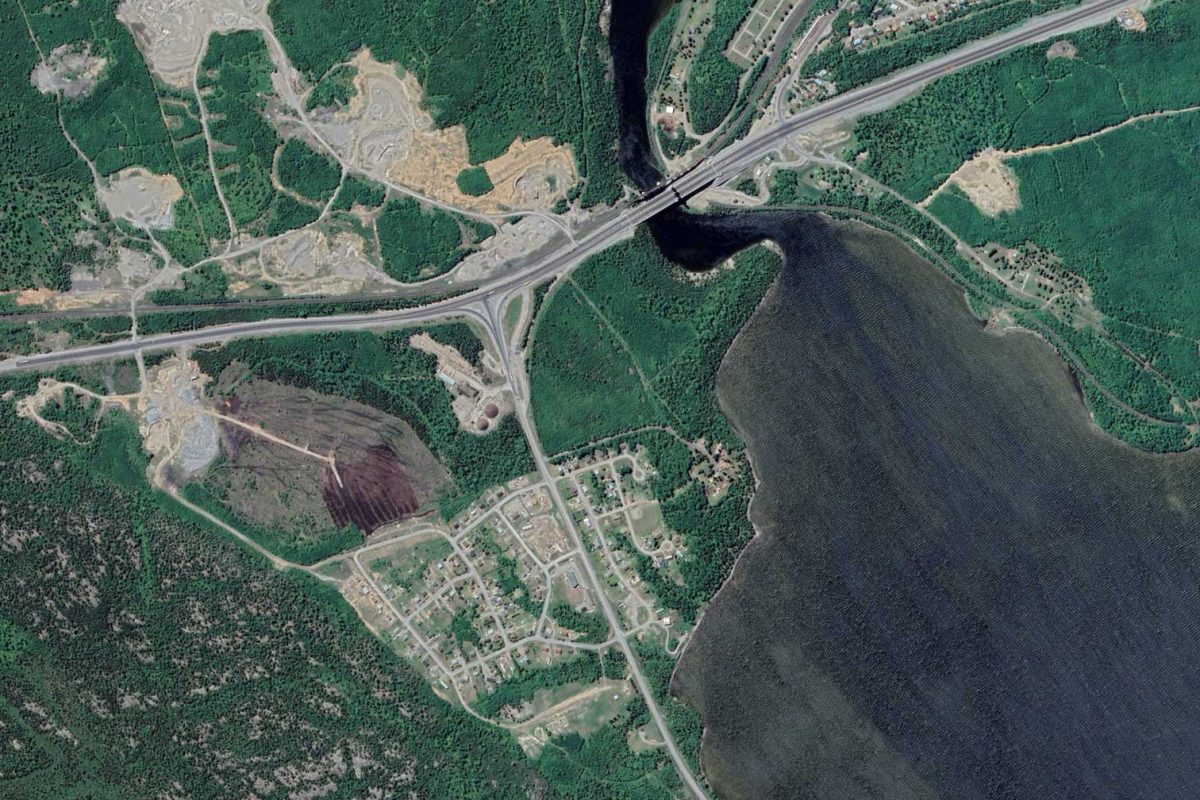
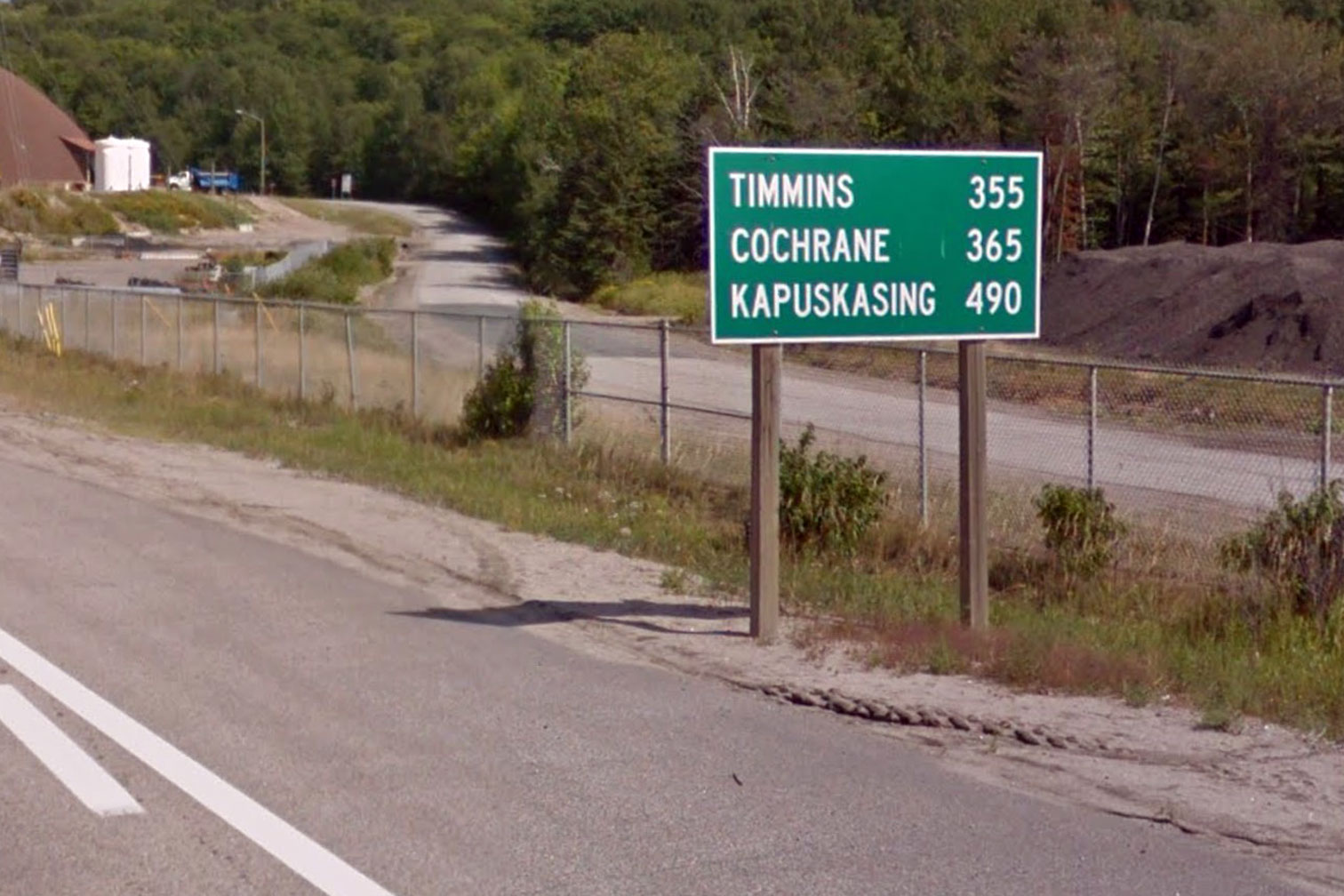
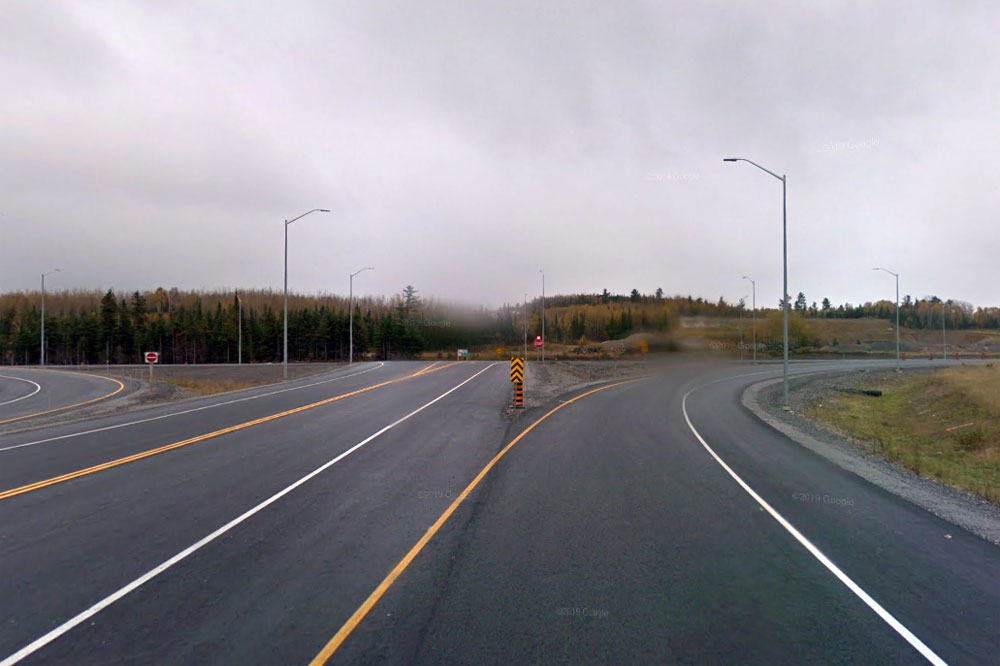
Above is the view looking south from Highway 11 at Highway 17, near Nipigon, where the two longest highways in Ontario meet again to form the only road access the two halves of the country have with the other. To the right it’s 786 km west to Winnipeg. To the left it’s 586 km southeast to Sault Ste. Marie and then 795 km from there to Ottawa. Or it’s back 1345 km northsoutheast to Toronto.

And that’s not the loneliness. No—not there yet.

Ontario has an area of 1,076,395 km2 making it larger than Germany, France, and Italy …combined. But that view—the clouds, the sense of the weather, the trees, the fields, even the road signs, pavement markings, and intersection—I bet that view can be found by anyone in Ontario. It’s somewhere anywhere in the province. It’s a few hundred square metres among millions more just like it.

And that’s still not the loneliness. Almost there…

That view of a place that looks like it’s anywhere is actually a view of a place that’s mostly nowhere. It’s a synthetic view, accessible to anyone here only if they’ve also got access to a road. Most places in Ontario cannot be arrived at by road, but most everyone who lives here is near one, so almost everyone living here thinks Ontario looks a way it actually doesn’t. I count myself among almost 15 million people who likely haven’t seen much of this province past the view from a road.

That’s the loneliness.

Cheap Thrills & Hot Links

Is there anything else on?

Sometimes the bully is more subversive in keeping me from finishing something I’ve started. Sometimes they’ll actively encourage me to pursue to the fullest extent whatever it is I’ve envisioned. Why? Because they know I’ll occasionally pursue something so fully and so intently I will not yield to any considerations, any little hints that might pop up along the way to let me know I might want to change how I’m doing something.

In this case the something was the format of this post. I’d originally planned another video, a joke tutorial on how to make mischief online by swapping out the contents of image files. There was going to be a live action shot I’d blend into the video signal from my computer screen, some overlaid graphics I’d add in after, maybe even some extra voice overs…

What was supposed to be another spur of the moment bit of unscripted fun was turning into a bit of a production, complete with notes and a growing shot list. And all of it was destined to go nowhere because I couldn’t get the introduction to look convincing, the screen capture software kept glitching out, and I would rewrite the script between what was turning into an afternoon of takes. Hours of work had produced a rough cut of just over eight unwatchable minutes, and it was looking like I’d need over ten more minutes to finish the video—I wasn’t even half way through the joke yet. But the show must go on, yes?

…No. Not when the show is almost twenty minutes of watching my computer screen and tending to terrible.

So—the video is gone. There will be no documentary for this joke, no behind the scenes bonus content. It’s just the setup and the punchline, so you’ll have to decide if it’s real or even funny for yourself.

This all started when I was looking through the reports for one of my web servers. It’s been online for almost 20 years and is filled with stuff, including a picture of one of my old phones:

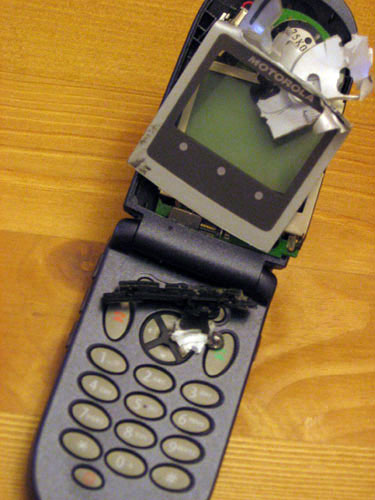
This particular phone was a Motorola V66, and it met with a spectacular end after falling into the drive belt area of a running car engine. I assume this is why shirt pockets traditionally come with buttons.

At the time I proudly posted the image up on my server, linked it to all my websites, emailed it out to whoever, and generally let it propagate throughout the internet. At one point it was among the top five images returned on Google’s image search for smashed phone if only because this was more than ten years ago, back when there were a countable number of smashed phone pictures available online. Now—thanks to the increased use of glass to make slightly heavy items that can’t quite be held in one hand—there’s no shortage of smashed phone pictures to browse through. But even with so much selection available now, the smashed phone image continues to be one of the most requested files from the server. I wanted to find out why, so I dug through the raw logs.

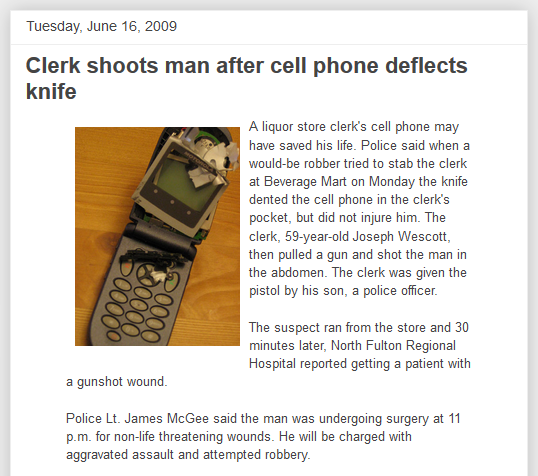
It turns out someone had hot linked to the image from their website. What this means is instead of putting a copy of the image file on their server for their website to load, they’ve created a link that will load the original image file from my server and have it appear on their website. In this case, their website is a collection questionable news snippets and what I’m now assuming is bogus accompanying photographic evidence:

A botched robbery and stabbing turning into a shooting and a hospital arrest sounds just plausible enough to have happened in anywhere in the United States. That, or it’s an equally plausible collection of events synthesized into an urban legend which accidentally became news. But even if that’s how the robbery went, real or otherwise, that isn’t the phone that got stabbed—it’s my phone.

Hot linking is generally considered against industry best practices. Some consider it a form of theft, like watching a neighbour’s TV from your own house through open windows. Some cry foul over the additional bandwidth charges that might result from other sites linking to their servers. There’s also a growing number of personal privacy implications as well. But hot linking is mostly not a good idea because—like that neighbour’s TV—there’s no real control over content. Right now there is a link on someone else’s website to an image that’s on my server. As long as I keep the file name of the image the same, the image itself can be whatever I want. Industry best practices exist for a reason, so I figure it’s best to create a little reminder why for this website operator.

Personally I don’t see this instance as a violation of my intellectual property rights or something that’s going to get me charged for using additional bandwidth. My offence is found in the shear laziness of the content management. Whoever it was cared enough for there to be an image to go along with the story, but they didn’t care enough for the image to have any real connection to the story. They also didn’t care enough to spend five seconds copying whatever image they did find to their server, choosing to instead save three seconds by hot linking it to my server. Who cares laziness is my least favourite kind of laziness. As my brother once said, I bet I can make them care.

So what do I change the image to? Well—it’s the internet, so ideally it should be something vaguely rude but not actually rude, most definitely confusing, and certainly suggestive. As luck would have it, I’ve just recently come across such an image: the faux butt from my lockdown coffee break.

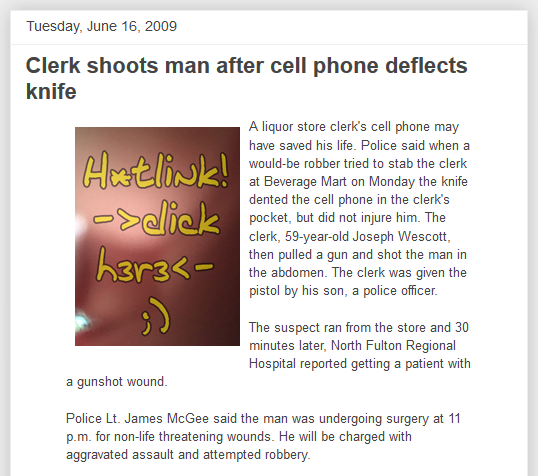
With some appropriately themed additional text the amount of suggestively vague rudeness is almost there, and the click here that can’t actually be clicked will definitely be confusing.

But I might never get another chance to do something like this, so why not go all out and bump up the elegance and sophistication as well:

There we go. Channel changed.

Turns out there is a North Fulton Regional Hospital, north of Atlanta in Roswell, Georgia. And there is a liquor store called Beverage Mart within a half hour’s drive of the hospital, about 15 minutes actually. I assume whoever it was didn’t run all the way to the hospital with a gunshot wound. It would have been almost 5 km, sorry, almost 3 miles. Perhaps they caught a bus? There is a bus that goes right by both the liquor store and the hospital. Though I don’t know if getting shot during a stabbing, running from an attempted robbery, and then waiting for a bus would suit the energy of the moment. Plus ten years ago there may not have even been a bus.

In any case, what’s around the hospital today amounts to a few pharmacies, a Burger King, a Dunkin’ (they dropped the Donuts last year), two different pawn shops, another and what I’m assuming would be a competing hospital, a building materials warehouse, and a Ferrari dealership. It’s all a bunch of stuff at once—very much like the how the internet is. So who out there online will even notice if one screen that’s been showing the same thing for the last decade is now showing something else? I guess I’ll just have to leave the blinds open and the TV on to find out.