Rogue Planets

Wander with me.

Back before we could or be allowed to observe anything suggesting otherwise we knew the entire sky and everything in it revolved around a stationary earth—geocentrism it’s called—and despite being completely incorrect, it was supported by tomes of information and was enshrined within religious texts for hundreds of years. And as is often the case with enshrinement, anything challenging it was met with ridicule, brutality, and death. Who needs to be concerned with finding out what’s actually correct when you can look in a book and be told you’re right instead…

Now—after several excommunications, imprisonments, torturings, and executions—we know the entire sky does not revolve around a stationary earth, that the earth instead revolves around the sun, along with all other objects in our solar system—heliocentrism it’s called—a reference to Helios, the personification of the sun in Greek mythology. Curiously, geocentrism takes its name from the root word geo, also Greek, but meaning pertaining to the earth, like geometry, which traces its origins back to attempts to measure the size of the planet, highly secular by comparison to heliocentrism’s more divine origins—in name that is.

Lingering ideas from the past would still—for some—frame the heliocentric model of our solar system as being in the centre of the universe, as if for an incredible reason our perfectly ordinary star was the most important place in all of existence. And—in some ways—they’re right. Our sun helps support the only place in all of existence to be inhabited by alive life as we know it. But in another, more accurate way, they’re not right, not by a long shot. There are countless other stars just like our sun, with even more countless Earth‐sized planets orbiting them at a distance called the habitable zone which describes an area around the star where a planet’s temperature would be the most conducive to supporting the life we’re familiar with here on Earth. And actually, it’s not exactly countless planets. Based on current estimates there may be as many as 40 billion of these Earth‐sized planets in our galaxy alone, our galaxy being one of 100 to 200 billion other galaxies. So in total, we’re looking at 4 to 8 trillion possible Earths—4,000,000,000,000 to 8,000,000,000,000 planets like ours. What are the odds we’re one in 8,000,000,000,000?

One of the challenges of knowledge is how it can also blind—you know or think you know something, but in knowing that thing, you unintentionally but sometimes quite deliberately shut out anything else running affront to what you think or believe you know. You become too comfortable in rightness and forget about being correct. It’s geocentrism all over again.

One of the consequences of heliocentrism is it places the Sun as being the central figure in our solar system. The Sun accounts for 99.86% of the mass in our solar system, and as a result, its gravity pulls the remaining 0.12% of the mass making up all the planets, asteroids, comets, and other space stuff around it into orbit around it—so from that perspective the Sun’s role as a central figure does make sense.

Heliocentrism also postulates all the objects in our solar system were once part of the same giant cloud of molecules in space that started swirling and compressing together into what would become the Sun, the planets, asteroids, comets, and aforementioned other space stuff in our solar system.

From the two prevailing points of heliocentrism we get following: a central figure much more massive than ourselves is responsible for the creation and sustenance of all that is around us. Now if that sounds a little familiar I attribute it to science and religion often describing the same thing but in their own language, a point I’m happy to concede but too often see others on both sides backing uncomfortably away from. And that’s too bad, because the idea of what we’re made of and how our world works isn’t anything to be uncomfortable about. We live in exciting times. We’re seeing deeper into space than we ever thought possible, and what we’re finding are incredible things—things that show us there is still much more to know and understand.

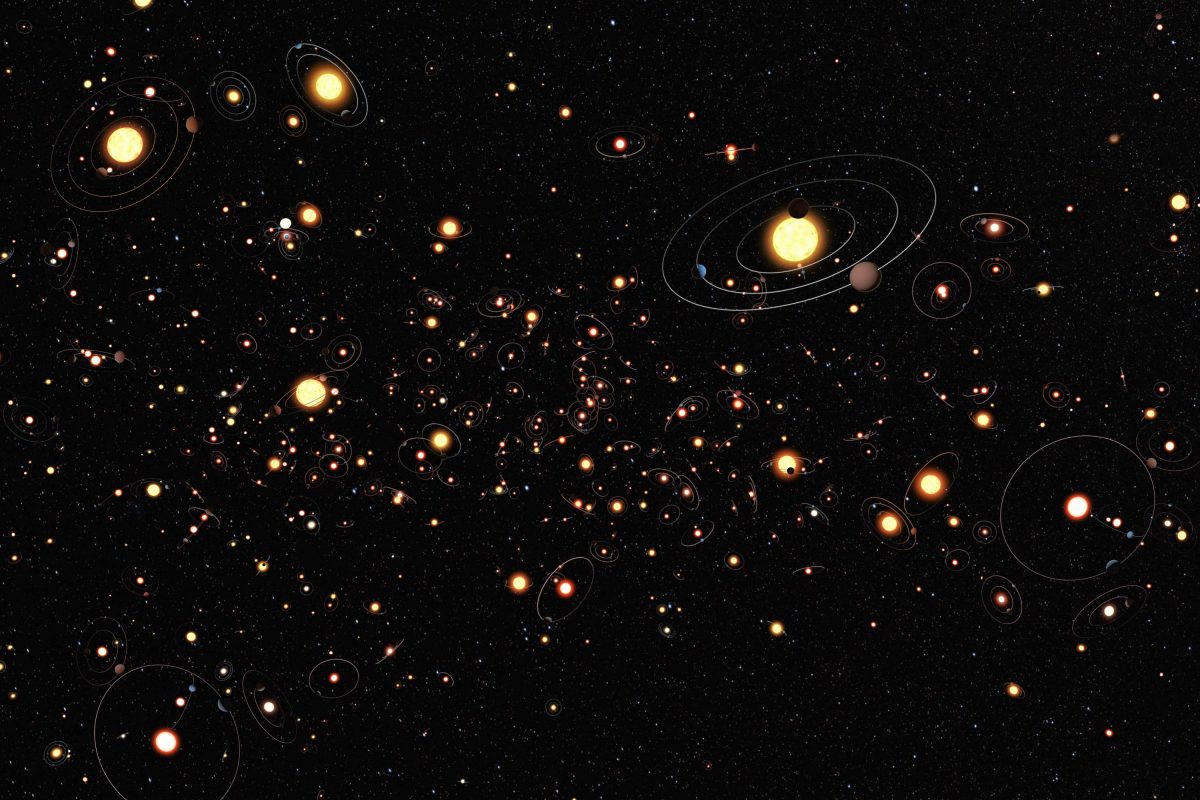
Astronomers have confirmed the existence of interstellar planets—or, as I like them described, rogue planets. These are planets orbiting the galaxy directly. They are not part of any solar system. They orbit no star. These planets formed by themselves, or were, as astronomers suggest, ejected from the systems they were formed in. Some estimate there may be two rogue planets for every star in our galaxy, while others suggest upwards of 100,000 rogue planets for every star in our galaxy. The conclusion: however many planets you think there are in the universe—there are even more than that.

The root word for planet comes from the ancient Greek word for wanderer and was used to describe the stars in the sky which would change position every night. These wandering stars would later become known to be the planets Mercury, Venus, Mars, Jupiter, and Saturn. Uranus and Neptune would eventually join them as Uranus was only properly categorized as a planet after the invention of the telescope, and Neptune’s existence was predicted by math first and then confirmed by observation second. This gives us today’s picture of the planetary system around the Sun—the keyword being today’s, because this is where things get interesting.

If it’s possible for planets to form outside the development of a star, and it’s possible for these planets to wander interstellar space following only the gravity of the galaxy (in the same way our star and entire solar system do), and it’s possible for planets to be ejected from the star systems they were formed in, or conversely captured from interstellar space by the gravity of a near‐by star, then it’s entirely possible the planets in our solar system now are not the same ones that were in it when our sun was formed. We may have lost planets. We may have gained planets. It’s been over 4 billion years since our sun formed. A lot can happen in 4 billion years.

And a lot can happen in 4 years.

And since—for the moment—Earth is 1 in 8 trillion, it’s all the more reason to keep a watchful eye on those geo and heliocentric thinkers bent on keeping our world a small place.

I was going to say more—but then I remembered it’s already been said:

The Earth is a very small stage in a vast cosmic arena. Think of the endless cruelties visited by the inhabitants of one corner of this pixel on the scarcely distinguishable inhabitants of some other corner, how frequent their misunderstandings, how eager they are to kill one another, how fervent their hatreds. Think of the rivers of blood spilled by all those generals and emperors so that, in glory and triumph, they could become the momentary masters of a fraction of a dot.

Carl—thank you.
Adventure Time

Let’s get the new year off to a good start—by leaving town.

Hello, 2017. Welcome.

Odd year? Don’t worry. Even numbers are for squares. You’re in good company here. And you’re prime, too. I like you more and more. Though I know it’s not possible—if you were irrational… I’d be in love. But what sort of sense would an irrational year make?

You already know—not much.

True—and the last few years have not been prime either.

Any more math puns in there?

No, I’ve reached my limit.

Okay—I’m done.

Work has slowed right down. Distributing local food means there is not a whole lot to distribute in the winter aside from dairy, dry goods, and squashes—I’ve learned so much about squashes! What it also means is I’m taking a vacation because my last actual vacation, aside from camping each year at the end of summer, was ten years ago. It was Cuba then—an all‐inclusive resort for a week in early March of 2006. It was fun to be somewhere warm while it was cold back home, but this time I’m going in the opposite direction.

At the end of the month I’m flying to Iceland to spend a few days in and around Reykjavík. Then I’m continuing on to Berlin for two weeks. I have no words other than how excited I am to be going to these places I have wanted to visit ever since I found out they were places.

In Berlin I’ll be staying with my sister while she completes a writing residency project with a fellow actor and playwright. I’m bringing some of my own stuff to work on as well, so it’ll be a mixed play/work vacation. But in Iceland it will be just me, just for a few days, just wandering around this amazing island where they generate power using the heat of the Earth itself. I’ll be able to walk from the North American to the Eurasian tectonic plate, and I’ll be able to see the northern lights.

So excited!

Life With Tina

Sour notes leave me feeling unwelcome. But it’s okay—the cat likes me.

I’m not sure what it is about my gravity, but I’ve got another nut‐job in orbit: the owner of the house I live in.

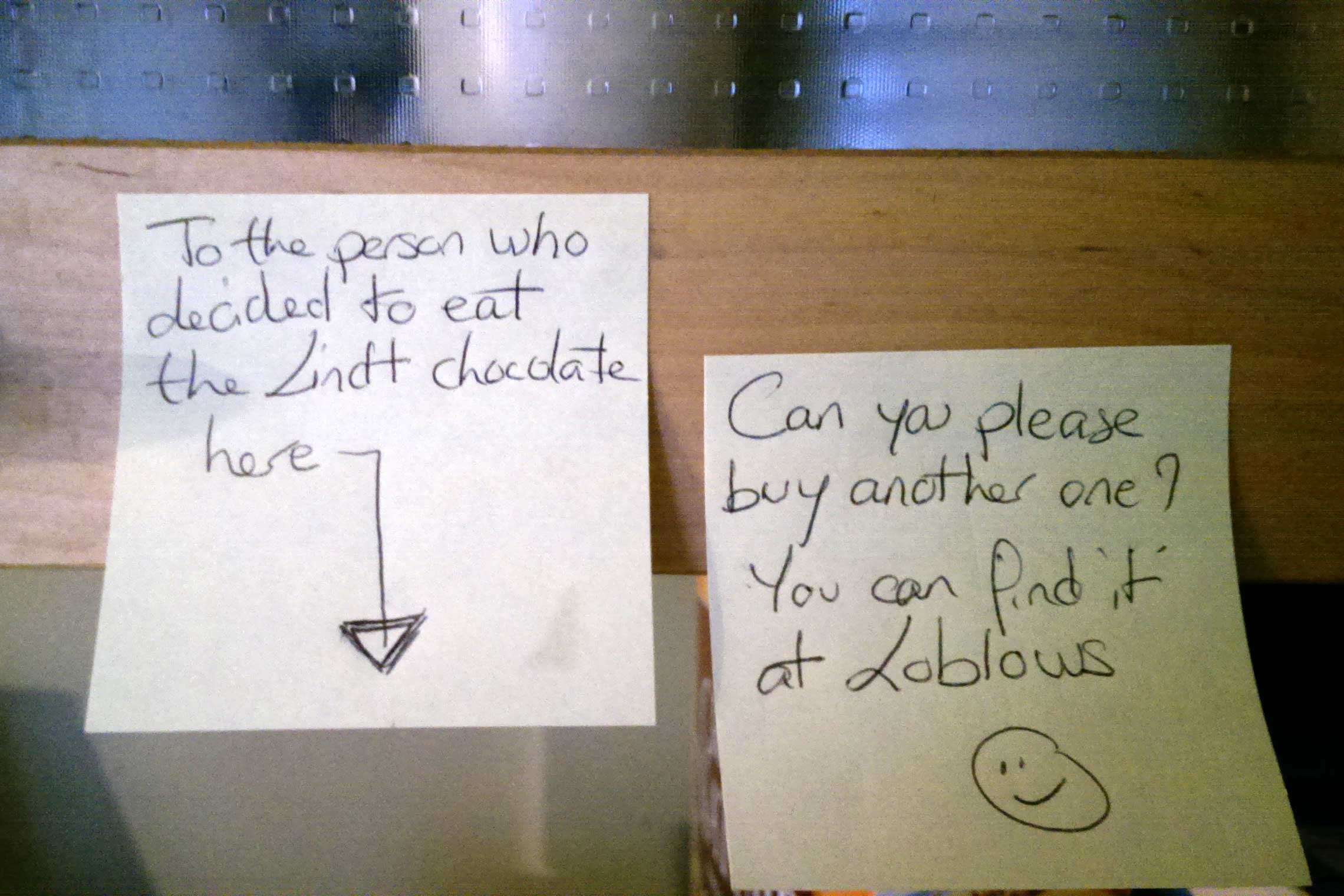
He eats coffee and cigarettes for breakfast, donuts with forceps, and raw sugar cubes stirred into giant bowls of plain yogourt. He’s constantly vocal about how busy he is despite never leaving the house, constantly commenting on how tight money is despite making what I estimate is at least $4500 renting out the rooms in the house, likes to speak French because he thinks I don’t understand it, and one day shared his unsolicited views on the races of the world in descending order of perceived politeness before ripping into Kathleen Wynne for her environmental policy. He’s political, but in an uncomfortable sort of way, like when you’re around someone who uses the word oriental and they’re talking about a person.

Then the notes started…

What is it they say about life and art?

imag1179

That’s from today—so I decided to document the rest, starting with the kitchen, the most noted area of the house.

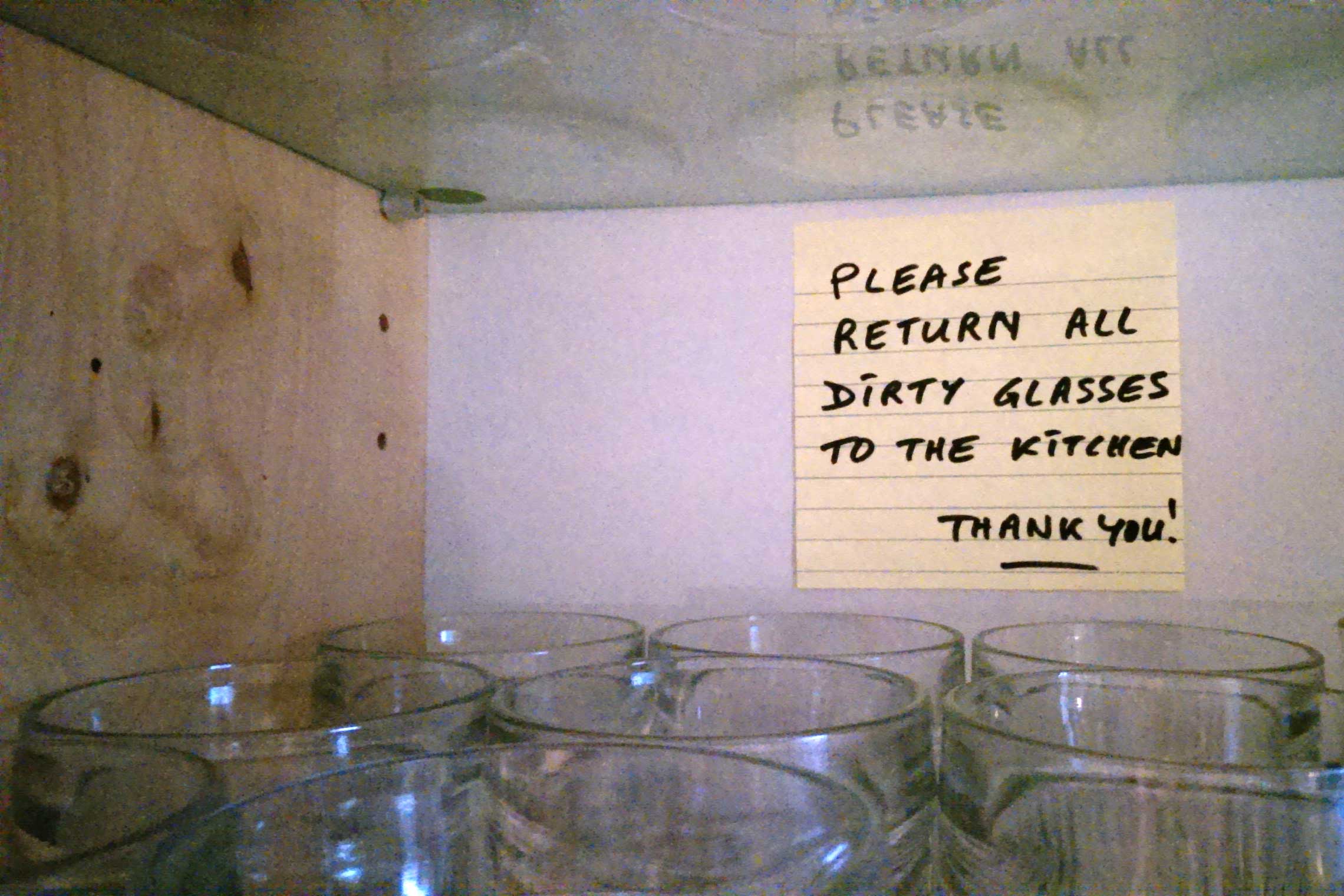
imag1182

I keep a rotating number of clean glasses in my room each week to throw his count off.

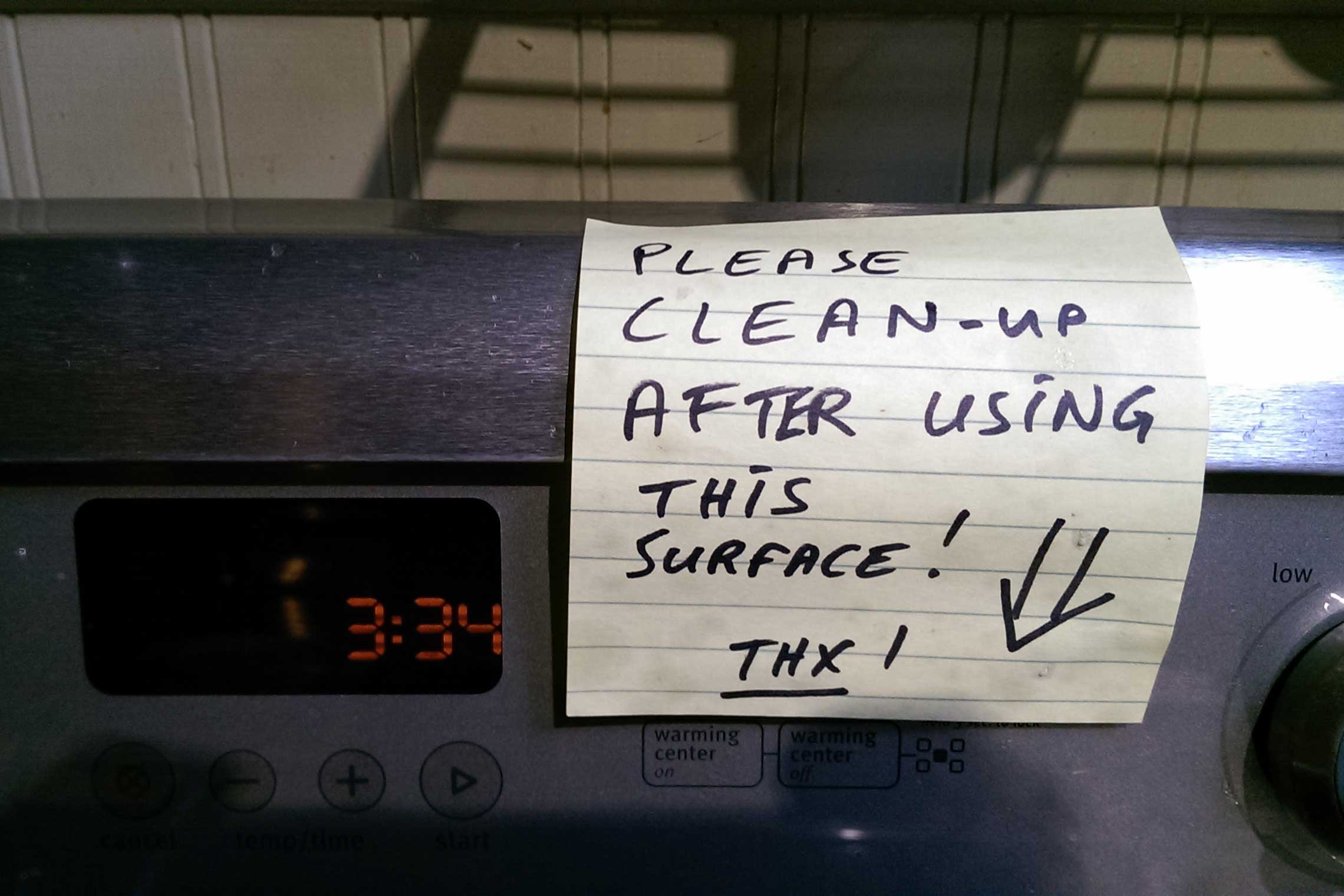
imag1180

It’s a ceramic cooktop—I don’t like ceramic cooktops because I like to cook and ceramic cooktops are bought by people who like to clean more than they like to cook because someone who likes to cook knows ceramic cooktops are terrible for cooking. The only way to easily keep them clean, like any cooktop, is to never use them—and you won’t because you don’t cook—but if you do, and you burn something on the surface—and you will because you don’t cook—you can’t just scour it off like on a normal stove. You have to get special cleaners and cloths or else you ruin the entire thing. On a normal stove you can boil a pot dry and just ruin a pot. On a ceramic cooktop you also melt the glass onto the underside of the pot and—surprise surprise—ruin the entire thing. I know this to be true having ruined exactly one ceramic cooktop in my life. As far as I can tell all a ceramic cooktop is supposed to do is look a certain way and nothing else, otherwise you risk its destruction. Useless!

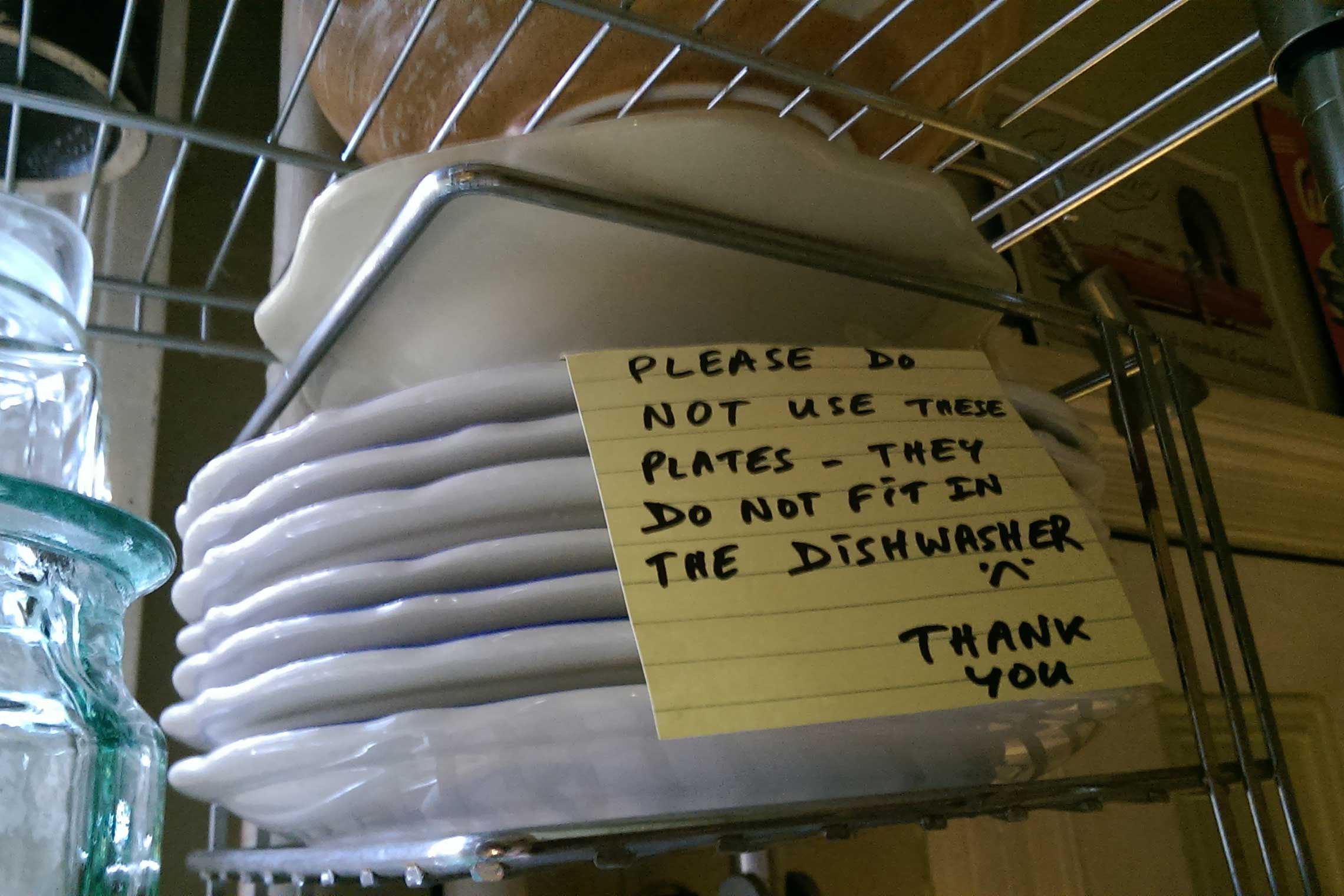
Much like these plates…

imag1181

…since everything in this house—including wood, tooth brushes, sponges, and razors—is run through the dishwasher.

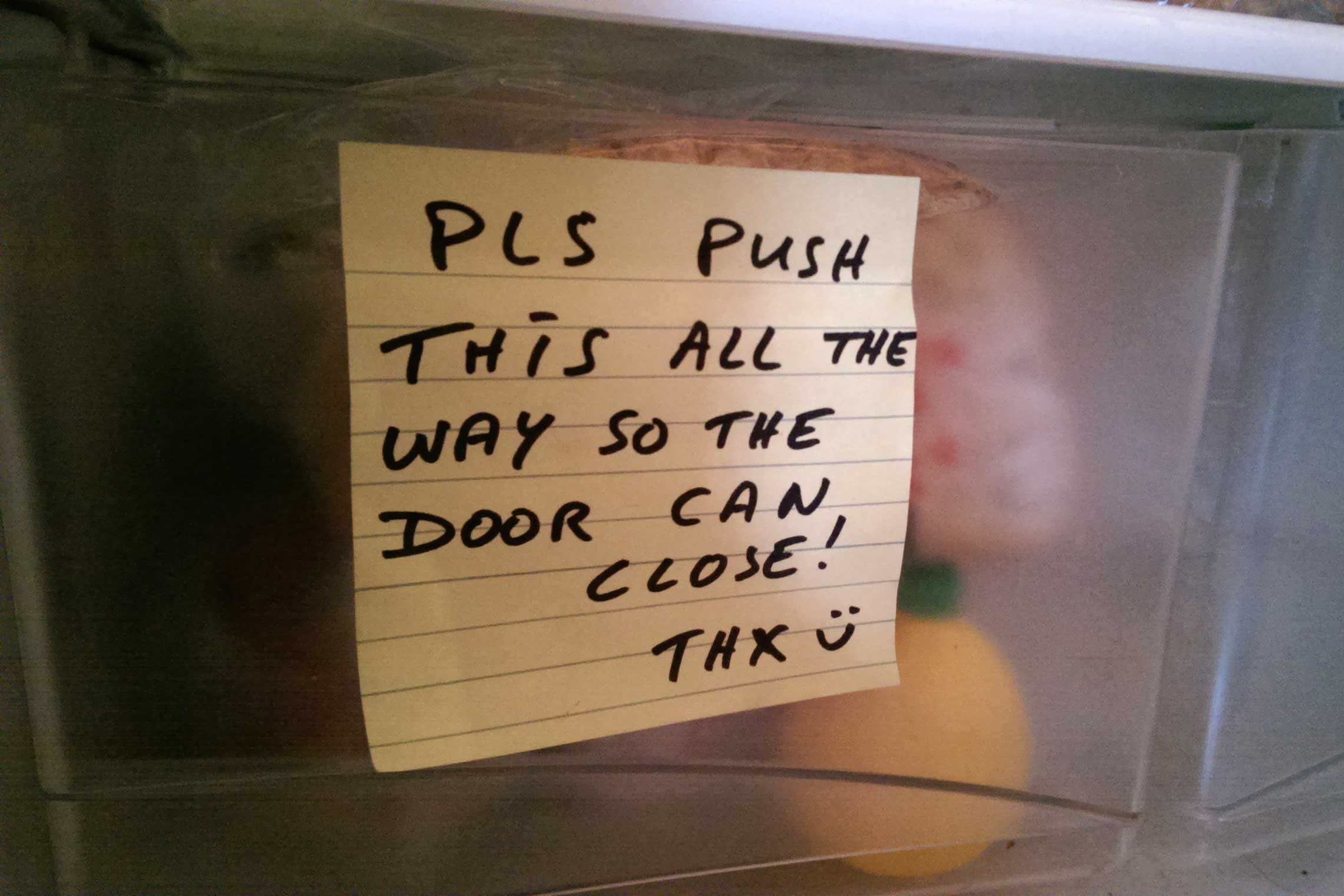
imag1183

Thank you—I know how a fridge works.

Seriously—what is it they say about life and art?

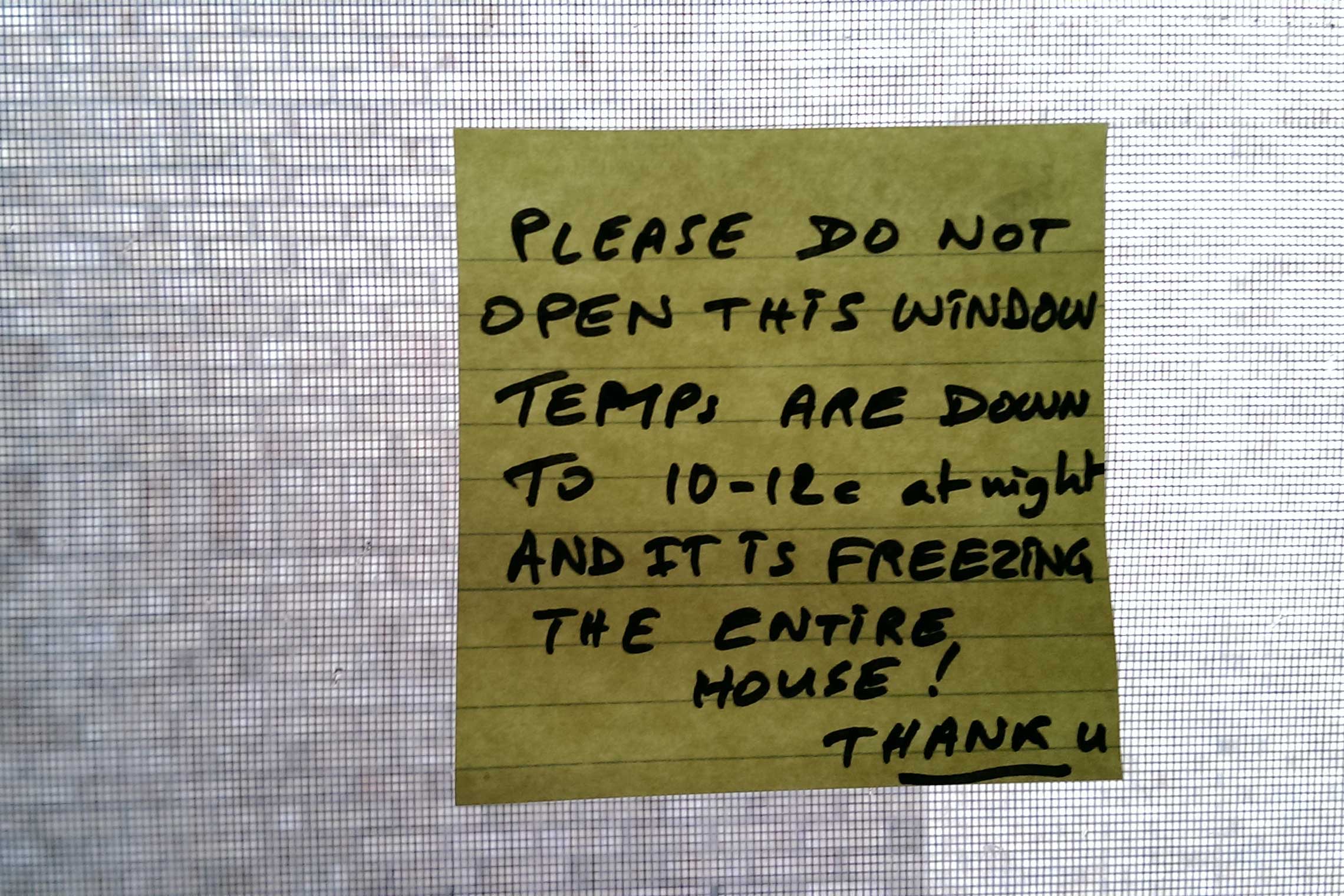
Innocuous at first, the tone of the notes became more condescending and passive‐aggressive as they appeared.

imag1184

You have made it clear what a sophisticated European you are, but despite being a backwater hick from the sticks of Canada, I also know how a window works.

And now the pièce de résistance, the following exercise in patronizing assery disguised as wit.

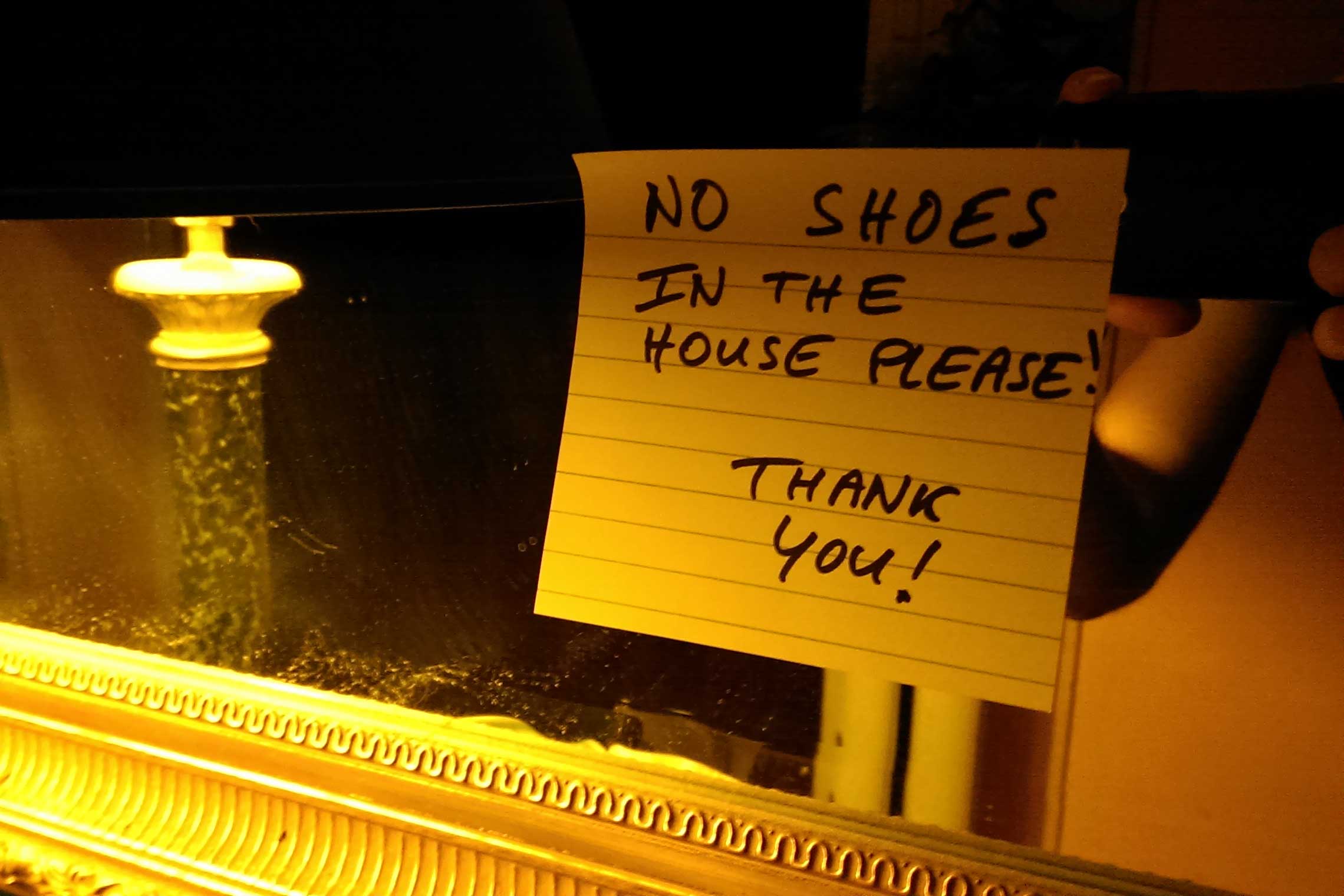
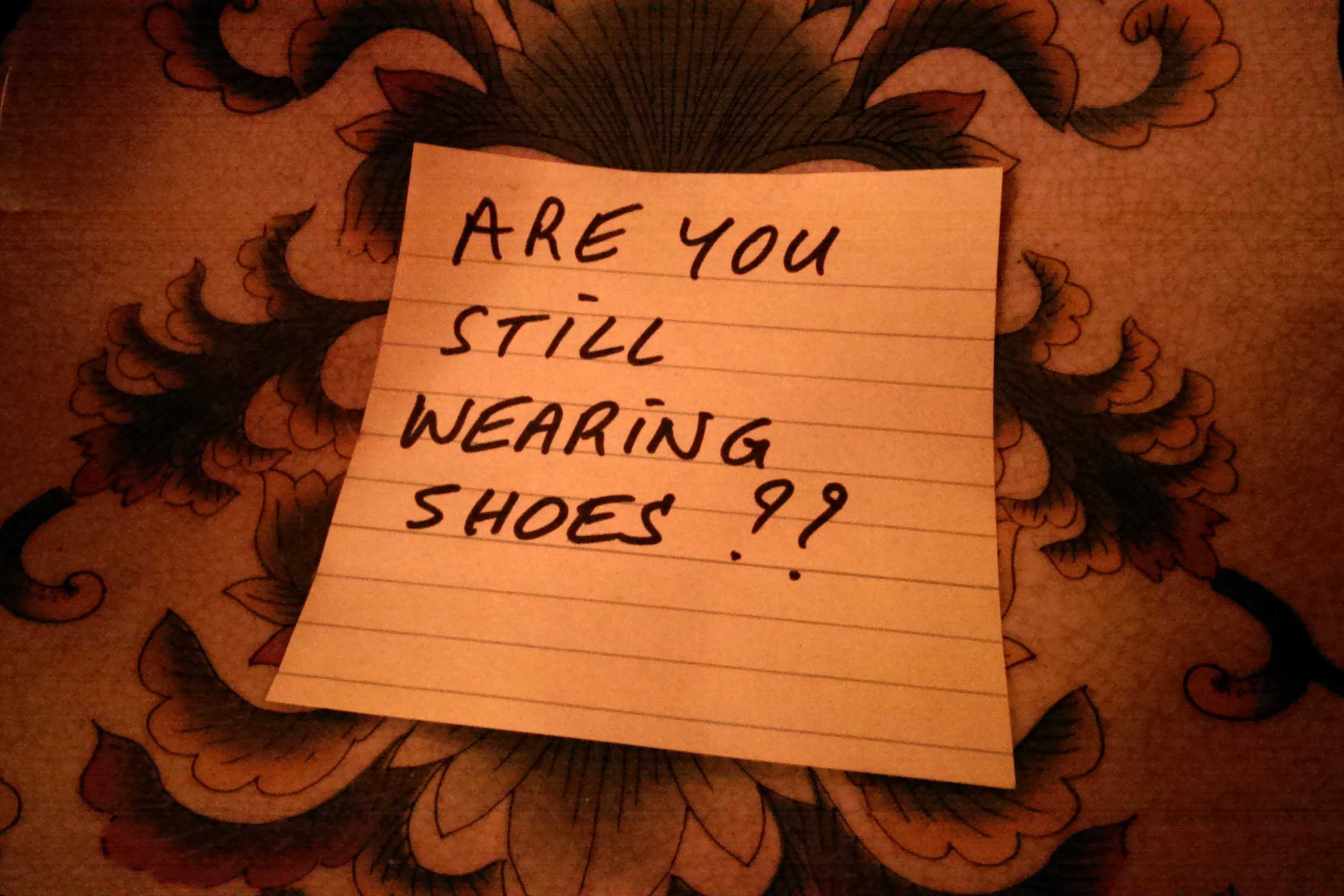
imag1188

I never wear my outside shoes, particularly during sloppy weather, around inside a house—but some people do. I get it…

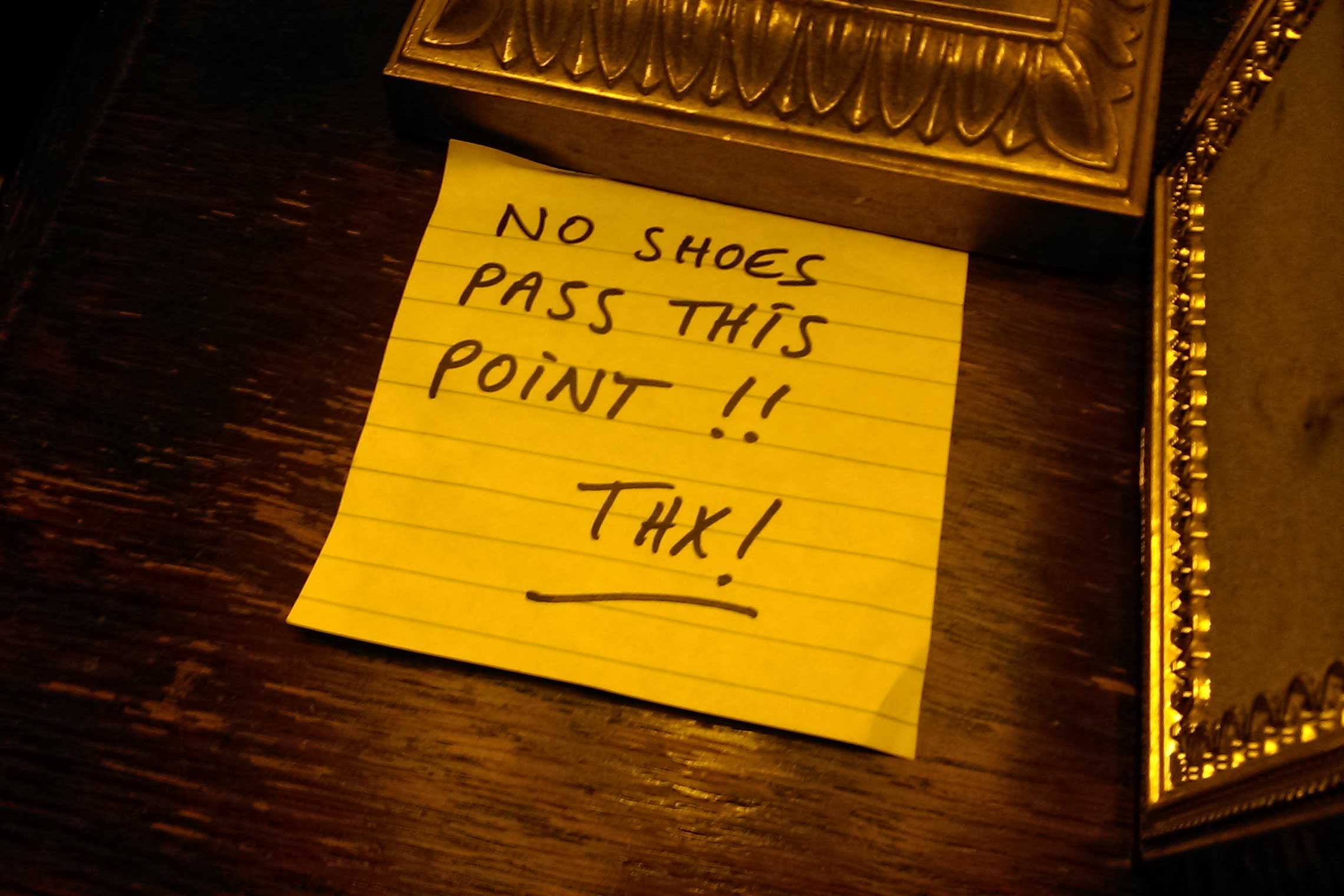
imag1187

Yes—point previously made and understood. My shoes are off. I’m carrying them.

imag1189

Fuck you. I’m putting them back on now.

-huffs-

Okay—now to end on a positive note. The best part about living here is this guy:

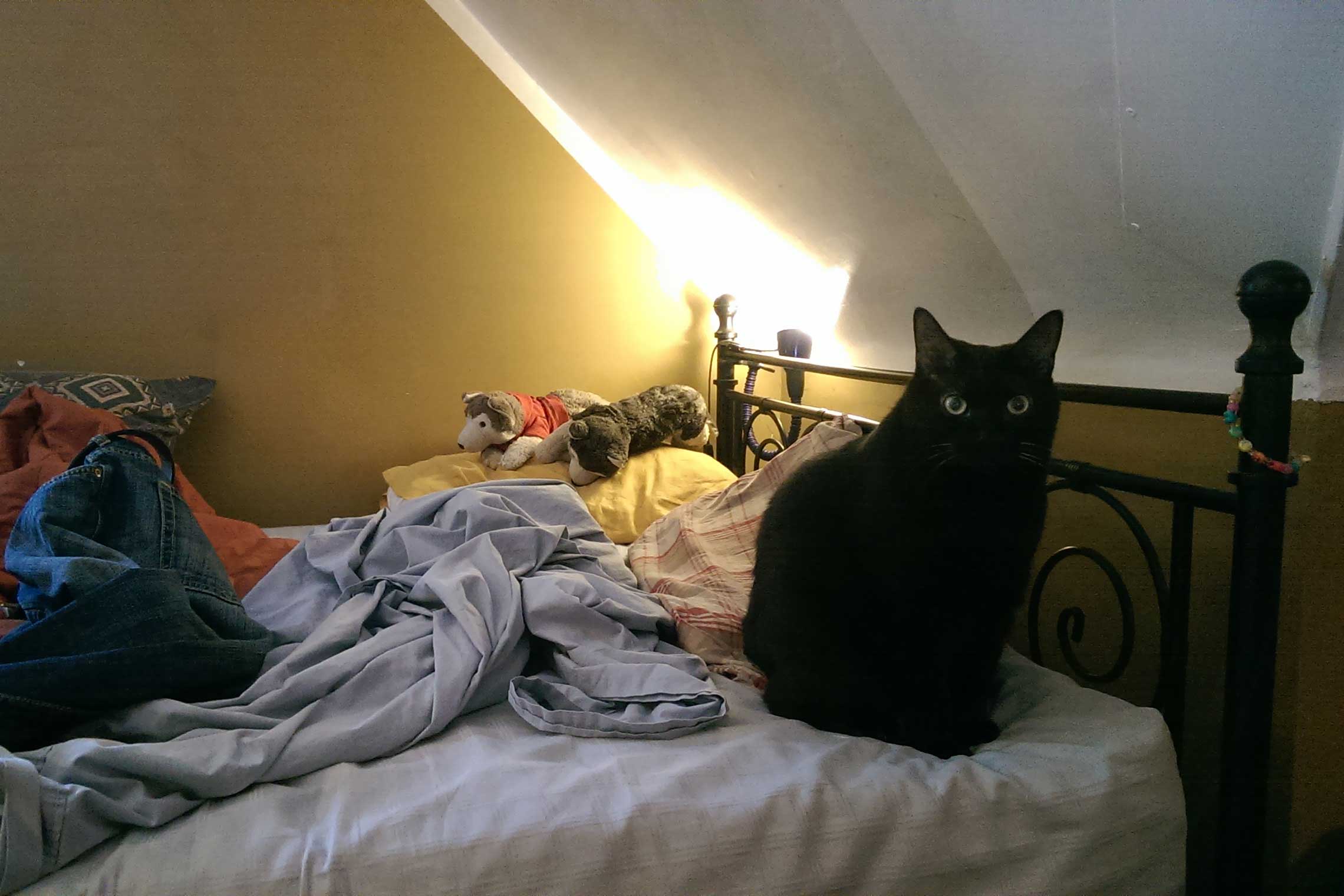
imag1175

This is Freddy, and he comes to my room to hang out before and after work. He sleeps at the end of the bed. He purrs loudly and I feed him clam snacks and brush his fur. He rolls on his back and stretches out to get tummy rubs. I thought he was a black cat at first, but his coat in the bright daylight is a rich chocolate filled with tabby echoes. He’s sitting in my lap right now reminding me it’s time for more snacks.

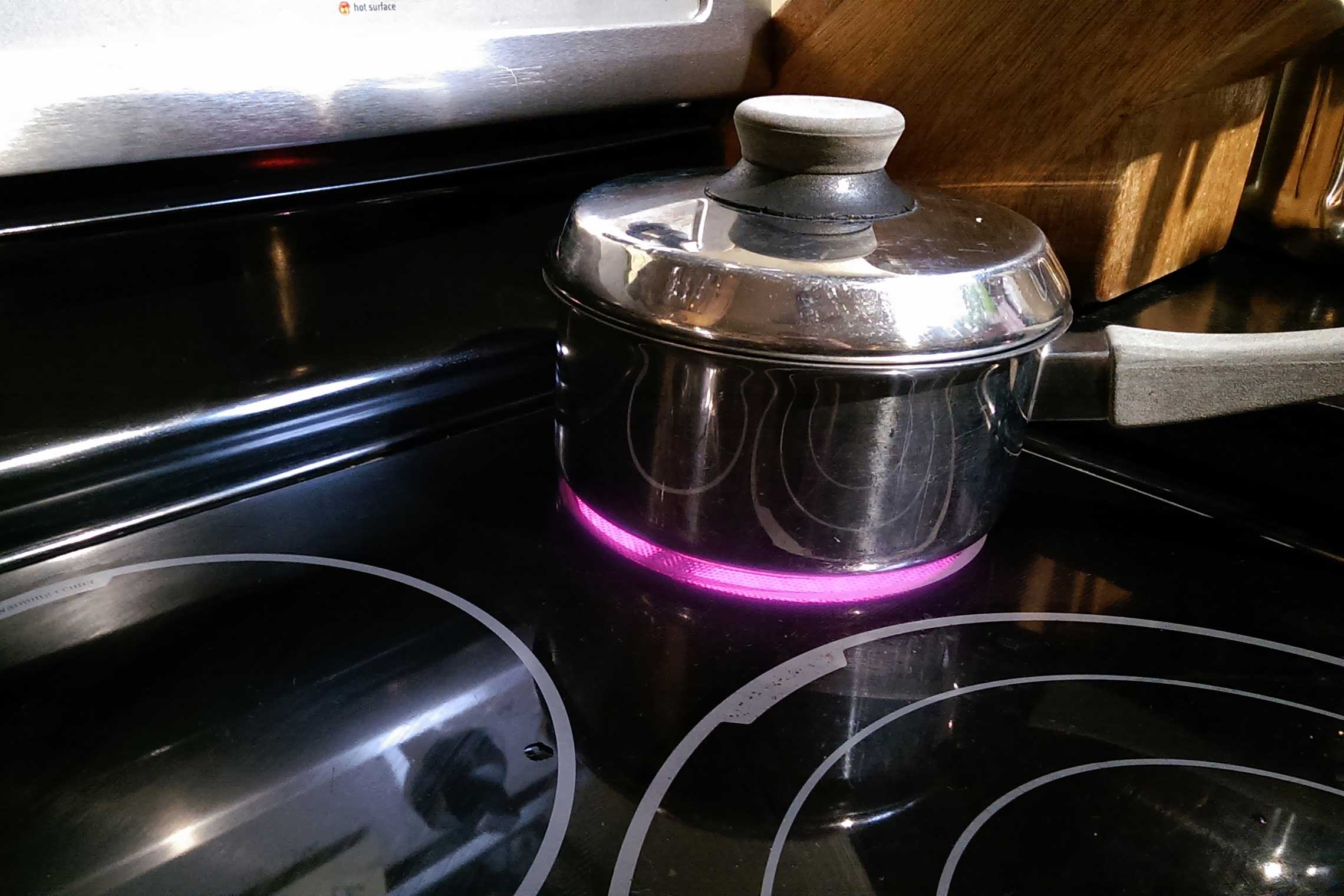
But before I go, one more neat thing I discovered. What colour is heat? Red, right?

imag1177

Nope! Purple.

The Care Were & Computer Island

I remember: Computers are fun. And also—RAWR!

For those of you who’ve seen Pixar’s Inside Out you may remember the concept of the islands of personality introduced in the beginning of the movie—and then watched later as each one slid off into the abyss, breaking apart as they fell. If you’ve not seen this movie, do. I’ve yet to come across anything so beautifully and compassionately illustrating of what it means to be emotionally stuck, to be so stuck you forget who you are—or were. I know I sank a good many of my islands over the last few years. And the rest felt like they were bombed—Massive Attack on Heligoland.

I see what you did there.

You always do. But…

I’m happy to be rebuilding my islands: cars, computers, photography, writing, reading, music, cooking—it’s all coming back. I’m having fun again. And it’s my fun—no encroachment by colonial powers, so to speak. No disclaimers. No having to hide my happiness from jealousy or envy. No more high school mean girls shit. Who knew some gay guys could be worse than some straight girls?

You’re going to get into trouble for that one.

Nope! I experienced both, it felt the same, and as Grimes says: Now I don’t care anymore.

But… the title?

I know—it took coming to a place where I don’t care anymore to start caring again.

So this is you?

When I’m bashing crates off my knees for the third time in the evening and the second time in the week, when I’m ripping apart a skid in a refrigerated truck at midnight looking for the beans, or the onions, or the whatever it is I need to fix so the order goes out right, when I’m wrapping cheese in bubble pack or counting all the blueberries in a deep freezer, or when I just want to punch everything, I sometimes see myself as a big pink care were with lots of teeth and a giant heart—and then things are okay. I snarl inside, think of the ridiculous smiley face sun, and then things are okay. I don’t punch anything. I keep counting the blueberries, keep wrapping the cheese. I find the onions and the beans. The order will go out right, the skid is back together, I’m warm in my coat, and my knees will be fine. Yes—this is me.

Last weekend I rebuilt my computer using some second hand parts and software I got from my family—and with all the trouble I’ve had with my computers this summer, I hope they know how grateful I am. The last PC I built was in 2002, and I’ve been keeping it going since then over many years with the odd part here and there, but as I was beginning to realize as more and more software slowed to a crawl, or stopped working all together, I was running a CPU just under a decade old with less memory than some phones today on a version of Windows Microsoft stopped supporting two years ago. The main hard drives were from 2004, and they connected to the fifteen year old mother board using an interface long since replaced in modern machines.

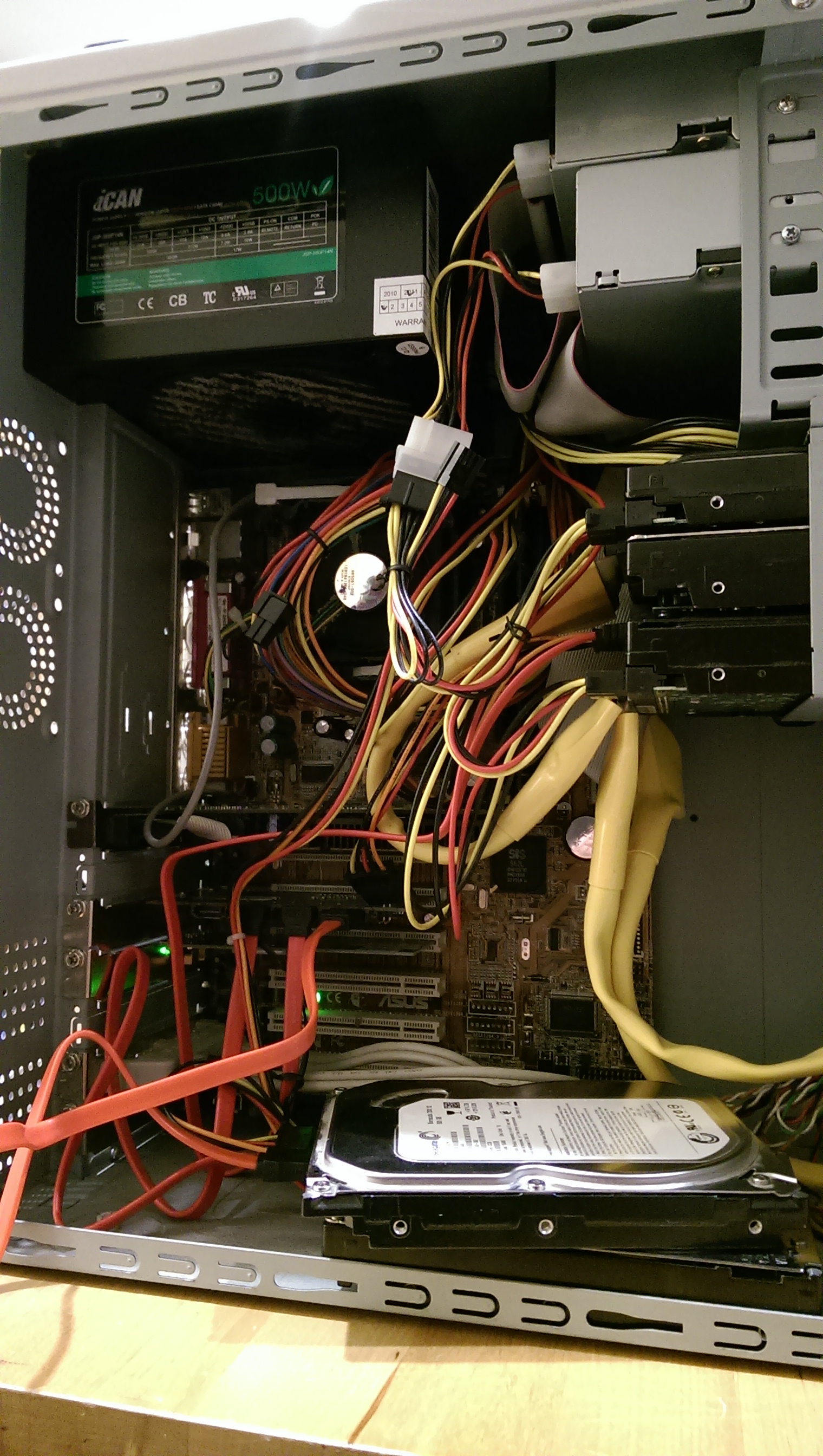
imag1130

Yes—those are a small pile of hard drives in the bottom of the case. They just sat there because there was no room anywhere else for any more drives despite me needing more storage. It’s a jumbled mess of cables and equipment, a tribute to my own attitude of not really caring about having a computer or looking after it—just keep it going, do whatever you need to do to keep it going. It’s actually something I’m quite good at—keeping things like a computer going—but I forgot to enjoy the act. I’d forgotten to care that I could. Most of my computers I’ve built from bits, and it seems fitting my newest machine is just more of the same.

imag1132

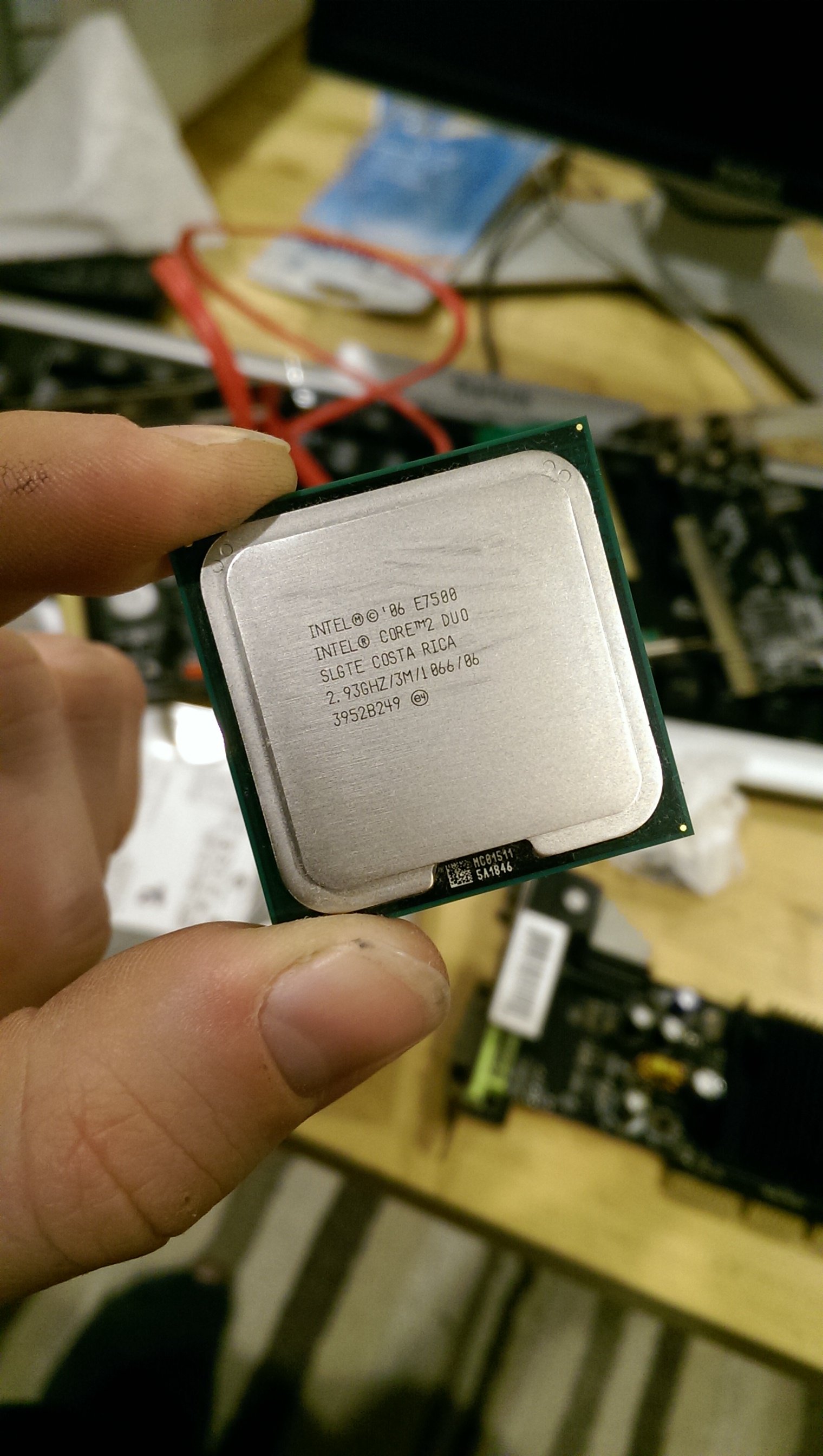
This is the new CPU—an Intel Core2 Duo. It’s still an old chip, but it’s a big improvement over the Pentium 4 I’ve been using.

imag1133

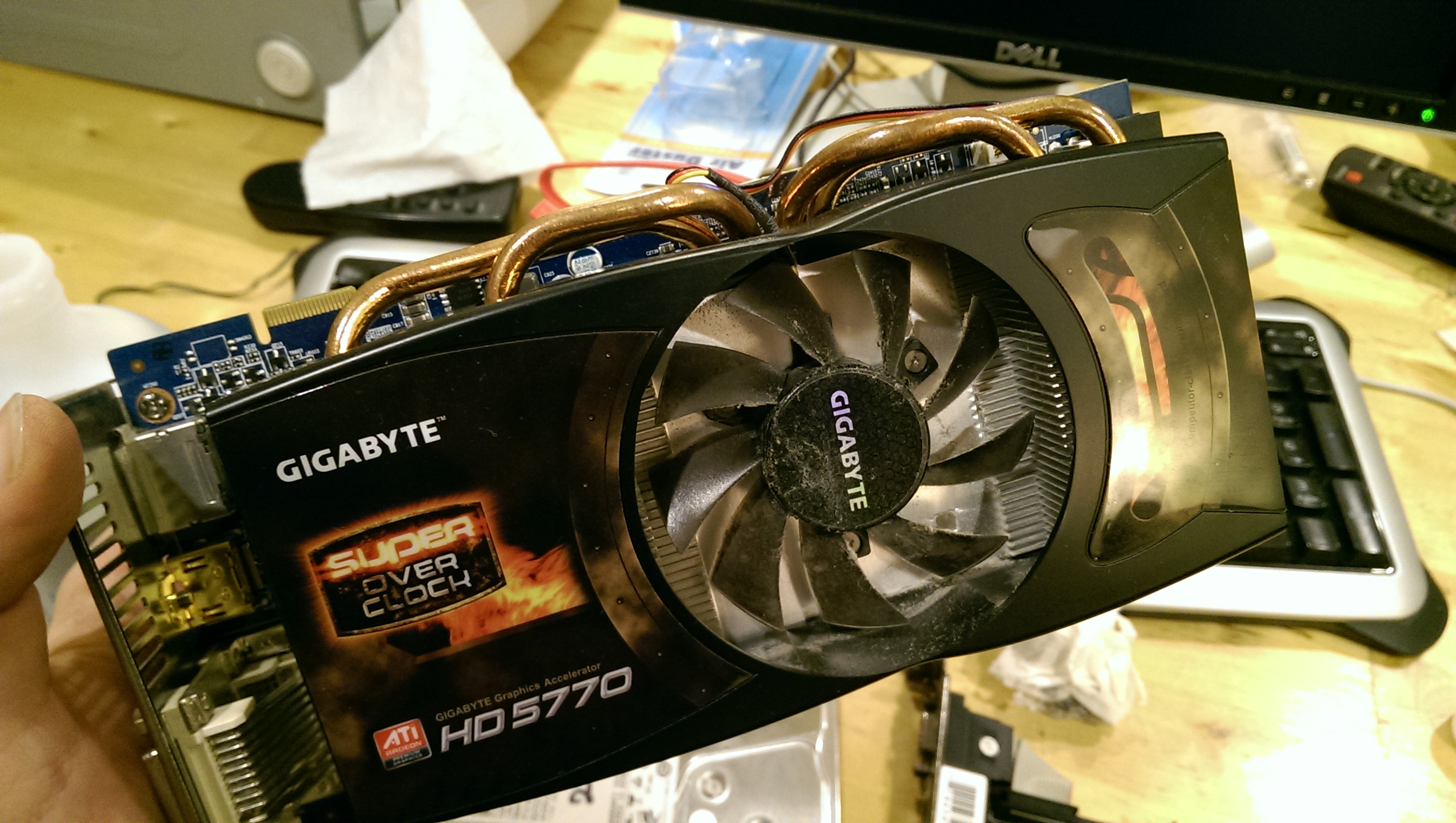
And this is my new graphics card—basically an entire little computer in its own right, complete with its own fan and heat pipes. Plus—with its HDMI connection I can use my TV as a 46″ monitor.

imag1134

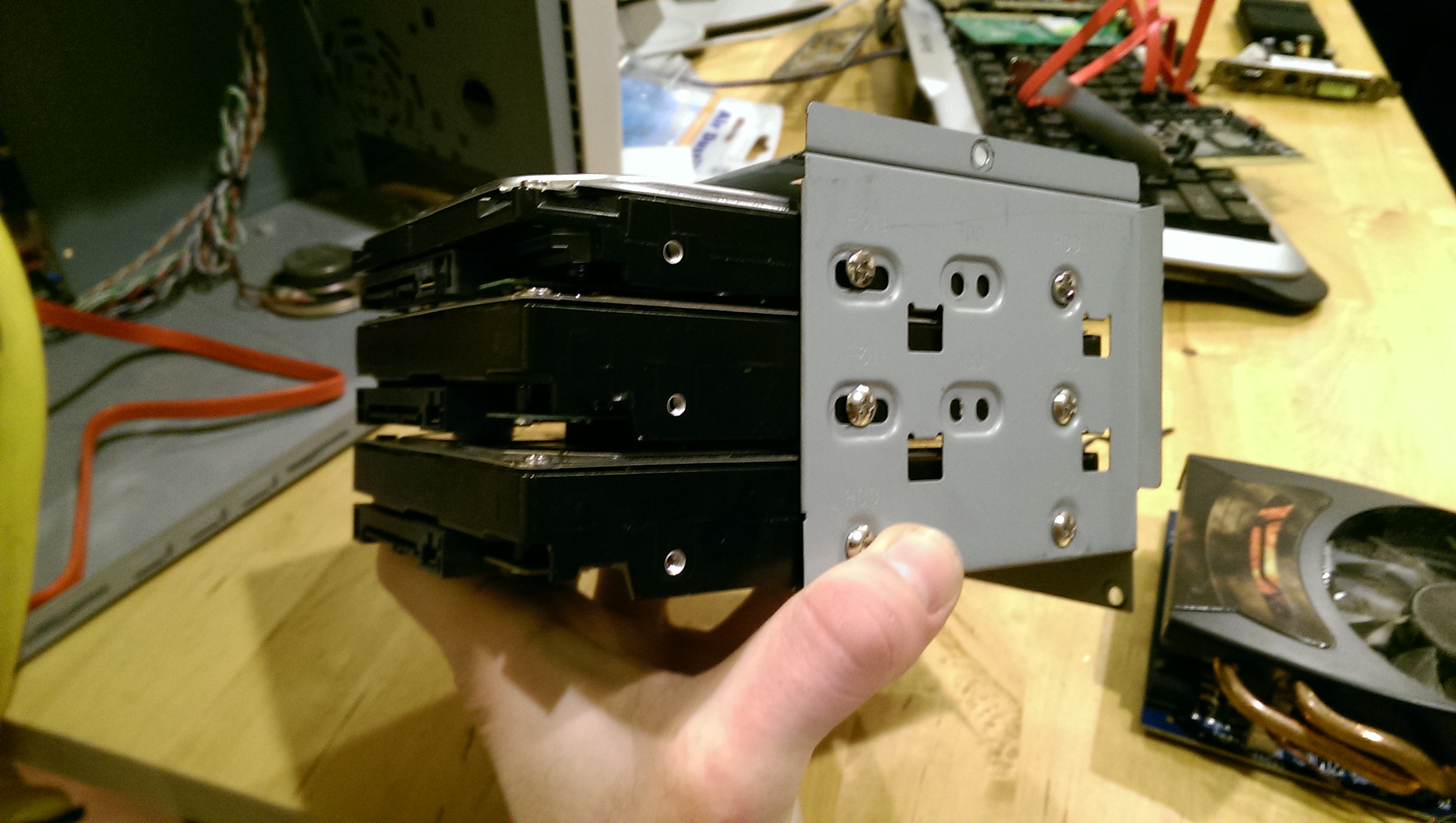
I’ve reduced the number of hard drives in the system from five to three: a 500GB system drive and a 1TB RAID made up of the two drives from my old (and failed) network storage device.

imag1135

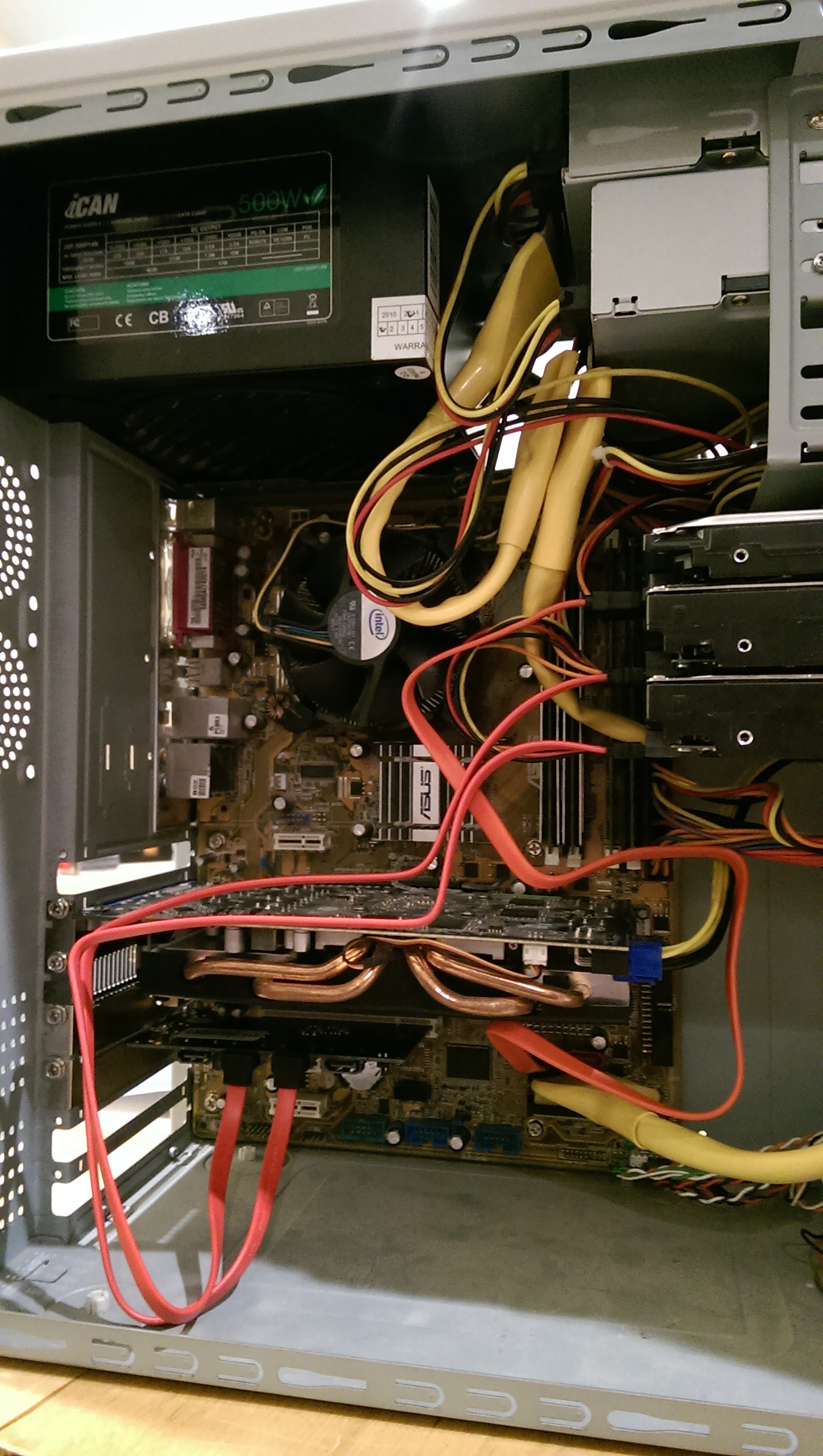
Here’s the completed system assembled into the old case—neat and tidy. Now—I’d thought about getting one of those new modern cases with the gills and the lights and everything. And maybe one day I will, but the case is now the only thing left from the 2002 machine, and my sense of continuity is telling me to keep it all in there for now. It was in 2002, after all, where my computer adventure really started, where I understood what it meant to be digital without realizing it until only recently—the consequences and effect of digitality—this binary universe—it from bit.

All that from a computer you built to a price coming up on fifteen years ago?

It’s been a good machine. Three cheers for Koinu! You ran near‐continuously for years, and though you exploded your original power supply in a shower of sparks, you never let me down, never lost a bit of data, and even in your advancing years, the only thing you sometimes forget was the time when you were left unplugged.

And, yes—I name my computers. Koinu—my old computer—is Japanese for puppy, and it was from my puppy days, when everything I named had something to do with pup stuff. If you have one of my email addresses you might notice the domain name—chiot—is the French word for puppy.

I’ve named the new machine Lundehund—after the Norwegian Puffin Dog, a nibble, six‐toed Spitz from Scandinavia. It’s a rare breed, with less than 1000 dogs in the world today, but the line is ancient, going back to what’s thought to be the primeval dog, Canis forus, rather than the more domesticated Canis familiaris we know today. It’s incredibly flexible, able to bend its head back and rest it on the top of its own spine. It can seal its ears shut by folding them forward or backward. And—what tugged at my heart the most—was the bizarre digestive disorder plaguing the breed—an inability to absorb enough nutrients no matter how much the dog eats, leading to malnutrition if diet isn’t properly managed.

A little freak dog from the north older than time with a rubber spine, bendy ears, and a tricky gut? Sounds like the perfect digital companion for a big, pink‐furred care were…

So let’s raise the flag up high on the new and improved computer island. Let it fly in the wonderful wind! This one’s mine again.

Rawr!

Consuming Culture

In case you’ve ever wondered—I’m on the planet’s side.

I will—generally—root for the underdog. Having endured many years at many schools I know what it’s like to have none of your peers cheer for you, notice you’re there or not, or be generally interested in your success or failure—aside from how it perhaps might impact their experience.

Popular things don’t need my support or interest. They’re already popular. But something challenging sometimes happens in my support of the underdog. Sometimes the underdog becomes popular. And that’s where it all goes wrong, because now the underdog isn’t anymore—now it’s part of popular culture, and now a part of me isn’t interested anymore, a growing part of me is waiting for the inevitable fade into the background of mass mediocrity, and the rest of me is quietly pleased because I know it always happens—it’s just a matter of when and how.

Remember Lady Gaga? She was good—I thought she was clever and smart, with a fantastic voice, and a good sense of the industry. Then she got swept away in borrowed iconography and insidery lyrics. She got hugely popular, and the lines between her playing the industry and the industry playing her blurred. Her latest single is terrible—a simplistic decry of a love being nothing but a perfect illusion. It’s trite and obvious. But it’s mass‐marketable. And I’m sure there will be no giant hats, Beyoncé, or fun in the video. Best of luck, Stefani. I’ll always enjoy what you were.

What I actually wanted to write about today—

You’re writing about something! See… You do have things to say. I’m pleased.

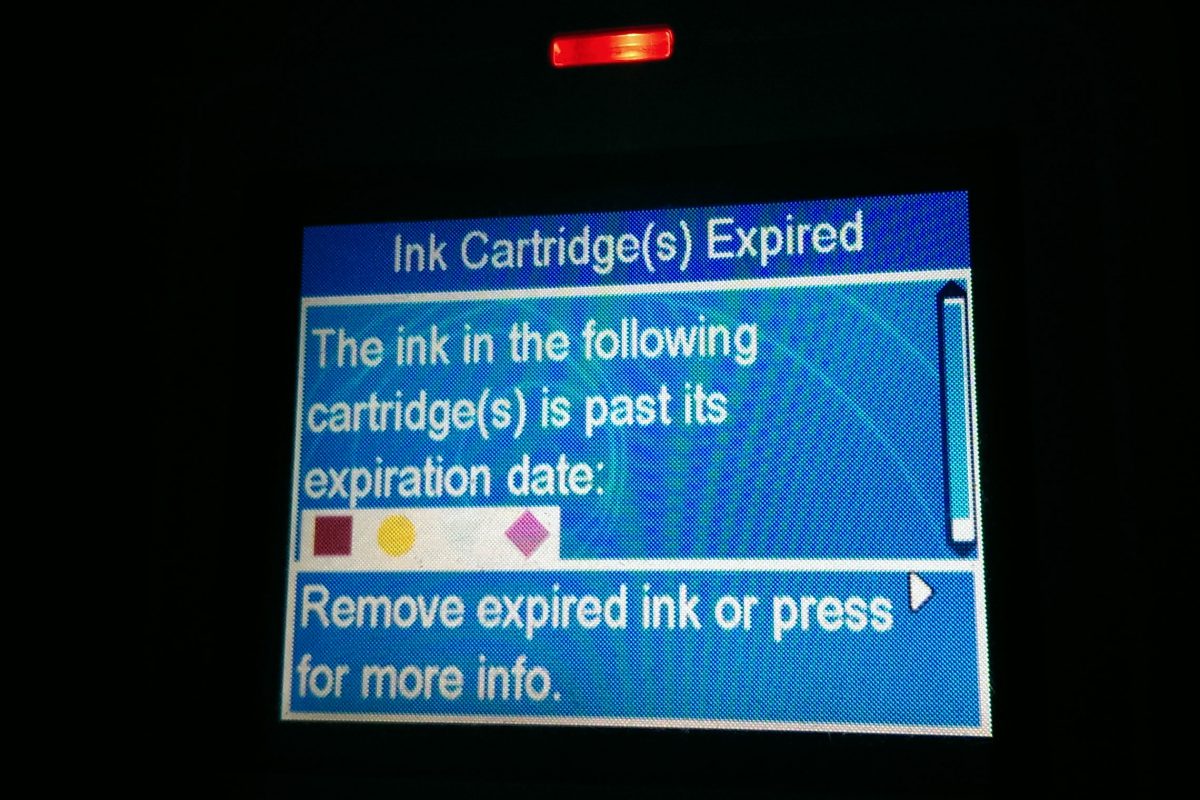
—was printer ink.

…What?

Popular culture is a lot like printer ink. The more pages you churn out, the more ink you use, which means you buy more ink, and more ink gets sold. With popular culture the consumption is of the culture itself—whatever it is or where ever it’s from—the faster you empty it the more often it needs to be replaced.

I see now.

It’s celebrated and rewarded because it sells stuff, and if you’re the one generating the culture and selling the stuff, you’re no different than a printer company under‐charging you for the printer you’re buying today so they can over‐charge you for ink you’ll be needing tomorrow.

Or a defence contractor who also sells televisions and soap?

Ain’t it grand?

What’s this got to do with pop culture?

Well—like pop culture itself—it’s a marketing thing. If you want access to the biggest market, then you’re looking at popular culture, at mass appeal. Statistically that’s where the money will be, even though for the most part we’re all broke—it becomes a chilling economy of scale: A bunch of people who can’t afford something all still manage to buy it anyway and then you end up with a bunch of people who have more of what they’ve been told they what than what they’ve ever been told they need. But it’s okay—just build and fill another container ship and…

I feel this is the part where I knock you back on point. Printer ink, remember?

There are two radio stations work will bounce back and forth between listening to throughout the day. One station plays a variety of new and old alt, indie, retro, and retro‐retro music. It’s the only station I know where I might hear David Bowie, Radiohead, The Weeknd, and Grimes all in the same hour along with a bunch of other one‐off stuff. I quite like it. The other station is Top 40, and I cannot begin to describe how much I don’t like it, but I will just a little. Most of the music is what I’d consider junk food for my ears anyway, with the odd good track snuck in there somehow amidst the repetitive ear‐worm buffet—but it’s the advertising I don’t like the most, and the commercial I don’t like the most is for printer ink.

Everyone is sort of aware of how printer ink is a rip‐off, but we also all sort of begrudgingly participate in the scam because life’s either too short or too long depending on what you tell yourself in the presence of bullshit. But you still need the ink. And if you’re listening to the Top 40 radio station, you’re going to hear about a new service from HP where they will automatically send you ink as instructed by your printer for a monthly fee ranging from $4 to $11. Sounds good, right? Too bad it teaches the wrong lesson—provided you’ve got the cash, resources will just appear at your door without you having to think, know, or care about the process behind it all. Keep calm and consume along… And try not to think about how you’ll buy that cheap printer 1 to 2 times a year in monthly ink fees.

How many defence contractors also make printers?

At least three: IBM, Mitsubishi, and LG. There’s probably more—just look at the war countries. Lots of money in war. Lots of printing to be done, I imagine.

Did you lose your thread?

I don’t like the culture of consumption being instilled in popular culture. It offends me. It’s serving a few in the short‐term at the expense of the many in the long‐term. It’s disrespectful. I’d previously thought environmentalism was something we did for the planet—but I know now it’s something we are trying to do for ourselves. As Dylan Moran so eloquently puts it: “…’Cause the planet’s not gonna miss us, you know, when we’ve finished fucking it up and killing each other.”

Earth, my current home, will always be fine. It always is. Life is nearly wiped out and then returns to it often, from a planetary perspective. Our time here amounts to a tiny fraction of the planet’s being, yet in this short time we’ve been able to conclusively damage not only our living environment time and time again, but that of the countless other inhabitants of our planet who’ve had even less say than the little most of us have had. And for what? …No I’m actually asking—What is taking our planet to the brink actually getting us other than printer ink delivered to our door? Or is it cellphones with curved screens we’re all supposed to be falling to our knees in gratitude for?

This hurts you—doesn’t it?

Of course it does. It’s like watching someone else slowly destroy, piece by piece, something beautiful and having everyone else do nothing, say that’s just how it is, or try to buy tickets to it. The only hope I have is it’s just a fad—and this current, and to my perspective, alien cultural obsession with consumption will turn into something more sustainable, that something more beautiful might emerge from this desire to pave the planet with garbage generated by disposable everything.

Do you think you’ll ever see it?

Are you kidding? I’m not going anywhere. I’ve got the time. And I wouldn’t miss it for the world.

And the underdog?

Well—turnabout is fair play. Now we’ll consume them.