
Back before we could or be allowed to observe anything suggesting otherwise we knew the entire sky and everything in it revolved around a stationary earth—geocentrism it’s called—and despite being completely incorrect, it was supported by tomes of information and was enshrined within religious texts for hundreds of years. And as is often the case with enshrinement, anything challenging it was met with ridicule, brutality, and death. Who needs to be concerned with finding out what’s actually correct when you can look in a book and be told you’re right instead…
Now—after several excommunications, imprisonments, torturings, and executions—we know the entire sky does not revolve around a stationary earth, that the earth instead revolves around the sun, along with all other objects in our solar system—heliocentrism it’s called—a reference to Helios, the personification of the sun in Greek mythology. Curiously, geocentrism takes its name from the root word geo, also Greek, but meaning pertaining to the earth, like geometry, which traces its origins back to attempts to measure the size of the planet, highly secular by comparison to heliocentrism’s more divine origins—in name that is.
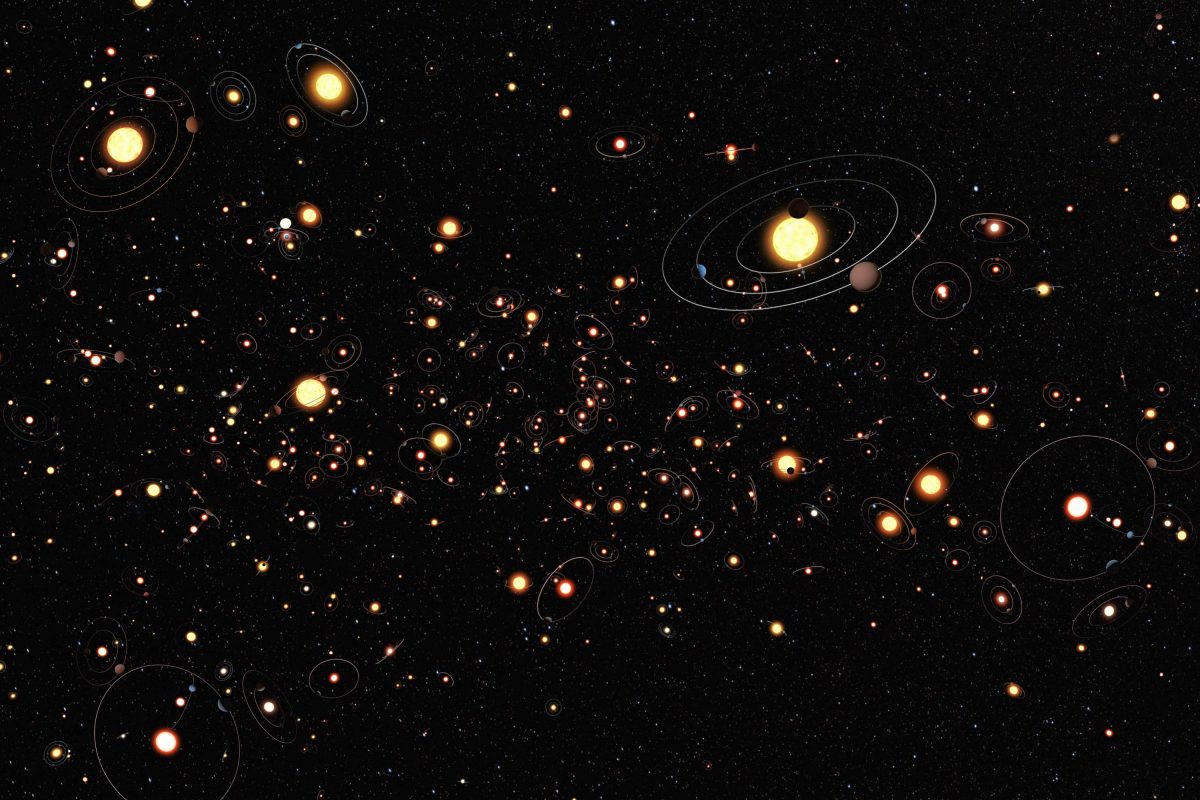
Lingering ideas from the past would still—for some—frame the heliocentric model of our solar system as being in the centre of the universe, as if for an incredible reason our perfectly ordinary star was the most important place in all of existence. And—in some ways—they’re right. Our sun helps support the only place in all of existence to be inhabited by alive life as we know it. But in another, more accurate way, they’re not right, not by a long shot. There are countless other stars just like our sun, with even more countless Earth‐sized planets orbiting them at a distance called the habitable zone which describes an area around the star where a planet’s temperature would be the most conducive to supporting the life we’re familiar with here on Earth. And actually, it’s not exactly countless planets. Based on current estimates there may be as many as 40 billion of these Earth‐sized planets in our galaxy alone, our galaxy being one of 100 to 200 billion other galaxies. So in total, we’re looking at 4 to 8 trillion possible Earths—4,000,000,000,000 to 8,000,000,000,000 planets like ours. What are the odds we’re one in 8,000,000,000,000?
One of the challenges of knowledge is how it can also blind—you know or think you know something, but in knowing that thing, you unintentionally but sometimes quite deliberately shut out anything else running affront to what you think or believe you know. You become too comfortable in rightness and forget about being correct. It’s geocentrism all over again.
One of the consequences of heliocentrism is it places the Sun as being the central figure in our solar system. The Sun accounts for 99.86% of the mass in our solar system, and as a result, its gravity pulls the remaining 0.12% of the mass making up all the planets, asteroids, comets, and other space stuff around it into orbit around it—so from that perspective the Sun’s role as a central figure does make sense.
Heliocentrism also postulates all the objects in our solar system were once part of the same giant cloud of molecules in space that started swirling and compressing together into what would become the Sun, the planets, asteroids, comets, and aforementioned other space stuff in our solar system.
From the two prevailing points of heliocentrism we get following: a central figure much more massive than ourselves is responsible for the creation and sustenance of all that is around us. Now if that sounds a little familiar I attribute it to science and religion often describing the same thing but in their own language, a point I’m happy to concede but too often see others on both sides backing uncomfortably away from. And that’s too bad, because the idea of what we’re made of and how our world works isn’t anything to be uncomfortable about. We live in exciting times. We’re seeing deeper into space than we ever thought possible, and what we’re finding are incredible things—things that show us there is still much more to know and understand.
Astronomers have confirmed the existence of interstellar planets—or, as I like them described, rogue planets. These are planets orbiting the galaxy directly. They are not part of any solar system. They orbit no star. These planets formed by themselves, or were, as astronomers suggest, ejected from the systems they were formed in. Some estimate there may be two rogue planets for every star in our galaxy, while others suggest upwards of 100,000 rogue planets for every star in our galaxy. The conclusion: however many planets you think there are in the universe—there are even more than that.
The root word for planet comes from the ancient Greek word for wanderer and was used to describe the stars in the sky which would change position every night. These wandering stars would later become known to be the planets Mercury, Venus, Mars, Jupiter, and Saturn. Uranus and Neptune would eventually join them as Uranus was only properly categorized as a planet after the invention of the telescope, and Neptune’s existence was predicted by math first and then confirmed by observation second. This gives us today’s picture of the planetary system around the Sun—the keyword being today’s, because this is where things get interesting.
If it’s possible for planets to form outside the development of a star, and it’s possible for these planets to wander interstellar space following only the gravity of the galaxy (in the same way our star and entire solar system do), and it’s possible for planets to be ejected from the star systems they were formed in, or conversely captured from interstellar space by the gravity of a near‐by star, then it’s entirely possible the planets in our solar system now are not the same ones that were in it when our sun was formed. We may have lost planets. We may have gained planets. It’s been over 4 billion years since our sun formed. A lot can happen in 4 billion years.
And a lot can happen in 4 years.
And since—for the moment—Earth is 1 in 8 trillion, it’s all the more reason to keep a watchful eye on those geo and heliocentric thinkers bent on keeping our world a small place.
I was going to say more—but then I remembered it’s already been said:
The Earth is a very small stage in a vast cosmic arena. Think of the endless cruelties visited by the inhabitants of one corner of this pixel on the scarcely distinguishable inhabitants of some other corner, how frequent their misunderstandings, how eager they are to kill one another, how fervent their hatreds. Think of the rivers of blood spilled by all those generals and emperors so that, in glory and triumph, they could become the momentary masters of a fraction of a dot.
Carl—thank you.