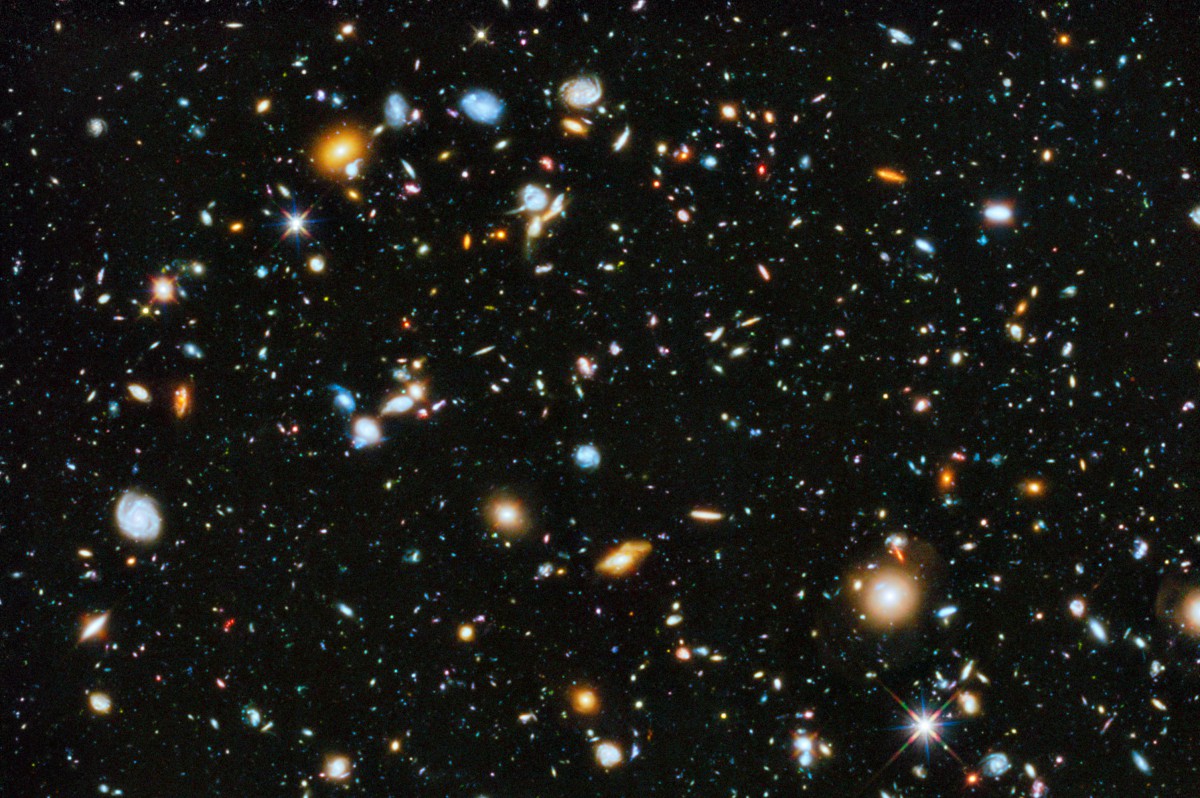
The image from my previous post is known as the Hubble Ultra-Deep Field, and I love it.
Taken using the Hubble Space Telescope it’s one of my favourite images from our universe, a beautiful snapshot of the patterns and colours of space—swirling galaxies and starbursts of light. It’s everything I ever imagined space to look like when I was little. And sure enough, that’s what it looks like now.
Or, more accurately, that’s what it did look like then: space doesn’t actually look like this anymore. When you look at this image you’re looking anywhere from 7 to 13 billion years into the past. This image is an exercise in understanding the vast scales spacetime plays out on. And that’s the other reason I love it.
But today I feel lost in this vastness, ungrounded from Earth and adrift in a place with no time—an ultra-deep field far from home… I’m supposed to this and supposed to that. Begin: The rest is easy is what I’d said.
So let’s try something new: instead of drifting, let’s see if I can engage my analytical mind. Let’s quantify it. If I’m stuck out here I might as well make myself useful, right? How vast a space is my ultra-deep field?
First off, the image itself is not one image. It’s a composite of images taken from two sets of observations using four different filters made between September 23 to October 28, 2003 and December 4, 2003, to January 15, 2004. Total exposure time was just under 1 million seconds, roughly eleven and a half days, with 800 separate exposures taken at an average of 20 minutes each. All these images were processed into a new image with varying exposures to create the illusion of a single snapshot of space.
Second, this single snapshot of space represents a small portion of the sky. To the soutwest of Orion lies the southern-hemisphere constellation of Fornax—Latin for chemical furnace—and this is where Hubble was pointed for each of its observations needed to build the image. Fornax is one of the 88 modern constellations and known only since the 18th century when it was “added” to the sky by astronomer Nicolas-Louis de Lacaille. There are no myths associated with the constellation as a result, but you already know Lacaille, even though you think you don’t, as he gave Halley’s Comet its now famous name.
Facinating—but I still don’t understand how this is a small portion of the sky…
Get your smallest, sharpest scissors out and somehow cut a millimetre by less than a millimetre rectangular piece of paper. Now, without dropping it, hold this paper a metre away from you and up toward Fornax. That’s approximately one thirteen millionth of the total area of the sky, and that’s the area of the Ultra-Deep Field. If the entire sky were to be imaged as the Ultra-Deep Field was it would take a million years of continuous observation.
And even though we’re only looking at one thirteen millionth of the sky for a total of eleven and a half days, at the end of the observation, we’ve an image composed of the light from 10,000 galaxies (each made up of billions upon billions of stars) that’s anywhere from 7 to 13 billion years old. Represented in this image are some of the most distant, ancient objects in the universe.
Space is an inherently lonely place at times, the only container large enough to hold the light from an entire civilization’s rise and decline all at once with room for eternity on either side. Despite this, and despite knowing how absolutely small the scale of my being is when compared to all that’s contained within the Ultra-Deep Field, and knowing how absolutely small the Ultra-Deep Field is when compared to the rest of the sky, I find it one of the most comforting commentaries on what it does mean to be here, now, able to look so far back into time and know I am still connected to it. It’s still my home. And how can I be lost when I’m home?