The Forest

Everyone’s going to be there.

I have on more than one occasion talked of the forest being for everyone. It, like every word on this site, is a metaphor. When I talk about the forest in this way, being for everyone, I’m talking about the future. So when I say the forest is for everyone, what I’m saying is the future is for everyone.

What does that mean? Well—it would appear to be straightforward enough to me: the future is for everyone. Once more? The future is for everyone.

…I can tell from the latest Ontario election results some of you are still not getting it. I can tell from a lot that’s going off the rails all over the world that a lot of you are still not getting it.

Perhaps a distillation into the simplest of terms will help: since the future is for everyone, it’s logical to presume everyone will be in the future. Who is everyone? Who do you think? Again—it’s fairly straightforward: everyone.

So if you want to be in the future and you’re sexist, sorry—everyone is going to be there. If you’re racist, sorry—everyone is going to be there. If you’re homo– or trans–phobic, sorry—everyone is going to be there. Basically, if you have a problem with anyone because of what they are, you’re going to have to get your shit together, because—and I hope it’s starting to sink in—the future is for everyone.

I like the metaphor of the forest for the future because a forest represents a complex system of interconnected processes which combine into something larger than the sum of its parts. Any disruption in those processes threatens the existence of the forest, yet no one process is any more important than any other other. A forest works because all within it have come to understand the inherent rules of the forest—the pursuit of balance, the cultivation of stability, and the need for resilience since what’s pursued or cultivated does not always come to fruition.

To the people in Ontario who thought cheap beer on Tuesdays was more important than developing a sustainable and profitable wind energy industry—congratulations: you can use the money you’ve saved on drinking to pay for the soon to be rapidly rising price of non–renewable energy. To all those Ontario parents who didn’t want their child exposed to a modern sexual education program—congratulations: the child you claim to be protecting is now an easier target for sexual predators. And to all those Ontario motorists celebrating 10 cents off the price of gas, again—congratulations: you now owe the federal government about $3 billion dollars starting in January.

I could go on, but I won’t. All I will say is Rob Ford didn’t understand the forest—now he’s dead. Doug appears just as ignorant…

This post doesn’t have the usual refinement, structure, or nuance I usually like to weave into my writing. My words are solely fuelled by my waning patience for those who do not understand the difference between being a taxpayer and a being a citizen.

So—to the taxpayer: remember…

…the forest is for everyone.

Equality & Equity & Taxes

More school work. More progress.

I’m spending more time writing this semester than I did last semester. I like it. It’s reminding me of my way with words, something I’d thought I’d lost or forgotten in the wash‐rinse‐repeat nature of my working afternoons and evenings from last year or the assassination of my spare time and energy by the unending homework of school this year. What’s also helpful is some of the unending homework is writing…

One class I’m particularly enjoying happens to be mandated by the college for all students to complete. It’s focused on the concept of global citizenship—the idea of acting as an individual who is aware of not only their immediate community, but of the many different communities around them and around the world. This is distinctly different than the idea of globalization, which for all intents and purposes (or at least in terms of observable results), is a fancy new word to disguise terrible old colonialism.

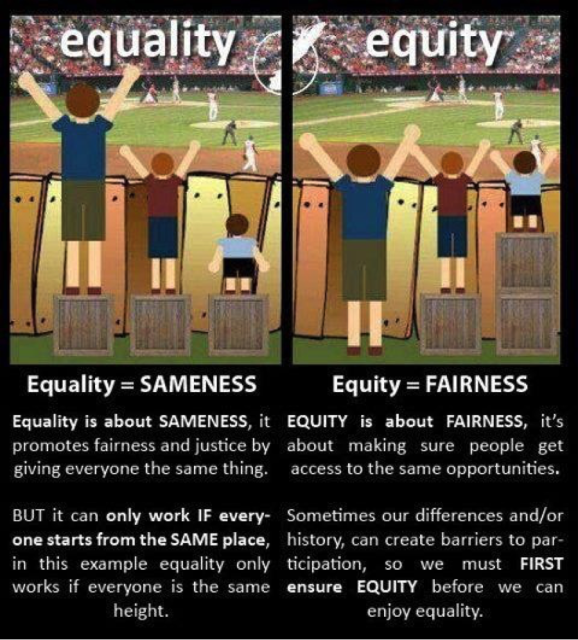
Each week we are to write a small response to the themes in whatever chapter in the textbook we’re reading through, and last week’s topic was the difference between equality and equity—something I had never fully understood until seeing this little graphic:

For my written response I was to give an example of equality and equity and how each impacts me as an individual along with references back to the text book. I figured something out, and it’s included here.


From my many experiences filing my taxes I can see elements of the Canadian personal tax system attempting to treat citizens both equally and equitably. Whether these attempts are ultimately successful is debatable, but the premise is to treat equally everyone’s income first and then consider equitably everyone’s tax payable second.

Each citizen is charged the same tax rate as a percentage of the same amount of income. This treats everyone’s income the same as everyone else’s income and is an example of equality. As each citizen’s income goes up the corresponding tax rate charged will go up as well. This is an example of attempting to create equity as those with less income will not be required to pay as much tax as those with more income. Further attempts to create equity through the tax system exist in the form of tax credits. These credits attempt to reconcile the different circumstances citizens are in when earning income and the additional expenses incurred in the process of earning income, such as a parent requiring day care services or an employee needing to pay transit fares to get to work. This reduces the taxes owed by citizens who must spend a higher amount of their income to earn income and shifts any shortfall in tax revenue to those who spend little to none of their income when earning income.

However; as outlined in the course textbook throughout chapter 7, inequalities present within social structures will hinder the progress of equity and therefor prevent the achievement of equality. How something like the personal tax system can exert its influence on the concepts of identity outlined in chapter 6 of the course textbook can by revealed by examining the consequences of some of the tax credits available to some citizens. In the case of intersecting identities (p.113), and prior to the legalization of same‐sex marriage in Canada, married couples were taxed at a lower overall rate than single individuals and had access to tax credits they could share with their spouses. At the time same‐sex couples could not get married so they had to pay more tax as single individuals and did not have access to the same tax credits a married couple did. This created an inequity in the form of financial power and privilege (p.133) which was extended to married couples but unavailable to same‐sex couples. More insidiously, this also created an ideological inequity (p.137) where the lifestyle associated with marriage was incentivised by the government through financial subsidies via the personal tax system.


Like I said, I’m particularly enjoying this class. It’s helping me articulate with far better language a sense I’ve had for a long time about the discrepancy between the claims Canada’s institutions make about supporting a diverse and equal population and what is actually experienced by those living here. We’re making progress, but we’re not there yet. And sometimes that’s the trouble with progress: in the act of moving forward you see just how far there is to go—but you still have to get there.

Midterm

In the absence of any new personal writing fit to post, here’s my in-a-hurry midterm from this semester’s English class.

A few weeks ago was my English midterm test, and it was my least favourite style of testing: write a well‐structured and properly referenced essay on blah blah blah… oh, and you have just two hours. Go! And remember—it’s gotta be good and gotta be done in 2 hours…

I loathe being asked to preform creatively (and intellectually for that matter) on-the-spot. It’s not a fair test. It’s not realistic.

I completed my writing just before time was up knowing I didn’t write the essay I knew I could write and generally not being pleased with the conditions of the test. Turns out I wrote an A+ paper that was only criticized for being more of a summery essay than the requested analytical essay, but because it was well‐structured and properly referenced I still got the grade.

School has been challenging. I often feel lost and confused with the material. I sit at my desk with a test in front of me as my mind blanks and my head gets confused: it doesn’t know what it knows it knows and what it thinks its forgotten. I’ll complete the test in misery and then I get an A, but I don’t know if it’s a real A or a lucky A. It’s stressful…

Anyway—what follows is almost word for word what I wrote in the two hours I had to write it. I’ve made minimal corrections just because I repeated a few phrases in the original essay, and even then it still reads a little safer than I normally would write. But it did its job better than I thought it would—so that’s one more lucky A for me.


With a world filled with multimedia undreamed of only ten years ago, in an increasing entertained age, the roll of traditional printed literature is viewed by some as old fashioned, its sole purpose seen as nothing other than time filler for the reader—disposable words to distract while riding a bus. In “With Pens Drawn” Mario Vargas Llosa maintains this trend of thinking about literature risks undermining the freedom taken so for granted in free places in the world. Throughout his essay, Llosa illustrates the changing role of traditional literature today against new forms and sources of both challenging social commentary act pure entertainment. Llosa’s effective use of the compare and contrast rhetorical mode solidifies how important the role of literature is now more than ever in maintaining a free and democratic society.

Llosa first compares the attitudes held by some of the critics that “…literature is already dead” (p.218) or the authors who will not write another novel because “the genre now fills them with disgust” (p.218). These statements, Llosa says, are made in countries where literature can exist as pure entertainment, where books can be a hobby (p.219). However; Llosa also effectively reminds the reader of all the place where the writer is “feared” (p.218) and being a writer is an act against the state and punishable by imprisonment or death. These writers are jailed, Llosa argues, by fulfilling literature’s purpose to not only entertain, but “to address itself to the problems of its time” (p.219).

It is this dual role Llosa suggests literature is at its most disadvantaged. As he states: “If the only point of literature is to entertain, then it cannot compete with the fictions pouring out of our screens, large or small” (p.219). Reading is work, and with today’s TV and movies getting easier and easier to watch each day, Llosa argues this results in viewers who are “allergic to intellectually challenging entertainment” (p.219). It is with this allergy in mind Llosa stresses the importance of literature filling in the intellectual gaps left by new audio and visual media’s role as pure entertainment. As opposed to the immediacy of something on a screen, passively consumed by instant gratification, Llosa states literary fiction “holds us captive for life” (p.219) and goes so far as to claim referring to the works of Mann, Faulkner, Kafka, Joyce, etc… as entertaining would be “to insult them” (p.219). Without literature as a forum for truth, Llosa maintains, our singular consumption of entertaining media “condemns us to a state of passive acceptance, moral insensibility, and psychological inertia” (p.220). This very state, Llosa says, is “the kind of lethargy dictatorships aspire to establish” (p.220).

This precarious balance of entertainment and tyranny is where Llosa believes good, true literature takes on its most important role. In a bold claim Llosa says literature is our best defence of freedom, our greatest weapon in preventing war. He argues wars in the last one hundred years have been fought between dictatorships or by totalitarian regimes against democracies, but not between two democracies (p.221). Llosa states, “the best way to promote peace is to promote democracy” (p.221). And from Llosa’s statement of what good literature taught him, that “in all our diversity of cultures, races, and beliefs, as fellow actors in the human comedy, we deserve equal respect” (p.219), he is also aware of literature’s role of being able to “detect the roots of the cruelty human beings can unleash” (p.219). An awareness of both of these truths is a requirement of democracy and a consequence of literature.

Llosa says his ideas of literature are old fashioned, comparing himself to a “dinosaur in trousers” (p.219), but with the role of intellectually challenging entertainment left vacant by new forms of instant media, literature is facing a role more critical than ever: the responsibility of fuelling the intellectual process so critical in a functioning and free democracy. By contrasting the life or death situations faced by those writers in other places against the luxury of writers in free places to declare literature dead, Llosa clearly demonstrates how intellectual literature must remain in public consumption in order to preserve peace and democracy. Complacency as a threat to democracy is fought by literature’s ability to express “indignation in the face of injustice and demonstrating there is room for hope” (p.221). Despite Llosa’s comparison to both himself and his vocation as something of a relic, his words suggest otherwise—these relics are more important now in our comfortable democracies than ever before.

Delusions

Where paths cross and when lines blur.

I first started writing this blog after witnessing the suicide of someone off of one the buildings in my old neighbourhood. I found myself both feeling and not at the same time—stuck telling myself how shocked I ought to be and surprised back at myself for not being more so. Regardless of my ultimate feelings, the events played out in my head over and over again until I wrote them all down. In doing so I realized how unhappy I was in my own life despite living in the urban paradise I so wanted to be happy in. I knew I needed to make changes, and I knew some of the changes would not be easy or quick. Sometimes life’s a barge.

Subsequent posts followed—and then I started writing posts about time travel, and then I started going back to talk to my past self and reposting paper journal entries from fifteen years ago when I was in school for digital media. I brought my past self into the future and we were going to figure out what it was that had happened to us. It was fun writing, and I found catharsis in being able to talk to myself from the perspective of someone who knew nothing about what was going to happen to him and from the perspective of someone who knew all too well what was going to happen to him.

There was a problem though. As I was creating the blog, and this is true for any blog, I knew any reader who began reading the blog after I’d started writing it would find the narrative running backwards before the point where they began reading. Imagine picking up a book and starting in the middle of a story. You can read normally forward from that point and you can also go back to the start of the book and catch up to the middle. But with a blog you’d have to read the pages backward from the point your started until you got to the beginning. It might not make much sense—then again, it might also make one of the funniest episodes of Seinfeld ever.

A few months later I pulled the plug on the entire thing. The back and forth dialogue was a mess. The backward and forward narrative was a mess. And it was getting far more personal than I’d ever intended. I could see what those who would want to see would see. The blog format creates an artificial intimacy, a consequence of these words seemingly spun directly from my head into my computer and onto the internet—seemingly unedited, unfiltered, unreviewed—before appearing on your screen as if I’d wrote them just for you. The blog format feels autobiographical because it is almost exclusively authored in the first–person, and I almost exclusively write in the first–person.

So—this is when the lines blur. There is an event in my head I need to get out, and much like the one which got this blog started, it’s going to be challenging to get the words right, it will be difficult not to sensationalize, and it will be impossible to keep me out of it all. How much of me is in what I write? All of me—I wrote it. But I have no interest in being my own biographer. Would this story be any more or less interesting because it’s based on real events from my real life or based on real events from my fake life? Have I blurred the lines now, or did I start with the first word of this post? Perhaps it was with the first words of this blog over a year ago. Or perhaps every word I’ve ever spoken or written is part of a crafted series of messages to position your mind exactly where it is now… where I’ll then start you wondering if you can trust anything I’ve ever written or indeed trust anything you take for granted as being known.

In early 2014 I experienced a stress–related psychosis. I lost my sense of self and sense of continuity within my own existence. I doubted my own memories and the validity of my personal relationships. I was an actor—and so was everyone else. I was an agent—but nobody knew who for. I could hear everyone’s thoughts—but I had none of my own. I was a wolf—and my life was in danger. The paranoia spread as quickly as my mind could fill in the details of why I couldn’t trust any aspect of any past, present, or future moment of my life.

I withdrew from rational thought and went into a crippling survival mode fuelled by terror. Each day, each hour, was one I had to consider as it related to whatever nonsense was streaming through my mind at the time. It was exhausting—I had to always be one step ahead of the paranoia, planning my next move and coming up with every contingency I could imagine to trick myself into thinking I had the upper hand, even if they thought they did. Yes—I became one of those people who was worried about a they. In my mind I was the target of an on–going mental and physical hijacking, and depending on the day I was having, they were either winning or losing.

Everything suffered. I felt as if I was being monitored, spied on. I didn’t trust emails and txt messages. I didn’t want to touch objects other people had handled recently. I only ate food I had bought and prepared myself. I became confused and lonely. I said nothing about anything I was experiencing to anyone aside from carefully crafted exchanges to try and figure out if I was dealing with a friend or a foe. But there was neither past a point. It was always just me and madness.

It went on for months. I burned bridges under the guise of protecting myself. I withdrew from friends and family and kept them at arm’s length, never being able to confidently determine their alliances. I halted all online activities. I deleted accounts, pulled down all my websites, erased any trace of my digital identity which could be linked to me offline. I didn’t do anything I thought might be used to profile or identify me. I was going to disappear. Then I’d be safe.

I lost my home, my sense of family, some of my dearest friends, and any financial stability before I was able to break through my own mind. I’ve never had to fight myself so hard before, and part of why it took so long was thinking I could fight myself and somehow win. The fight is what kept it all going. I was trying to fight a fire with more fire. It was only after I stopped trying to fight did things start to get better.

In my dream I am with people. My dream sense tells me I know these people even though my waking mind doesn’t recognize their faces. We’re in a snowy place near an icy river. There are rocks jutting out of the ice as we stand by the shore. It’s overcast and cold. The air is calm. And then there is the sound of ice cracking and snow crunching. A giant polar bear is by the river right beside us. I can tell the people I’m with are slowly backing away, but I stay where I am. I’ve caught the gaze of the animal—we regard the other. Then the bear is in front of me, towering in front of me on their hind legs. But I sense no threat and in turn wish no harm—we have happened into the same moment. And then the bear’s arms are around me, lifting me up off the ground. It’s a hug. I’m getting hugged by a polar bear.

I wake and feel different—a quiet resolve surrounds me instead of my usual terror of having to face another day not knowing which delusion was going to fuel which awful thought at any given terrible moment. I remember my bear hug and a song lyric—Just ’cause you’re crazy doesn’t mean that you’re free.

My life had vanished into my delusions, my energy consumed with attempting to figure them out, my sense of self lost in trying to understand what was real and what wasn’t real—that was the trap. The escape was accepting the delusions might be real or the delusions might be imagined because it actually didn’t matter what they were, what matters was the self I wanted to be at the end of the day, or in this case, at the start of the day.

If my entire world were a Truman Show, or a Groundhog Day, or an Inception, or a Matrix, I would still want to be the gentle, compassionate, intelligent, helpful, strong, genuine person I strive to be. If I was being held captive, being experimented and spied on I would want to show the true nature of my character regardless of circumstance. I’d still want to be the best me I could be no matter if that me was happening in a computer simulation, at an alien zoo, or on the surface of a black whole.

It’s taking months to heal, but I feel it happening. Each day is a little better, and then some days I wake up and feel like I’ve slipped back. I get echoes of madness at times, if I’m under stress or under slept, but from what I’ve been told this is normal and nothing to be discouraged by. A mind doesn’t just snap—the circumstances build slowly over time, over years in some cases, until you reach the definitive moment where a new path is created—suddenly you find yourself on it—and it takes laps before you realize it’s circular.

We are the compilers of our own experience—in that sense it is only ever our own selves in this world. But, and this is the challenge, how we compile our world will impact how others compile theirs. It’s all the same source code, but every machine, every system, will interpret this code in its own way. The resultant will be the appearance of many paths to walk, many lines in time.

But, amongst these infinite paths, there is also only one path—the one you’re on right now. And whether you believe you’re able to choose to stay on this path or that path or not, it’s up to you to walk it.
Last Nights in April

Moving on.

In Departures: Part II I mentioned an old piece of poetry I needed to unpack before I could post it here. You’re in luck—I found it.

Did you remember it being better? was the response I got to this work the last time I shared it. Not exactly the most constructive critique I’ve ever received, nor particularly flattering, but—who cares, right? Live through this and you won’t look back.

But I will just a bit…

I was eighteen when I wrote this. It was my last year of high school, and it was part of the last assignment for my creative writing class—one of the only classes in school, aside from photography and shop, where I felt like I could be me the most, where it was okay with other people if I was good at something. I hadn’t learned yet I could be good at something and it didn’t matter if people where okay with it or not.

It was late on a summer evening—much like tonight—and I was at my computer listening to music when one of my favourite tracks came on. You might know it from the movie Mortal Combat or Mean Girls, but I know it from the opening of Hackers, one of the first movies I ever saw with just me and my friends in a theatre—so the track, the movie, and the entirely new‐to‐me genera of electronic music became forever etched in my mind. It’s a truly laughable movie in its terriblness, but it’s one of the greatest things I’ve ever seen. Yet I digress…

The track is Orbital’s Halcyon + on + on, and to this day it will still give me goosebumps when it starts, pulling me right back to the night when I wrote these words, when I knew when to start and when to stop and didn’t think for one second in between it all. I went from moment to moment, zigzagging through my memories as years of previous nights streamed in front of me. I changed seasons, changed provinces—I moved through time and revisited myself. It all just sort of happened—I ended up happy with it—and then the song ended.

Last Nights in April

on the night before,
the rain stopped in the air
and was held in the orange lamp light,
like silent smoke,
drifting up from an ash tray
sitting on the corner
of a pool table
in the bar down the street.

on the night before,
my feet stood in the fallen snow
and the coldness crept in.
the wind cut into my bare face.
the moon came down
illuminating the yard,
and my mind
like the frozen trees,
stood naked in the night.

tonight, all the thoughts,
of all the nights before,
came to me all at once,
and the night seemed far too long.
and morning might never come,
for all the things that had to be thought of
seemed to take more time.

on the night before,
the summer air was thick
and the mosquitoes filled what space was left.
the iron porch railing caught me as I stood
head to the sky,
thoughts to the past,
wishing for the future
and at the same time
dreading its arrival,
like the front of the line
for the highest roller coaster in town.

on the night before,
the mountains looked sad,
and the sky bluer than usual.
the cool air came rolling down
to push the heat of the day
away until tomorrow,
and me away forever,
like any other day past by
in this small town,
whose confined valley
sets the spirit free
and holds it down at once
in a perpetual state of confusion and
understanding.

on the night before,
the true nature of life revealed itself to me
for a split second.
eyes of failing vision
called to a distant hospital,
but me across a lake
linked by a collection of orange,
and a car that's leaking oil.
hours of darkness after days of the same,
and another week to go.

the night is the time
for transformations
from high to low,
far to near,
away to home,
home to away,
and away from home.
welcome to the city,
with lights orange bright
tracing the path of other night time travellers,
in glowing trails that dance from the plane.

on the night before I left,
the rooms were empty,
the dog was sleeping,
and the last of the tape was stuck to the floor.
the cool cement on my bare feet
as I stepped away,
was just like the night before.