

I’m spending more time writing this semester than I did last semester. I like it. It’s reminding me of my way with words, something I’d thought I’d lost or forgotten in the wash‐rinse‐repeat nature of my working afternoons and evenings from last year or the assassination of my spare time and energy by the unending homework of school this year. What’s also helpful is some of the unending homework is writing…
One class I’m particularly enjoying happens to be mandated by the college for all students to complete. It’s focused on the concept of global citizenship—the idea of acting as an individual who is aware of not only their immediate community, but of the many different communities around them and around the world. This is distinctly different than the idea of globalization, which for all intents and purposes (or at least in terms of observable results), is a fancy new word to disguise terrible old colonialism.
Each week we are to write a small response to the themes in whatever chapter in the textbook we’re reading through, and last week’s topic was the difference between equality and equity—something I had never fully understood until seeing this little graphic:
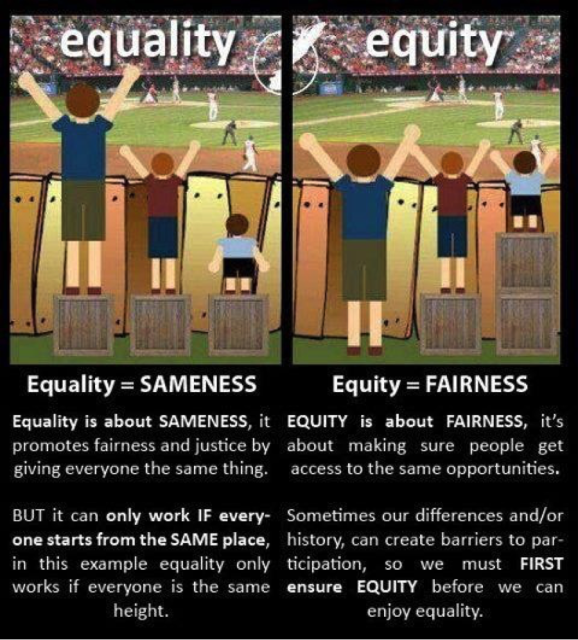
For my written response I was to give an example of equality and equity and how each impacts me as an individual along with references back to the text book. I figured something out, and it’s included here.
From my many experiences filing my taxes I can see elements of the Canadian personal tax system attempting to treat citizens both equally and equitably. Whether these attempts are ultimately successful is debatable, but the premise is to treat equally everyone’s income first and then consider equitably everyone’s tax payable second.
Each citizen is charged the same tax rate as a percentage of the same amount of income. This treats everyone’s income the same as everyone else’s income and is an example of equality. As each citizen’s income goes up the corresponding tax rate charged will go up as well. This is an example of attempting to create equity as those with less income will not be required to pay as much tax as those with more income. Further attempts to create equity through the tax system exist in the form of tax credits. These credits attempt to reconcile the different circumstances citizens are in when earning income and the additional expenses incurred in the process of earning income, such as a parent requiring day care services or an employee needing to pay transit fares to get to work. This reduces the taxes owed by citizens who must spend a higher amount of their income to earn income and shifts any shortfall in tax revenue to those who spend little to none of their income when earning income.
However; as outlined in the course textbook throughout chapter 7, inequalities present within social structures will hinder the progress of equity and therefor prevent the achievement of equality. How something like the personal tax system can exert its influence on the concepts of identity outlined in chapter 6 of the course textbook can by revealed by examining the consequences of some of the tax credits available to some citizens. In the case of intersecting identities (p.113), and prior to the legalization of same‐sex marriage in Canada, married couples were taxed at a lower overall rate than single individuals and had access to tax credits they could share with their spouses. At the time same‐sex couples could not get married so they had to pay more tax as single individuals and did not have access to the same tax credits a married couple did. This created an inequity in the form of financial power and privilege (p.133) which was extended to married couples but unavailable to same‐sex couples. More insidiously, this also created an ideological inequity (p.137) where the lifestyle associated with marriage was incentivised by the government through financial subsidies via the personal tax system.
Like I said, I’m particularly enjoying this class. It’s helping me articulate with far better language a sense I’ve had for a long time about the discrepancy between the claims Canada’s institutions make about supporting a diverse and equal population and what is actually experienced by those living here. We’re making progress, but we’re not there yet. And sometimes that’s the trouble with progress: in the act of moving forward you see just how far there is to go—but you still have to get there.