Bad Apples

A few is too many—especially when they’re everywhere.

It’s a line heard so many times before, and with each utterance of this trite response by someone—usually a stuffy white guy in a position of power—I wonder the same things: what draws white people to use food‐based metaphors to dismiss complex social issues? Are they aware in every instance where they default to this contemptuous idiom it makes them sound just a little bit more racist? Are they aware that in offering this sad and tired turn of phrase they’re actually admitting they don’t understand the situation—be it actual bad apples or institutionalized racism—at all?

In its entirety, the saying goes a bad apple spoils the bunch. Today it’s used to illustrate how the undesirable actions of a few individuals within a group can not only tarnish the reputation of the entire group, but, more importantly, could cause those undesirable actions to spread if left unchecked. This second part of the metaphor appears to be where the lesson has been lost, so perhaps a literal examination will help clear things up.

What happens to actual bad apples? They’re disposed of. Why? Because no one wants them. They’re not desirable or generally useful when compared to good apples. Bad apples don’t get to continue hanging around the other apples once they’re discovered. They don’t get a chance to attract flies as they continue to rot and stink up the place. And they don’t get promoted to be head of the apples or king of the pies. Would you accept a grocer’s explanation of there’s always a few bad apples when questioned about the declining quality of the apples in their store? If there’s indeed always a few bad apples, when does the conversation move away from acknowledging what’s already painfully known about the state of some of the apples to what’s going on at the orchard?

Throughout last week I had been watching videos by Amber Ruffin on her experiences with the police:

In Ruffin’s first video she shares an experience where she feared for her own life. As upsetting as it was to hear about her experience, it wasn’t the most upsetting thing she said in the video. That came near the video’s conclusion, when she said every black person she knew had a few stories like that. Not a few black people, but every. And not one story, but a few. That’s too many. That’s a few too many stories about a few bad apples.

I don’t know how many black people Ruffin knows. But does knowing either way make the situation any more or less horrible? Any number over zero starts to paint a grim picture almost immediately. How grim? Let’s look at some uncomfortable numbers and make some uncomfortable assumptions. Yeah—it might get a little uncomfortable. And if reading about this situation is uncomfortable then imagine what living it must be like.

But first… I am not a researcher, statistician, or sociologist. I am not a member of a traditionally marginalized racial community. I’m not even American. I am an outsider to a situation attempting to generalize the experiences of another individual and scale them up to gain a rough idea of what’s being experienced at a national level.

Data from the US Census Bureau shows 40.9 million people living in the Unites States who identify as African American. That’s more than the entire population of Canada, and amounts to about 12% of the total population of the United States. Ruffin says every black person she knows has a few stories like the ones she shared. She shared four stories out of what she said were thousands more. I would hope there was an amount of hyperbole in her statement, but—

Step into a hypothetical world where each of those 40.9 million people will each have a few experiences like the ones Ruffin had. In this world a few will mean 5 experiences. That’s 204.5 million frightening—possibly fearing for one’s life frightening—experiences with the police. These experiences will happen over time, and in this world that time will be 10 years, so that’s 20.45 million terrifying interactions with law enforcement per year. That works out to just over 56,000 people terrified per day, everyday, anywhere in the land of the free, for the next ten years. That’s just over 2000 people per hour, just under 40 people per minute. That’s a traumatic experience starting about every 1.5 seconds for the next decade.

Data from the US Department of Justice shows about 800,000 sworn officers (officers authorized to make arrests) working part and full‐time in state and local law enforcement. There are roughly 120,000 federal officers authorized to make arrests as well. That’s about 920,000 officers. How many of them are poorly trained, overly aggressive, violent sadists? Just a few? Is a few 1%? That would suggest 9,200 of America’s finest are responsible for 56,000 traumatic experiences per day.

—it’s just a few bad apples.

As Canadian it’s easy to see the blatant racism in America and condemn it—without hesitation. But as is often the case in Canada, this condemnation comes with its own set of national blinders. Canada too often pats itself on the back when it comes to progress on social issues, too often congratulates itself for being better than United States of America, too often forgets that being better than among the worst is still not great. The racism in Canada is different than the racism in the United States. It’s not nearly as blatant here. It sits just below the surface, cropping up just often enough to create the illusion of isolated incidents which reinforce a notion of it can’t happen here.

But it does happen here. The Ku Klux Klan registered their first provincial chapter in Toronto in 1925. Their activities spread throughout the still developing country, taking hold primarily in Saskatchewan where a membership of about 25,000 included Walter Davy Cowan, the Mayor of Regina. Cowan would later go on to serve as a federal MP for two different ridings under two different political parties, all while serving as the provincial treasurer for the KKK until his death in 1934. In Ontario, cross burnings took place outside of London and Kingston in the mid to late 1920s.

Racially segregated communities for black and white Canadians existed and were challenged in 1946 when Viola Desmond was removed from the whites only section of a theatre in Nova Scotia. Africville, also in Nova Scotia, was a predominately black segregated community whose history predates Canada’s. This settlement was left to crumble in the 1960s as the city of Halifax failed to provide such basic services as roads, water, and sanitation. The last segregated school in Halifax closed in 1983.

Black Canadians experience disproportionate levels of poverty and incarceration as compared to white Canadians, particularly in Toronto. Black Lives Matter protests have been held in Toronto since 2015 when Andrew Loku and Jermaine Carby were both shot to death during separate incidences with police. A major protest was held in 2016 at the headquarters of the Toronto Police Services. By then a deemed illegal yet still practised form of policing known as carding had overwhelmingly been demonstrated to target black people.

Doug Ford, the Premier of Ontario, said recently the racism in Canada had none of the systemic, deep roots that are present in America. Ford later retracted his comments. Perhaps he was made aware that the last segregated school in Ontario closed one year after he was born, in 1965. Or perhaps that the Special Investigations Unit (SIU) in Ontario was created in 1990 as a response to the Black Action Defence Committee accusation of the Toronto police being the most murderous in North America.

On May 27th of this year Regis Korchinski-Paquet fell to her death from a high-rise balcony. Officers from the Toronto police were the only witnesses to this event. Compounding the tragedy is an open question over how Korchinski-Paquet came to fall: was she pushed by the police?

That the question is even asked, that the question is unanswered pending investigation, that alone should be enough to exemplify the level of distrust and trauma present in the experiences of black Canadians. Those experiences are the result of the systemic, deeply rooted racism too often denied as existing in Canada. And the existence of that unanswered question says more about the state of racism in this country than the 21 infuriating and embarrassing seconds of silence used to denounce the state of racism in another.

Cheap Thrills & Hot Links

Is there anything else on?

Sometimes the bully is more subversive in keeping me from finishing something I’ve started. Sometimes they’ll actively encourage me to pursue to the fullest extent whatever it is I’ve envisioned. Why? Because they know I’ll occasionally pursue something so fully and so intently I will not yield to any considerations, any little hints that might pop up along the way to let me know I might want to change how I’m doing something.

In this case the something was the format of this post. I’d originally planned another video, a joke tutorial on how to make mischief online by swapping out the contents of image files. There was going to be a live action shot I’d blend into the video signal from my computer screen, some overlaid graphics I’d add in after, maybe even some extra voice overs…

What was supposed to be another spur of the moment bit of unscripted fun was turning into a bit of a production, complete with notes and a growing shot list. And all of it was destined to go nowhere because I couldn’t get the introduction to look convincing, the screen capture software kept glitching out, and I would rewrite the script between what was turning into an afternoon of takes. Hours of work had produced a rough cut of just over eight unwatchable minutes, and it was looking like I’d need over ten more minutes to finish the video—I wasn’t even half way through the joke yet. But the show must go on, yes?

…No. Not when the show is almost twenty minutes of watching my computer screen and tending to terrible.

So—the video is gone. There will be no documentary for this joke, no behind the scenes bonus content. It’s just the setup and the punchline, so you’ll have to decide if it’s real or even funny for yourself.

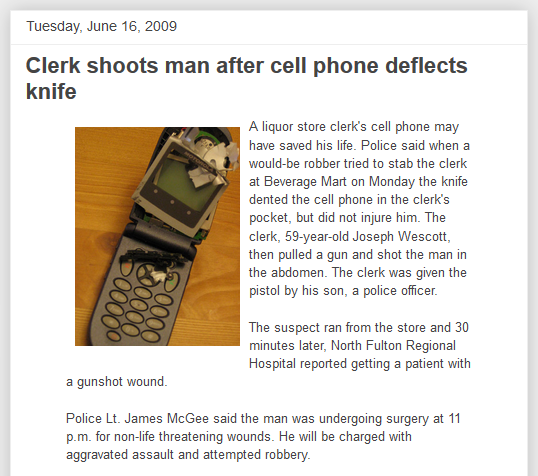
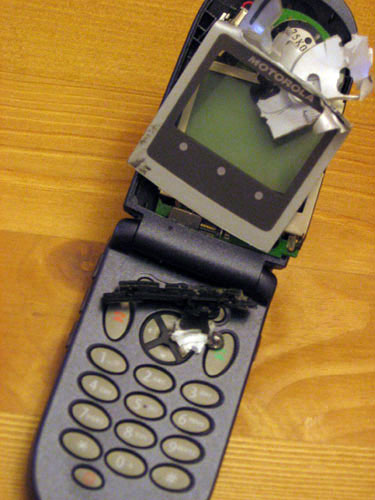
This all started when I was looking through the reports for one of my web servers. It’s been online for almost 20 years and is filled with stuff, including a picture of one of my old phones:

This particular phone was a Motorola V66, and it met with a spectacular end after falling into the drive belt area of a running car engine. I assume this is why shirt pockets traditionally come with buttons.

At the time I proudly posted the image up on my server, linked it to all my websites, emailed it out to whoever, and generally let it propagate throughout the internet. At one point it was among the top five images returned on Google’s image search for smashed phone if only because this was more than ten years ago, back when there were a countable number of smashed phone pictures available online. Now—thanks to the increased use of glass to make slightly heavy items that can’t quite be held in one hand—there’s no shortage of smashed phone pictures to browse through. But even with so much selection available now, the smashed phone image continues to be one of the most requested files from the server. I wanted to find out why, so I dug through the raw logs.

It turns out someone had hot linked to the image from their website. What this means is instead of putting a copy of the image file on their server for their website to load, they’ve created a link that will load the original image file from my server and have it appear on their website. In this case, their website is a collection questionable news snippets and what I’m now assuming is bogus accompanying photographic evidence:

A botched robbery and stabbing turning into a shooting and a hospital arrest sounds just plausible enough to have happened in anywhere in the United States. That, or it’s an equally plausible collection of events synthesized into an urban legend which accidentally became news. But even if that’s how the robbery went, real or otherwise, that isn’t the phone that got stabbed—it’s my phone.

Hot linking is generally considered against industry best practices. Some consider it a form of theft, like watching a neighbour’s TV from your own house through open windows. Some cry foul over the additional bandwidth charges that might result from other sites linking to their servers. There’s also a growing number of personal privacy implications as well. But hot linking is mostly not a good idea because—like that neighbour’s TV—there’s no real control over content. Right now there is a link on someone else’s website to an image that’s on my server. As long as I keep the file name of the image the same, the image itself can be whatever I want. Industry best practices exist for a reason, so I figure it’s best to create a little reminder why for this website operator.

Personally I don’t see this instance as a violation of my intellectual property rights or something that’s going to get me charged for using additional bandwidth. My offence is found in the shear laziness of the content management. Whoever it was cared enough for there to be an image to go along with the story, but they didn’t care enough for the image to have any real connection to the story. They also didn’t care enough to spend five seconds copying whatever image they did find to their server, choosing to instead save three seconds by hot linking it to my server. Who cares laziness is my least favourite kind of laziness. As my brother once said, I bet I can make them care.

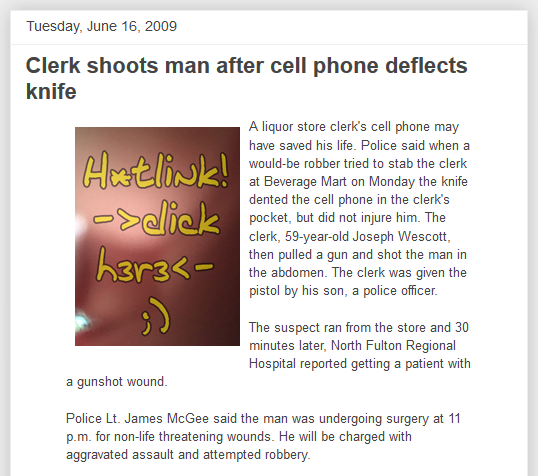
So what do I change the image to? Well—it’s the internet, so ideally it should be something vaguely rude but not actually rude, most definitely confusing, and certainly suggestive. As luck would have it, I’ve just recently come across such an image: the faux butt from my lockdown coffee break.

With some appropriately themed additional text the amount of suggestively vague rudeness is almost there, and the click here that can’t actually be clicked will definitely be confusing.

But I might never get another chance to do something like this, so why not go all out and bump up the elegance and sophistication as well:

There we go. Channel changed.

Turns out there is a North Fulton Regional Hospital, north of Atlanta in Roswell, Georgia. And there is a liquor store called Beverage Mart within a half hour’s drive of the hospital, about 15 minutes actually. I assume whoever it was didn’t run all the way to the hospital with a gunshot wound. It would have been almost 5 km, sorry, almost 3 miles. Perhaps they caught a bus? There is a bus that goes right by both the liquor store and the hospital. Though I don’t know if getting shot during a stabbing, running from an attempted robbery, and then waiting for a bus would suit the energy of the moment. Plus ten years ago there may not have even been a bus.

In any case, what’s around the hospital today amounts to a few pharmacies, a Burger King, a Dunkin’ (they dropped the Donuts last year), two different pawn shops, another and what I’m assuming would be a competing hospital, a building materials warehouse, and a Ferrari dealership. It’s all a bunch of stuff at once—very much like the how the internet is. So who out there online will even notice if one screen that’s been showing the same thing for the last decade is now showing something else? I guess I’ll just have to leave the blinds open and the TV on to find out.

Beams

Spectrums of K‐PAXian light…

Look—no prologue.

Many months ago…

No—!

…I wished I had more time to work on some of the larger posts I wanted to finish. Now with all the time to work on those larger posts, I need a break. They’re not easy to write. My head is goo by the time they’re published. The latest post ended up including far more data than I’d usually include, so now I feel the need to go back and cite it all. Sometimes I’ll stray from the rough structure I’ve mapped out. A new thought will pop out of nowhere and challenge me to incorporate it, so I will, and then I’ll realize I’ve tanked the ending. Endings are the toughest. If I’m not careful I’ll write myself into an open field instead of converging on the final one–liners I live for.

There’s an emotional component as well. The heavier topics leave me feeling deeply isolated and incredibly distant from the world around me. I’ve noticed to myself and remarked to others on how lonely the future can feel. But I know it won’t always feel like that. And I’m not necessarily adverse to isolation, distance, or solitude. At times I’ve drawn great inspiration, strength, and clarity when I’ve found myself among those melancholic islands.

However; with isolation, distance, and solitude available at any hour of any day, I figure some jocular fjords are in order, clearly the metaphorical if not geological foil to melancholic islands.

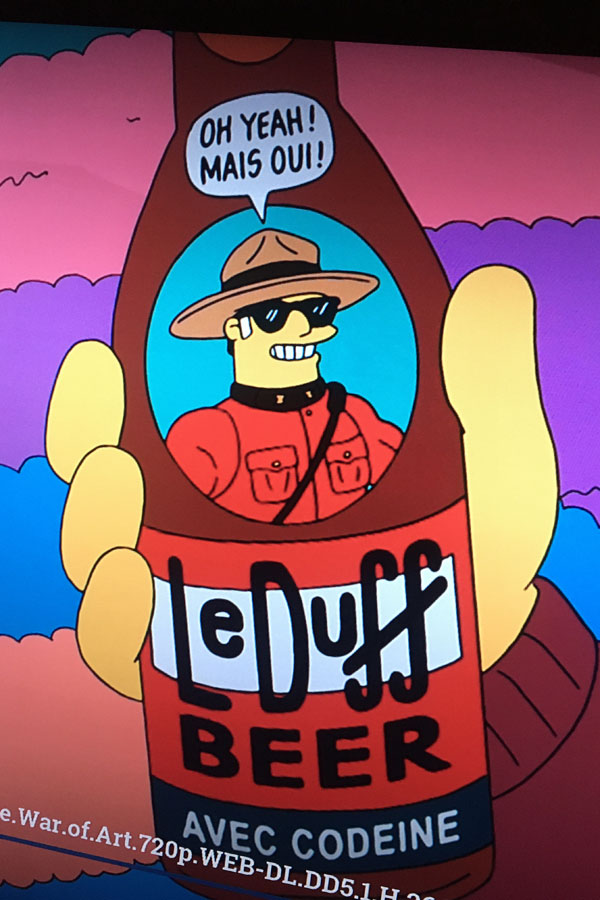
This bottle of Canadian Duff from a later Simpsons episode cracks me up:

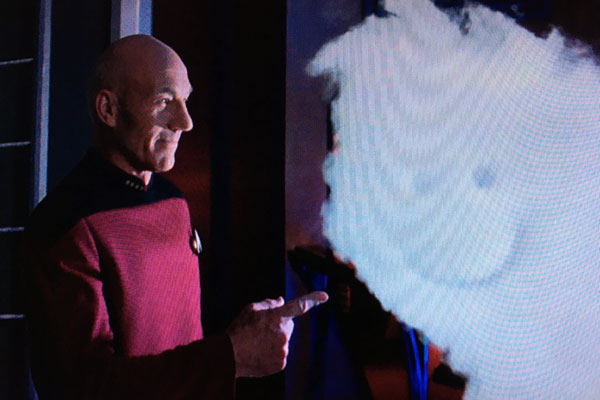
As does this moment from Star Trek: The Next Generation, an episode where Picard himself is starting to crack under the stress of a different sort of isolation:

While going through some of pictures on my phone from last summer, back before isolation was politely yet strongly recommended, I came across this shot I took—from a bus!—of someone who’s headed off to get away from it all:

As well as this screen capture of a Google Photo Sphere disaster:

And what I’m sure must be the single most exciting place to be in Burlington at 1:30AM on a Thursday night:

Back to the present, I’ve been enjoying Seth Meyers’ re–imagined show from the attic of his family’s home. Meyers himself has a genuine quality to him, extending far past what I consider part of the act. Amber Ruffin, a writer for the show, will occasionally get a segment of her own, including this Easter Quarantine Parade:

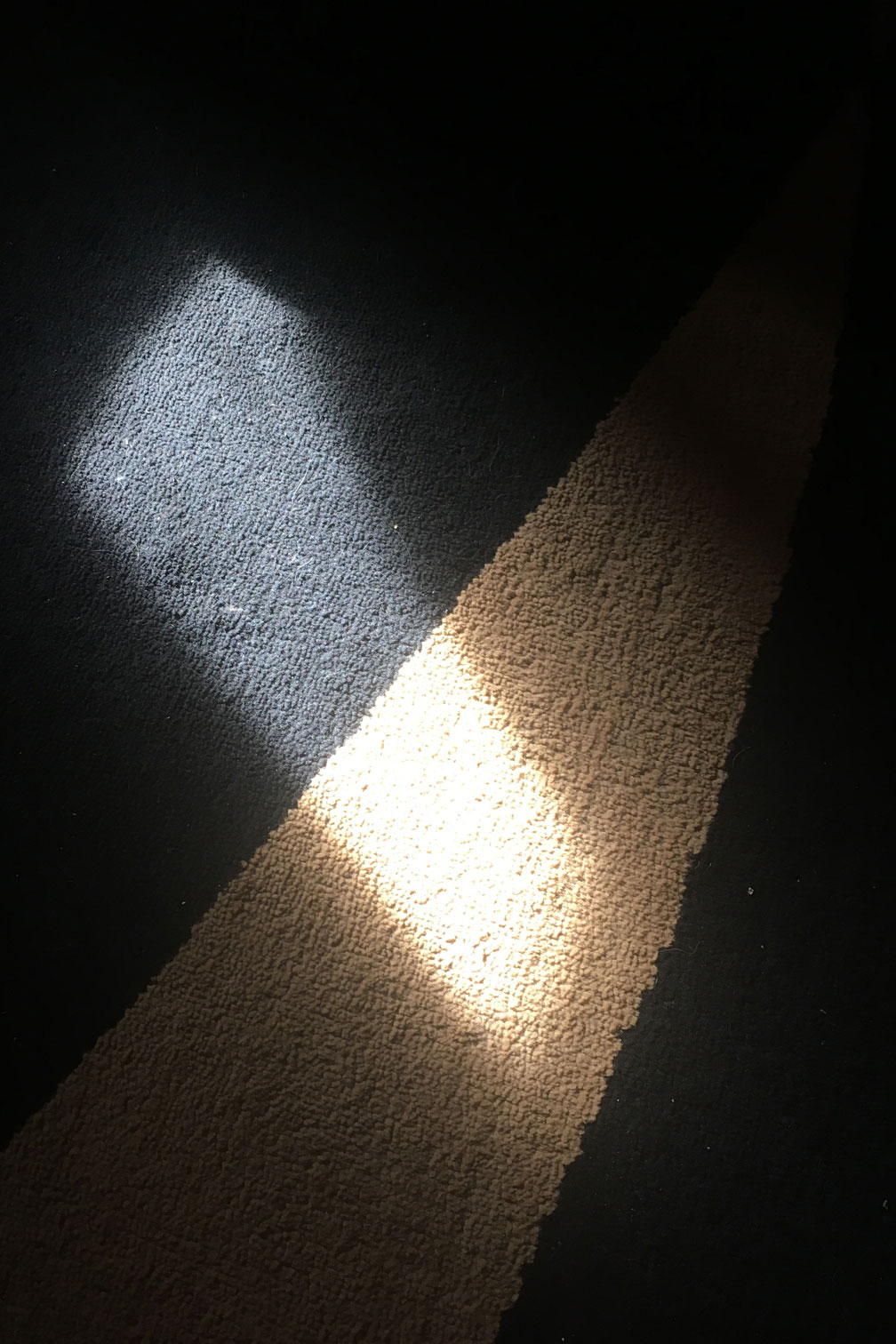
Jocular fjords aside, some moments of darkness require only for me to see the light—literally.

Each image below is an attempt to capture some quality of light I noticed just enough for it lift my spirits. Light moves fast—fast enough for me to watch it change before my eyes as I frame the shot and try to figure out just what it was I saw.

Here’s one more for good measure, and because it didn’t fit nicely into the gallery:

I still intend to write long and at times heavier posts. I’ll inevitably find myself navigating around the many and familiar melancholic islands as I do. It’ll be okay—I’ve grown to know these islands. But I’ve also grown to know where to find humour and absurdity, where to find what’s heartfelt and genuine.

And I know to bide my time for that one beam of light…

For now I will continue to wait in recommended solitude for the future to unfold, because until it does, as the old saying the goes: two’s company; three’s a crowd; and more than five is a provincial offence.

Lockdown Coffee Break

Please join me for a staying in latte to go.

I’ve too often dismissed the ideas I get for creative things as being too time consuming to plan and execute. I’m not sure how this particular part of me bullied the rest of me into apathetic subservience, but I’ve had enough—so, now the bully’s got; one: a bleeding nose; and two: knows not to antagonize the art kid anymore.

When I was little I liked to make videos. With the days ahead of me filling with little kid‐level quantities of summer holiday commitments, now seems like a good time to make more videos.

What follows is immersive mixed media experience, what was known as going out for coffee in the before times. So—select a coffee making apparatus, grab an appropriate coffee receiving vessel, and join me for a cup!

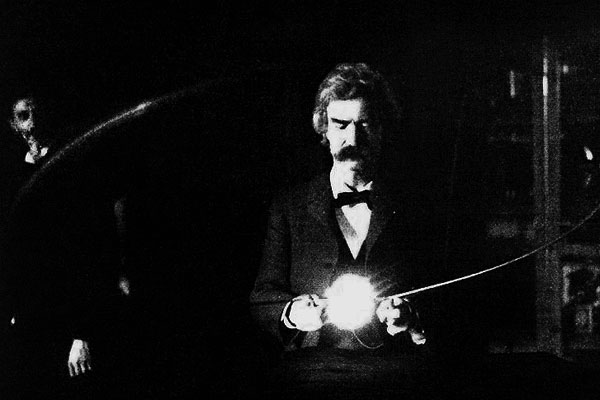
First, get into the coffee house vibe with a possibly obscure or slightly unusual but certainly large black and white image printed on the wall to stand beside or lean against while your beverage is made.

In this case it’s Samuel Clemens holding a vacuum lamp while Nikola Tesla watches from the background. I recently read they were friends.

Today’s coffee order is an always seasonal pumpkin spice latte prepared in traditional high definition.

And now that your drink is ready, please have a sip, and take a seat.

A historical recording of an old fashioned indoor concert is playing in the background…

…while you scroll through YouTube on your phone.

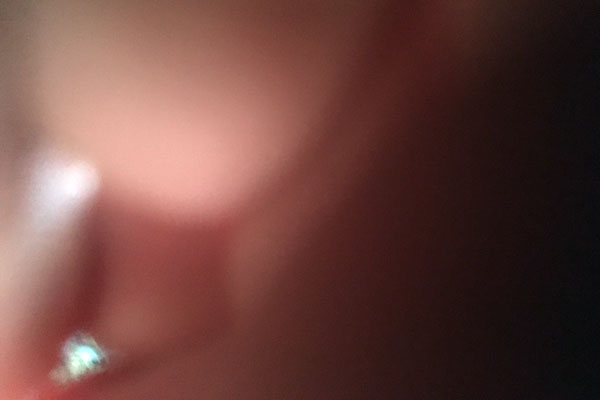
p.s. – During the bonus content video I managed to take a picture of the camera side of my fingers while trying to demonstrate the shutter button.

Here’s the full version in all its confusing glory.

It totally looks like a butt—I’m sorry.

When the thumbnail image popped up in my photo stream a few minutes later I thought someone had Zoom-mooned me. But no—just my fingers and sunshine.

Think of this as the weird conversation you unintentionally yet partially overhear on your way out. A couple a few tables over has just realized one of their unlocked phones is taking pictures on its own and sending them to the other.

I said this was going to be an immersive mixed media experience, and I meant it.

The McPizza

One among finer things.

It’s important during any hardship to nourish the many selves dwelling within. Food is but one of many ways to nourish not only the body and mind, but the spirits as well—though perhaps not always all in the same dish or at the same meal. It’s good to eat to be healthy, but it’s also good to eat to be happy. There’s a balance, and understanding the implications of that balance has taken almost ten years of my life. Sometimes the happy pleasure of food is the main event, and there’s little point in discussing the health benefits, or lack thereof. And sometimes food is just a little silly because the spirits needed something a little silly.

But whether you’re eating to be healthy, happy, or silly, please keep in your thoughts all who are working in the food service industry. These people are putting themselves at risk to stock shelves, prepare and deliver food, or disinfect shopping carts and grocery stores—all jobs which by definition cannot be done from home. They’re working in extraordinary circumstances, yet exceptions had to be made under current provincial labour laws to protect the wages for some of these workers if they were to get sick. I do not wish to politicize a public health emergency, but it’s hard not to when an employee in 2020 must choose between their physical or financial well‐being. They are—now more than ever—providing an essential service, and their effort deserves respectful protection and appropriate compensation.

Some time ago a guest in my house happened to catch a glimpse inside one of my kitchen cupboards while it was open.

“Kraft Dinner?” he asked with indigence. I paused and answered with a cocked brow.

“But you’ve been to Paris!” he said. “You know the finer things.”

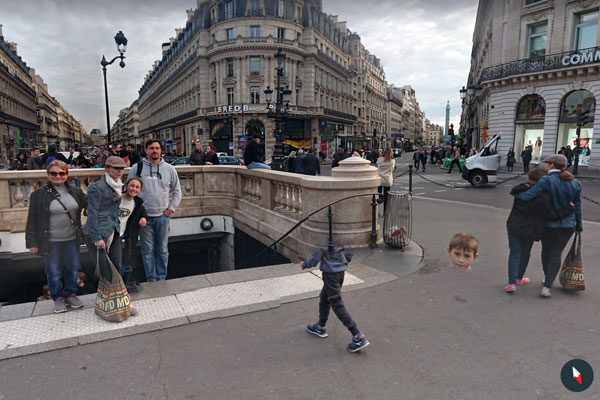
It’s true. I had been to the Paris. And while there I enjoyed many fine meals, drank many fine wines, viewed many fine works of art, and walked along many fine tree‐lined boulevards, each one bound with many examples of fine French architecture.

I also stepped full stride into one of the many massive piles of sidewalk‐fresh dog shit before dragging my suitcase through the rest of it. With no available means to clean any of it off, what was clung to my thickly treaded new boot and jammed into the wheel of my equally new suitcase joined me for what felt like a not entirely short journey on the crowded and overly warm Paris metro. Upon arrival at the bus station and having zero change in my pocket, I was forced to quickly and stinkily sneak into the stall of a pay toilet to extract whatever I could from the situation before boarding my bus to Brussels. You know—the finer things.

The association of the contents of someone’s cupboard with their potential to appreciate fine things—whatever that highly subjective concept might be—is not the topic for today. And why would it need to be anyway? It amounts to a form of prejudice, and I’m unaware of any situation where prejudice has generally worked out well for all involved. Indeed I felt a certain amount of apprehension in my kitchen back then. Must I choose between my fondness of Kraft Dinner or my many memories of Paris? No—of course not. How silly…

So rather than choose, I’m doubling down. May I present to you: the McPizza.

This tête de cuvée was well represented in the haute cuisine zeitgeist of early 2009. The particular preparation I’m sharing is a modification of an original internet recipe initially discovered by a housemate on a Tuesday night in the rolling suburbs of Don Mills. Local ingredients were subsequently foraged during a February snowstorm from a nearby strip mall.

Step № 1

Procure the following and preheat oven along with a seasoned pizza stone to 450 ℉ or 230 ℃.

• 1x precooked pizza kit with sauce
• 1x brick of cheese, mostly grated
• 1x large fries
• 2x cheeseburgers
• 6x chicken nuggets

Step № 2

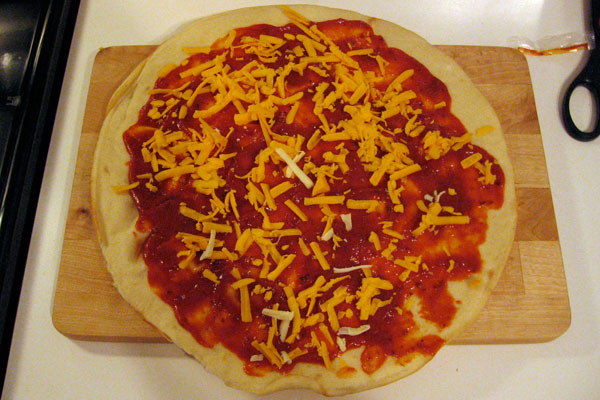
Assemble pizza kit with sauce and sprinkle with some of the grated cheese.

Step № 3

Slice cheeseburgers into quarter segments.

Step № 4

Adorn centre of pizza with chicken nuggets and surround with cheeseburger segments.

Step № 5

Garnish with french fries.

Step № 6

Finish with the remaining grated cheese, or to taste.

Step № 7

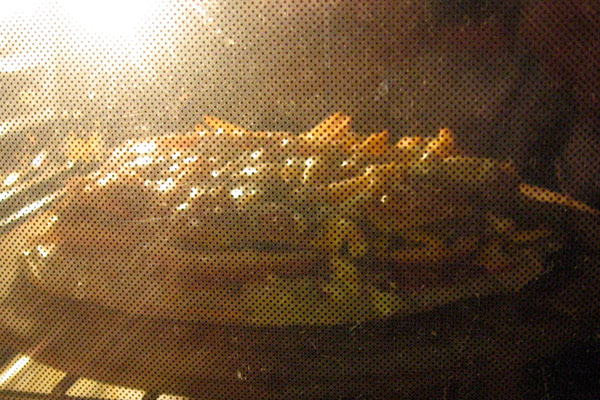
Place on pizza stone and bake until cheese is melted and crust is browning.

Step № 8

Let rest until cheese is semi‐molten.

Step № 9

Cut and serve immediately with plum sauce and cannabis.

Voilà et bon appétit!