17C

Part II

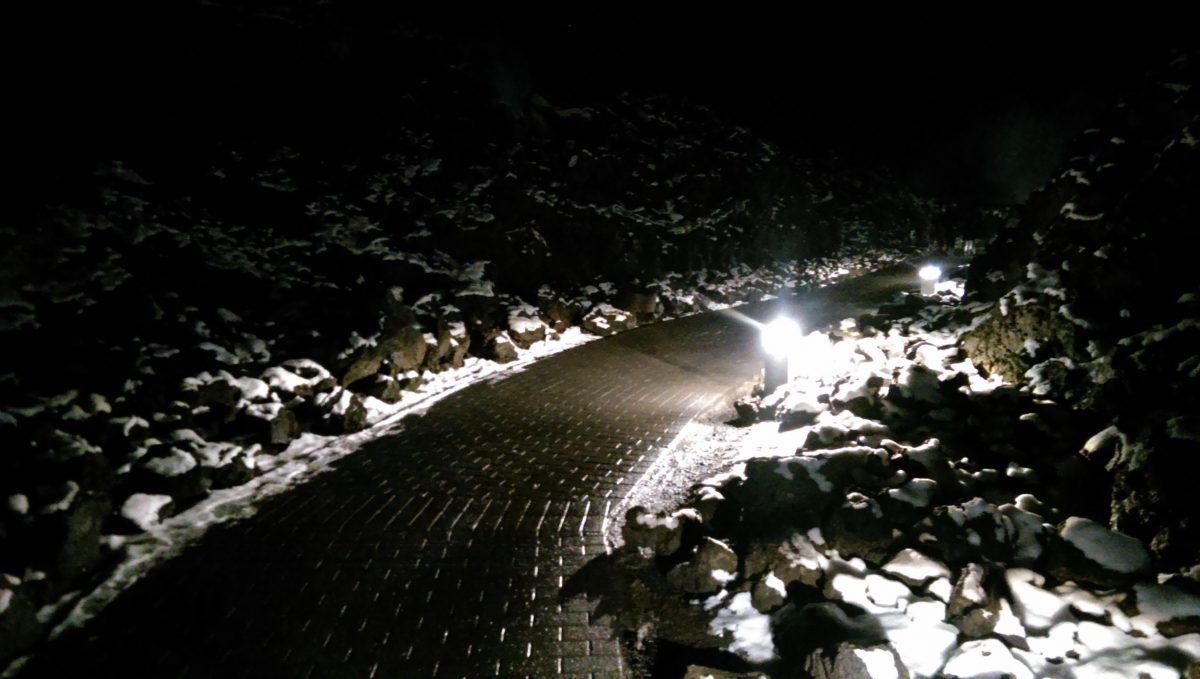
I spent enough time in Iceland to know I will becoming back for more than an extended stopover of 1.5-2 days. I love it here, and the pictures—once I stop fighting with software—I am not sure do this place justice. The light is challenging. It’s harsh when the sun is out, direct and piercing. Unforgiving. Under clouds it softens and defuses all colour. Things are muted and contrast is drowned in grey. There is so much depth lost in my images of the landscape. And it’s hard to stop for any pictures on some of the roads I was on—there is no shoulder. Just volcanic rock and snow. Yes! I rented a car and spent today driving around. I was going stir crazy in Reykyavik. More on my snow adventures later…

For now, I’ve realized all I will be able to do is get a quick nap before I’m due at the airport at 4AM for my morning flight to Berlin—the main event! Knowing I was only here for a couple of days, looking back, put some pressure on me to make sure I was at maximum “take advantage of your time here!” mode, so with just over two weeks in Germany I can afford to take a little more down time and make sure I get enough sleep.

But I did get to see the Northern Lights—so happy! I needed a very long and very warm shower after freezing beside the ocean, but it was worth it.

Okay. Sleep time.

Halló

Og góðan daginn!

Except for some core words that look or sound just like they do in both languages, Icelandic and English are nothing alike on the surface—despite a common Germanic background—they diverged over a thousand years ago. English has been through at least three major shifts since then, and Icelandic, spoken almost entirely on just one island in the world (and in Gimili, Manitoba!), has remained almost the same since then. Icelandic is as close to Old Norse as you can get today. It’s interesting to listen to because every few worlds will kind of sound like something I think I can understand. It’s like listening to English being mumbled through a wall.

I like it here. It’s calm and quiet, but there is a lot going on at the same time. The weather, well, my phone’s summery of dreary is spot on. It’s unusually warm for this time of the year, around 8 degrees, so it’s all very Vancouver in the winter here at the moment. The air is damp and cold, everything is grey, and the position of the island on the planet and within the time zones means the sun comes up at after 10AM while I’m here. It was surreal eating a big, late breakfast and having it still be dark outside. No one, and I mean no one, is doing anything in the city until at least 8AM, and even then, it’s not until the sun is up that the city really gets going—none of this Ontario‐style leave for work before 6AM nonesense. Like I said, I like it here.

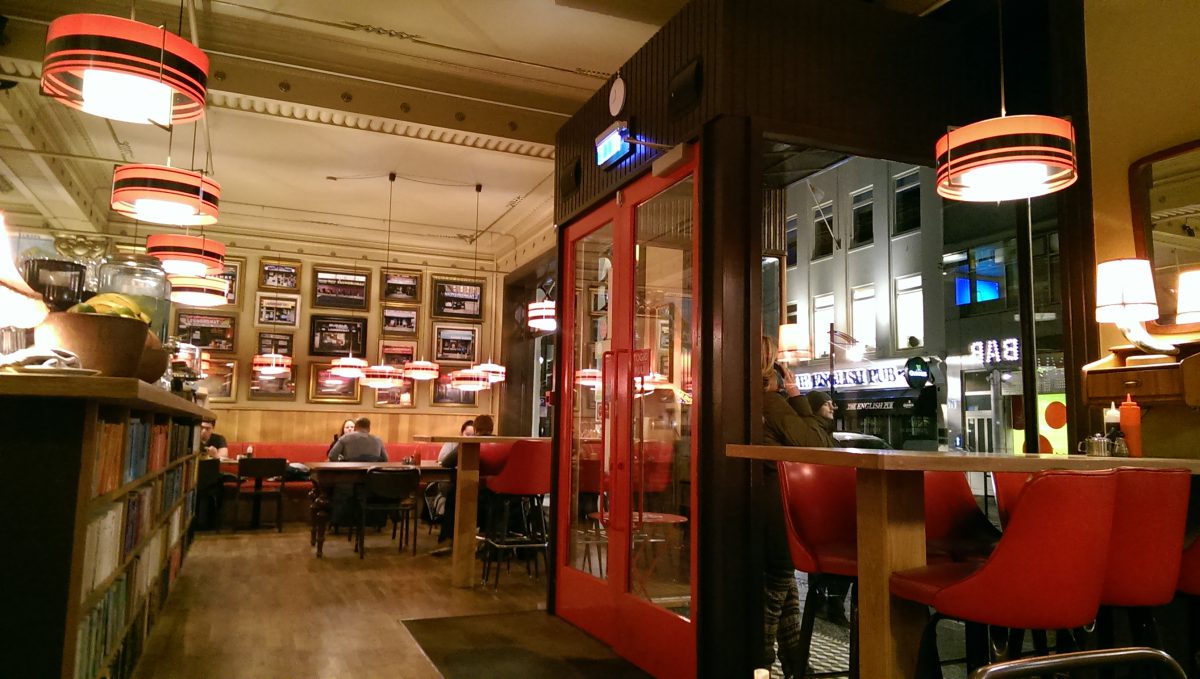
There are meant to be more pictures for this post, but it is after midnight in whatever time zone I’m in (I’m stuck someplace between EST and GMT) and want to see if I can get some actual sleep since I’ve not really had any more than a few hours since Sunday night. Instead, the featured image is a quick pic from my phone of where I had Iceland’s version of the full English breakfast—delicious eggs and bacon with some of the best bread I’ve had in a while, and, AND… yogurt that didn’t make me sick! I don’t know what they’ve done to yogurt in Canada, but they should stop.

Tomorrow, weather permitting, I’m going to visit a hot spring and see some of the countryside. Actually even if it’s still dreary I’m going to visit a hot spring and see some of the countryside.

Until then, góða nótt og sofðu vel.

p.s. — ð is pronounced like the th in the so the above is goh-tha no-ht og sov-thu vel or good night and sleep well. See? Like English through a wall 🙂

27F

And away we go!

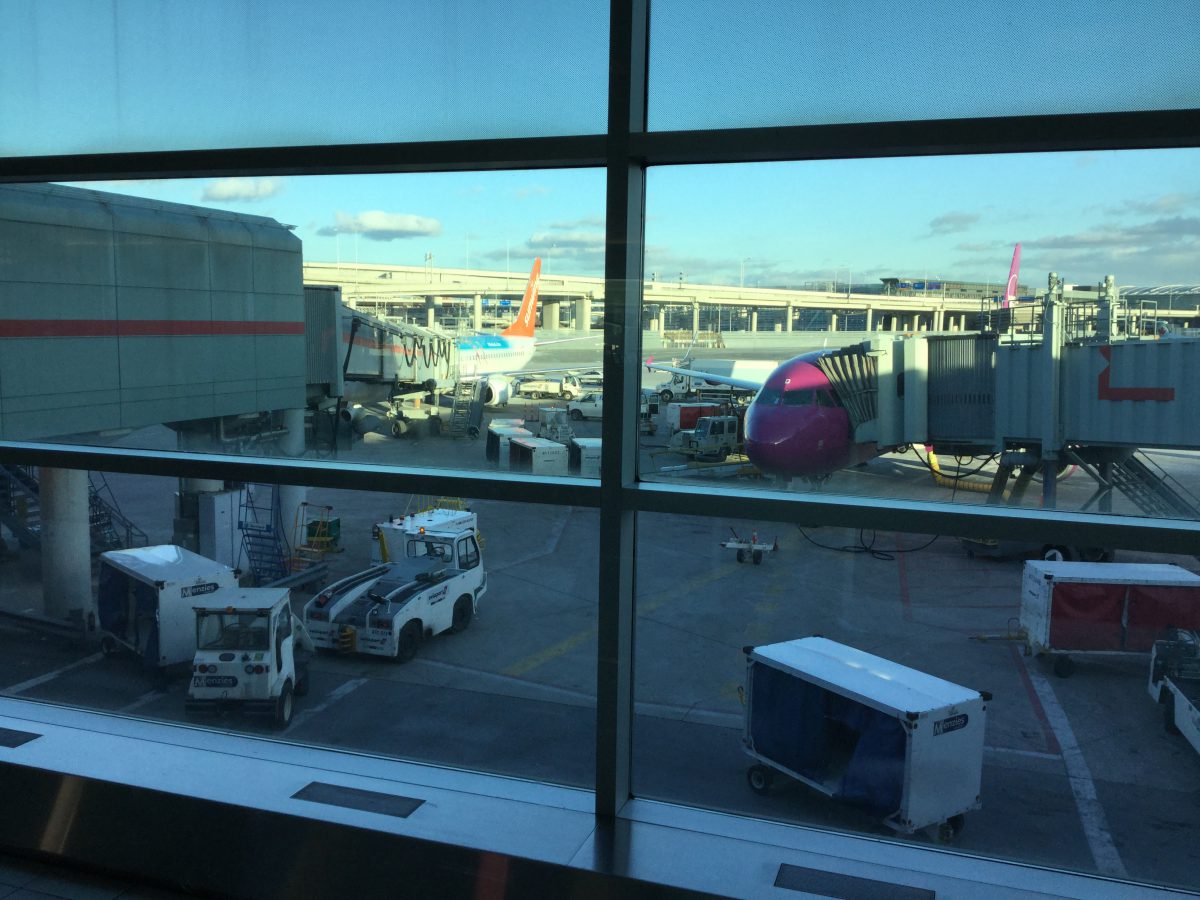
Half an hour to go before I get on the purple jet to Iceland. And—of course—time travel! I fly into the night first, and then into the dawn second. I fast‐forward five hours and won’t see them again until the return flight home.

Neat, right?

Rogue Planets

Wander with me.

Back before we could or be allowed to observe anything suggesting otherwise we knew the entire sky and everything in it revolved around a stationary earth—geocentrism it’s called—and despite being completely incorrect, it was supported by tomes of information and was enshrined within religious texts for hundreds of years. And as is often the case with enshrinement, anything challenging it was met with ridicule, brutality, and death. Who needs to be concerned with finding out what’s actually correct when you can look in a book and be told you’re right instead…

Now—after several excommunications, imprisonments, torturings, and executions—we know the entire sky does not revolve around a stationary earth, that the earth instead revolves around the sun, along with all other objects in our solar system—heliocentrism it’s called—a reference to Helios, the personification of the sun in Greek mythology. Curiously, geocentrism takes its name from the root word geo, also Greek, but meaning pertaining to the earth, like geometry, which traces its origins back to attempts to measure the size of the planet, highly secular by comparison to heliocentrism’s more divine origins—in name that is.

Lingering ideas from the past would still—for some—frame the heliocentric model of our solar system as being in the centre of the universe, as if for an incredible reason our perfectly ordinary star was the most important place in all of existence. And—in some ways—they’re right. Our sun helps support the only place in all of existence to be inhabited by alive life as we know it. But in another, more accurate way, they’re not right, not by a long shot. There are countless other stars just like our sun, with even more countless Earth‐sized planets orbiting them at a distance called the habitable zone which describes an area around the star where a planet’s temperature would be the most conducive to supporting the life we’re familiar with here on Earth. And actually, it’s not exactly countless planets. Based on current estimates there may be as many as 40 billion of these Earth‐sized planets in our galaxy alone, our galaxy being one of 100 to 200 billion other galaxies. So in total, we’re looking at 4 to 8 trillion possible Earths—4,000,000,000,000 to 8,000,000,000,000 planets like ours. What are the odds we’re one in 8,000,000,000,000?

One of the challenges of knowledge is how it can also blind—you know or think you know something, but in knowing that thing, you unintentionally but sometimes quite deliberately shut out anything else running affront to what you think or believe you know. You become too comfortable in rightness and forget about being correct. It’s geocentrism all over again.

One of the consequences of heliocentrism is it places the Sun as being the central figure in our solar system. The Sun accounts for 99.86% of the mass in our solar system, and as a result, its gravity pulls the remaining 0.12% of the mass making up all the planets, asteroids, comets, and other space stuff around it into orbit around it—so from that perspective the Sun’s role as a central figure does make sense.

Heliocentrism also postulates all the objects in our solar system were once part of the same giant cloud of molecules in space that started swirling and compressing together into what would become the Sun, the planets, asteroids, comets, and aforementioned other space stuff in our solar system.

From the two prevailing points of heliocentrism we get following: a central figure much more massive than ourselves is responsible for the creation and sustenance of all that is around us. Now if that sounds a little familiar I attribute it to science and religion often describing the same thing but in their own language, a point I’m happy to concede but too often see others on both sides backing uncomfortably away from. And that’s too bad, because the idea of what we’re made of and how our world works isn’t anything to be uncomfortable about. We live in exciting times. We’re seeing deeper into space than we ever thought possible, and what we’re finding are incredible things—things that show us there is still much more to know and understand.

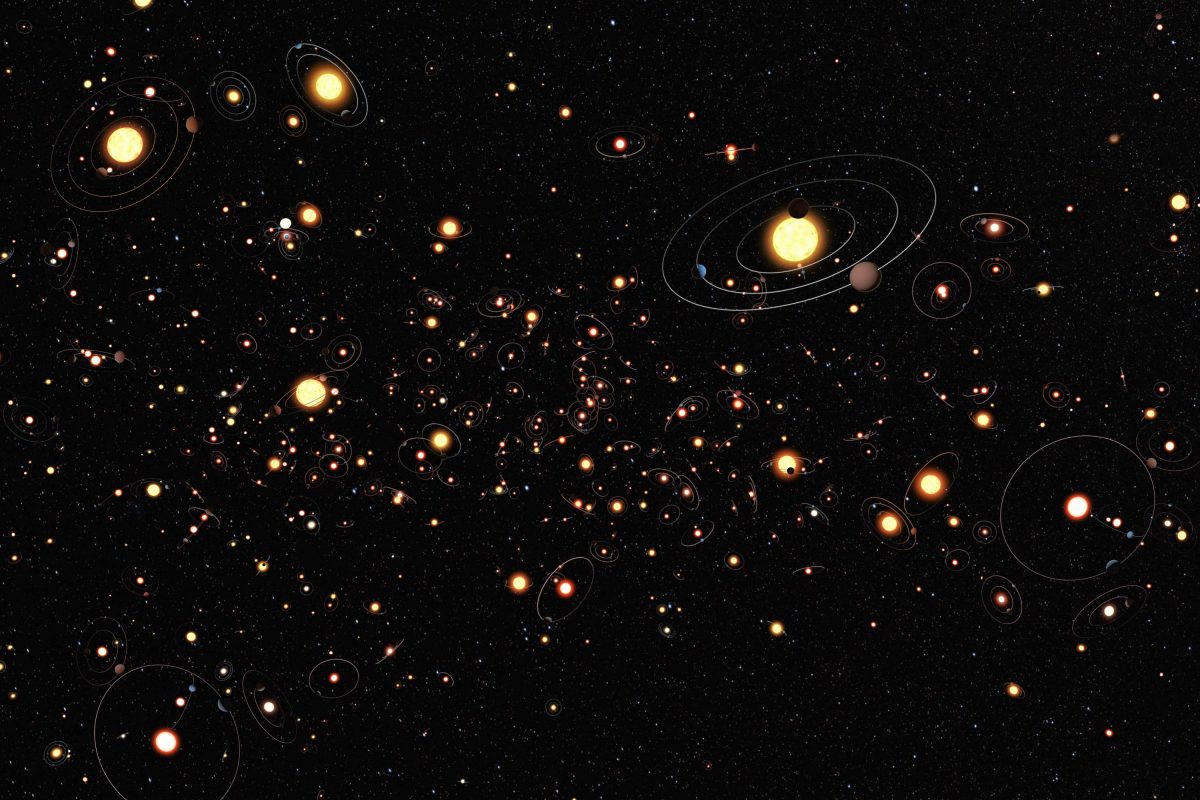
Astronomers have confirmed the existence of interstellar planets—or, as I like them described, rogue planets. These are planets orbiting the galaxy directly. They are not part of any solar system. They orbit no star. These planets formed by themselves, or were, as astronomers suggest, ejected from the systems they were formed in. Some estimate there may be two rogue planets for every star in our galaxy, while others suggest upwards of 100,000 rogue planets for every star in our galaxy. The conclusion: however many planets you think there are in the universe—there are even more than that.

The root word for planet comes from the ancient Greek word for wanderer and was used to describe the stars in the sky which would change position every night. These wandering stars would later become known to be the planets Mercury, Venus, Mars, Jupiter, and Saturn. Uranus and Neptune would eventually join them as Uranus was only properly categorized as a planet after the invention of the telescope, and Neptune’s existence was predicted by math first and then confirmed by observation second. This gives us today’s picture of the planetary system around the Sun—the keyword being today’s, because this is where things get interesting.

If it’s possible for planets to form outside the development of a star, and it’s possible for these planets to wander interstellar space following only the gravity of the galaxy (in the same way our star and entire solar system do), and it’s possible for planets to be ejected from the star systems they were formed in, or conversely captured from interstellar space by the gravity of a near‐by star, then it’s entirely possible the planets in our solar system now are not the same ones that were in it when our sun was formed. We may have lost planets. We may have gained planets. It’s been over 4 billion years since our sun formed. A lot can happen in 4 billion years.

And a lot can happen in 4 years.

And since—for the moment—Earth is 1 in 8 trillion, it’s all the more reason to keep a watchful eye on those geo and heliocentric thinkers bent on keeping our world a small place.

I was going to say more—but then I remembered it’s already been said:

The Earth is a very small stage in a vast cosmic arena. Think of the endless cruelties visited by the inhabitants of one corner of this pixel on the scarcely distinguishable inhabitants of some other corner, how frequent their misunderstandings, how eager they are to kill one another, how fervent their hatreds. Think of the rivers of blood spilled by all those generals and emperors so that, in glory and triumph, they could become the momentary masters of a fraction of a dot.

Carl—thank you.
Second Life

Card table for sale. Surface badly damaged, one leg missing, otherwise fine. $1 or best offer.

I’ve been trying to post a few posts now for a few weeks, and what happens is I start them, get interrupted—usually by having to go to work—and then they sit unfinished because I’ve started a new day, with a new train of thought, and truth be told, I’ve usually dreamt out the remainder of the post while I was sleeping, so I’m not really left with any real desire to finish writing it because I’ve just finished living it. I have to force myself to write, and that’s not good, because this is supposed to be what I want to do. And I can’t keep writing about how I’m not writing because that’s boring for the reader and self‐serving for the writer.

What I’ve concluded is I’ve managed to write myself into a corner—the expectation I’ve placed on my larger writing project eventually coming together from the chaotic mess of my smaller ones seeming less and less like reality and more and more like a rehearsed explanation to myself about why I’m not finished.

That doesn’t sound like you. Or me.

No—I can see right through it. I doubt myself. I see my own doubt, it sickens me, and I turn away.

That’s a biggie. Not to seem like we’re doing just that, but what if we tried talking about something else… The title and featured image for this post—What’s that about?

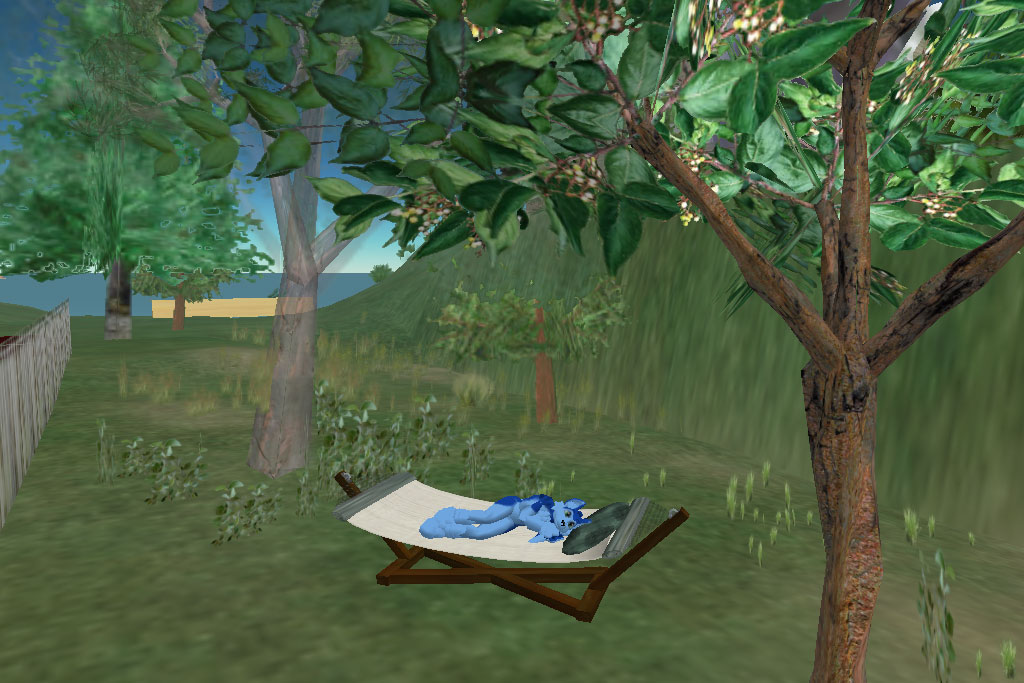
It’s the name of an online world where you can walk around and build stuff and chat with your fellow onliners. It’s sort of like an unending multi‐player game but without the game portion. It’s supposed to be a place where anything and everything is possible because you build anything and everything you see yourself using graphics and code. I used to play around with it from time to time, and the other week I found a screen shot from around ten years ago on my computer of myself as an anthropomorphic blue husky resting peacefully in a hammock.

I liked the idea of Second Life, but when I looked a little closer at this world where anything and everything is possible, I found it’s only actually possible if you follow the same rules we have out here in reality, whatever that is, with regard to land, ownership, and money. There’s an in‐game currency which you can trade American dollars for. As a result there’s an entire little economy running inside the game. That land my hammock is on was given to me by a friend of mine who’d bought some land in the game and let me use some of it to do whatever on. He used what land was left to build a house with a couch and a big TV in it for himself. Sometimes I would see him in the house watching TV—actual TV streamed into the game.

Just like in real life.

Yeah, well that’s what I didn’t get. He already had a TV and a house and a job and a pile of money. Why have a world where anything is possible and use it to build things you already have and then do things things you already do? Why would you have a world in there where anything is possible and end up having to go through all the same rigmarole you do out here? It reminded me of jobs I’d work at where I’d be asked to think outside the box, I’d do just that, and they’d freak out—I only realized after the fact what they really wanted was the same box that was already for sale dressed up as a new box to sell.

Some people are comfortable in their boxes.

I get that—I do. I totally get that. What I don’t get is… I understand why some people like their boxes. I’m not trying to do anything to them. What I don’t get is why those same people then get freaked out when I’m happy with another one. Or none at all. I may as well have set up a real hammock in a real field because the reaction I got in the game was the same as I’d imagine I’d get in real life: What’s wrong with you?

What is wrong with you?

Nothing—except maybe for always being aware there’s going to be people wondering if anything’s wrong with me.

Sounds cyclical.

It does make me a little cynical.

No—cyclical.

Say again?

Cyclical. It sounds cyclical, and—

Heh…

You’re just supposed to write. This space isn’t a book. There are no rules. It’s just your words. Make it into the second life you wished Second Life could have been. It’s your world to play in, to play with words and language and concepts. You don’t have to polish anything. It’s just you here. You and a very few others.

A very few? Is it that few?

Oh definitely. I’ve pulled the stats for this thing many times. There’s like—very little traffic. If it were an intersection a yield sign would be plenty.

I see…

All the more reason to not care how things look—it’s what you wanted. It’s where you’re going—a place where it doesn’t matter what things look like. Remember?

I was headed to a place where appearance mattered above all else—I broke free. Hey—this does remind me of the early version of this thing, where we’d talk back and forth to each other trying to figure out who was who. Did we ever figure it out?

If I remember correctly, you’re me, and I’m you—but we’re from different times.

I came back for you.

And I went forward to you.

Ah—time travel.

You’ve done this before. You’ll do it again. And don’t forget—when you get to Iceland at 4 in the morning—look up. Write about it.