As far as my Icelandic adventure goes, I disappeared into a guest house while in Reykjavík sometime during early 2017 and haven’t been seen since.
Back here in 2020: a few too many started and dead‐ended writing and blog posts sit accusingly on my desktop along with a folder of unfinished photography work. It’s suddenly September, and my subconsciousness is rebelling hard against the slightest suggestion things are in any way headed back to a new normal—will incongruent circular nonsense be an all the time thing now? The thought of checking the local, national, or international headlines provokes an immediate anxiety response, and I’ve probably experienced more than 5 years worth of per hour inside time in less than 5 months. My latest movie‐based life metaphor is a precarious mix of Groundhog Day and I Am Legend.
It’s a perfect time to reappear.
I awake after a warm shower and a long nap. It’s now late in the afternoon—about 10AM for me—and having temporarily tricked my body into thinking it got more sleep than it did I head back out to explore more of the city. It’s still January 31st. My flight to Berlin isn’t until the morning of February 2nd. I’ve got the remainder of the current day and the entirety of the next one to see… I don’t know what exactly.
I didn’t pick a same‐day connecting flight to Berlin very much on purpose. I was feeling impulsive and wanted to experience a bit of solo travel, something I’ve never done before. I also wanted to see some of Iceland, someplace I’ve never been before. The only plan I had was a plan would eventually take shape.
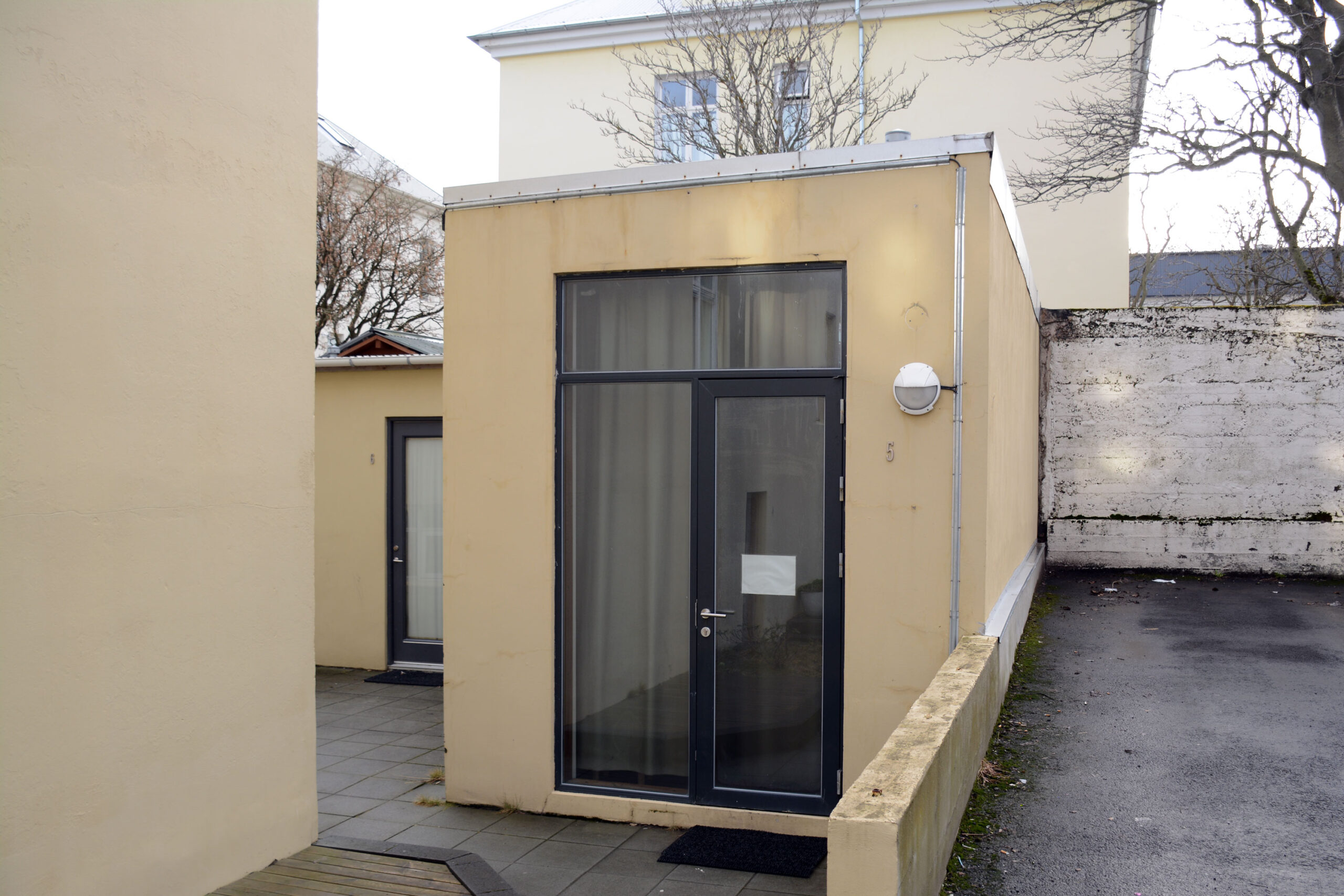
When I said I had a room in a guest house, what I actually ended up having was a room behind a guest house. The building above contained my entire room, complete with a delightfully tiny kitchenette, a hilariously tiny bathroom, and a stylishly tiny loft space—basically my own tiny house. An extensive tour will be available in another post.
The omnidirectional wind and ever‐present mist from earlier are gone—most pleasing—but there are still only hints of a blue sky mixed among the white and grey clouds. The sunlight is punching through where it can. Reflections are everywhere. Bright colours and dark shadows appear with an end of day intensity. It’s only just after 3PM, and at this latitude and time of year the sun is already setting. Had I been in Reykjavík at the start of January there would have only been about 4 hours of daylight, so I’m glad to be here now instead. Colours and shadows make me happy—relentless greys and uniform mid‐tones not as much.
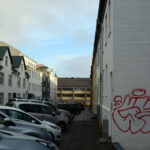
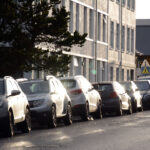
I decide to check out the other gallery near where I was staying. This one is dedicated to photography and is featuring a collection of images from day‐to‐day life in and around the city. The gallery happens to be on the top floor of the local library—one of the taller buildings in the immediate area at five stories—so I’m keen to check out the view as well.

It’s a curious view—one which highlights how most of the buildings in the area are three to four stories and are all rather close to each other—I’m slightly underwhelmed otherwise. But at least it’s been confirmed: somewhere out there clear skies exist!
The photo gallery itself wasn’t as expansive as I’d pictured either. It coexisted along with the shelves of books in the library, with prints hanging along the exterior walls and in the stairwells. Though there are millions of photos in the collection, only a handful are available to view at any given time. Images are regularly rotated, so there’s always something new to check out, but it did mean seeing the entire exhibit in just a few minutes rather than the hour or so I’d figured it would take. The photographs themselves were an eclectic mix of indoor and outdoor images from the 1960s and onward. Some are of just the city itself, others are of known and unknown people. But they were all black and white prints—and I found myself reacting quite negatively to a mood dwelling within—a closed off feeling, one of isolation. I was starting to feel claustrophobic. I couldn’t see enough of the sky and the city from the windows. The framed pictures on the walls suddenly and aggressively felt too small to be around. The walls weren’t closing in on me, but I realized needed to leave the building immediately.
The outside air hits my face and brings instant relief. Each step I take reaffirms the space around me. As I walk I look down the street toward the harbour: there are new mountains.
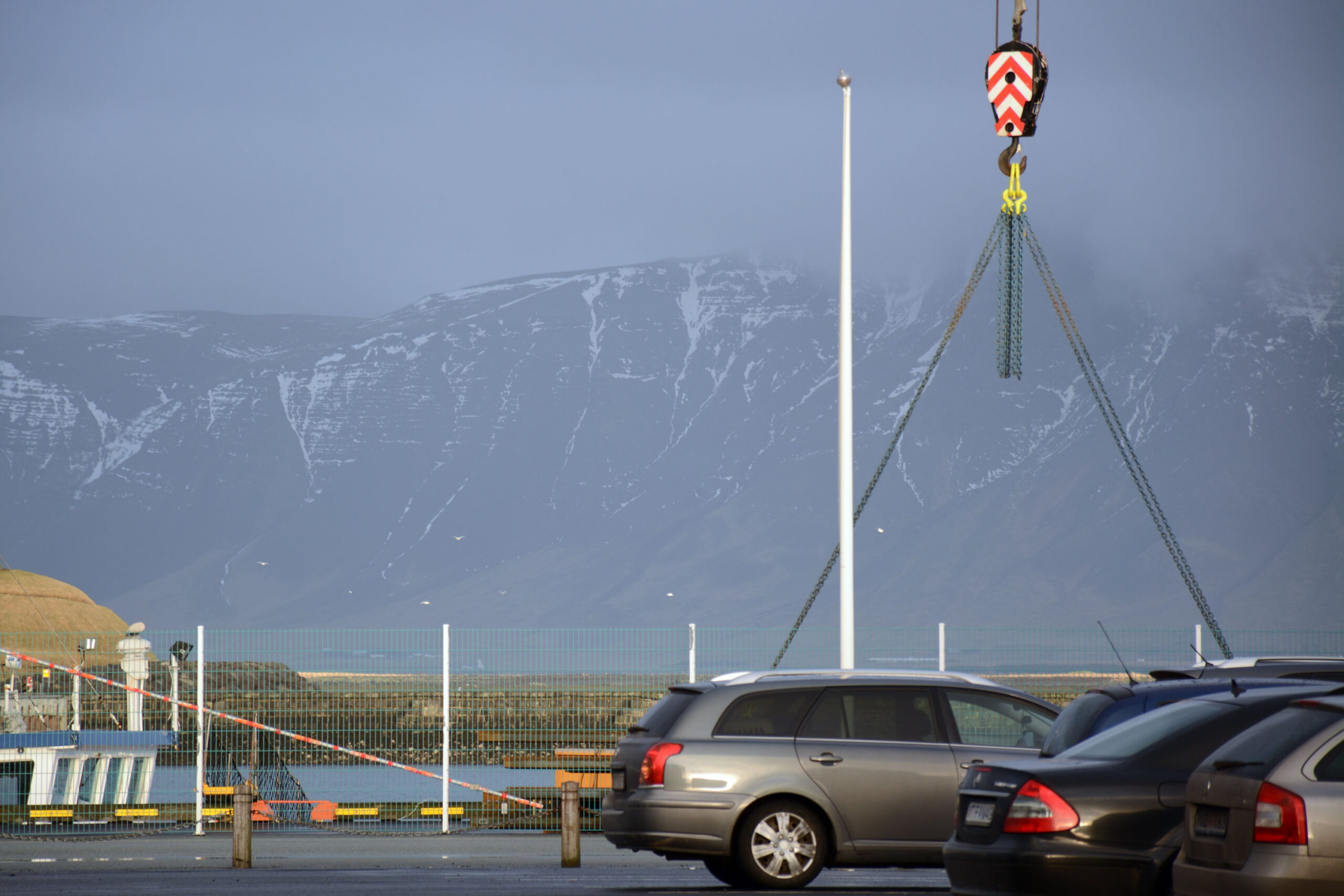
No longer obscured by weather, mountains like the ones I saw in the misty distance earlier that day are now sitting just a few kilometres away. They feel closer than before, though that may just be lingering claustrophobic feelings from moments ago. Mountains as a sight bring me great comfort. They’re calm in their presence, yet unyielding in their purpose. They simply are, and I feel much better.
I return to the pond I’d first walked by yesterday—wait, no—earlier that day. Much earlier that day. Time is becoming disorganized in my mind. My body is starting to figure out I’ve tricked it into thinking it was more rested than it was. The smattering of late afternoon sunlight and shadows has been replaced with grey cloud cover. The feel of the air has changed: now it’s dry and cold instead of wet and cold. As I look out over the pond focused on nothing in particular a single and unanticipated quack demands my attention.
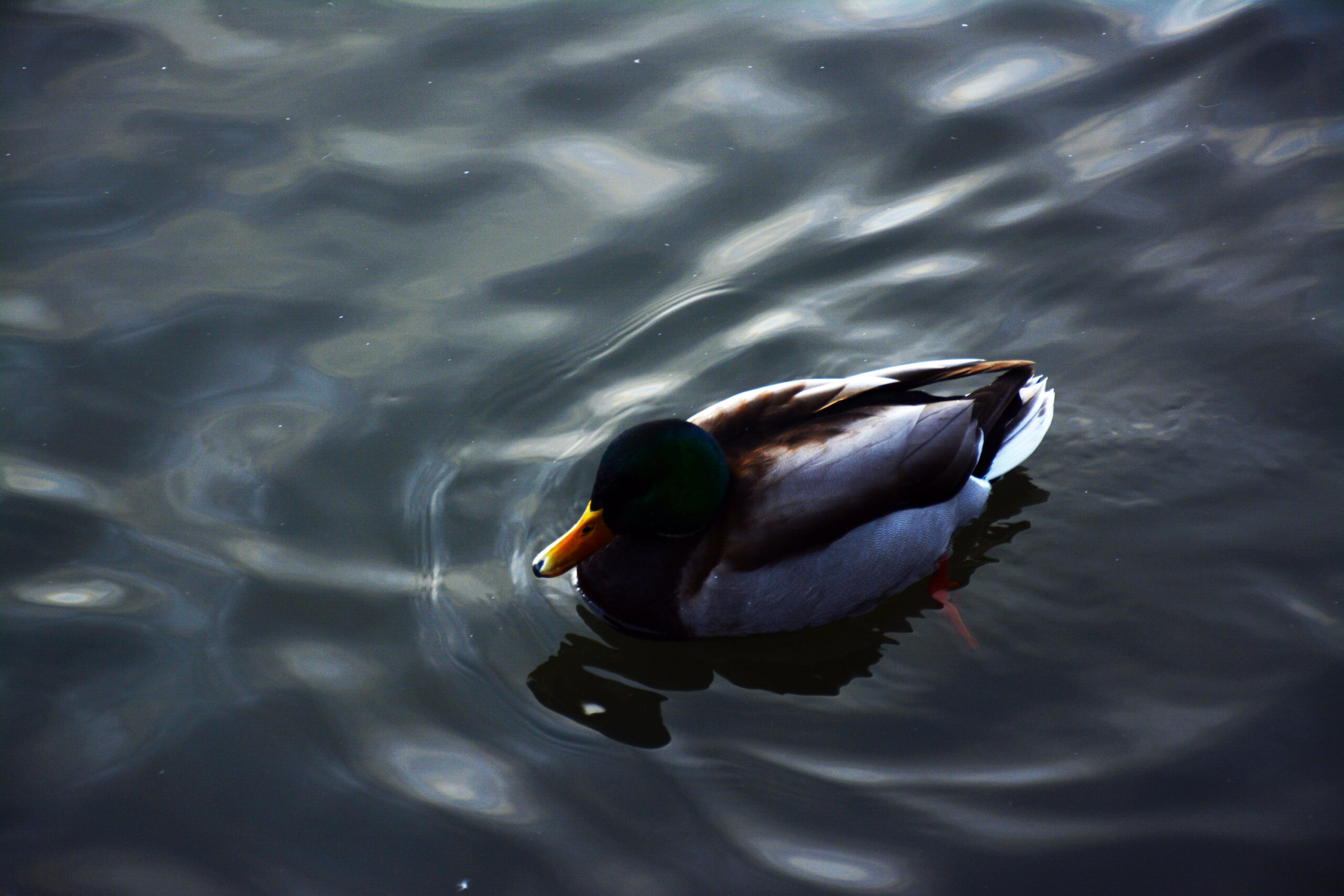
Swimming all by themselves, this mallard reminded me of the one I’d seen earlier, the one standing on a floating sheet of ice looking particularly cold about it. I watch them swim past and wonder if it was colder standing on the ice then or floating in the water now. There’s another quack from another duck, and then another, and more ducks swim past. They’re all headed to a group of people who’ve started feeding what they think is a small number of ducks—what they haven’t seen yet is every bird in and around the pond converging on their location.
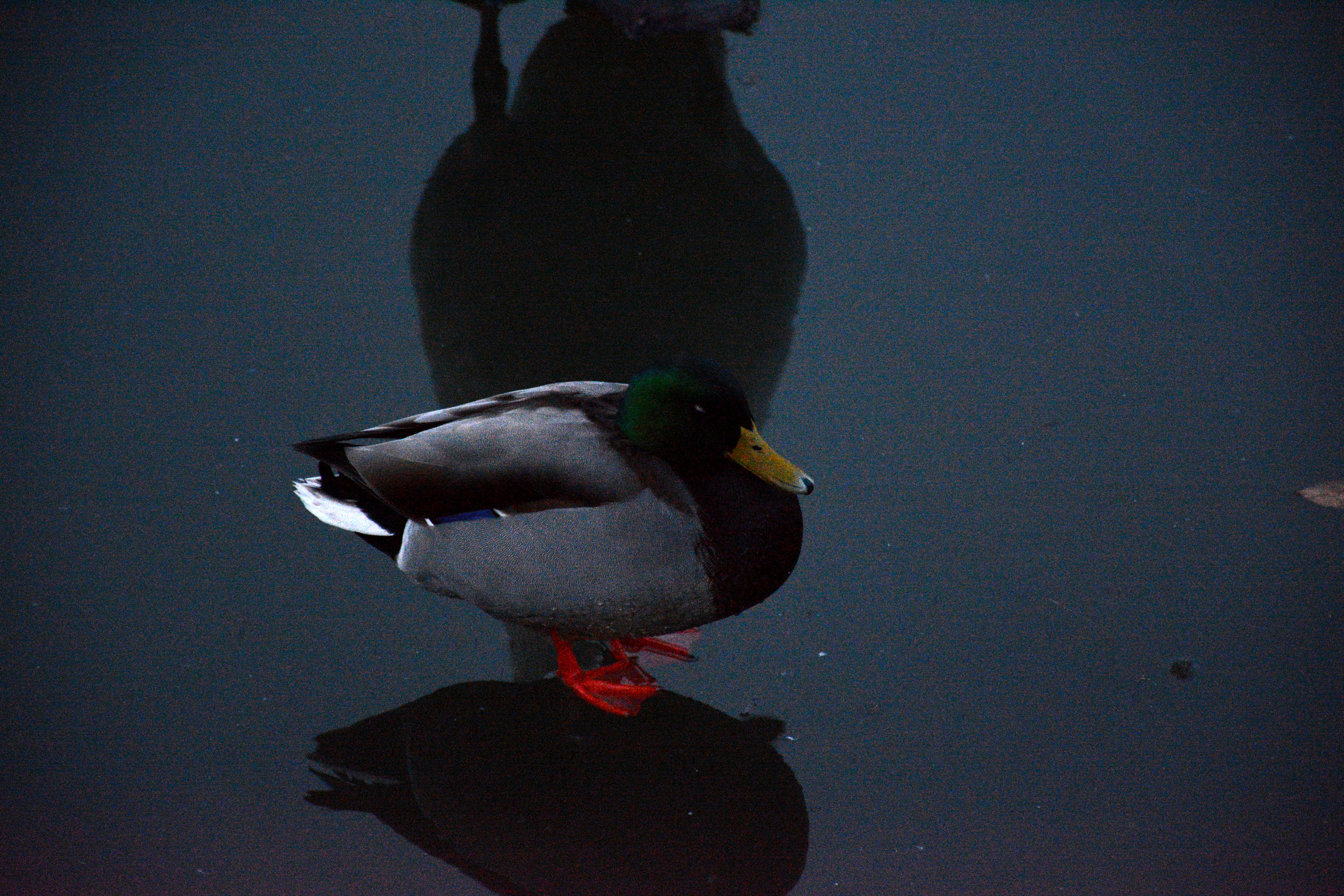
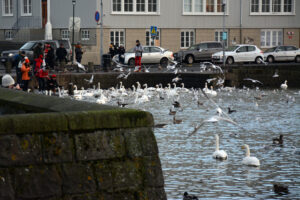
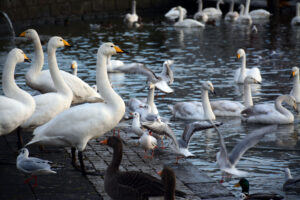
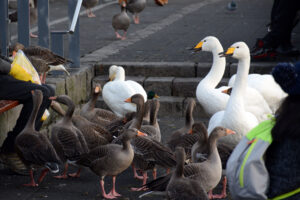
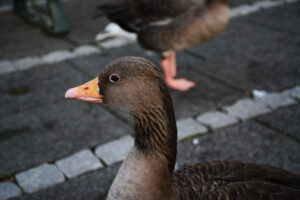
Pictured above in addition to the mallards are white whooper swans, brown greylag geese (I had to look these up because I’d never seen them before), Iceland’s version of seagulls, and, as far as I could tell, a single pigeon—which seemed like an impossible amount of pigeons. When has there only ever been one pigeon?
Having lived for over twenty years among the millions of people in the Toronto area I’ve grown acclimatized to a particular scale of experience when I’m out and about. The population of Reykjavík is about 130,000, almost half the national population of about 330,000. That means there are more people living in just the city of Markham than in all of Iceland.
Suddenly I am the pigeon, the only one among groups of others. Normally there are so many other people around me I don’t notice who’s in a group and who’s solo—they all just blend into the crowd. But it’s different here. Here it seems everyone is grouped together. Here it seems I am the only one by myself. My tired mind seeks to defuse what is growing into a mild existential crisis. I turn to see nothing that helps.
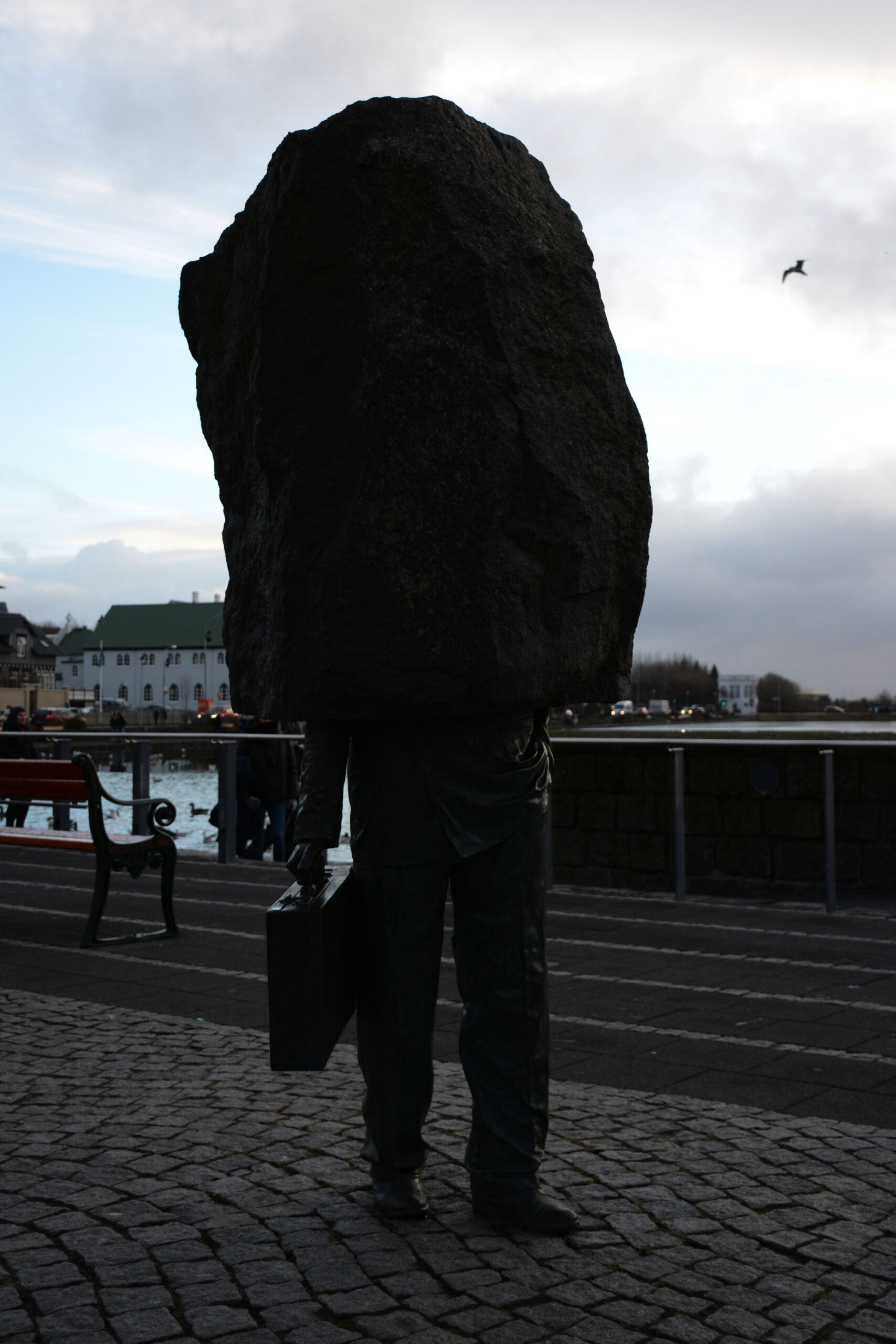
The uncomfortable form of the business rock and its ironic appearance during my fowl‐based experience is the perfect amount of jarring.
What was the pigeon doing out by themselves? Heading over with all the others to get something to eat, something I needed to think about doing myself but was too tired to realize. My big breakfast had been many hours ago, ditto for my hot dog snack. I wasn’t sure how much sleep I’d gotten in the past 48 hours, but I had to acknowledge it hadn’t been enough to be doing this much walking around in this much miserable weather. I was tired above all else, then hungry, then just a bit lonely. Now everything made sense. Clarity superseded. I was no longer the pigeon. I never was. But I was having fish and chips for dinner.
With re‐renewed vigour—it’s my forth or fifth wind by now—I head back to the city centre, back to the prospect of a feast of fish and French fries. En route are the many textures I’ve come to know during my outside time.

Prevailing clouds have returned along with Reykjavik’s palette of infinite greys. Anything with even a hint of contrast leaps out of the mid‐tones, as does anything with saturated colour—almost to an artificial extent.


Mac users will recognize the symbol in the above middle photo as the command key—in use on Macintosh keyboards since 1984—but in use as a places of interest marker in Nordic countries since the 1960s. The symbol itself goes back over fifteen hundred years and has been found on objects throughout northern Europe. It also appears on artifacts from the Mississippian cultures of North America. I didn’t know any of this at the time—I was busy wondering what mix of compounds would be required to produce a polar bear approved chemical warmer before being completely distracted by what was around an unknown corner.
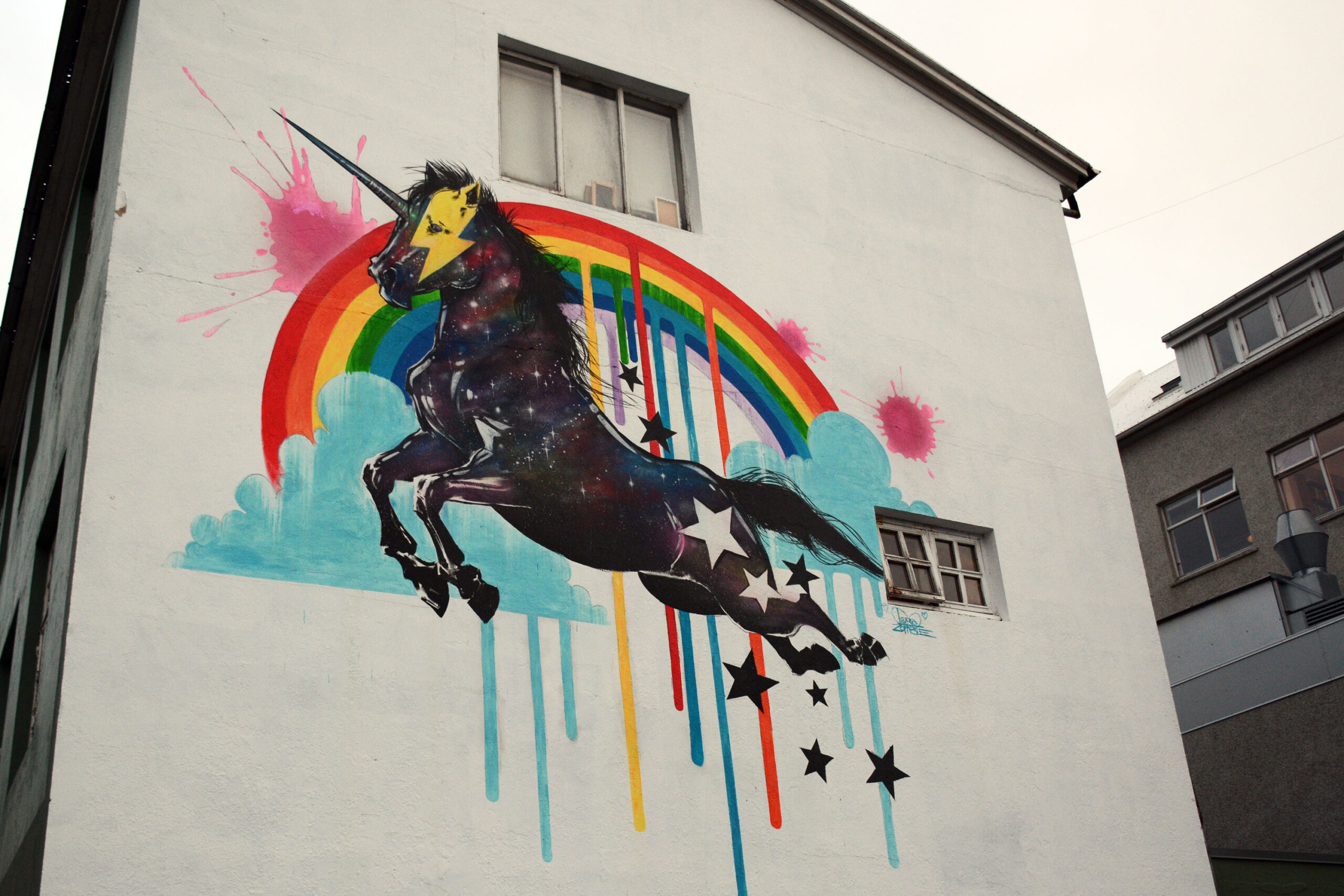
As if responding to my developing chroma deficiency, a building‐sized David Bowie unicorn mural appears out of the grey streets and white buildings to remind me: there are colours, they do exist here, and here they all are at once just in case the clouds are covering them. Also keep walking—face the strange. It’s dinner time.
Back near the harbour the mountains are even more clearly defined than they were earlier in the afternoon, now looking like I could touch them—yet still a feeling of them being just out of reach.

Where I decide to eat is more than just a restaurant. It’s also a geology exhibit with a documentary film theatre and information centre detailing some of the volcanic history and activity throughout Iceland. Featured are the eruptions of Eyjafjallajökull in 2010—responsible for a dust cloud which disrupted air travel over most of Europe for more than a week—and Eldfell in 1973—which required the evacuation of an entire island off the southern coast of Iceland for several months. The island itself, Heimaey, is a product of on‐going volcanic activity. It’s still new in geologic terms at only 10‐12,000 years old. The lava from the 1973 eruption destroyed half a town and grew the island by about 2 square kilometres. Ten years prior, an underwater eruption of another volcano lasted almost 4 years, producing a new island estimated to exist for about 100 more years before erosion from the sea washes it back below the surface of the water.
I’m too hungry to wait for and watch the next set of documentaries, plus I’ve noticed it’s happy hour at the restaurant bar: there’s a special price on a gigantic beer when ordered with fish and chips. It doesn’t come in a glass shoe though—perhaps that’s more of a Greenland thing. The dinning area looks out over the harbour. I enjoy the view. I watch the mountains. The fish and chips are crispy and steamy at the same time, perfection as far as I’m concerned. The beer is as advertised—gigantic.
The light has changed during dinner, and it’s bringing about curious sights and colours while I walk back to my room, just around the corner from the restaurant. I’m not generally drawn to hastily scrawled tags as they tend slightly more toward vandalism than street art on my graffiti spectrum, but sometimes the forms and interactions they create intrigue me.

In this case it was being able to see the path the paint took as it was being applied, where it doubled back on itself, and where it had collected as it was drying. The implied motion from both the applier and the paint combined well with the shadowy dark and inset background, giving the red paint a floating quality.

I don’t know if it was painted all at once to give it that effect or if it’s a poor attempt to cover up the blue paint after the fact. Either way I find it compliments the crooked 5 in the fifteen quite nicely.

And check out that window.
But more so, check out that reflection in the window. The clouds have broken in a most spectacular way, both concealing and revealing a pallet of sunset colour unlike any other I can remember. There’s still some blue in the sky the camera can see to highlight some of the muted coral pinks and water colour purples, but I’ve never seen such intensely varied oranges or such heavily faded greys both approaching darkness before.

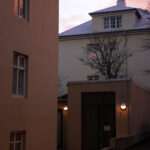

I’m at the street outside my room now and standing in roughly the same spot for the pictures above. It’s all the same sky, but I’ve rotated my view by about 45 degrees for each shot.
And then—for a balanced perspective—a shot of the ground I’m standing on.

I’ve done my best to crash though jet lag by doing whatever local time expects me to do, but my mind has turned to goo. My body is so tired—filled with fish and chips and beer. The setting sun is communicating only one local time expectation: sleep.
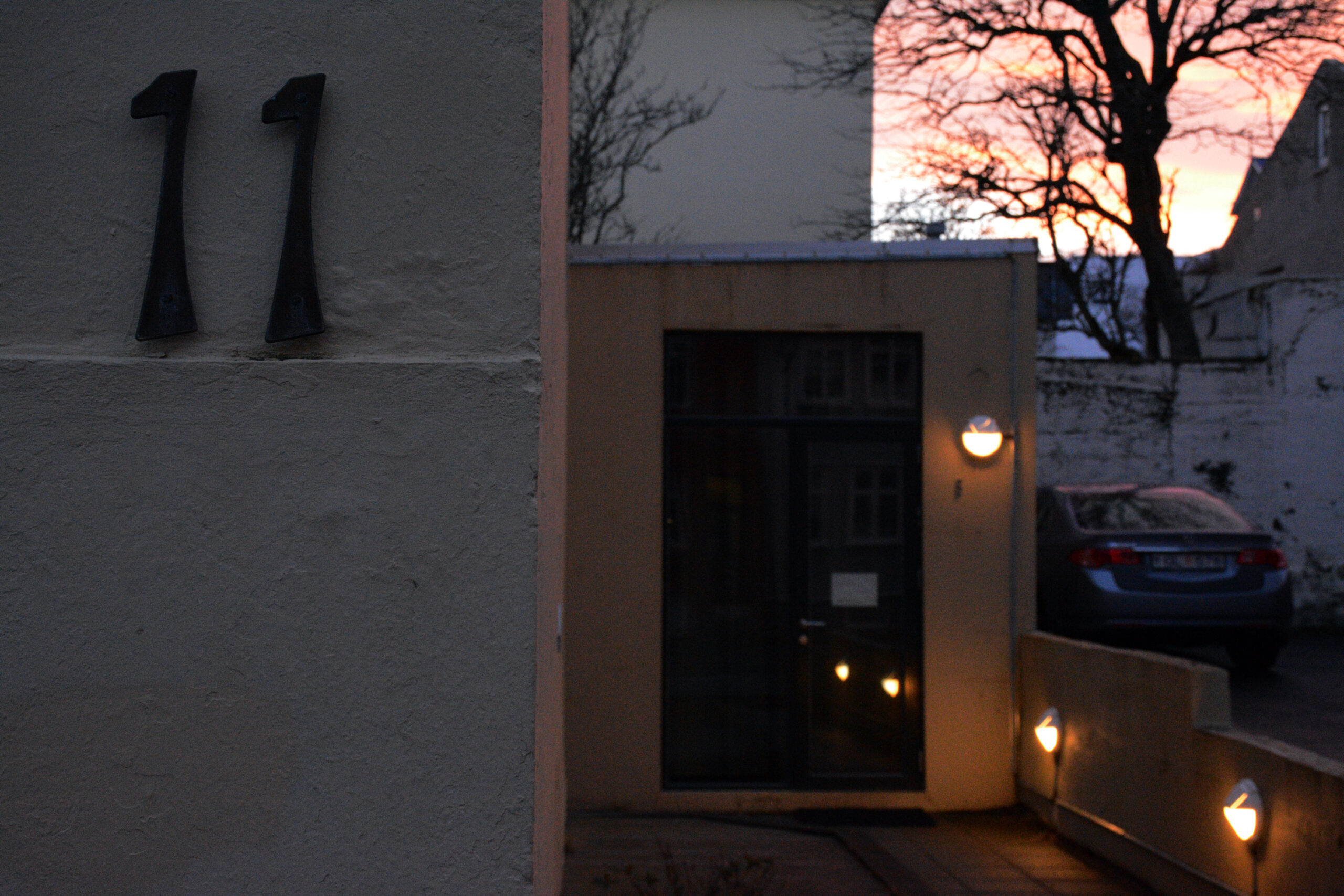
Three Dog Night says one is the loneliest number, and that’s why I find 11 amusing: one embracing the antithesis of singularity by being near another.
My tiny house awaits.