The thing with scale is its limitless. You can always go smaller, bigger, longer, narrower, wider, taller—the sky is the limit, so we’re told, but it’s actually not. It’s as close to limitless as we can get, and even that’s wrong, since you can always get a little closer to closer without ever reaching it.
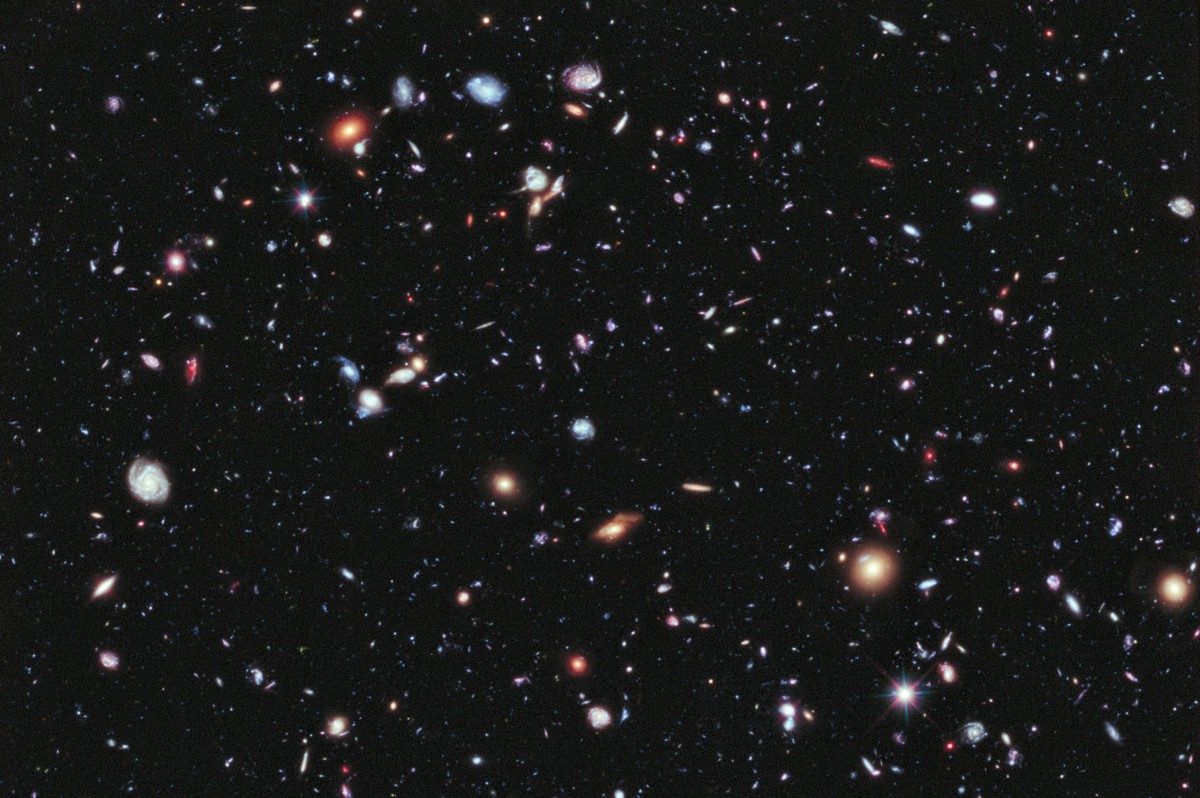
Welcome to the Hubble eXtreme Deep Field.
This is no joke.
The image above is a slight zoom of the previous Ultra-Deep Field image representing 80% of the area previously imaged. Total exposure time has been doubled to two million seconds, roughly twenty-three days. Represented here are ten years of combined images. And the numbers just keep climbing…
With the exception of a very few clearly defined stars—the only objects with visible diffraction spikes—every single point of light is an entire galaxy. There are an estimated 5,500 additional galaxies in the eXtreme Deep Field than in the previous Ultra-Deep Field. The faintest galaxies represent one ten-billionth of the brightness of what the human eye perceives. These galaxies are 13.2 billion years old. The universe itself is an estimated 13.8 billion years old. This, right now, is the deepest optical view into space we’ve ever had. This is what our world looked like moments after it was created—an ever-expanding, ever-limitless world.
We can look into the sky for an eternity, but it always shows us back the same thing: endlessness. There are no limits. And if our world out there has no limits, and our world here is a part of that world, there are no limits here, either. All we must do is realize this. We are beings borne by potential.
Our limits come from within.